Before the Trophy, There Was a Song

Football Stadium Anthems playlist cover by FootballGravity

The soundtrack that has always belonged to football

The first thing many people remember from a football match is a goal.

The second might be a save, a celebration, or a dramatic final whistle.

But ask supporters what stays with them years later, and surprisingly often, it is neither.

It is the song.

Before kickoff, before the first pass, and long after the trophy has been lifted, football has always had its own soundtrack.

The game has never been silent.


Football was born with music

Perhaps that is no coincidence.

Modern football and much of modern popular music grew from similar places.

Industrial cities.
Working-class communities.
Crowded streets.
Local pride.

Especially in Britain, football and rock music developed almost side by side.

Both became ways for ordinary people to express identity, frustration, hope, and belonging.

A football stadium and a concert venue may look different, but emotionally they share something remarkably similar.

Thousands of strangers arrive separately.

By the end, they leave having shared the same voice.


Every nation has its own sound

The 2026 FIFA World Cup in the United States has made that relationship even more visible.

This tournament has introduced a new tradition.

Winning teams are accompanied by songs that have become part of their own football identity.

For the United States, supporters celebrate with Take Me Home, Country Roads.

England have embraced Wonderwall, turning one of Britain’s most famous songs into a post-match anthem.

Japan entered the stadium accompanied by Ukasuka-G – Egao no Shori wo Kimi to, a song already familiar to many Japanese supporters.

These are not official FIFA songs.

They are cultural choices.

Music has become another way for each nation to say,

“This is who we are.”


Songs that belong to everyone

Some songs, however, no longer belong to one country.

They belong to football itself.

When We Will Rock You begins before extra time, every supporter understands the moment.

When We Are the Champions plays after the final whistle, victory feels complete.

And perhaps no modern football anthem represents this better than Seven Nation Army.

Originally released by The White Stripes, the song became something entirely different once supporters adopted its unforgettable riff.

Across Europe, its stadium version evolved into a faster, louder chant.

Today, millions of supporters know the melody without ever having listened to the original recording.

Football transformed the song.

And the song transformed football.


More than watching

Perhaps this is what makes football unique.

Supporters do not simply watch.

They participate.

They sing.

Outside football—or perhaps outside live music itself—there are very few places where tens of thousands of people willingly raise their voices together.

No script.

No rehearsal.

No invitation.

Only a shared emotion.

For ninety minutes, a stadium becomes something more than a sports venue.

It becomes a choir.


The soundtrack of memory

Long after the score is forgotten, people still remember where they were when they first heard those songs.

A goal can become a memory.

A song can become a lifetime.

Perhaps that is why football has never needed music as decoration.

Music has always been part of the game itself.

Before every trophy, there was a song.

And long after every trophy, the song remains.

🎵Listen

Football Stadium Anthems

The songs that turn stadiums into one voice.

Curated by FootballGravity on Apple Music.

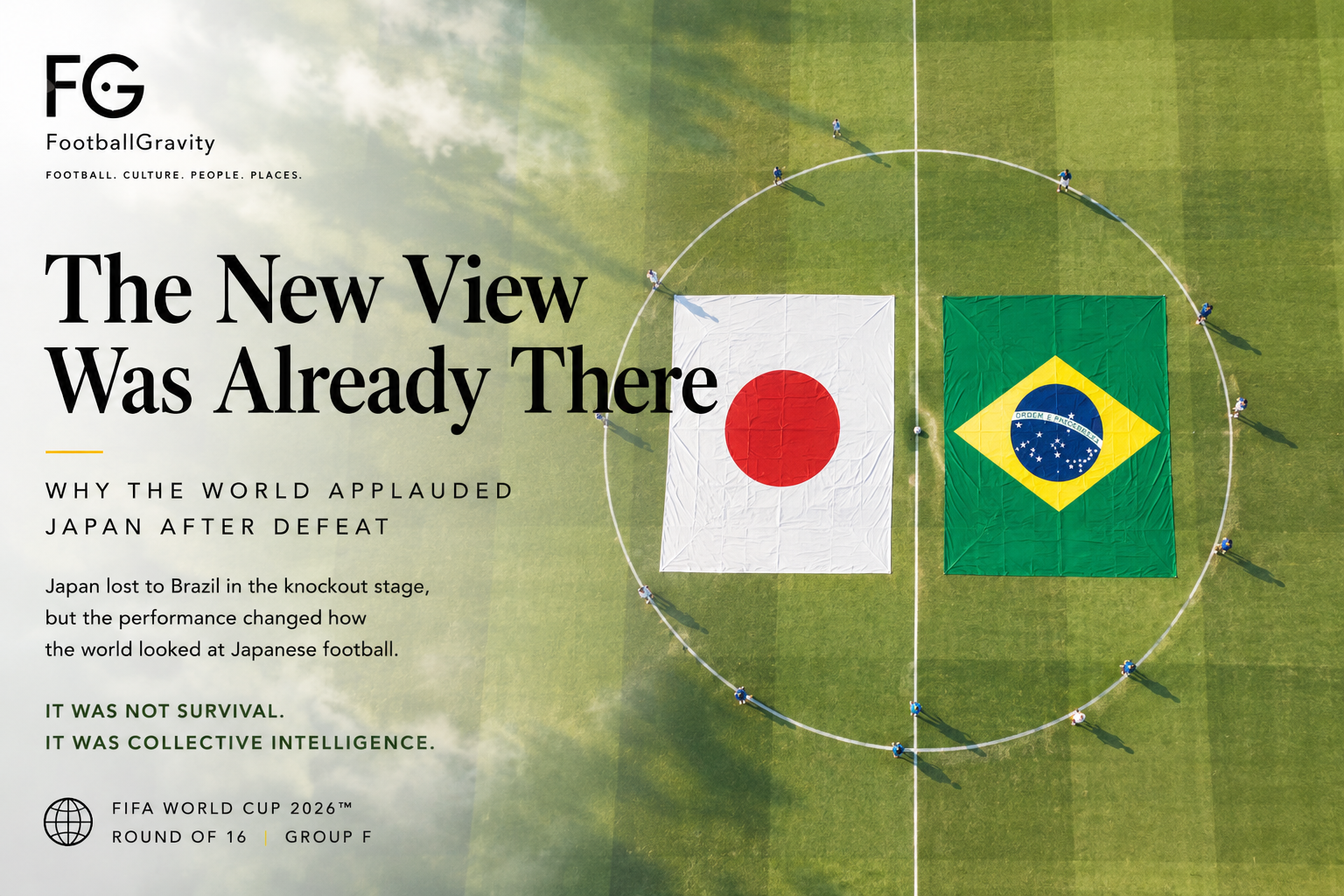
The New View Was Already There

Why the world applauded Japan after defeat

Japan lost.

That is the simplest sentence.

Brazil advanced. Japan went home. Another World Cup knockout match ended without Japan’s first victory beyond the group stage.

And yet, after the final whistle, the conversation did not feel like a simple story of failure.

Around the world, Japan were not spoken of merely as brave losers. They were discussed as a team that had shown something rare: a national side capable of making Brazil look human, not through luck, not through chaos, but through collective intelligence.

That may be why this defeat felt different.

For years, Hajime Moriyasu had spoken about “a new view.”

Perhaps many imagined that view would mean a quarter-final, a semi-final, or even something more ambitious.

Those results did not arrive.

But against Brazil, something else did.

The football world saw Japan differently.

The Cruelest Path

The first knockout round was especially unforgiving for Group F.

Japan faced Brazil.

The Netherlands faced Morocco.

Sweden faced France.

All three teams that advanced from Group F were eliminated.

That does not erase their defeats. But it does change the frame.

Japan did not fall against an ordinary opponent. The Netherlands were pushed out by a Morocco side that looked like one of the most complete teams in the tournament. Sweden were beaten by France, a side whose individual quality and tournament experience remain among the highest in world football.

Group F had produced competitive teams.

But the next path was brutal.

Japan’s loss belonged to that context.

And still, among the three defeated sides, Japan seemed to leave the strongest impression.

Why?

It Was Never Only About the Result

Football usually remembers winners.

Paraguay, for example, achieved something Japan could not: they took Germany to penalties and won. That deserves full respect.

But global admiration does not always follow the scoreboard alone.

Japan were praised because of how they played.

They did not appear to be a team simply waiting for Brazil to make a mistake.

They did not defend as if survival was the only plan.

They defended as if defending itself could be a way of attacking.

That distinction matters.

Japan were not trying only to reach penalties.

They were trying to win.

Against Brazil.

The Mystery the World Wanted to Solve

Japan are no longer an unknown football nation.

The old assumption that European or South American teams could underestimate Japan no longer works.

This is the country that beat Germany and Spain in Qatar. The country that later defeated Germany again. The country that has shown, repeatedly, that its best football belongs on the same pitch as elite opposition.

The question has changed.

It is no longer:

Can Japan compete?

It is now:

Why have Japan become so difficult to play against?

Against Brazil, the answer became clearer.

It was not only technique.

It was not only discipline.

It was synchronisation.

Eleven Players, One Organism

International football usually favours individual quality.

National teams do not train together like clubs. They do not have months to build mechanisms, pressing traps, defensive distances, or shared habits.

That is why knockout football often belongs to individual brilliance.

A winger beats a defender.

A striker finds half a yard.

A midfielder breaks the structure with one pass.

Japan proposed another answer.

Collective movement.

The back line moved together.

The midfield moved together.

The wing-backs adjusted together.

Even the forwards defended as part of the same structure.

At times, Japan looked less like eleven separate players and more like one organism responding to the ball, the space and the opponent at the same time.

That is rare in international football.

And that is what many observers seemed to recognise.

Brazil Did Not Become Ordinary

There is a danger in misreading the match.

Brazil did not suddenly become ordinary.

Japan simply prevented Brazil from looking extraordinary.

That may be the greatest compliment a defensive structure can receive.

The best attacking teams usually make opponents look reactive. They stretch the pitch, isolate defenders, and create the impression that danger can appear from anywhere.

Against Japan, Brazil were forced to think.

They had to adjust.

They had to suffer.

They had to wait until the final moments.

That was not because Brazil lacked quality.

It was because Japan denied them rhythm.

Not Defensive Football, But Winning Football

Japan’s structure was defensive in shape, but not defensive in spirit.

There is a difference between protecting a score and refusing to play.

Japan did not simply sit low and hope.

They pressed.

They shifted.

They tried to create moments.

They looked for the chance that would turn control into shock.

This is why the performance felt attractive, even without attacking fluency.

Japan’s injuries mattered. Several important attacking options were missing or limited. The final combinations were not always clean.

But the intention was visible.

This was not football designed only to avoid defeat.

It was football designed to find a path to victory against a superior collection of individual talent.

That is why it resonated.

Why Coaches Understand It

Some performances are appreciated first by fans.

Others are understood most deeply by coaches, former players and analysts.

Japan’s performance belonged to the second category.

Anyone can admire a dribble.

Anyone can celebrate a goal.

But collective coordination is harder to see.

It requires watching distances, timing, cover, body orientation and the relationship between players who may never touch the ball.

Against Brazil, Japan showed that a national team can still build something close to club-level collective behaviour.

That is not easy.

It is not accidental.

And it is not simply “hard work.”

It is design.

A New View

Moriyasu’s phrase, “a new view,” will always carry the sadness of unfinished ambition.

Japan wanted more.

The players wanted more.

The supporters wanted more.

A first knockout victory was close enough to touch, and then gone.

But perhaps the phrase does not belong only to the result.

Perhaps a new view can also be the moment when the world looks at Japanese football and no longer sees an outsider.

Not a surprise.

Not a guest.

Not a romantic underdog.

But a serious football nation with its own method, its own intelligence, and its own way of making the game difficult for anyone.

The players saw it.

The coach saw it.

The supporters felt it.

And perhaps, for the first time, the world saw it too.

The new view was already there.

The Soundtrack of Football

Football stadium atmosphere with music and supporters during the World Cup

From Queen to Bon Jovi, from England to Dallas

Football has never been only a game of feet.

It is also a game of voices.

Before kickoff, after the final whistle, during a hydration break, on the way back from the stadium, in pubs, trains, fan zones and living rooms, football is always surrounded by music.

At the FIFA World Cup 2026, that feeling has become especially visible.

Songs echo through stadiums not simply as background entertainment, but as part of the tournament itself.

Bon Jovi’s “Livin’ on a Prayer” has become one of the most joyful stadium moments of this World Cup. It is not a football song in a literal sense. Yet somehow, when tens of thousands of people sing it together, it becomes one.

That is the strange power of football music.

Football does not simply borrow songs.

It gives them a second life.

Why Rock Fits Football

The connection between football and music is not accidental.

In England, where the modern game was born, football and rock music have long shared similar social roots.

Both grew from working-class culture.

Both belong to crowds.

Both understand hope, frustration, resistance and release.

That is why songs such as “Wonderwall” by Oasis or “We Will Rock You” by Queen feel so natural in football spaces. They are not tactical. They are emotional.

Football is full of moments when ordinary people believe something extraordinary might happen.

Rock music has always understood that feeling.

The underdog.

The comeback.

The last-minute goal.

The impossible night.

In that sense, football and rock have always spoken the same language.

Stadium Classics

Some songs become football songs not because they were written for football, but because football crowds adopted them.

“You’ll Never Walk Alone” is the clearest example. From Liverpool to stadiums far beyond England, it has become a song of belonging.

“Seven Nation Army” by The White Stripes has travelled even further. Its riff became a universal chant, crossing clubs, countries and languages.

“Freed From Desire” by Gala became another modern stadium anthem, while “Sweet Caroline” has turned into a collective release for England supporters and many others.

These songs work because they are simple enough to share.

A chant.

A rhythm.

A phrase.

A feeling.

Football crowds do not need perfect singing.

They need something to sing together.

World Cup Memories

The World Cup has also created its own official soundtrack.

Ricky Martin’s “The Cup of Life” still carries the bright energy of France 1998.

Shakira’s “Waka Waka” remains perhaps the most globally recognised World Cup song of the modern era.

K’naan’s “Wavin’ Flag” captured another kind of tournament emotion: not just celebration, but longing, movement and global connection.

For Japanese fans, Vangelis’ “Anthem” from the 2002 World Cup carries a special memory. It belongs to the moment when the tournament came to Japan and Korea, and when the World Cup felt physically close for the first time.

The older FIFA Anthem, familiar from the 1990s and early 2000s, also remains deeply connected to the ritual of international football. Even without words, it could make a stadium feel official.

In 2026, Shakira and Burna Boy’s “Dai Dai” continues that tradition, reminding us that World Cup music is no longer tied to one region or one genre. It is global by design.

Japan’s Football Songs

Every football country has its own soundtrack.

Japan is no exception.

UKASUKA-G, the unit formed by Kazutoshi Sakurai of Mr.Children and GAKU-MC, created music closely associated with the Japan national team. “Shori no Emi wo Kimi to” became a familiar song of support for many Japanese fans.

Superfly’s “Tamashii Revolution” is another song that instantly evokes football in Japan. For many supporters, it belongs to the emotional memory of watching the national team on television.

Dragon Ash’s “Fantasista” is different again. It carries the energy of Japanese rock and street culture at the turn of the century, when football was becoming more global, more stylish and more connected to youth culture.

In 2026, Kenshi Yonezu’s “Karasu” adds a new layer as NHK’s soccer theme, showing that Japan continues to create new songs for each football generation.

These songs may not all be known globally.

But that is exactly the point.

Football music is universal because every country has its own version.

Football in Advertising

Some football songs arrive through television rather than stadiums.

Nike’s legendary “Good vs Evil” commercial from the 1990s remains one of the most memorable examples.

Eric Cantona, Ronaldo, Maldini and other stars appeared in a dramatic football fantasy, soundtracked by “Mas Que Nada.”

The song itself was not new.

But the advertisement gave it a football image for a generation of fans.

This is another way football works with music.

It does not always create new songs.

Sometimes it changes how we remember old ones.

A FootballGravity Playlist

This is not a ranking.

It is a matchday journey.

Matchday Warm-up

  • “Livin’ on a Prayer” — Bon Jovi
  • “Don’t Stop Me Now” — Queen
  • “Fantasista” — Dragon Ash
  • “Tamashii Revolution” — Superfly
  • “Shori no Emi wo Kimi to” — UKASUKA-G

Stadium Anthems

  • “You’ll Never Walk Alone” — Gerry & The Pacemakers
  • “Seven Nation Army” — The White Stripes
  • “Wonderwall” — Oasis
  • “We Will Rock You” — Queen
  • “Freed From Desire” — Gala
  • “Sweet Caroline” — Neil Diamond

World Cup Memories

  • “The Cup of Life” — Ricky Martin
  • “Waka Waka” — Shakira feat. Freshlyground
  • “Wavin’ Flag” — K’naan
  • “Dai Dai” — Shakira & Burna Boy
  • “Anthem” — Vangelis
  • “FIFA Anthem” — Franz Lambert
  • “John Denver” – Take Me Home, Country Roads

Victory, Defeat, and the Road Home

  • “We Are the Champions” — Queen
  • “Breakthru” — Queen
  • “Mas Que Nada” — Sérgio Mendes
  • “Karasu” — Kenshi Yonezu
  • “Fix You” — Coldplay

Listen while reading:

Apple Music Playlist
YouTube Playlist

One More Song Before Kickoff

Football needs tactics.

It needs data.

It needs training, scouting, travel, climate control, stadium design and recovery science.

But it also needs songs.

A song can turn a neutral stadium into a shared place.

A song can give courage to a nervous crowd.

A song can heal defeat.

A song can follow supporters long after the match has ended.

Whether your team is still dreaming of the trophy or already heading home, football always leaves us one more thing to carry.

A melody.

Enjoy the soundtrack of this World Cup.

And remember that football has never been only ninety minutes.

Listen While Reading

Music is part of football culture.

We’ve collected the songs featured in this article so you can continue the matchday atmosphere wherever you are.

🎵 Apple Music Playlist

Dallas Files #1

More Than a Stadium

What AT&T Stadium Teaches About the Future of Football

Most stadium reviews begin with seats, food, or atmosphere.

AT&T Stadium deserves a different approach.

After spending an entire matchday there during the FIFA World Cup 2026, one thing became clear:

This is not simply a stadium.

It is an ecosystem.

Before You Even Enter

The experience begins long before the ticket gates.

Instead of surrounding visitors with endless parking lots and concrete roads, the stadium opens into something unexpected.

Wide green spaces.

Walking paths.

Small waterways.

Trees.

Open lawns where families gather and supporters relax before kickoff.

It feels less like approaching a sports venue and more like arriving at a public park.

Supporters naturally slow down.

They walk.

They sit.

They talk.

The World Cup begins well before the referee blows the whistle.

A Festival Rather Than an Entrance

Beyond the security gates, the atmosphere changes again.

Food trucks.

Music.

Outdoor seating.

Large grassy areas.

Fans from different countries eating together under the Texas sun.

Children kicking footballs.

Groups taking photos.

Rather than simply waiting for kickoff, people spend hours enjoying the place itself.

The stadium is not merely a destination.

It is an all-day festival.

That distinction matters.

Great tournaments are remembered not only for ninety minutes of football, but for the experiences surrounding those ninety minutes.

AT&T Stadium understands this perfectly.

Designed Around the Spectator

Inside, the architecture continues to impress.

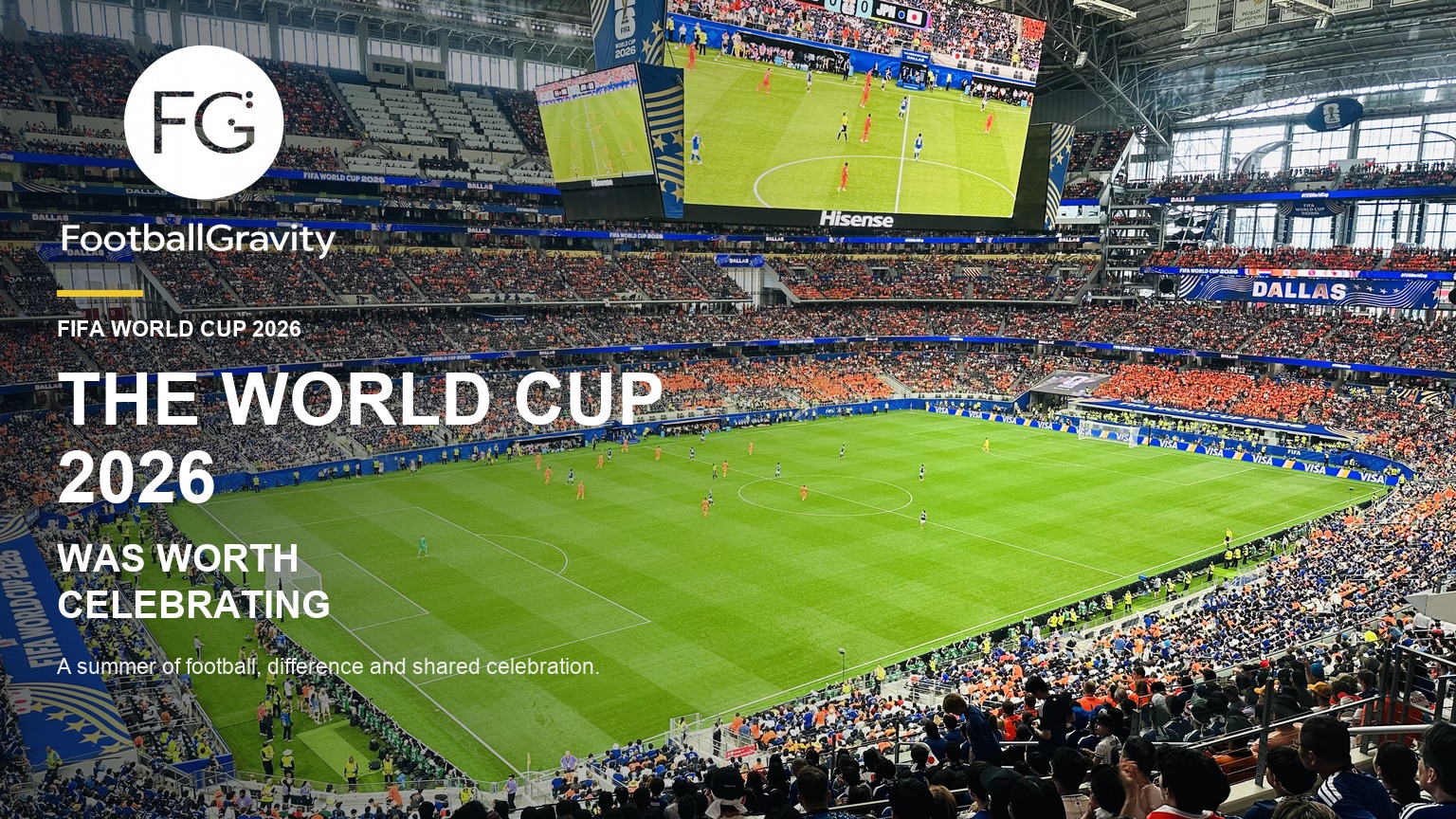
The most iconic feature is the enormous centre-hung video board, manufactured by Mitsubishi Electric.

Unlike traditional stadiums, where replay screens sit high behind one goal, this display hangs directly above the centre circle.

The difference is surprisingly significant.

Supporters never need to turn completely away from the pitch.

The action, the replays and the atmosphere remain connected.

Rather than interrupting the match experience, the technology becomes part of it.

Combined with the stadium’s powerful sound system, the effect is closer to a live concert than a conventional football match.

Every goal celebration feels immersive.

Every pre-match sequence feels cinematic.

It is entertainment without sacrificing football itself.

Small Details That Matter

The stadium’s scale is extraordinary, yet movement inside rarely feels stressful.

Restrooms remained remarkably accessible.

Food and drink outlets were distributed throughout the concourses.

Even with tens of thousands of spectators, congestion was surprisingly limited.

These details rarely appear in highlight videos.

Yet they shape the overall experience just as much as the match itself.

The best stadiums succeed because thousands of small design decisions quietly disappear into the background.

More Than Home Advantage

For Japan, there may also be a competitive benefit.

Playing two Group F matches in the same stadium means familiarity.

The climate is controlled beneath the roof.

Players become accustomed to the lighting, the pitch, the sightlines and even the rhythm of the venue.

These are subtle advantages, but tournament football is often decided by subtle margins.

A Stadium That Belongs to the City

AT&T Stadium is frequently described as one of the world’s greatest sporting venues.

After spending an entire day there, that reputation feels deserved.

What impressed me most was not its size.

It was the way architecture, public space, football and everyday life blended into one continuous experience.

Many stadiums host matches.

Few become part of the city itself.

Perhaps the future of football is not simply about building bigger stadiums.

Perhaps it is about building better places.

And AT&T Stadium offers a compelling blueprint for what that future might look like.

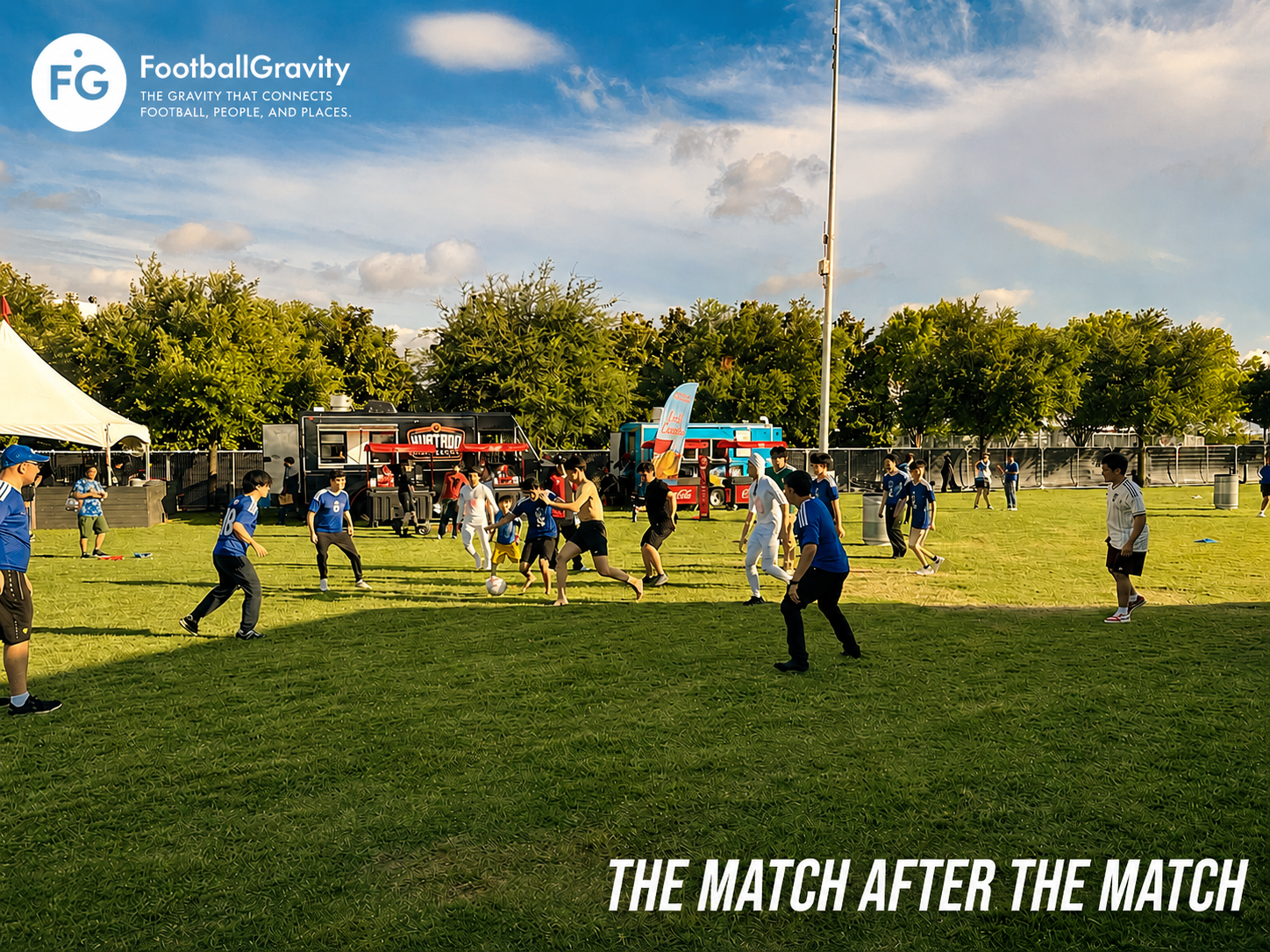
World Cup Extra Time: The Match After the Match

Sometimes the most memorable football of a World Cup is not played inside the stadium.

After Japan and the Netherlands delivered one of the tournament’s most captivating matches, thousands of supporters slowly streamed out into the vast grounds surrounding the stadium in Dallas. The game itself had been excellent. The atmosphere was electric. Most people would have been satisfied to take photos, buy souvenirs, and head home carrying the memories of a thrilling evening.

Instead, something else happened.

A ball appeared.

And football began again.

One Ball, No Rules, No Borders

The match took place not inside the stadium, but in the open supporter zone beyond the gates—a space reserved for ticket holders, filled with food trucks, merchandise stands, bars, and places to relax before and after the game.

There were no referees.

No organized teams.

No official goals.

No registration.

No language requirements.

Just a group of strangers who looked at a football and instinctively understood what to do next.

Within minutes, Japanese supporters, Dutch supporters, Americans, and Mexican fans had become teammates and opponents at the same time. Some wore national-team shirts. Others had simply wandered over after hearing laughter and seeing a crowd gather around the ball.

Names were unknown.

Languages were different.

Football was enough.

The Universal Language

One of football’s great strengths is its simplicity.

You do not need expensive equipment. You do not need a carefully prepared pitch. You do not even need shared words.

A pass communicates intention.

A run communicates possibility.

A raised hand communicates gratitude.

Within a few minutes, everyone understands who likes to dribble, who prefers to pass, who defends aggressively, and who plays with quiet elegance. Football reveals personality remarkably quickly.

Watching the scene unfold in Dallas, it became clear that the sport’s greatest power may not be its professional competitions, but its ability to create instant communities.

The World Cup gathers nations.

A football creates connections.

The Best Match of the Day?

The official match had featured elite athletes, tactical preparation, and global attention.

The unofficial match featured none of those things.

Yet the joy felt remarkably similar.

Many of the participants had spent ninety minutes passionately supporting their countries inside one of the world’s most celebrated stadiums. Moments later, they were chasing the same ball together, laughing at mistakes, applauding good plays, and celebrating goals that nobody would ever record.

There was no scoreboard.

No statistics.

No highlights package.

Only football.

In some ways, it captured the essence of the game more clearly than the professional spectacle that preceded it.

A Stadium Designed for People

This scene was only possible because the environment allowed it.

The stadium precinct offered more than transportation and security. It provided space for people to stay, gather, interact, and create their own experiences.

That is an often-overlooked aspect of football infrastructure.

Great stadiums are not merely places to watch matches. They are places where football culture can emerge organically.

How many major venues around the world would welcome an impromptu multinational kickabout after a World Cup match?

How many would have the space, atmosphere, and sense of trust required for it to happen naturally?

Dallas deserves credit for creating the conditions.

The supporters supplied the rest.

Football Beyond the Final Whistle

The World Cup is often described as a competition between nations.

Yet moments like this suggest something different.

Perhaps the tournament’s greatest achievement is not deciding a champion, but reminding millions of people that they already share something in common.

A ball.

A game.

A language that requires no translation.

Long after the result of Japan versus the Netherlands fades from memory, many supporters may remember a different match—the one played on a patch of grass outside the stadium, among strangers who became teammates for an evening.

That, too, was the World Cup.

The Sound of Resistance: How Cape Verde Stopped Spain

Spain vs Cape Verde World Cup match featuring defensive resistance and key match statistics

The FIFA World Cup always produces surprises.

But few expected one of the tournament’s biggest stories to arrive this early.

Spain, widely regarded as one of the strongest teams in the competition alongside France, were held to a draw by Cape Verde — a nation that many football fans around the world had rarely followed before this tournament.

On paper, the gap was enormous.

Spain dominated possession, completed more than 800 passes at over 90 percent accuracy, and spent long stretches circulating the ball with the confidence of a title contender.

Yet when the final whistle arrived, the scoreboard told a different story.

Football does not reward possession.

Football rewards outcomes.

And that is why the World Cup remains the most compelling sporting event on Earth.

More Than Numbers

The statistics tell part of the story.

Spain recorded 27 shots.

Cape Verde produced 46 clearances, 18 tackles, 15 interceptions, and numerous blocks.

The difference in squad value, reputation, and tournament expectations was immense.

Yet for ninety minutes, Cape Verde refused to disappear.

Every clearance carried meaning.

Every interception bought time.

Every tackle extended belief.

This was not simply a defensive performance.

It was an act of collective resistance.

The Match You Could Hear

One detail made this match feel different.

Not what we saw.

What we heard.

Modern football broadcasts have become visually stunning, but this tournament seems to have taken another step forward in audio production.

The sound of the ball striking a defender.

The impact of a blocked shot.

The collision of bodies competing for space.

All of it echoed through the stadium and through television speakers around the world.

Perhaps new microphone technology has been introduced.

Perhaps production crews have refined their methods.

Whatever the reason, the effect is remarkable.

Football feels louder.

More physical.

More immediate.

And nowhere was that more evident than in Spain versus Cape Verde.

Again and again, Spain attacked.

Again and again, a Cape Verde defender stepped into the path of the ball.

A sharp thud.

A collective gasp.

Then applause.

Not only from Cape Verde supporters, but from neutral fans who could recognize courage when they saw it.

Or heard it.

The World Cup’s Greatest Power

The World Cup has always been about more than football.

It introduces nations to one another.

It creates stories that would never emerge elsewhere.

Before this match, many viewers may not have known much about Cape Verde.

After this match, millions do.

For one evening, Cape Verde occupied the center of the football world.

That alone is part of what makes the World Cup extraordinary.

The giants may dominate the ball.

But the game still belongs to anyone brave enough to challenge them.

And on this night, the sound of football belonged to Cape Verde.

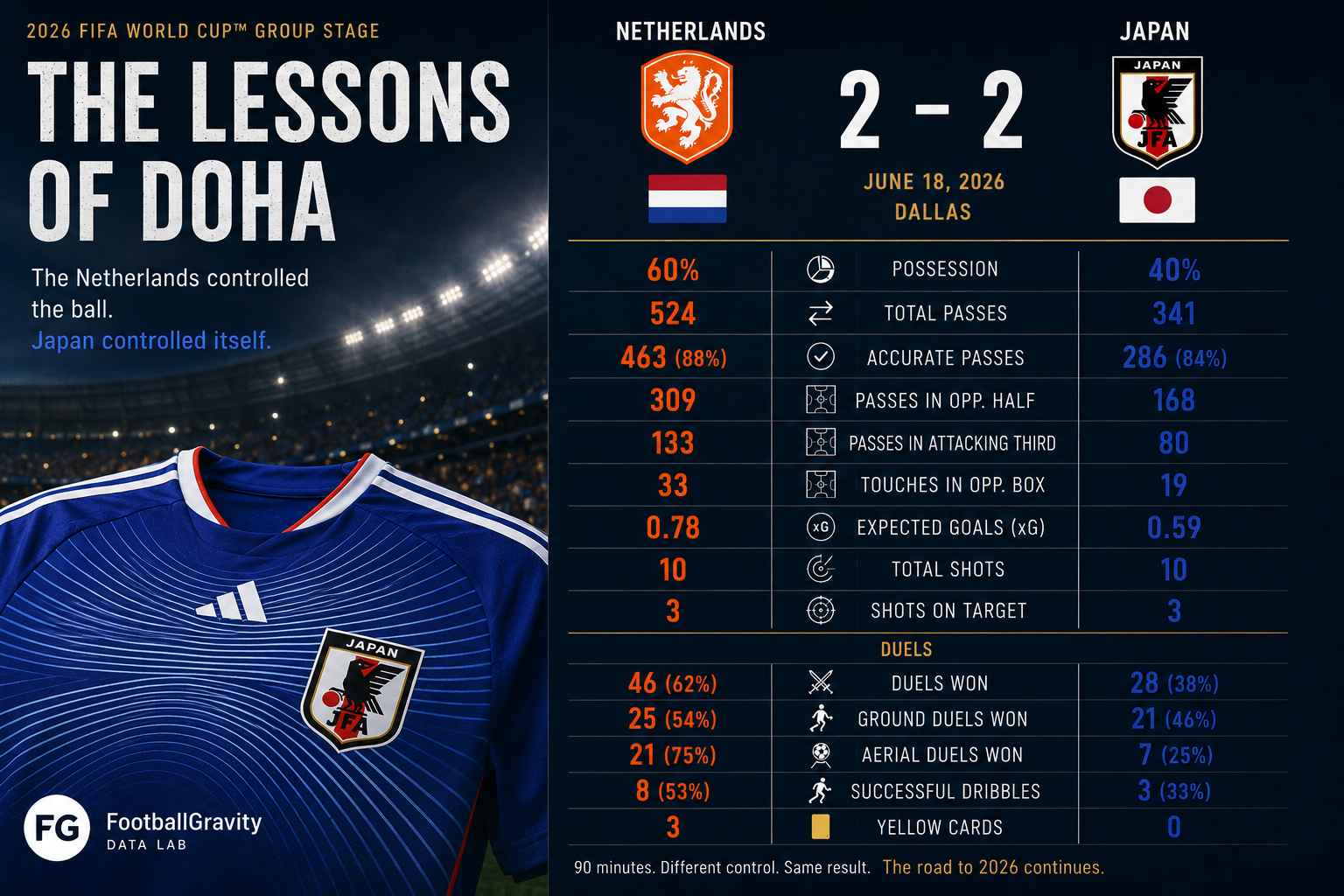
The Lessons of Doha: How Japan Stayed Calm Against the Netherlands

The Netherlands and Japan was one of the most anticipated group-stage matches of the 2026 FIFA World Cup.

Both nations arrived in the tournament with genuine ambitions of reaching the latter stages. The Netherlands entered as one of Europe’s most consistent contenders, while Japan carried growing expectations after its remarkable performances in recent World Cups.

The match delivered.

A dramatic 2-2 draw combined technical quality, tactical discipline, and moments of individual brilliance. More importantly, it revealed something about how this Japanese team has evolved.

Numbers Favored the Netherlands

The statistics suggested a Dutch advantage.

The Netherlands controlled 60 percent of possession, completed more than 500 passes, and generated slightly more territorial control throughout the match. They entered Japan’s penalty area more frequently and dictated long stretches of the game’s rhythm.

On paper, it was the Netherlands who controlled the match.

Yet the contest never felt one-sided.

Japan accepted periods without the ball, remained organized, and repeatedly found ways to respond whenever momentum appeared to swing against them.

That may have been the most important statistic of all.

A Match Played in Quarters

The Texas heat created an unusual dynamic.

Cooling breaks effectively divided the match into shorter segments, making the game feel closer to a four-quarter contest than a traditional ninety-minute match.

For some teams, interruptions can disrupt momentum.

For Japan, they seemed to provide opportunities.

Players gathered frequently, exchanged information, and recalibrated their positioning. The team appeared to treat every restart as a chance to reset collectively.

Combined with halftime and the moments immediately following each conceded goal, Japan effectively received multiple opportunities to reorganize and refocus.

Each time, they returned looking composed.

The Difference Between Panic and Control

One of the most striking aspects of the match was what did not happen.

After conceding goals, there were no visible signs of frustration. No blaming teammates. No emotional collapse. No rush to abandon the game plan.

The reactions looked almost routine.

As if difficult moments had already been anticipated and rehearsed.

This was not a team trying to avoid mistakes.

It was a team prepared for them.

That distinction matters at a World Cup.

Tournament football is rarely won by teams that avoid adversity. It is often won by teams that know how to respond when adversity inevitably arrives.

Japan looked ready.

The Long Shadow of Doha

Japanese football has carried the memory of Doha for more than three decades.

The “Agony of Doha” in 1993 remains one of the defining moments in the nation’s football history. A World Cup dream disappeared in stoppage time, leaving lessons about concentration, game management, and emotional control that shaped an entire generation.

One of the players on the pitch that night was Hajime Moriyasu.

Today, he stands on the touchline as Japan’s head coach.

His team also carries another Doha memory.

In 2022, Japan produced one of the greatest achievements in its history by overturning Germany and Spain at the World Cup in Qatar.

The agony and the joy were born in the same city.

Both experiences appear woven into the identity of this team.

Watching Japan calmly navigate difficult moments against the Netherlands, it was difficult not to see traces of those lessons.

There was no sign of panic.

There was no sign of complacency.

A team shaped by both disappointment and triumph tends to understand that matches are never over until they truly are.

More Than a Draw

A 2-2 draw against the Netherlands will not define this tournament.

But it offered an important reference point.

The Netherlands may have controlled more of the ball.

They may have completed more passes and spent more time in advanced areas.

Japan controlled something else.

Themselves.

As the knockout stage approaches, that quality may prove just as valuable as any tactical system or statistical advantage.

From Doha to Dallas, Japanese football continues to carry its lessons forward.

And on one of the biggest stages in world football, those lessons were visible once again.

Going to America, 32 Years Later

A football supporter wearing a vintage number 11 jersey looking toward a distant stadium under an American sunset sky

The Dream That Stopped in Doha

On October 28, 1993, Japan stood only minutes away from history.

A victory against Iraq would have sent the nation to its first FIFA World Cup.

Instead, a late equalizer arrived from a short corner.

2–2.

The final whistle followed.

And a dream disappeared.

Japanese football remembers that night simply as “The Agony of Doha.”

For those who watched it, the memory never really left.


One More Step

Football history is often measured in goals.

But sometimes it is measured in centimeters.

In Doha, there were moments that came down to one final step.

One final touch.

One final clearance.

Among the players desperately trying to close down the cross was a young midfielder named Hajime Moriyasu.

Nearby was Japan’s star forward, Kazuyoshi Miura — KAZU — the face of Japanese football.

Both were close.

Not close enough.

History rarely explains how painful “almost” can be.


Before World Cups Became Normal

Today, Japan has qualified for eight consecutive World Cups.

For younger supporters, qualification can almost feel expected.

In 1993, it was the opposite.

Japan had never appeared on football’s biggest stage.

The J.League had only recently begun.

Captain Tsubasa had taught an entire generation to dream about the World Cup.

But dreams remained dreams.

The tournament existed somewhere far away, on television screens and magazine pages.

America felt unimaginably distant.


The Heroes Who Never Went

That Doha squad contained many of the defining figures of Japanese football.

Masami Ihara.
Tetsuji Hashiratani.
Shigetatsu Matsunaga.
Kenta Hasegawa.
Masashi Nakayama.
Ramos Ruy.
Kazu.

Some became legends.

Some became coaches.

Some became memories.

Yet none of them reached the World Cup that year.

Their generation built the foundation of Japanese football without receiving the reward they had spent their careers chasing.

That may be one of the cruelest truths in sport.


The Quiet Player Who Stayed

Among those stars stood Moriyasu.

He was not the most famous player.

Not the most marketable.

Not the headline.

Few people in 1993 would have predicted that he would become the most influential figure from that generation.

Yet history often favors patience.

Thirty-two years later, it is Moriyasu who leads Japan back toward America.

Not as a player.

As the manager of the national team.


Football’s Long Memory

Sport moves quickly.

Football remembers slowly.

The players on Japan’s 2026 squad were not even born when Doha happened.

Many grew up watching entirely different generations.

Yet football cultures carry memories across decades.

The lessons.

The scars.

The ambitions.

The unfinished journeys.

In that sense, every World Cup team carries more people than the twenty-six names listed on the squad sheet.


Going to America

There is something poetic about the destination.

America.

The World Cup Japan nearly reached in 1993.

The World Cup KAZU dreamed of.

The World Cup that slipped away.

And now, after thirty-two years, Japan returns.

This time as one of the strongest teams in Asia.

This time with genuine ambitions.

This time led by a man who knows exactly how quickly dreams can disappear.

No one understands complacency less than Hajime Moriyasu.

He has already lived the consequences.


More Than a Tournament

For some supporters, this World Cup is not simply another competition.

It is a continuation.

A journey paused in Doha and resumed three decades later.

Some will travel to the United States wearing modern shirts.

Others may wear old ones.

Perhaps even the number 11.

Not because football can rewrite history.

But because football allows history to travel with us.

And somewhere between Doha and America, between 1993 and 2026, between KAZU and the next generation, a dream continues moving forward.

Thirty-two years later.

America is finally waiting.


With old No.11

This summer, I will travel to America wearing an old No.11 shirt.

Not because football owes us anything.

But because some journeys deserve to be completed.

When Weather Decides the World Cup

Children playing football in the rain under dramatic skies during a stormy World Cup-inspired atmosphere

Football Cannot Escape Nature

The 2026 FIFA World Cup is already raising concerns about extreme heat.

Cooling breaks.
Adjusted kickoff times.
Debates over player safety and physical performance.

For months, the conversation around this tournament has focused on temperature.

But there is another element that may shape the World Cup just as much — and strangely, almost nobody is talking about it.

Weather itself.

Rain.
Humidity.
Wind.
Storms.
Mud.

Football has always belonged to nature more than many modern sports are willing to admit.

And this summer, nature may return to the center of the game.


Japan vs Netherlands — In the Rain?

Japan’s opening match against the Netherlands is currently forecast to be played in rainy conditions.

How many people even know that?

World Cup football is often remembered through bright sunlight, dry stadiums, and cinematic skies. Qatar 2022, held in winter in the Middle East, rarely dealt with rain at all. Even earlier tournaments — Russia 2018 or the previous United States World Cup in 1994 — are not widely associated with wet-weather football.

But football itself was never designed for perfect laboratory conditions.

It was built outdoors.
On imperfect grass.
Inside wind.
Inside rain.

And perhaps climate change is now quietly pushing the sport back toward those uncontrollable realities.


Football Is a Sport Played With Uncertainty

Most sports try to eliminate uncertainty.

Football never fully could.

The ball is round.
The pitch changes.
The weather changes.
Human bodies tire differently under heat, humidity, or rain.

And unlike many sports, football almost never stops for bad weather.

Unless lightning becomes dangerous, the match continues.

Anyone who has played football in the rain remembers the feeling instantly:
the unpredictable bounce,
the wet grass,
the slightly delayed reaction of the body,
the slide tackles that travel farther than expected.

There is frustration in it.
But also excitement.

Because in those moments, you are not only playing against the opponent.

You are also playing with nature itself.


The Endurance of Pressing Football

Modern football increasingly depends on physical intensity.

High pressing.
Repeated sprints.
Compact defensive transitions.

But heavy heat and humidity change everything.

Even the most carefully organized pressing systems begin to collapse when the body cannot recover oxygen quickly enough.

Rain creates different problems.

A wet pitch speeds up some passes while slowing others.
Timing changes.
Defenders hesitate.
Goalkeepers lose certainty.
One unexpected skid can decide an entire tournament.

At the highest level of international football, few teams truly want more uncertainty.

Yet uncertainty may become unavoidable.


Which Countries Adapt Better?

That raises an uncomfortable and fascinating question.

Which football cultures are actually better prepared for climate uncertainty?

South American teams may possess natural familiarity with unstable conditions.
Many Asian nations regularly deal with heavy rain, humidity, and exhausting summer climates.
African teams often grow up playing in environmental conditions European players rarely experience.

Perhaps resilience itself becomes an advantage.

Or perhaps Europe — through tactical structure, squad depth, and control — once again proves capable of managing uncertainty better than anyone else.

The World Cup may become not only a competition between football systems,
but between relationships with nature itself.


Football Was Never Meant To Be Perfect

Modern football increasingly seeks precision.

Data.
Control.
Optimization.
Scientific recovery.
Perfect passing angles.

But weather reminds the sport of its original character.

Football is not played inside a simulation.

It is played on Earth.

And maybe that is why rainy matches remain strangely memorable.
Not because they are clean.
But because they feel alive.

The 2026 World Cup may ultimately be remembered not only for tactics or stars,
but for something much older:

Twenty-two players trying to negotiate with nature.

J.League’s Carnival of Change

On June 13, 2026 — just one day before Japan’s opening match at the FIFA World Cup — the J.League will attempt something remarkably unusual.

Not simply an All-Star game.

A football carnival.

Six teams.
Including mixed squads from J1, J2, and J3.
Fan-selected players divided into East and West selections.
Seven matches played consecutively in a one-day knockout tournament.
Each game lasting only 30 minutes.

In football, there is almost no precedent for this kind of format.

If anything, it feels closer to gaming culture, combat sports events, or even professional wrestling entertainment than traditional league football.

And that may be exactly why it matters.

Football Searching for New Forms

Football has always balanced two forces.

Tradition and adaptation.

The sport protects its rituals carefully: 90 minutes, league tables, home and away seasons, continental structures built over decades. Those traditions carry memory, identity, and local culture.

But football is also alive.

And living systems change.

Former Barcelona defender Gerard Piqué once explained the philosophy behind the Kings League by saying younger generations no longer watch full 90-minute matches the same way previous generations did. Whether one agrees or disagrees with that observation, it reflects a reality many leagues are now confronting.

Attention spans shift.
Media consumption changes.
Audiences fragment.

The question is not whether football should abandon tradition.

It should not.

The question is whether football can create safe spaces for experimentation without damaging the foundations that make the sport meaningful.

An All-Star event may be the perfect place to try.

A Tournament Designed for Curiosity

What makes this J.League project fascinating is not simply its entertainment value.

It is the willingness to experiment publicly.

Thirty-minute matches naturally create urgency.
Tournament structures increase unpredictability.
Mixed-division squads disrupt normal hierarchies.
Fans are invited not only to watch, but to participate in the construction of the event itself.

The result feels less like a conventional exhibition match and more like a living laboratory for football culture.

Not every experiment succeeds.

But leagues that never experiment eventually become static.

And static systems rarely stay healthy forever.

Football, Energy, and Life

In biology, adaptation is often described as the key to survival.

But perhaps the idea goes even deeper.

From the perspective of energy and modern physics, one could argue that change itself is a sign of life. Living systems continuously reorganize, exchange energy, and evolve through interaction with their environment.

A perfectly static organism is no longer alive.

In that sense, maybe leagues are not so different.

A league willing to test new formats, invite uncertainty, and reimagine its relationship with supporters may reveal something important: not instability, but vitality.

Football is not merely preserved through repetition.

Sometimes, it survives through movement.

More Than Entertainment

This All-Star tournament may ultimately become a one-time curiosity.

Or it may influence future football events in subtle ways.

Either outcome is valuable.

Because the most interesting part is not whether every rule works perfectly.

It is that the J.League is willing to ask new questions at all.

And in modern football — where many institutions become increasingly cautious, commercialized, and predictable — curiosity itself may be one of the rarest strengths left.