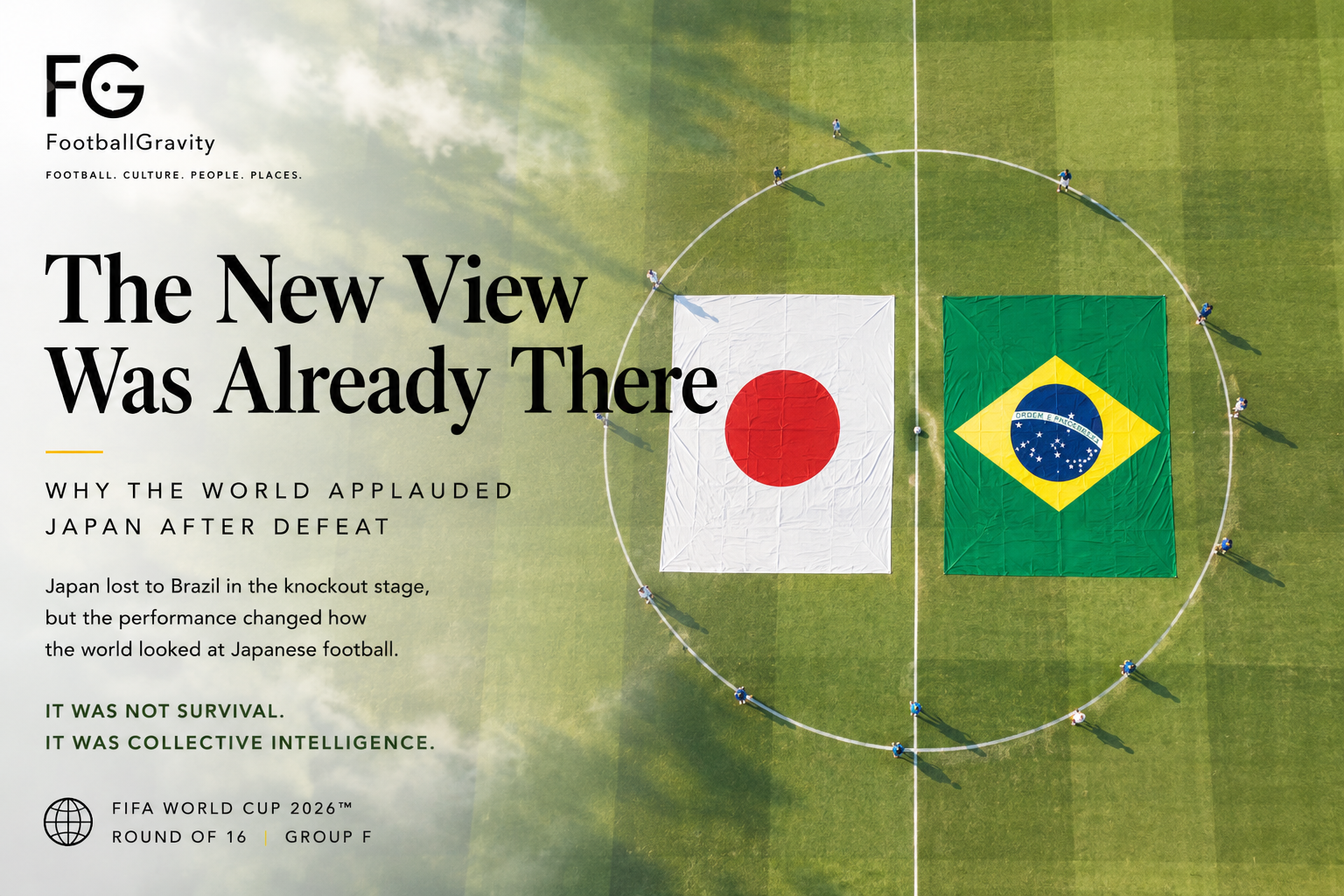
The New View Was Already There

Why the world applauded Japan after defeat

Japan lost.

That is the simplest sentence.

Brazil advanced. Japan went home. Another World Cup knockout match ended without Japan’s first victory beyond the group stage.

And yet, after the final whistle, the conversation did not feel like a simple story of failure.

Around the world, Japan were not spoken of merely as brave losers. They were discussed as a team that had shown something rare: a national side capable of making Brazil look human, not through luck, not through chaos, but through collective intelligence.

That may be why this defeat felt different.

For years, Hajime Moriyasu had spoken about “a new view.”

Perhaps many imagined that view would mean a quarter-final, a semi-final, or even something more ambitious.

Those results did not arrive.

But against Brazil, something else did.

The football world saw Japan differently.

The Cruelest Path

The first knockout round was especially unforgiving for Group F.

Japan faced Brazil.

The Netherlands faced Morocco.

Sweden faced France.

All three teams that advanced from Group F were eliminated.

That does not erase their defeats. But it does change the frame.

Japan did not fall against an ordinary opponent. The Netherlands were pushed out by a Morocco side that looked like one of the most complete teams in the tournament. Sweden were beaten by France, a side whose individual quality and tournament experience remain among the highest in world football.

Group F had produced competitive teams.

But the next path was brutal.

Japan’s loss belonged to that context.

And still, among the three defeated sides, Japan seemed to leave the strongest impression.

Why?

It Was Never Only About the Result

Football usually remembers winners.

Paraguay, for example, achieved something Japan could not: they took Germany to penalties and won. That deserves full respect.

But global admiration does not always follow the scoreboard alone.

Japan were praised because of how they played.

They did not appear to be a team simply waiting for Brazil to make a mistake.

They did not defend as if survival was the only plan.

They defended as if defending itself could be a way of attacking.

That distinction matters.

Japan were not trying only to reach penalties.

They were trying to win.

Against Brazil.

The Mystery the World Wanted to Solve

Japan are no longer an unknown football nation.

The old assumption that European or South American teams could underestimate Japan no longer works.

This is the country that beat Germany and Spain in Qatar. The country that later defeated Germany again. The country that has shown, repeatedly, that its best football belongs on the same pitch as elite opposition.

The question has changed.

It is no longer:

Can Japan compete?

It is now:

Why have Japan become so difficult to play against?

Against Brazil, the answer became clearer.

It was not only technique.

It was not only discipline.

It was synchronisation.

Eleven Players, One Organism

International football usually favours individual quality.

National teams do not train together like clubs. They do not have months to build mechanisms, pressing traps, defensive distances, or shared habits.

That is why knockout football often belongs to individual brilliance.

A winger beats a defender.

A striker finds half a yard.

A midfielder breaks the structure with one pass.

Japan proposed another answer.

Collective movement.

The back line moved together.

The midfield moved together.

The wing-backs adjusted together.

Even the forwards defended as part of the same structure.

At times, Japan looked less like eleven separate players and more like one organism responding to the ball, the space and the opponent at the same time.

That is rare in international football.

And that is what many observers seemed to recognise.

Brazil Did Not Become Ordinary

There is a danger in misreading the match.

Brazil did not suddenly become ordinary.

Japan simply prevented Brazil from looking extraordinary.

That may be the greatest compliment a defensive structure can receive.

The best attacking teams usually make opponents look reactive. They stretch the pitch, isolate defenders, and create the impression that danger can appear from anywhere.

Against Japan, Brazil were forced to think.

They had to adjust.

They had to suffer.

They had to wait until the final moments.

That was not because Brazil lacked quality.

It was because Japan denied them rhythm.

Not Defensive Football, But Winning Football

Japan’s structure was defensive in shape, but not defensive in spirit.

There is a difference between protecting a score and refusing to play.

Japan did not simply sit low and hope.

They pressed.

They shifted.

They tried to create moments.

They looked for the chance that would turn control into shock.

This is why the performance felt attractive, even without attacking fluency.

Japan’s injuries mattered. Several important attacking options were missing or limited. The final combinations were not always clean.

But the intention was visible.

This was not football designed only to avoid defeat.

It was football designed to find a path to victory against a superior collection of individual talent.

That is why it resonated.

Why Coaches Understand It

Some performances are appreciated first by fans.

Others are understood most deeply by coaches, former players and analysts.

Japan’s performance belonged to the second category.

Anyone can admire a dribble.

Anyone can celebrate a goal.

But collective coordination is harder to see.

It requires watching distances, timing, cover, body orientation and the relationship between players who may never touch the ball.

Against Brazil, Japan showed that a national team can still build something close to club-level collective behaviour.

That is not easy.

It is not accidental.

And it is not simply “hard work.”

It is design.

A New View

Moriyasu’s phrase, “a new view,” will always carry the sadness of unfinished ambition.

Japan wanted more.

The players wanted more.

The supporters wanted more.

A first knockout victory was close enough to touch, and then gone.

But perhaps the phrase does not belong only to the result.

Perhaps a new view can also be the moment when the world looks at Japanese football and no longer sees an outsider.

Not a surprise.

Not a guest.

Not a romantic underdog.

But a serious football nation with its own method, its own intelligence, and its own way of making the game difficult for anyone.

The players saw it.

The coach saw it.

The supporters felt it.

And perhaps, for the first time, the world saw it too.

The new view was already there.

The Lessons of Doha: How Japan Stayed Calm Against the Netherlands

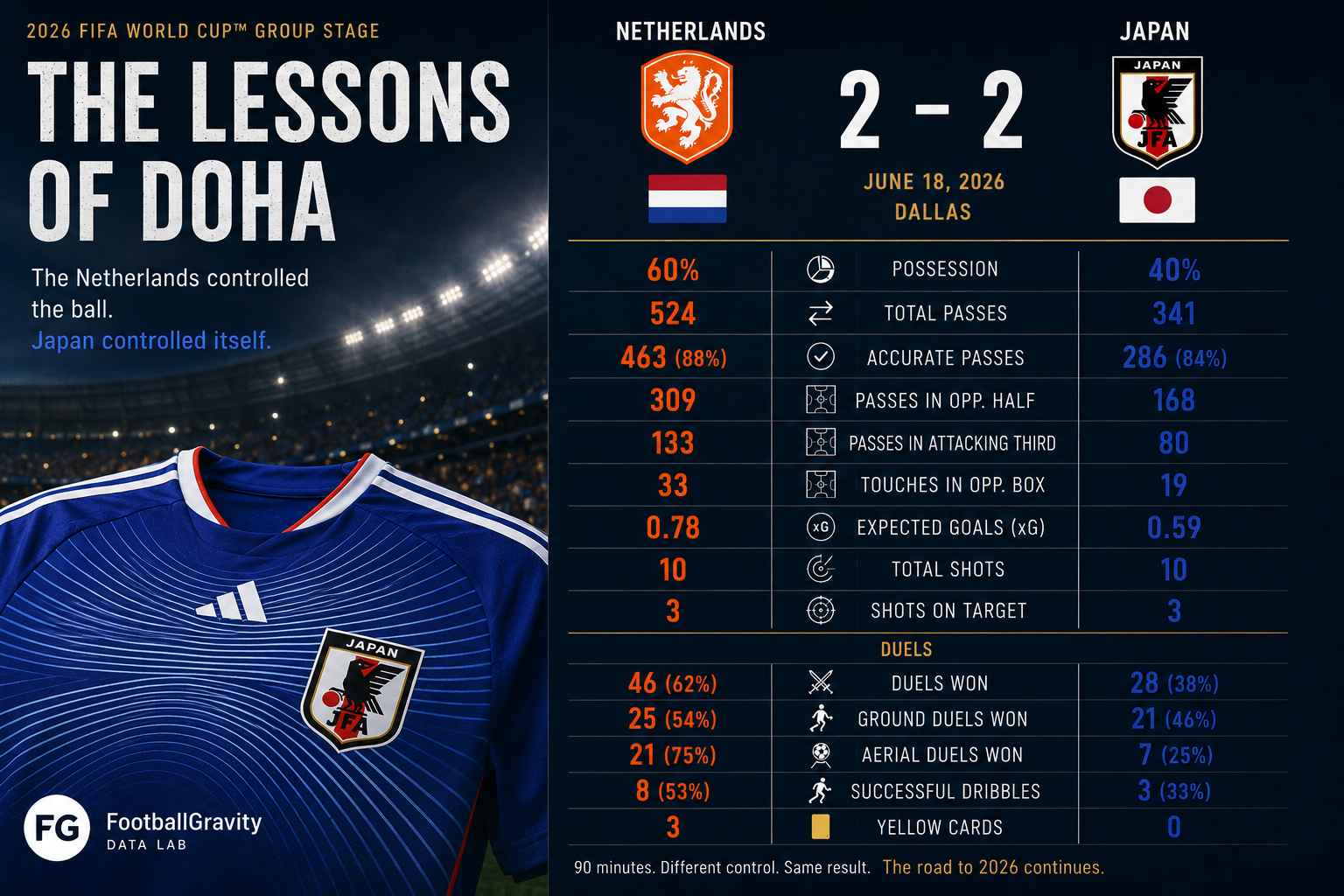
The Netherlands and Japan was one of the most anticipated group-stage matches of the 2026 FIFA World Cup.

Both nations arrived in the tournament with genuine ambitions of reaching the latter stages. The Netherlands entered as one of Europe’s most consistent contenders, while Japan carried growing expectations after its remarkable performances in recent World Cups.

The match delivered.

A dramatic 2-2 draw combined technical quality, tactical discipline, and moments of individual brilliance. More importantly, it revealed something about how this Japanese team has evolved.

Numbers Favored the Netherlands

The statistics suggested a Dutch advantage.

The Netherlands controlled 60 percent of possession, completed more than 500 passes, and generated slightly more territorial control throughout the match. They entered Japan’s penalty area more frequently and dictated long stretches of the game’s rhythm.

On paper, it was the Netherlands who controlled the match.

Yet the contest never felt one-sided.

Japan accepted periods without the ball, remained organized, and repeatedly found ways to respond whenever momentum appeared to swing against them.

That may have been the most important statistic of all.

A Match Played in Quarters

The Texas heat created an unusual dynamic.

Cooling breaks effectively divided the match into shorter segments, making the game feel closer to a four-quarter contest than a traditional ninety-minute match.

For some teams, interruptions can disrupt momentum.

For Japan, they seemed to provide opportunities.

Players gathered frequently, exchanged information, and recalibrated their positioning. The team appeared to treat every restart as a chance to reset collectively.

Combined with halftime and the moments immediately following each conceded goal, Japan effectively received multiple opportunities to reorganize and refocus.

Each time, they returned looking composed.

The Difference Between Panic and Control

One of the most striking aspects of the match was what did not happen.

After conceding goals, there were no visible signs of frustration. No blaming teammates. No emotional collapse. No rush to abandon the game plan.

The reactions looked almost routine.

As if difficult moments had already been anticipated and rehearsed.

This was not a team trying to avoid mistakes.

It was a team prepared for them.

That distinction matters at a World Cup.

Tournament football is rarely won by teams that avoid adversity. It is often won by teams that know how to respond when adversity inevitably arrives.

Japan looked ready.

The Long Shadow of Doha

Japanese football has carried the memory of Doha for more than three decades.

The “Agony of Doha” in 1993 remains one of the defining moments in the nation’s football history. A World Cup dream disappeared in stoppage time, leaving lessons about concentration, game management, and emotional control that shaped an entire generation.

One of the players on the pitch that night was Hajime Moriyasu.

Today, he stands on the touchline as Japan’s head coach.

His team also carries another Doha memory.

In 2022, Japan produced one of the greatest achievements in its history by overturning Germany and Spain at the World Cup in Qatar.

The agony and the joy were born in the same city.

Both experiences appear woven into the identity of this team.

Watching Japan calmly navigate difficult moments against the Netherlands, it was difficult not to see traces of those lessons.

There was no sign of panic.

There was no sign of complacency.

A team shaped by both disappointment and triumph tends to understand that matches are never over until they truly are.

More Than a Draw

A 2-2 draw against the Netherlands will not define this tournament.

But it offered an important reference point.

The Netherlands may have controlled more of the ball.

They may have completed more passes and spent more time in advanced areas.

Japan controlled something else.

Themselves.

As the knockout stage approaches, that quality may prove just as valuable as any tactical system or statistical advantage.

From Doha to Dallas, Japanese football continues to carry its lessons forward.

And on one of the biggest stages in world football, those lessons were visible once again.

J.League’s Carnival of Change

On June 13, 2026 — just one day before Japan’s opening match at the FIFA World Cup — the J.League will attempt something remarkably unusual.

Not simply an All-Star game.

A football carnival.

Six teams.
Including mixed squads from J1, J2, and J3.
Fan-selected players divided into East and West selections.
Seven matches played consecutively in a one-day knockout tournament.
Each game lasting only 30 minutes.

In football, there is almost no precedent for this kind of format.

If anything, it feels closer to gaming culture, combat sports events, or even professional wrestling entertainment than traditional league football.

And that may be exactly why it matters.

Football Searching for New Forms

Football has always balanced two forces.

Tradition and adaptation.

The sport protects its rituals carefully: 90 minutes, league tables, home and away seasons, continental structures built over decades. Those traditions carry memory, identity, and local culture.

But football is also alive.

And living systems change.

Former Barcelona defender Gerard Piqué once explained the philosophy behind the Kings League by saying younger generations no longer watch full 90-minute matches the same way previous generations did. Whether one agrees or disagrees with that observation, it reflects a reality many leagues are now confronting.

Attention spans shift.
Media consumption changes.
Audiences fragment.

The question is not whether football should abandon tradition.

It should not.

The question is whether football can create safe spaces for experimentation without damaging the foundations that make the sport meaningful.

An All-Star event may be the perfect place to try.

A Tournament Designed for Curiosity

What makes this J.League project fascinating is not simply its entertainment value.

It is the willingness to experiment publicly.

Thirty-minute matches naturally create urgency.
Tournament structures increase unpredictability.
Mixed-division squads disrupt normal hierarchies.
Fans are invited not only to watch, but to participate in the construction of the event itself.

The result feels less like a conventional exhibition match and more like a living laboratory for football culture.

Not every experiment succeeds.

But leagues that never experiment eventually become static.

And static systems rarely stay healthy forever.

Football, Energy, and Life

In biology, adaptation is often described as the key to survival.

But perhaps the idea goes even deeper.

From the perspective of energy and modern physics, one could argue that change itself is a sign of life. Living systems continuously reorganize, exchange energy, and evolve through interaction with their environment.

A perfectly static organism is no longer alive.

In that sense, maybe leagues are not so different.

A league willing to test new formats, invite uncertainty, and reimagine its relationship with supporters may reveal something important: not instability, but vitality.

Football is not merely preserved through repetition.

Sometimes, it survives through movement.

More Than Entertainment

This All-Star tournament may ultimately become a one-time curiosity.

Or it may influence future football events in subtle ways.

Either outcome is valuable.

Because the most interesting part is not whether every rule works perfectly.

It is that the J.League is willing to ask new questions at all.

And in modern football — where many institutions become increasingly cautious, commercialized, and predictable — curiosity itself may be one of the rarest strengths left.