
Gravity and the Ball

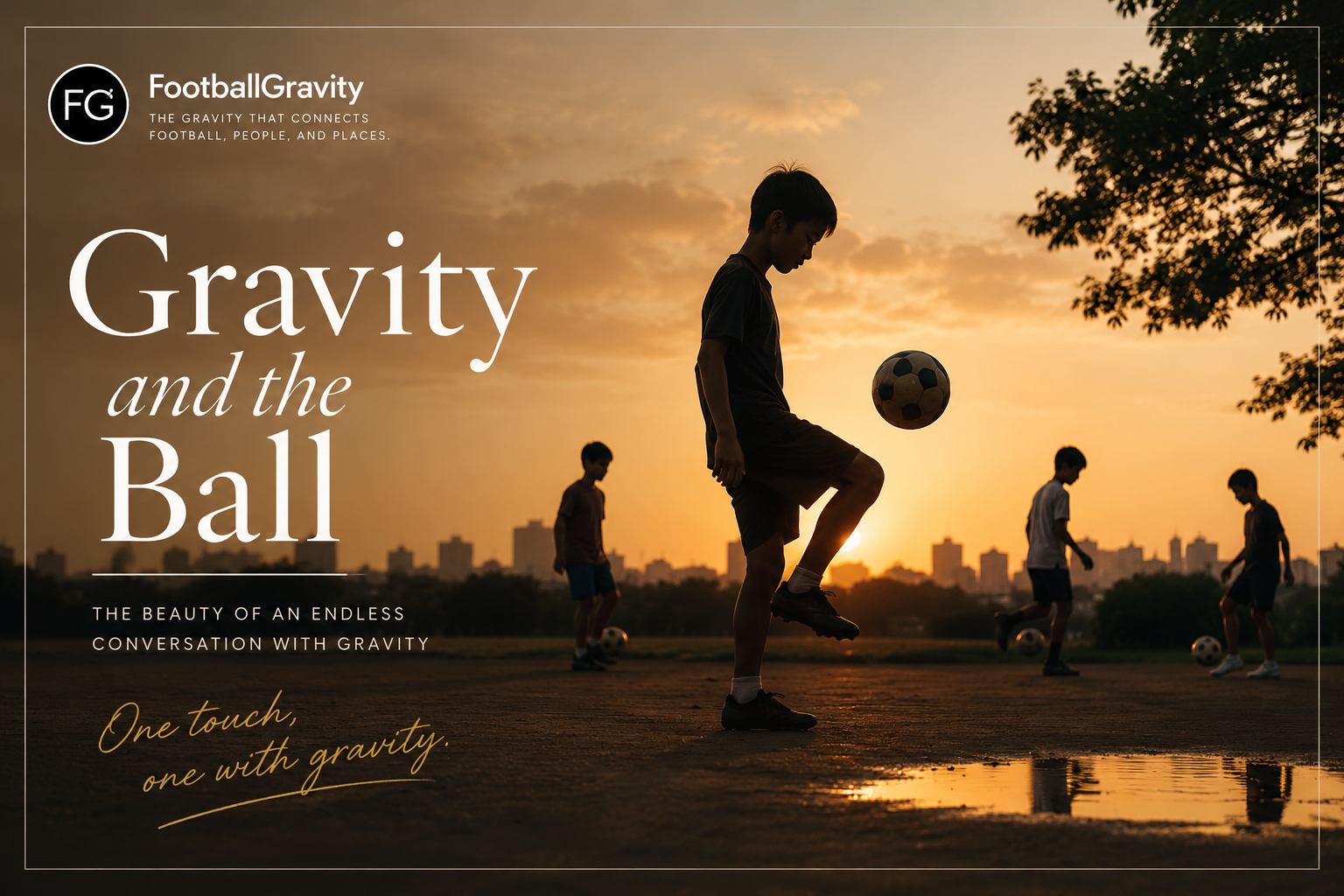
In a small park at sunset, children were practicing juggling.

Most of them could not even reach ten touches consistently. The ball would bounce away after three, five, sometimes eight touches. Then they would run after it, place it carefully back on the ground, and start again.

Again.
And again.

Even after the sky slowly turned orange.

There is something strangely beautiful about football juggling.

At its core, it is an endless conversation with gravity.

Kick the ball upward, and it always comes back down. According to Newtonian physics, gravitational acceleration is effectively constant on Earth. The speed at which the ball falls does not care whether you are a child in a park, a professional footballer, or a retired player in your sixties.

The ball always returns at almost the same speed.

That shared rhythm is part of what makes football universal.

Little by little, the body adapts to that rhythm. Eyes begin to predict the fall. Ankles react slightly faster. Timing improves. One clean touch becomes two. Two become five.

And for a brief moment, the body feels synchronized with the laws of the planet itself.

That is why juggling is so addictive.

Every great footballer once followed the exact same falling ball.

Whether it was Dennis Bergkamp, Romário, Ronaldinho, Zinedine Zidane, or Japan’s Shinji Ono, they all spent countless hours adjusting themselves to the same gravity, the same uncertainty, and the same imperfect sphere.

Football is difficult precisely because the ball is round.

A perfect control is impossible. Even the greatest players misjudge a bounce or slightly mistime a floating pass. Human legs are not designed for precision in the same way human hands are. That instability — that constant possibility of failure — is what makes football beautiful.

If someone catches a square object with their hands, nobody is amazed.

But when a player cushions a spinning ball perfectly with one touch using their foot, chest, or thigh, people stop and stare. We admire it because we understand, instinctively, how difficult it really is.

We have all felt the ball bounce away from us before.

That shared experience matters.

The beauty of football does not come from perfect control. It comes from humanity trying to negotiate with imperfection.

And sometimes, for just one touch, it works.

One perfectly controlled juggling touch can feel magical. For a second, you feel connected to the same sensation experienced by the masters of the game.

For one touch, maybe you become Zidane.
For one touch, maybe you become Shinji Ono.

That is enough to make you smile and try again.

The Earth has changed across centuries, cultures, and generations. Stadiums became larger. Football became faster. Data became more sophisticated.

But gravity never changed.

And somewhere in the world, even tonight, a child is still kicking a ball upward and learning the same rhythm that footballers have followed for generations.

That may be one of football’s simplest and most beautiful truths.

Everyone Becomes a National Team Coach in World Cup Summer

Every four years, football expands beyond stadiums and tactics.It enters conversations, identities, arguments, memories, and imagination across the world.


Before the World Cup even begins, something unusual starts happening.

People begin debating football everywhere.

At cafés.
At offices.
On trains.
Across group chats and timelines.

National team squads are announced one by one, and suddenly millions of people become temporary national team coaches.

Who should start?
Who should be left out?
Who still deserves one last tournament?

The discussions quickly spread beyond tactics.

They become emotional.

And that emotional intensity may be one of the most unique atmospheres in global sport.


The Arrival of a Different Kind of Summer

World Cup summers feel different from ordinary football seasons.

League football is continuous. Club football is routine.

But the World Cup compresses emotion into a short period of global anticipation.

Every squad announcement feels consequential.

Every injury update changes possibility.

Every rumor creates another version of the future.

In recent weeks alone, supporters around the world have debated questions that are simultaneously tactical and deeply emotional:

Should Neymar still be included?
Can Phil Foden really be left out?
Should Luis Suárez return one more time?
Will Cristiano Ronaldo or Lionel Messi remain physically ready for another World Cup run?
Can Tomiyasu or Endo recover their highest level in time?

These conversations are not limited to each country’s own supporters.

Football fans everywhere begin temporarily adopting the emotions and perspectives of other nations.

For a few weeks, people become unofficial Brazilians, Argentinians, Dutch, Japanese, or Uruguayans — emotionally invested in football stories far beyond their own borders.


Beyond Winning

What makes these debates fascinating is that they are rarely only about maximizing the probability of victory.

People discuss what kind of football they want to watch.

Which players deserve a final stage.
Which personalities represent the spirit of a country.
Which combinations simply feel exciting.

The World Cup transforms football into something closer to collective imagination.

Part sporting competition.
Part emotional projection.
Part global fantasy draft.

In that sense, World Cup discussions resemble a strange mixture of tactical analysis, mythology, nostalgia, and dream-building.

Supporters are not only predicting reality.

They are constructing ideal versions of it.


Infinite Possibilities Before Reality Arrives

Before the first kickoff, the tournament exists only as possibility.

Countless imagined futures overlap simultaneously.

A veteran’s final redemption.
A young player’s breakthrough.
An unexpected underdog run.
A tactical revolution.
A tragic injury.
A perfect goal.

Every supporter carries a slightly different version of the tournament in their mind.

And for a brief period before reality arrives, all of those futures remain alive together.

Perhaps this is why pre-World Cup weeks feel so emotionally powerful.

Because uncertainty itself becomes part of the experience.

The tournament has not yet collapsed into fact.

It still exists as probability, hope, memory, fear, and imagination all at once.


A Global Conversation About Identity

International football has always been about more than football.

National teams become temporary reflections of how countries see themselves — or wish to see themselves.

Should a team prioritize youth or experience?
Structure or creativity?
Discipline or freedom?

Squad selection debates often reveal deeper cultural ideas about identity, personality, and national character.

And unlike many modern global conversations, these discussions remain strangely participatory.

Millions of people feel personally involved.

Not because they control the outcome.

But because football allows emotional ownership.

Everyone carries their own vision of what the national team should become.


Soon, the debates will end.

The squads will be finalized.
Reality will begin replacing imagination.
Some dreams will survive. Others will disappear immediately.

But perhaps that fragile period before kickoff is part of what makes the World Cup special.

For a few weeks, the entire world participates in the same expanding conversation.

A global network of arguments, expectations, nostalgia, probability, and hope.

Millions of imagined tournaments existing simultaneously before a single ball is kicked.

And somewhere inside that collective uncertainty, another unforgettable football summer quietly begins.


The Beauty of Uncertainty in Football

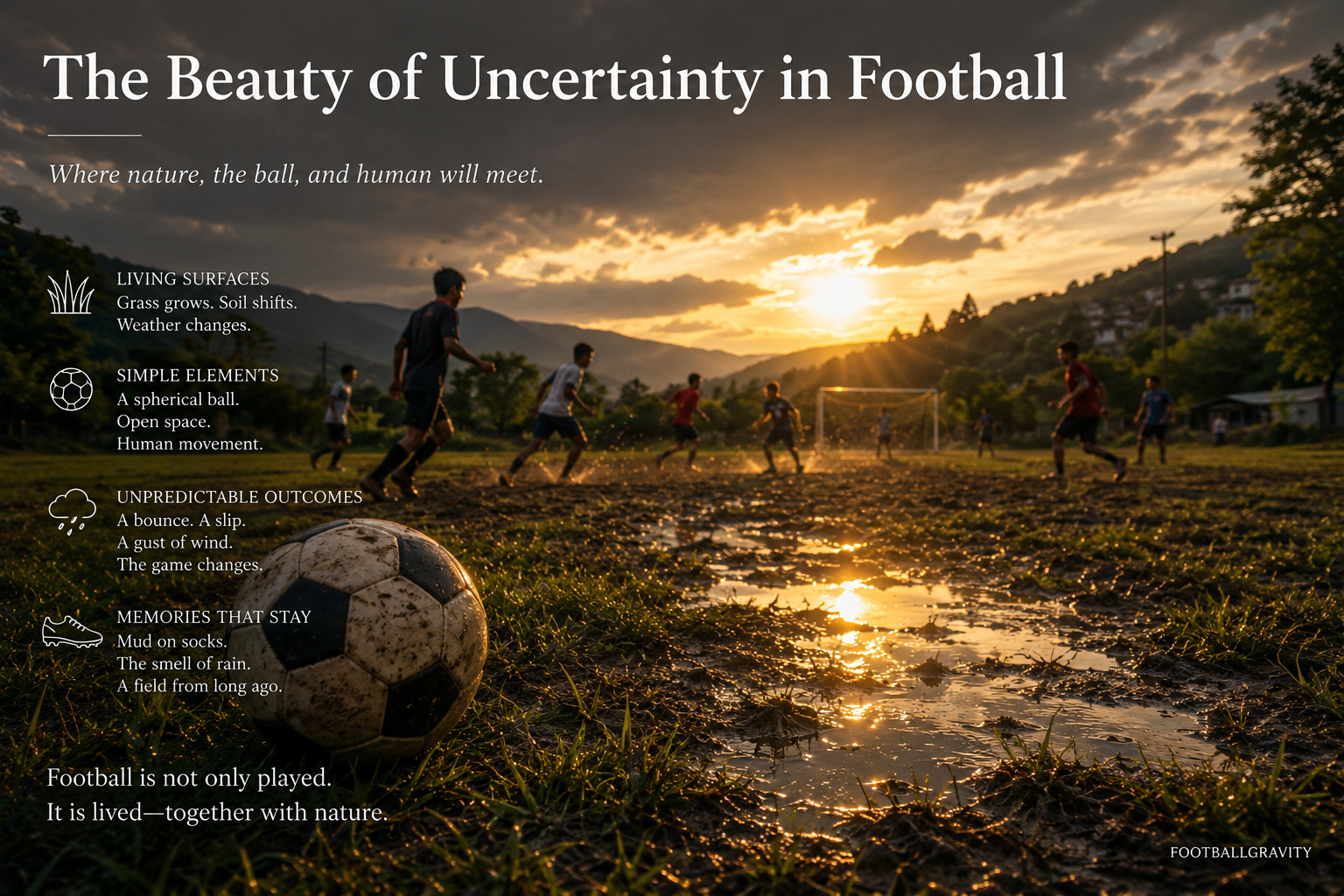
Football is shaped not only by players and tactics, but by grass, rain, soil, wind, and the unpredictable movement of a simple ball across living ground.


Some of the strongest memories in football are not only about goals.

They are about places.

The smell of wet grass after rain.
Dust rising from dry ground in summer.
Mud on socks.
Sand inside boots.
The sound of a ball bouncing differently on uneven soil.

Football has always existed slightly closer to nature than many modern sports.

And perhaps that connection is one reason the game still feels alive.


Football Is Played on Living Surfaces

Football is unusual because it is played directly on changing natural environments.

Grass grows. Soil shifts. Water changes movement. Wind alters trajectories.

Even at the highest level, football remains dependent on surfaces that are never completely identical from one day to the next.

That uncertainty influences everything.

Ball speed.
Passing rhythm.
Player balance.
Decision-making.

Ground conditions are not simply background scenery.

They participate in the match itself.

In some stadiums, grass is cut shorter to increase passing speed. In heavy rain, the game slows into physical struggle. On dry pitches, the ball moves unpredictably across rough surfaces.

Football constantly negotiates with the physical world around it.


The Ball, the Field, and Uncertainty

At its core, football is surprisingly simple.

A spherical ball.
Open space.
Human movement.

And yet from those simple elements emerges endless unpredictability.

Perhaps this is part of football’s beauty.

The ball never moves perfectly. The surface is never completely controlled. The environment always introduces small variations beyond human intention.

A wet patch changes a pass.
A bounce changes a goal.
Wind changes timing by fractions of a second.

Modern football increasingly relies on analysis, precision, and optimization.

But football never becomes fully programmable.

Nature still interrupts the system.

And maybe that interruption is essential.


Artificial Perfection — and What Gets Lost

Artificial turf reduces uncertainty.

The bounce becomes more predictable. Maintenance becomes easier. Conditions become more standardized.

In many situations, that consistency is practical and necessary.

Yet something subtle also disappears.

Perfectly controlled surfaces often reduce the strange emotional texture that natural environments create.

The game becomes cleaner.
More manageable.
More optimized.

But perhaps slightly less alive.

Because football has never been only about technical perfection.

It is also about adaptation.

Players responding to conditions they cannot fully control.

Teams negotiating rain, mud, friction, noise, fatigue, and atmosphere together in real time.

Natural imperfection creates part of the drama.


Why Football Memories Feel Physical

When people remember playing football as children, they rarely remember statistics.

They remember environments.

A local dirt field at sunset.
Grass stains on knees.
Cold air in winter training.
The uneven bounce that ruined or created a goal.

Football memories often remain tied to texture, weather, light, and landscape.

Perhaps this happens because football is experienced not only mentally, but physically through the environment itself.

The game enters memory through the senses.

And unlike many increasingly digital experiences, football still depends on contact with real surfaces, changing conditions, and uncontrollable surroundings.


Football is often described through tactics, data, and systems.

But underneath all of those structures remains something older and simpler:

a ball moving across living ground.

Perhaps that is why football continues to feel universal across generations and cultures.

Because despite all modern technology, the game still depends on uncertainty.

Grass grows differently. Rain changes rhythm. Soil shifts beneath movement.

And somewhere between human intention, physical law, and the unpredictability of nature, football finds its beauty.