
When Weather Decides the World Cup

Children playing football in the rain under dramatic skies during a stormy World Cup-inspired atmosphere

Football Cannot Escape Nature

The 2026 FIFA World Cup is already raising concerns about extreme heat.

Cooling breaks.
Adjusted kickoff times.
Debates over player safety and physical performance.

For months, the conversation around this tournament has focused on temperature.

But there is another element that may shape the World Cup just as much — and strangely, almost nobody is talking about it.

Weather itself.

Rain.
Humidity.
Wind.
Storms.
Mud.

Football has always belonged to nature more than many modern sports are willing to admit.

And this summer, nature may return to the center of the game.


Japan vs Netherlands — In the Rain?

Japan’s opening match against the Netherlands is currently forecast to be played in rainy conditions.

How many people even know that?

World Cup football is often remembered through bright sunlight, dry stadiums, and cinematic skies. Qatar 2022, held in winter in the Middle East, rarely dealt with rain at all. Even earlier tournaments — Russia 2018 or the previous United States World Cup in 1994 — are not widely associated with wet-weather football.

But football itself was never designed for perfect laboratory conditions.

It was built outdoors.
On imperfect grass.
Inside wind.
Inside rain.

And perhaps climate change is now quietly pushing the sport back toward those uncontrollable realities.


Football Is a Sport Played With Uncertainty

Most sports try to eliminate uncertainty.

Football never fully could.

The ball is round.
The pitch changes.
The weather changes.
Human bodies tire differently under heat, humidity, or rain.

And unlike many sports, football almost never stops for bad weather.

Unless lightning becomes dangerous, the match continues.

Anyone who has played football in the rain remembers the feeling instantly:
the unpredictable bounce,
the wet grass,
the slightly delayed reaction of the body,
the slide tackles that travel farther than expected.

There is frustration in it.
But also excitement.

Because in those moments, you are not only playing against the opponent.

You are also playing with nature itself.


The Endurance of Pressing Football

Modern football increasingly depends on physical intensity.

High pressing.
Repeated sprints.
Compact defensive transitions.

But heavy heat and humidity change everything.

Even the most carefully organized pressing systems begin to collapse when the body cannot recover oxygen quickly enough.

Rain creates different problems.

A wet pitch speeds up some passes while slowing others.
Timing changes.
Defenders hesitate.
Goalkeepers lose certainty.
One unexpected skid can decide an entire tournament.

At the highest level of international football, few teams truly want more uncertainty.

Yet uncertainty may become unavoidable.


Which Countries Adapt Better?

That raises an uncomfortable and fascinating question.

Which football cultures are actually better prepared for climate uncertainty?

South American teams may possess natural familiarity with unstable conditions.
Many Asian nations regularly deal with heavy rain, humidity, and exhausting summer climates.
African teams often grow up playing in environmental conditions European players rarely experience.

Perhaps resilience itself becomes an advantage.

Or perhaps Europe — through tactical structure, squad depth, and control — once again proves capable of managing uncertainty better than anyone else.

The World Cup may become not only a competition between football systems,
but between relationships with nature itself.


Football Was Never Meant To Be Perfect

Modern football increasingly seeks precision.

Data.
Control.
Optimization.
Scientific recovery.
Perfect passing angles.

But weather reminds the sport of its original character.

Football is not played inside a simulation.

It is played on Earth.

And maybe that is why rainy matches remain strangely memorable.
Not because they are clean.
But because they feel alive.

The 2026 World Cup may ultimately be remembered not only for tactics or stars,
but for something much older:

Twenty-two players trying to negotiate with nature.
Everyone Becomes a National Team Coach in World Cup Summer

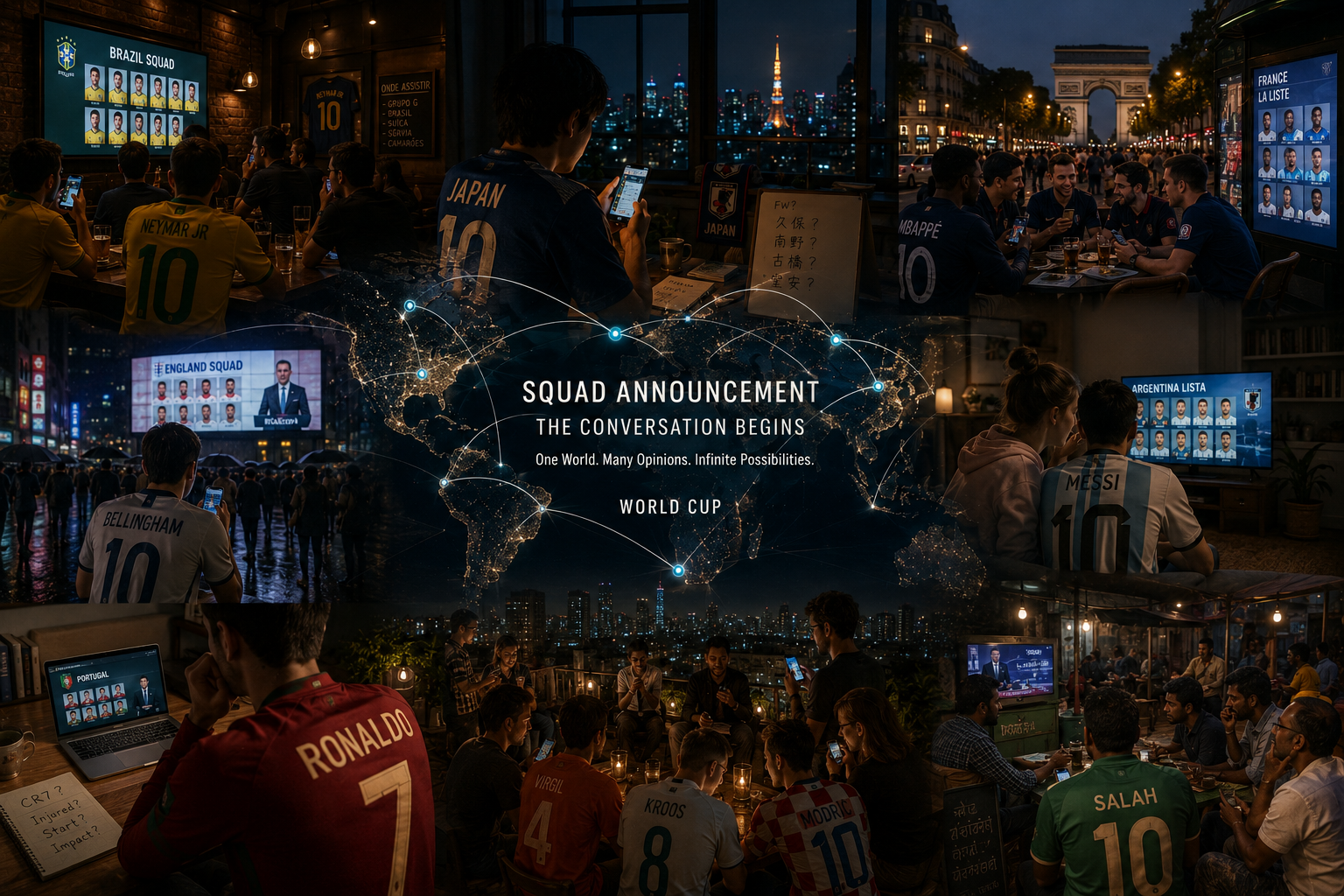
Every four years, football expands beyond stadiums and tactics.It enters conversations, identities, arguments, memories, and imagination across the world.


Before the World Cup even begins, something unusual starts happening.

People begin debating football everywhere.

At cafés.
At offices.
On trains.
Across group chats and timelines.

National team squads are announced one by one, and suddenly millions of people become temporary national team coaches.

Who should start?
Who should be left out?
Who still deserves one last tournament?

The discussions quickly spread beyond tactics.

They become emotional.

And that emotional intensity may be one of the most unique atmospheres in global sport.


The Arrival of a Different Kind of Summer

World Cup summers feel different from ordinary football seasons.

League football is continuous. Club football is routine.

But the World Cup compresses emotion into a short period of global anticipation.

Every squad announcement feels consequential.

Every injury update changes possibility.

Every rumor creates another version of the future.

In recent weeks alone, supporters around the world have debated questions that are simultaneously tactical and deeply emotional:

Should Neymar still be included?
Can Phil Foden really be left out?
Should Luis Suárez return one more time?
Will Cristiano Ronaldo or Lionel Messi remain physically ready for another World Cup run?
Can Tomiyasu or Endo recover their highest level in time?

These conversations are not limited to each country’s own supporters.

Football fans everywhere begin temporarily adopting the emotions and perspectives of other nations.

For a few weeks, people become unofficial Brazilians, Argentinians, Dutch, Japanese, or Uruguayans — emotionally invested in football stories far beyond their own borders.


Beyond Winning

What makes these debates fascinating is that they are rarely only about maximizing the probability of victory.

People discuss what kind of football they want to watch.

Which players deserve a final stage.
Which personalities represent the spirit of a country.
Which combinations simply feel exciting.

The World Cup transforms football into something closer to collective imagination.

Part sporting competition.
Part emotional projection.
Part global fantasy draft.

In that sense, World Cup discussions resemble a strange mixture of tactical analysis, mythology, nostalgia, and dream-building.

Supporters are not only predicting reality.

They are constructing ideal versions of it.


Infinite Possibilities Before Reality Arrives

Before the first kickoff, the tournament exists only as possibility.

Countless imagined futures overlap simultaneously.

A veteran’s final redemption.
A young player’s breakthrough.
An unexpected underdog run.
A tactical revolution.
A tragic injury.
A perfect goal.

Every supporter carries a slightly different version of the tournament in their mind.

And for a brief period before reality arrives, all of those futures remain alive together.

Perhaps this is why pre-World Cup weeks feel so emotionally powerful.

Because uncertainty itself becomes part of the experience.

The tournament has not yet collapsed into fact.

It still exists as probability, hope, memory, fear, and imagination all at once.


A Global Conversation About Identity

International football has always been about more than football.

National teams become temporary reflections of how countries see themselves — or wish to see themselves.

Should a team prioritize youth or experience?
Structure or creativity?
Discipline or freedom?

Squad selection debates often reveal deeper cultural ideas about identity, personality, and national character.

And unlike many modern global conversations, these discussions remain strangely participatory.

Millions of people feel personally involved.

Not because they control the outcome.

But because football allows emotional ownership.

Everyone carries their own vision of what the national team should become.


Soon, the debates will end.

The squads will be finalized.
Reality will begin replacing imagination.
Some dreams will survive. Others will disappear immediately.

But perhaps that fragile period before kickoff is part of what makes the World Cup special.

For a few weeks, the entire world participates in the same expanding conversation.

A global network of arguments, expectations, nostalgia, probability, and hope.

Millions of imagined tournaments existing simultaneously before a single ball is kicked.

And somewhere inside that collective uncertainty, another unforgettable football summer quietly begins.


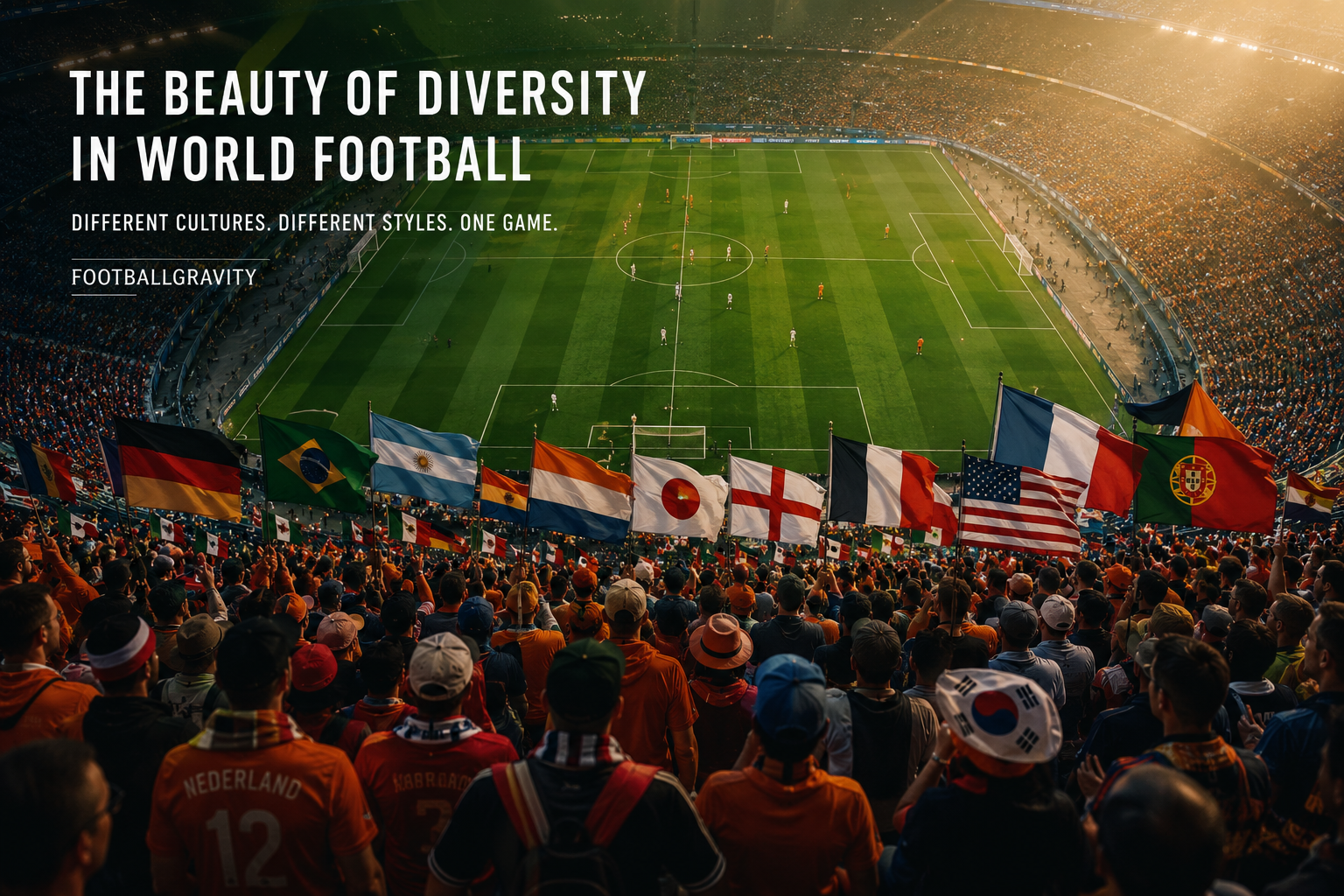
Football Beyond Tactics: Why the World Cup Feels Different in Every Country

The World Cup is not only a tournament of football.It is a collision of histories, personalities, aesthetics, and national identities.


Every World Cup feels familiar.

And yet, every World Cup feels completely different.

Different rhythms.
Different emotions.
Different atmospheres.

Some teams appear calm and structured. Others feel chaotic, improvisational, emotional, or explosive.

Supporters sing differently. Players celebrate differently. Even the movement of teams across the pitch often reflects deeper cultural tendencies.

The World Cup is not only a tournament between nations.

It is a meeting point between different ways of seeing the world.

And perhaps that diversity is one reason football continues to feel uniquely global.


Football as Cultural Expression

Football is often discussed through tactics and results.

But international football has always carried something larger than sport.

National teams become temporary expressions of identity.

Not in a simplistic sense, but through atmosphere, style, rhythm, emotional behavior, and collective psychology.

Some countries value structure and discipline. Others celebrate improvisation and individuality. Some emphasize collective synchronization. Others rely on moments of genius.

Of course, modern football is increasingly globalized. Players train abroad. Coaches move internationally. Tactical systems spread rapidly.

Yet even today, traces of cultural personality still remain visible.

And supporters around the world continue to recognize them intuitively.


Germany: Precision, Physicality, and Resilience

Few football cultures carry a stronger historical identity than Germany.

German football has long been associated with structure, physical strength, tactical organization, and psychological resilience.

Even during difficult matches, German teams often appear emotionally stable. They continue pressing forward with discipline and intensity.

For decades, international football has attached almost mythological language to Germany:

“German efficiency.”
“The machine.”
“Never give up.”

These stereotypes are sometimes exaggerated, yet they emerged for a reason.

Germany repeatedly built teams capable of combining athletic power with strategic control.

From Franz Beckenbauer — “Der Kaiser” — to modern high-intensity pressing systems, German football often projects authority through organization.

Physically, German teams have also historically embodied a recognizable image:

high stamina,
strong duels,
powerful running,
and aerial dominance.

But perhaps the defining characteristic is mental.

Germany often appears most dangerous when matches become psychologically difficult.

Because resilience itself has become part of the football identity.


The Netherlands: Innovation, Individuality, and Beautiful Risk

If Germany represents structure, the Netherlands often represents imagination.

Dutch football has consistently produced ideas that changed the sport globally.

Total Football.
Positional fluidity.
The offside trap.
Technical spatial play.

For a relatively small country, the Netherlands has had an extraordinary tactical influence on world football.

And perhaps that influence reflects something broader within Dutch culture itself:

openness,
experimentation,
and a willingness to challenge convention.

The visual identity is equally distinctive.

Orange crowds.
Minimalist aesthetics.
Tall silhouettes moving fluidly across space.

Dutch football often feels stylish even before kickoff.

At the same time, Dutch football history is filled with strong personalities.

Johan Cruyff.
Marco van Basten.
Dennis Bergkamp.
Arjen Robben.

Many of these players possessed not only technical brilliance, but highly individual ways of interpreting the game.

Dutch teams can appear intellectually creative and emotionally fragile at the same time.

Moments of beauty coexist with moments of internal tension.

And perhaps that contradiction is part of what makes Dutch football endlessly fascinating.

The multicultural influence of migration — including players with Surinamese roots — has also shaped modern Dutch football identity in profound ways.

Technique, athleticism, rhythm, and creativity merged into something globally recognizable, yet difficult to replicate.


Why Difference Creates Beauty

Modern football is becoming increasingly interconnected.

Tactical ideas spread instantly online. Elite players move constantly between leagues. Training methods become standardized.

Yet during the World Cup, national differences still feel visible.

Not perfectly.
Not scientifically.
But emotionally.

And that emotional contrast matters.

Because football becomes more compelling when styles collide.

Control versus improvisation.
Structure versus freedom.
Collective discipline versus individual genius.

The World Cup is powerful not because every team is the same.

But because every team carries different histories, climates, social structures, and emotional cultures into the same tournament.

Football transforms those invisible differences into something visible on the pitch.


Perhaps the World Cup is ultimately a celebration of human diversity.

Different languages.
Different movements.
Different ideas of beauty.

And for a few weeks, those differences gather inside the same stadiums.

That is why the tournament feels larger than sport.

It becomes a global conversation played through atmosphere, identity, and movement.

And maybe that is the deepest gravity of football:

it allows the world to remain different — while still sharing the same game.

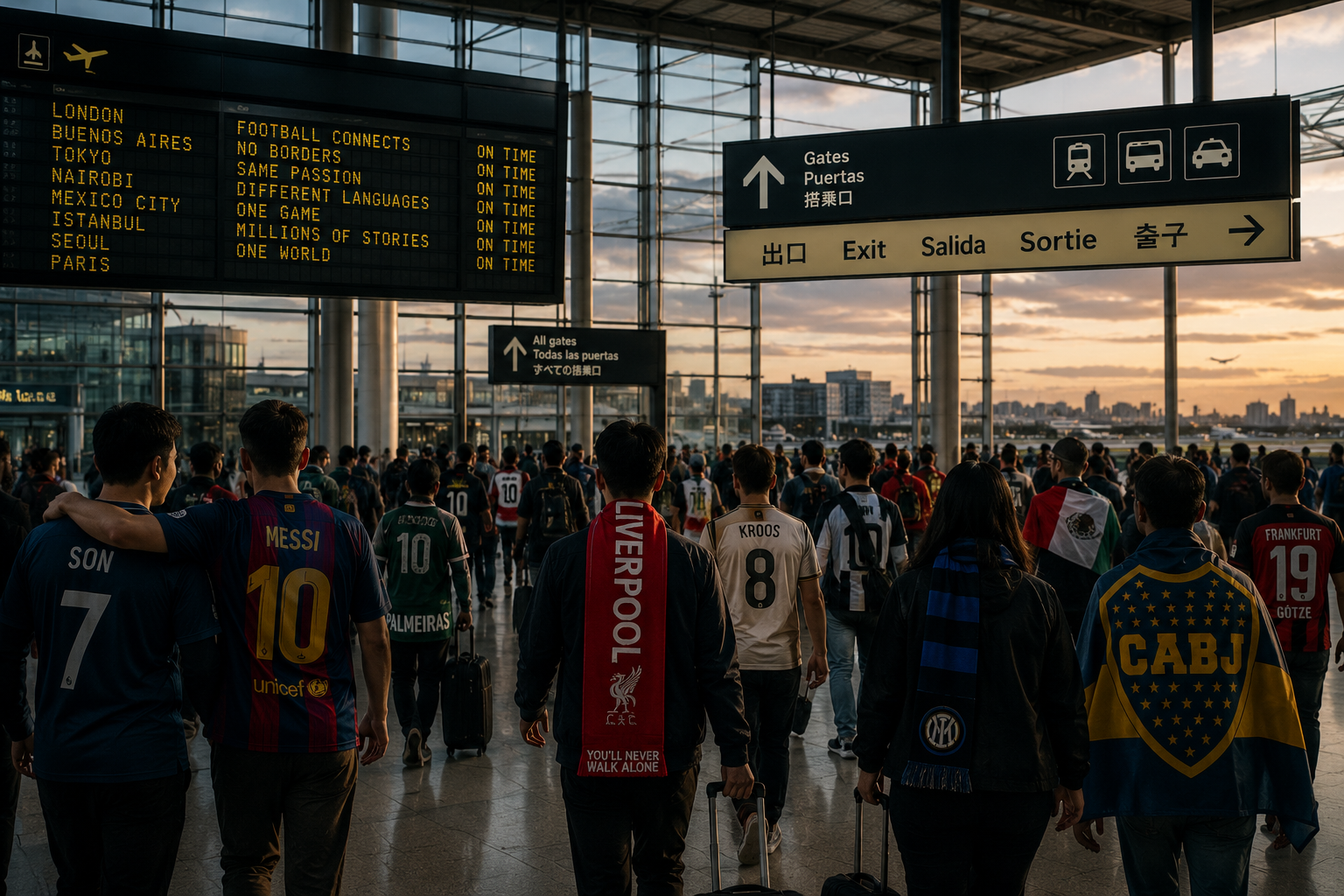
Football Beyond Borders

Why football continues to create connection across languages, cultures, and identities.

In many parts of the world, football begins long before kickoff.

It begins at airports.

At train stations. In crowded city centers. In conversations between strangers wearing different colors and speaking different languages.

A scarf from Buenos Aires appears in Tokyo. A supporter from Seoul shares a table with fans from Amsterdam. A child in Nairobi wears the shirt of a club thousands of kilometers away.

Football moves constantly across borders.

Not only through players and clubs, but through people, memory, migration, media, and emotion.

And perhaps that global movement is one reason the sport continues to feel uniquely powerful in an increasingly fragmented world.

A Shared Language Without Translation

Football is one of the few cultural experiences that can be understood almost immediately across languages.

A celebration. A collective gasp. A last-minute goal.

Even without translation, people recognize the emotional structure of the game.

This does not erase cultural differences. In fact, football often amplifies them through chants, traditions, styles of support, and local identity.

But at the same time, football creates temporary spaces where strangers can still participate in something shared.

That balance between difference and connection may be one of football’s most remarkable qualities.

Migration, Identity, and Football

Modern football has always been shaped by movement.

Players move between continents. Families migrate across borders. Supporters carry club identities far from their places of origin.

Many of today’s teams reflect multiple histories simultaneously.

A single squad may contain players with different languages, religions, and cultural backgrounds — all operating within the same collective structure.

Football does not remove complexity.

But it often provides a visible example of cooperation across identity.

And in many cities, football clubs become important cultural anchors for migrant communities and second-generation families navigating questions of belonging.

Clubs as Global Cultural Networks

Today, football clubs exist simultaneously in physical and digital space.

A supporter in Jakarta may wake up at 3 a.m. to watch a match in London. Fans in Mexico City discuss the same moment as supporters in Berlin or Lagos within seconds online.

Football communities increasingly operate like global networks connected through media, algorithms, and shared emotional investment.

Yet despite this digital expansion, football remains deeply physical.

People still travel across countries and continents to experience atmosphere directly — to hear chants in person, walk through stadium districts, and become temporarily part of a crowd.

In an era dominated by screens, that physicality still matters.

Why Football Still Creates Belonging

Many modern societies are experiencing increasing fragmentation.

People move more frequently. Communities become less stable. Public trust declines. Daily life becomes more individualized.

Football does not solve these problems.

But it continues to create recurring moments of collective presence.

People gather regularly in the same places. They wear shared symbols. They experience synchronized emotion with thousands of others.

Perhaps this explains why football remains emotionally resilient even as media environments rapidly change.

Because beneath the business, spectacle, and commercialization, football still satisfies something fundamentally human:

the desire to belong to something larger than ourselves.

Football crosses borders because people do.

The sport travels through migration, memory, media, and movement.

And wherever it arrives, football creates new local meanings while still remaining globally recognizable.

That tension between local identity and worldwide connection may be what makes football more than a game.

It becomes a shared human language — spoken differently in every city, but understood almost everywhere.