
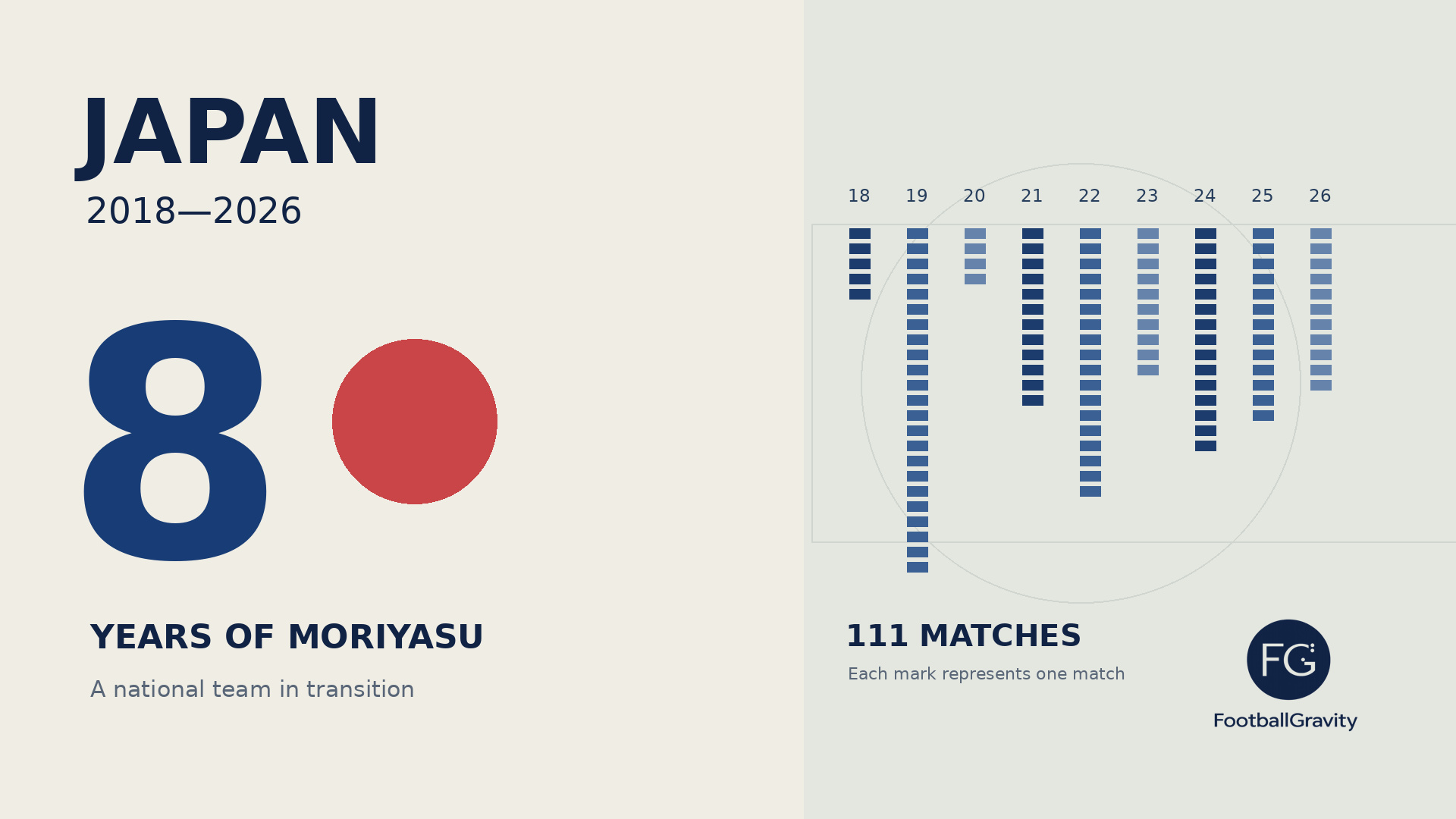
Across 111 matches, Japan's playing-time records reveal a broad pool of opportunity and a substantial change in the players carrying the team.
Eight years is a long time for a national team to live under one coach. The name on the touchline can become familiar enough to make the team itself seem continuous. The players' minutes tell a more complicated story.
FootballGravity has compiled Japan's official match records from Hajime Moriyasu's first game, against Costa Rica on 11 September 2018, through the New Zealand match on 5 October 2026. The dataset covers 111 played senior internationals. It offers a way to look beyond individual tournament results: who received opportunities, who became a regular presence, and where the team's workload moved.
The clearest finding is the change in Japan's core. Only three players appear in the ten highest playing-time totals in both the 2018–2022 and 2023–October 2026 periods: Wataru Endo, Junya Ito and Ritsu Doan.
That does not settle the question of whether every transition worked. It does establish that a long-serving coach presided over a team whose principal players changed considerably.
The players carrying the minutes
For this comparison, the first period runs through the end of 2022; the second begins in 2023. There are 62 matches in the first and 49 in the second. The table compares the leaders within each period, rather than treating a longer period's larger totals as evidence of greater importance.
| Rank | 2018–2022 | Minutes | 2023–5 October 2026 | Minutes |
|---|---|---|---|---|
| 1 | Maya Yoshida | 3,240 | Zion Suzuki | 2,648 |
| 2 | Shuichi Gonda | 3,135 | Ritsu Doan | 2,332 |
| 3 | Takumi Minamino | 2,919 | Ko Itakura | 2,278 |
| 4 | Wataru Endo | 2,750 | Ayase Ueda | 2,190 |
| 5 | Gaku Shibasaki | 2,699 | Hiroki Ito | 2,052 |
| 6 | Takehiro Tomiyasu | 2,688 | Wataru Endo | 2,020 |
| 7 | Yuto Nagatomo | 2,514 | Takefusa Kubo | 1,866 |
| 8 | Junya Ito | 2,350 | Junya Ito | 1,829 |
| 9 | Hiroki Sakai | 2,030 | Daichi Kamada | 1,805 |
| 10 | Ritsu Doan | 1,933 | Keito Nakamura | 1,750 |
Yoshida and Gonda head the first period. Suzuki and Itakura figure prominently in the second, while Ueda moves into the top five. The change reaches across the goalkeeper, defensive and attacking positions.
Doan is a particularly useful point of continuity. He ranks tenth in the first period, with 1,933 minutes, and second in the next, with 2,332. Remaining in the team and taking on a greater share of its work can happen together. Endo and Junya Ito provide other connections between the periods.
The ranking records a change in workload. Injuries, availability, competition formats and the composition of each squad also affect that workload. The figures cannot isolate how much of the change came from a deliberate succession plan. They do show where continuity was preserved while the surrounding team was renewed.
A wide door, followed by repeated choices
Across the full dataset, 154 different players appeared. That is a count of players who took the field, rather than a total of everyone called up. Of those 154, 31 made one appearance and 71 made between one and three.
Almost half of the playing pool therefore sits at the shorter end of the appearance distribution. A national team can offer many players a first look while concentrating its repeated selections around a much smaller group.
Those short stays need care in interpretation. A player with one appearance may have been an experimental selection, may have faced limited availability, or may have entered the team close to this dataset's cutoff. The count does not provide a failure rate for scouting or selection.
Tournament context matters too. The dataset includes nine matches from the EAFF E-1 championships. Japan used 128 different players in matches outside those tournaments. Separating the two gives a clearer picture of the breadth of the playing pool without treating every selection environment as equivalent.
For Japan, whose player pathways connect domestic clubs with teams abroad, these records make the point at which a player receives an opportunity visible. Understanding what happens next requires attention to both representative football and the player's club career. An international appearance alone cannot tell us whether a career has progressed.
Different ways to remain important
The cumulative leaders also show why appearances and minutes should be read together.
| Player | Appearances | Starts | Minutes |
|---|---|---|---|
| Wataru Endo | 61 | 54 | 4,770 |
| Takumi Minamino | 71 | 53 | 4,367 |
| Ritsu Doan | 73 | 50 | 4,265 |
| Junya Ito | 74 | 42 | 4,179 |
| Takehiro Tomiyasu | 46 | 40 | 3,662 |
| Ko Itakura | 44 | 40 | 3,527 |
| Daichi Kamada | 57 | 39 | 3,353 |
| Maya Yoshida | 41 | 38 | 3,254 |
| Shuichi Gonda | 35 | 35 | 3,135 |
| Hidemasa Morita | 40 | 33 | 2,861 |
Endo leads the minutes. Junya Ito leads the appearances, but started 42 of his 74 games. Tomiyasu's smaller appearance total includes 40 starts in 46 matches.
These are different forms of presence: accumulated time, frequent involvement, and a high proportion of starts when taking the field. A single league table of appearances would compress those differences.
Goals offer another view. Minamino leads this period with 26, followed by Ueda on 22, Yuya Osako on 17 and Junya Ito on 16. The overlap with the playing-time leaders shows that some of the most persistent contributors also carried a substantial scoring workload. It does not make total goals a complete measure of attacking quality: penalties, minutes and the matches in which those goals arrived still matter.
What a long tenure leaves visible
Moriyasu's eight years can be examined through the distribution of opportunity as well as the results. The records show a large number of players entering the team, a smaller group returning repeatedly, and a marked shift in the players receiving the most time across two World Cup cycles.
With the Asian Cup still ahead, this is an interim account of that work. It gives credit to continuity without making continuity itself a verdict. Endo, Junya Ito and Doan connect the two periods; the seven other places in each period's top ten show how much changed around them.
For a national team, maintaining a recognisable identity while changing the people responsible for it is part of the job. Japan's minutes provide a concrete record of that process—one that can be revisited as the next group takes on more of the team's work.
Data and sources
FootballGravity's calculations use the Japan Football Association's annual results and official match records, covering 11 September 2018–5 October 2026. The 2021 match against Japan's under-24 team and the unplayed March 2024 fixture against DPR Korea are excluded. E-1 games are included unless stated otherwise. Minutes use nominal substitution times, excluding added time but including extra time; penalty-shootout goals are excluded. The two periods contain different numbers of matches. These figures describe participation and workload, and do not establish a coaching effect on player development.