
Part two of Between Club and Country, a FootballGravity series examining what happens when the international calendar changes shape.
In Porto, the most revealing number was not on the scoreboard. It was 67.
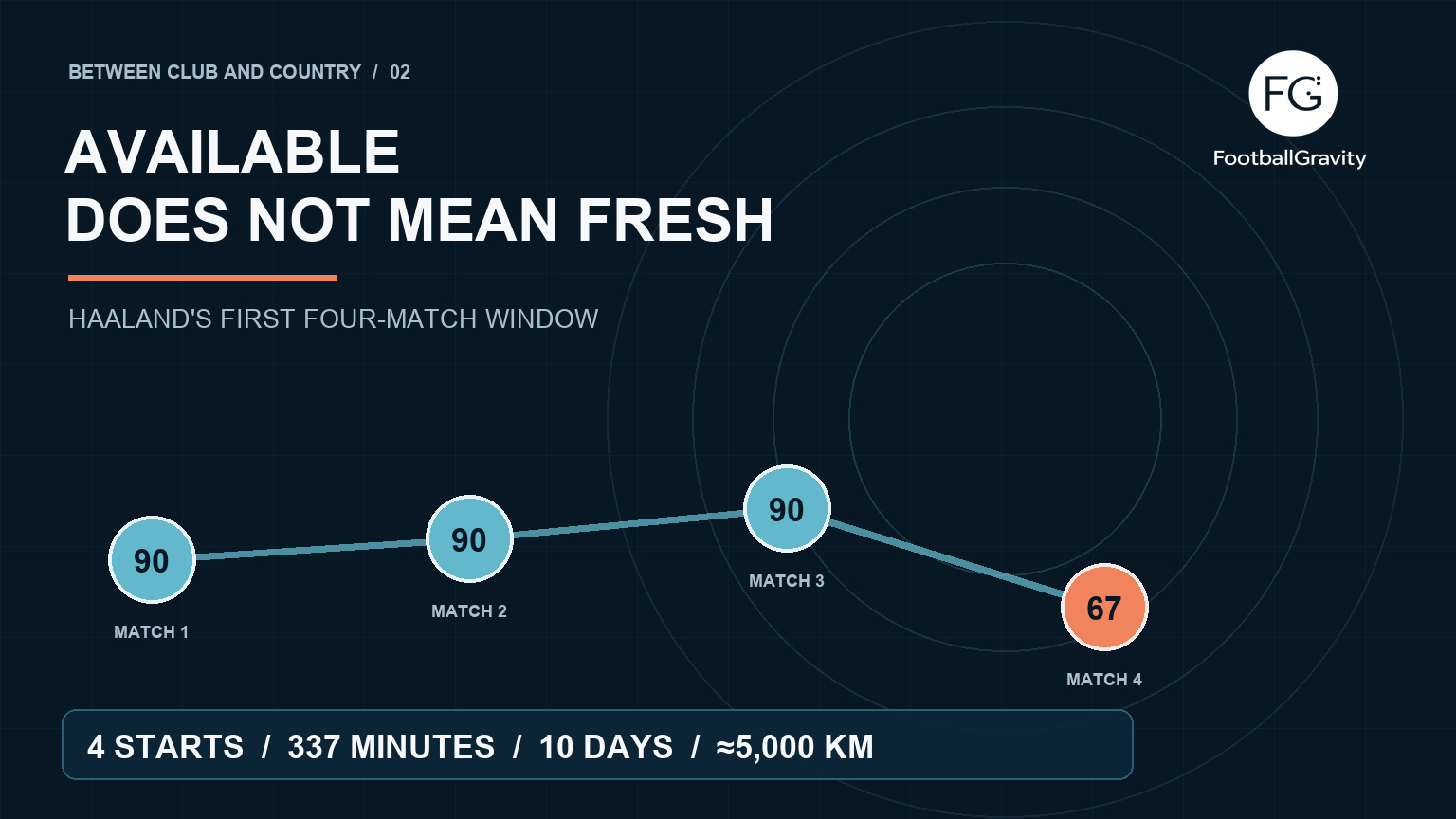
That was the minute Erling Haaland left Norway’s 2–1 defeat by Portugal on 4 October. He had started all four of Norway’s matches in the new extended international window. Before the last one, coach Ståle Solbakken and Haaland had discussed a target of roughly an hour. Haaland then asked to come off, and Solbakken said he was “thoroughly spent”.
No injury was announced. That distinction matters. Public discussions of player load often wait for an absence, a diagnosis or a damaged muscle. Porto offered a different kind of observation: a player remained available, started the match and still reached a point at which his minutes had to be managed.
This is not evidence that the new calendar caused Haaland’s fatigue, and it is not a medical assessment. It is something narrower: an unusually clear, public load-management signal at the end of the first 16-day, four-match international period.
Four starts, 337 minutes, one continuous camp
| Date | Match | City | Haaland minutes | Full days before next match |
|---|---|---|---|---|
| 24 Sep | Norway 3–2 Denmark | Oslo | 90 | 2 |
| 27 Sep | Norway 1–2 Portugal | Oslo | 90 | 3 |
| 1 Oct | Wales 2–1 Norway | Cardiff | 90 | 2 |
| 4 Oct | Portugal 2–1 Norway | Porto | 67 | — |
The four matches were played across 11 calendar dates, with ten elapsed days from the first kick-off to the last. Haaland completed 337 of the possible 360 regulation minutes. He also scored three goals, twice against Denmark and once in the first Portugal match.
The recovery pattern was 72 hours, 96 hours and 72 hours between kick-offs. Counting only complete calendar dates between games, Norway had two, then three, then two full days. Those days were not necessarily rest days. The Norwegian federation’s published programme included recovery, training, media activity and travel from Oslo to Cardiff and then Porto.
Using the same city-centre method as the first article in this series, Haaland’s modelled route is Manchester → Oslo → Cardiff → Porto → Manchester: about 5,000 km. It involves one club-to-country cycle and no intercontinental crossing. The sum of absolute time-zone changes is only two hours.
That is precisely why this case is useful. The travel geography is relatively modest beside the long-haul routes in our ten-player model. The match exposure is not. A shorter route can still contain four starts and a long uninterrupted period away from the club environment.
The load did not begin with Norway–Denmark
The international window was one section of a longer sequence. Norway played six matches at the 2026 World Cup and reached the quarter-finals, where its tournament ended against England on 11 July. The new Premier League season began for Manchester City in late August. By the international break, Haaland had played 90 minutes in each of City’s first five league matches.
Norway’s run therefore did not start from a clean seasonal reset. Solbakken described some of his players as having received only six or seven days of holiday after the summer, without saying that this exact number applied to Haaland. The Norwegian players’ union NISO said Haaland had entered the English season without a normal preparation period after Norway’s World Cup.
This wider sequence prevents a simple conclusion. The four-match window may concentrate national-team exposure, but the observed fatigue cannot be assigned to those four games alone. World Cup minutes, club minutes, training, travel, sleep, individual physiology and mental demand all sit inside the same accumulated load.
Availability is a poor yes-or-no measure
An injury register asks whether a player sustained a reportable health problem or lost time. That is essential information, but it does not capture every stage between full freshness and absence.
Sports-medicine consensus work treats load more broadly, distinguishing the work performed from the individual’s response to it. Match minutes and travel are forms of external exposure. Fatigue, soreness, sleep, perceived effort and readiness are part of the internal response. Two players can complete the same schedule and experience it differently.
| Layer | What public data can show here | What remains private or unknown |
|---|---|---|
| Exposure | Four starts; 337 minutes; match spacing; modelled route | Training load; sprint distance; accelerations; collisions |
| Response | Player asked to come off; coach described him as spent | Wellness scores; sleep; soreness; perceived exertion |
| Medical outcome | No injury was announced at the research cutoff | Clinical findings; later symptoms; future injury risk |
| Availability | Started all four Norway matches | Readiness for the next club match |
Calling the Porto substitution “functional fatigue” can be useful as editorial shorthand, but it should not be mistaken for a validated diagnosis or a new binary statistic. A better description is a fatigue-signalled substitution: a visible management decision supported by the player’s request and the coach’s explanation.
If analysis counts only injuries, it misses that signal. If it labels every early substitution as fatigue, it invents information. The useful middle ground is to record observable events—planned minute limits, requests to come off, rest from training, omitted starts and delayed club returns—while stating exactly who explained them and what is still unknown.
NISO’s question is about the brake, not only the speed
NISO’s response moved the discussion beyond one striker. The union called for clearer workload and recovery rules covering time between matches, continuous rest periods, travel strain and recovery after a long season. Its central concern was that protection should not depend on a player being the person who finally says stop.
That position is consistent with a 2025 FIFPRO consensus exercise involving 70 medical and performance experts. Its 12 proposed safeguards included a four-week off-season, at least two completely commitment-free weeks, a four-week retraining period before competition and explicit consideration of travel burden.
These are proposals from player representatives and independent specialists, not the current rules of every competition. They also do not turn one substitution into proof that a calendar design has failed. They do identify the governance question exposed in Porto: where should collective safeguards sit when a player’s competitive instinct is to remain available?
What this case changes—and what it does not
Our first window analysis found a consistent structural benefit: replacing two separate September and October periods with one integrated window removes a club-to-country round trip. Haaland’s case does not reverse that result. It adds another dimension.
Fewer transitions can coexist with concentrated match exposure. Lower travel distance can coexist with fatigue. Continued availability can coexist with reduced freshness. Those are not contradictions; they are different measurements.
A single case cannot tell us whether players were more or less fatigued under the old two-window structure. It cannot establish injury risk, and it cannot show that Haaland would have felt fresher under a different schedule. A matched comparison would need completed minutes, recovery intervals, travel, off-season length, club return and later health outcomes across a much larger group.
It can, however, improve what that future dataset looks for. Injury should remain an outcome, but not the only one. The moments before absence—the conversation about a minute limit, the player asking to leave, the coach changing the plan—belong in the record too.
Manchester City are scheduled to visit Liverpool on 11 October, seven calendar dates after the Portugal match. Whether Haaland trains, starts or plays is a follow-up observation, not a conclusion available today. The responsible approach is to record it when it happens.
Method note: National-team minutes and substitutions come from official NFF match records. “Full days” counts calendar dates strictly between matches. The route uses standardised city-centre coordinates and the haversine formula: Manchester → Oslo → Cardiff → Porto → Manchester, summed before rounding to the nearest 100 km. Time-zone shift is the sum of absolute UTC-offset changes on each leg at local noon, including daylight-saving time. It is a comparison proxy, not a measurement of jet lag. No airport, flight, hotel, training-base or personal movement is inferred. Research cutoff: 6 October 2026, 15:00 JST.