Arsenal and the Work of Continuity

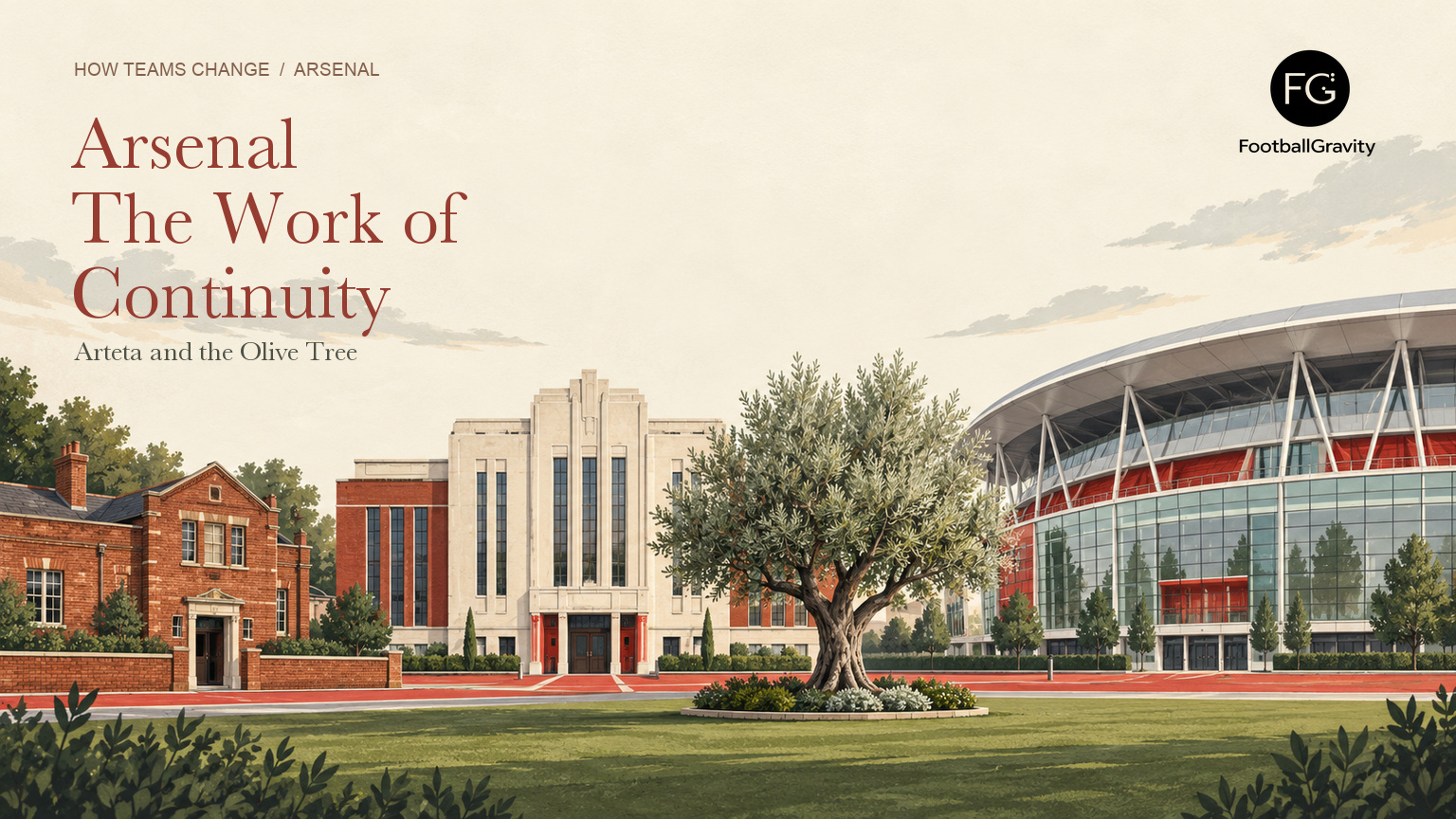
Conceptual illustration showing an early red-brick pavilion, a white Art Deco stadium facade and a modern curved stadium from left to right, with an olive tree in the foreground and Arsenal and the Work of Continuity typography.

An old olive tree at the training ground offers a way into a larger question: how does a club give change enough time to take root?

The opening Arsenal study in FootballGravity’s How Teams Change series, examining the relationship between managerial trust, squad renewal and the care of a club’s identity.

At Arsenal’s training ground, Mikel Arteta placed an old olive tree between his office and the pitches. In a 2023 interview with GQ, it was described as around 150 years old: something the manager could see each day and the players would pass on their way to work.

An ancient tree is an appealing emblem for a football club. It suggests survival, deep roots and a life extending beyond any individual season. Arteta’s explanation, however, placed the emphasis on responsibility. Speaking in May 2023, he said its roots needed daily care and protection from damage. The age of the tree made that work more meaningful; it did not make the work unnecessary.

Arsenal’s decision to extend his contract until June 2030, following the 2025/26 Premier League title, gives the image a fresh context. A manager appointed in December 2019 has been offered the possibility of leading the club for more than a decade. A contract cannot guarantee that future. It can give the people building it a clearer horizon.

The more revealing episode came before the league championship. In 2022, Arsenal committed to Arteta when the immediate evidence was uncomfortable. That decision, together with the changes he made inside the club, helps explain what continuity can involve: time granted to a direction, and permission to alter the people and practices carrying it.

Trust during a losing run

In April 2022, Arsenal lost successive league matches to Crystal Palace, Brighton and Southampton. Arteta later said the club offered him his new contract after those defeats. “The club offered me the contract when we lost three matches,” he told reporters. By the announcement on 6 May, Arsenal had won their next three games, but the offer, in his account, preceded that recovery. The contemporary report preserves that distinction.

The sequence matters. Renewing a successful coach can simply confirm what the league table already says. Renewing one during a damaging run requires a view of his work that reaches beyond the most recent results. Arsenal’s owners were accepting the risk that their judgement might be wrong.

From outside, that judgement cannot be reconstructed in full. Yet the decision itself had practical value. Players considering their futures, coaches planning their work and those recruiting for the next season could act with greater confidence about who would lead the team. Stability changes the conditions in which decisions are made.

This is a useful distinction when discussing patience. Waiting can be passive. Extending a contract commits a club to a particular course and gives others reason to commit alongside it. It also raises the responsibility of those making the decision: they must keep examining whether the work justifies the time they have provided.

Understanding the people around the team

Arteta’s own account of changing Arsenal’s culture begins with listening. In a December 2024 press conference, he described employing a specialist to ask players and staff across different roles how it felt to work at the club. Their responses, he said, clarified the need for change. He wanted to move beyond his own impression of the environment.

The account gives the olive tree a more substantial setting. A symbol can make an idea memorable, but understanding a workplace requires attention to the experiences of the people within it. A manager who asks about relationships, communication and responsibility is looking at conditions that a match report rarely captures.

That exercise was Arteta’s description of his approach, rather than an independent measure of its effectiveness. Still, it suggests a useful way of assessing the cultural work of a coach. Can he identify problems beyond the starting XI? Can the people around the team understand their contribution? Do daily decisions reinforce the standards he asks others to follow?

These questions become especially relevant during a long tenure. Familiarity can help colleagues communicate more easily. It can also allow grievances or ineffective routines to settle into the background. Keeping a manager provides an opportunity to accumulate knowledge of the organisation; continuing to listen determines whether that knowledge stays useful.

Wenger and the different uses of time

Arsenal had already lived through another long managerial relationship. Looking back in his final press briefing in 2018, Arsène Wenger said he had accepted more limited resources during the stadium project and had chosen to remain through that challenge. He described debt repayment alongside competition from clubs with greater outside resources.

The club’s 2016/17 annual report recorded the end of 19 consecutive seasons in the Champions League and, in the same report, Wenger’s reappointment for another two years. European continuity had been a substantial achievement. Its interruption also exposed the difficulty of deciding when a trusted relationship should change.

Wenger’s era should not be compressed into a story of thrift. The stadium years had particular constraints, and his time at Arsenal encompassed different sporting and financial circumstances. His longevity likewise offers no automatic proof that every extension was the right decision. A club can value a manager’s contribution while still debating whether the next phase requires another person.

Arteta’s reconstruction has received a different kind of support. Arsenal’s accounts for the year ended 31 May 2024 recorded £255.7 million in additions to player registrations and stated that KSE UK provided funding for transfers and working capital. That accounting figure is distinct from cash paid in a single transfer window. It establishes that trust in the sporting project was accompanied by substantial resources.

The comparison makes Arsenal more interesting than a simple tale of a patient club. Time helped Wenger manage a period of financial constraint. Time and investment gave Arteta room to remake the team. Continuity has depended on what the club enabled its manager to do.

A club can keep its direction while changing its people

There are limits to any claim about Arsenal’s inherent patience. Unai Emery, appointed after Wenger in 2018, was dismissed in November 2019 after seven matches without a win. The club has been capable of ending a managerial project quickly. The different treatment of Emery and Arteta makes the criteria for trust more interesting than a general label of loyalty.

Arteta’s tenure has also included sharp changes of personnel. In May 2023, Arsenal renewed Aaron Ramsdale’s contract. That August, David Raya arrived on loan; in July 2024, Arsenal made his transfer permanent, following a season in which he made 32 Premier League appearances. Within a continuing managerial project, the goalkeeper position had changed.

Such decisions carry a human cost. A player who has helped a team improve may reasonably expect to remain central to it. The demands of the next team can lead the manager elsewhere. Claims about a shared culture therefore have to be judged alongside the way a club handles people whose roles diminish, as well as those whose careers advance.

For How Teams Change, Arsenal brings the question of succession inside the tenure of one coach. Barcelona and Manchester City invite us to examine how a team finds new configurations. Arsenal also asks how a club creates the conditions for that work to continue through disappointment, and how it distinguishes persistence from drift.

The 2030 contract extends Arteta’s opportunity to shape those conditions. It leaves a further question open: how much of the understanding being built around him will eventually belong to the club itself? That will depend on the people who carry standards into new roles, the decisions made under pressure and the ways newcomers learn what is expected of them.

An olive tree can remain beside the pitches for years. The responsibility represented by it has to pass from one group of people to the next.
Milan, Between Eras: When Greatness Still Had a Successor

An abstract editorial illustration in charcoal, oxblood red and ivory, with arches and a luminous thread representing AC Milan passing knowledge between football eras.

Part one of Milan, Between Eras, a club study in FootballGravity’s How Teams Change series, examining how AC Milan once renewed great teams without severing the knowledge that made them great.

AC Milan’s summer of 2012 is easy to remember as a sale. Thiago Silva and Zlatan Ibrahimović went to Paris Saint-Germain within days of one another. The image is clean, dramatic and financially legible: a world-class defender and Serie A’s leading scorer leaving the same club for the same destination.

The deeper rupture had begun before either transfer was completed. On 13 May, Milan beat Novara in the final game of the league season. Gennaro Gattuso, Filippo Inzaghi, Alessandro Nesta, Clarence Seedorf, Gianluca Zambrotta and Mark van Bommel all made their last Milan appearances. Inzaghi scored the winner from a Seedorf pass. It was an almost excessively perfect farewell scene, followed two months later by the departure of the team’s best defender and most decisive forward.

What Milan lost that summer was larger than a list of names. For more than two decades, the club had been unusually good at making greatness overlap. One generation did not disappear before the next one learned how Milan worked. Players, coaches and habits crossed the boundary together. The question raised by 2012 is therefore not simply why so much quality left. It is why the next Milan had so little time beside the previous one.

The first inheritance was a way of playing

Arrigo Sacchi’s Milan is often recalled through the Dutch trio, and reasonably so. Ruud Gullit and Marco van Basten arrived in 1987; Frank Rijkaard followed a year later. Yet the team that beat Steaua București 4–0 in the 1989 European Cup final was built from two kinds of knowledge. The Dutchmen gave Milan force, technique and a new international horizon. Franco Baresi, Paolo Maldini, Mauro Tassotti and Alessandro Costacurta gave the defence an Italian spine that already understood the club.

Sacchi’s real inheritance was collective. Milan compressed the pitch, defended forward and asked gifted players to submit their movement to a shared geometry. The club’s official history calls the game itself an “extra man”. The phrase matters because it explains how the team survived individual change. A star could leave, decline or be unavailable; a method could be taught.

Fabio Capello inherited much of that platform and altered its emphasis. His Milan were more pragmatic and, over time, less dependent on the Dutch attack. The 1993/94 season provides the sharpest evidence. Gullit and Rijkaard had left, Van Basten’s ankle had effectively ended his career, and Baresi and Costacurta were suspended for the Champions League final. Milan still beat Johan Cruyff’s Barcelona 4–0, with Filippo Galli and Christian Panucci entering a defensive structure that remained recognisable.

This was renewal without theatrical reinvention. Capello added Marcel Desailly, Zvonimir Boban and Dejan Savićević, while Maldini, Tassotti, Baresi, Costacurta, Roberto Donadoni and Demetrio Albertini carried standards between teams. Four Scudetti in five seasons, three consecutive European finals and a 58-match unbeaten league run were produced by continuity that still allowed difference.

Ancelotti rebuilt the centre of the team

Carlo Ancelotti’s Milan did not recreate Sacchi’s football. It recreated the club’s ability to assemble exceptional players around a coherent idea. The connection to the old Milan was personal as well as tactical: Ancelotti had played in Sacchi’s midfield; Maldini and Costacurta remained in the squad; Massimo Ambrosini had arrived in 1995. Around them, Milan built a new centre.

Andrea Pirlo came in 2001 and was moved away from his earlier attacking-midfield position to become the deep playmaker. Seedorf joined from Inter in 2002. Nesta arrived at the end of the same window, adding a defender able to protect space and begin possession. Rui Costa, Gattuso, Inzaghi and Andriy Shevchenko supplied different forms of invention, resistance and finishing. Kaká arrived in 2003 and immediately accelerated the team without making it abandon the ball.

The familiar team sheet can obscure how unusual the construction was. Pirlo, Seedorf, Rui Costa and Kaká were all players who wanted to interpret the game rather than merely occupy a lane. Ancelotti found roles that allowed their intelligence to coexist. Gattuso and Ambrosini gave the midfield its recoveries and duels; Maldini and Nesta provided authority behind it; Inzaghi and Shevchenko converted its control into depth and goals.

European championWhat remainedWhat changedKnowledge carrier
1988/89Baresi and an emerging MaldiniThe Dutch trio inside Sacchi’s collective gameBaresi
1993/94The defensive culture and senior coreCapello’s control; Desailly, Boban and SavićevićMaldini
2002/03Maldini, Costacurta and the memory of earlier winnersPirlo’s deeper role; Seedorf, Nesta and a new technical midfieldMaldini and Ancelotti
2006/07Seven starters from the 2003 finalKaká as the central accelerator; a narrower Christmas-tree shapeMaldini, Seedorf and the midfield core

The “knowledge carrier” column is FootballGravity’s editorial interpretation: it identifies people who connected successful sides through long service or lived experience, rather than assigning formal responsibility for club culture.

Athens was another version, not a reunion

Seven of Milan’s starters in the 2007 Champions League final had also started the 2003 final: Dida, Nesta, Maldini, Gattuso, Pirlo, Seedorf and Inzaghi. That figure sounds like preservation. The football says something more subtle.

Kaká had become the team’s vertical force and the competition’s leading scorer. Seedorf played higher, close enough to combine with him. Ambrosini added an extra midfielder, while Inzaghi occupied the centre-backs alone. The 4-3-2-1 of Athens distributed responsibility differently from the 4-3-1-2 that had started at Old Trafford four years earlier. Familiar players had changed jobs as the team aged and its most dangerous talent changed.

This may be the most useful definition of Milan’s old succession strength. The club did not always find a direct replacement. It found a new arrangement before the old one had entirely vanished. Kaká learned inside a team still led by Maldini. Pirlo’s new position was protected by midfielders who understood its risks. Nesta joined a defensive tradition while one of its defining figures was still beside him.

The last bridge still carried a title

The 2010/11 Scudetto can look like a late encore from the Berlusconi era. It was also a credible act of transition. Allegri kept Nesta, Gattuso, Seedorf, Ambrosini and Pirlo around a newer core. Thiago Silva had become the defence’s future. Ibrahimović gave the attack a reference point. Kevin-Prince Boateng and Robinho added running and flexibility, while Mark van Bommel arrived in January and immediately helped stabilise midfield.

The title-winning team against Roma contained both sides of the bridge: Nesta next to Thiago Silva, Gattuso and Seedorf around van Bommel, Ibrahimović ahead of Boateng and Robinho. Milan finished on 82 points, six clear of Inter, and secured the title with two matches remaining. The old group had not prevented renewal. It had given the new group context.

A year later, Milan finished second and scored more than 100 goals in all competitions. Ibrahimović was Serie A’s leading scorer with 28 league goals. The team was still competitive. That is what makes the summer of 2012 historically awkward: Milan were not dismantling an exhausted side that had already stopped mattering.

One summer removed the team and its memory

Gattuso, Inzaghi, Nesta, Seedorf, Zambrotta and van Bommel left after the Novara match. Pirlo had gone to Juventus the previous summer. Then PSG signed Thiago Silva and Ibrahimović in July. The departures belonged to different categories—retirement, expiring contracts, sporting choices and major sales—and should not be flattened into one decision. Their combined effect was still extraordinary.

Milan lost experience from almost every zone of the pitch, two current reference points and much of the group that could explain what elite Milan looked like from inside the dressing room. Philippe Mexès, Antonio Nocerino, Boateng, Robinho, Alexandre Pato and Stephan El Shaarawy were not without quality. What they inherited was a thinner institution.

It would be too convenient to make that summer the single cause of everything that followed. Italian football’s revenues were changing relative to its European rivals. Milan’s ownership model, wage structure, recruitment and later corporate transitions each deserve their own examination. Even the reported fees for Ibrahimović and Thiago Silva tell only part of the financial story; transfer income can protect accounts without constructing a successor.

Still, 2012 remains the hinge because it interrupted Milan’s old timing. Sacchi’s team had passed defenders, leaders and a method to Capello. Maldini had carried that memory into Ancelotti’s European champions. The 2011 title side still placed new authority beside old authority. After the summer of 2012, the next Milan had to learn with fewer witnesses.

The question is succession, not nostalgia

Great names can make this history feel like a museum. That is the wrong lesson. Milan’s best teams were alive because they changed: Sacchi’s pressing became Capello’s control; Ancelotti moved Pirlo and built through a crowded, intelligent midfield; Allegri won with a more physical side organised around Ibrahimović and Thiago Silva.

The continuity was human. Someone remained who knew the level, while someone new arrived who could alter it. Milan’s first chapter therefore ends with a question that reaches beyond one club. When a successful team grows old, how much ability must be replaced—and how much memory must be kept long enough to teach the replacement?

The next article will examine the years after the hinge: how Milan spent, what kinds of players it pursued, and why buying talent did not immediately restore the chain that had once connected one great team to another.

Method note: The four-team table compares European Cup-winning line-ups from 1989, 1994, 2003 and 2007 using AC Milan’s official match records. “Knowledge carrier” is a qualitative measure based on overlap, longevity and role; it does not claim access to private dressing-room influence. Reported 2012 transfer fees are intentionally omitted from the body because the clubs announced the moves without disclosing a combined official fee.

Manchester City, Rewritten: The Many Peaks of Pep’s City

An AI-generated abstract editorial illustration of ten evolving vertical panels in Manchester sky blue and midnight navy, with a rising line and the title Manchester City, Rewritten.

Part one of Manchester City, Rewritten, a club study in FootballGravity’s How Teams Change series, examining how Pep Guardiola’s City changed its players, shape and leadership without losing the idea that held it together.

When Pep Guardiola’s Manchester City is recalled, the image usually arrives already framed: Rodri on the grass in Istanbul, a blue crowd behind him, the European Cup finally in the club’s hands. The Treble is an irresistible ending. It is also an incomplete way to remember the team.

Guardiola’s City did not spend a decade protecting one perfect side. It changed the goalkeeper’s function, rebuilt both full-back positions, replaced a century of striker instinct with a false nine, then brought in Erling Haaland and found a new way to occupy the middle of the pitch. Its captains changed. Its senior players changed. The principles were recognisable; the solutions rarely stood still.

That is why this series begins with a deliberately simple question: how many times did Guardiola complete Manchester City? The answer is not a ranking. It is a small correction to the instinct that treats 2022/23 as the only summit.

Five peaks, five different teams

City’s Premier League record is the clearest place to begin. Across Guardiola’s ten seasons, the club collected 865 league points with a goal difference of +576, winning six titles. The seven seasons from 2017/18 to 2023/24 averaged 91.1 points and produced six championships. That is not the shape of a single extraordinary year. It is sustained reinvention under the pressure of being expected to win again.

SeasonLeague recordWhat it achievedThe footballing answer
2017/18100 points
106–27, +79
Premier League and League CupWidth, pace and a relentless 3-2-5
2018/1998 points
95–23, +72
England’s domestic four-trophy sweepControl with greater tactical flexibility
2020/2186 points
83–32, +51
Premier League, League Cup and first Champions League finalFalse nine, patience and defensive rest control
2022/2389 points
94–33, +61
Premier League, FA Cup and Champions LeagueHaaland ahead of a Stones–Rodri box
2023/2491 points
96–34, +62
A fourth consecutive Premier League titleA bigger, more adaptable title-winning side

League points and goals are Premier League records. European stages are recorded by UEFA. The tactical descriptions are FootballGravity’s interpretation of the cited season reviews; formations describe tendencies in possession, not a fixed team-sheet.

The first complete answer was the 100-point team

The 2017/18 side remains the league’s purest statistical monument. One hundred points, 106 goals and a +79 goal difference were the outward evidence of a more profound change. Ederson made the goalkeeper an extra passing option. Kyle Walker gave the right side recovery speed and width. Kevin De Bruyne and David Silva could drift into the spaces behind the first press because Raheem Sterling and Leroy Sané stretched the pitch to its edges.

The shape was often described as 4-3-3, but the important picture came after possession had been secured: three behind the ball, two in front of them, five spread across the final line and half-spaces. It asked defenders to make decisions with the ball, wingers to run beyond it, and opponents to defend a pitch that suddenly felt too wide. This was the team that made Guardiola’s idea in Manchester look fully inhabited for the first time.

It was not, however, the team that won everything available in England. That came a year later.

The domestic four was a different kind of mastery

The 2018/19 title race with Liverpool ended at 98 points, not 100. De Bruyne missed much of the league season. Yet City also won the FA Cup, League Cup and Community Shield, becoming the first English men’s side to hold the four domestic honours in a single campaign. The achievement mattered because it asked for a different kind of depth: decisive cup nights, rotation without a loss of control, and a capacity to absorb absence.

Bernardo Silva moved closer to midfield. İlkay Gündoğan and David Silva offered different ways to govern a match. Sterling’s goals arrived from increasingly central positions. The football still had the sky-blue velocity of the previous season, but it had become less dependent on one route to the penalty area. Its distinction is not that it was somehow better than the Centurions. It solved a different problem, with less margin for error.

When control became quieter

The next transformation is easier to miss because it looked slower. Rodri’s arrival, Rúben Dias’s authority in defence and João Cancelo’s movement into midfield changed the geometry of City’s possession. During 2020/21, Guardiola often played without a conventional centre-forward. A false nine would drop away from the centre-backs; midfielders would arrive into the spaces he left; the ball would travel through the match with more patience.

The Premier League’s own tactical review measured a sharp fall in City’s direct speed from Guardiola’s first season to 2020/21, alongside a rise in the passes opponents were allowed before a defensive action. Those are imperfect measures, but they help name a visible shift. City had learned to make a match smaller: fewer uncontrolled transitions, fewer invitations to race, more time spent arranging the next attack. They won the league and reached their first Champions League final with a side that felt less like a sprint than a long possession of the room.

The Treble was a variant, not the destination

Haaland’s arrival in 2022 did not restore an old-fashioned City. It forced another solution. His presence offered a permanent threat between centre-backs, but it also removed one midfielder from the old false-nine picture. Guardiola’s answer was John Stones: nominally a centre-back, increasingly a second midfielder beside Rodri once City had the ball. The resulting 3-2-4-1 could protect against counterattacks while still feeding Haaland in the box.

UEFA’s technical observers named Stones to their 2022/23 Champions League Team of the Season and described the hybrid role he had made visible. Haaland finished the campaign with 57 big chances, more than twice the highest individual total among City’s previous Premier League title-winning seasons in the same comparison. The Treble side was overwhelming, but its greatness came from adaptation: a team associated with midfield abundance had created room for an exceptional finisher without surrendering its defensive balance.

Then came the fourth title in a row. City recorded 91 points and a +62 goal difference in 2023/24, becoming the first side in English top-flight history to win four consecutive league championships. The squad was changing again—larger defenders, new wide options, Julián Álvarez closer to Haaland at times—and still the standard held. If the Treble was the European peak, four in a row was perhaps the clearest proof of domestic durability.

What the decade asks us to remember

There is no need to flatten these teams into one argument. The Centurions carried the highest points total. The 2018/19 side collected every domestic prize. The false-nine team brought City to its first European final. The 2022/23 team completed the Treble. The following year made a record that may be even harder to repeat.

What binds them is less a formation than a habit: City kept treating success as a reason to revise the team, rather than preserve it in glass. That habit now makes the post-Guardiola transition more interesting than a simple before-and-after. The next article will follow the players and roles that disappeared from the league-minute core, and ask what a club has to retain when the people who carried its standards begin to leave.

Method note: This opening article uses Premier League season records for points, goals and goals conceded, and UEFA’s club history and technical report for European outcomes and the Stones role. “Five peaks” is an editorial selection, not a statistical model. It is intended to compare distinct successful versions of City, rather than declare a single best side.

The €222m Question: When Barcelona Lost Its Timetable

An abstract editorial illustration in midnight blue, burgundy and gold about Barcelona’s squad transition, featuring the official FC Barcelona crest and the FootballGravity logo.

Part one of Barcelona, In Transition, a club study in FootballGravity’s How Teams Change series, examining how Barcelona rebuilt its squad, its relationships and its room to act after the end of MSN.

There are transfers that alter a team, and there are transfers that alter the calendar around a team. Neymar’s departure from FC Barcelona belonged to the second category. On 3 August 2017, his legal representatives paid the €222 million release clause that ended his contract. The number became football’s loudest shorthand for the summer that followed: a fortune received, a fortune spent, a familiar warning about what came next.

But money is a poor clock. It tells us how large an event was, not how much time it left behind.

Barcelona had not merely lost a brilliant left-sided forward. It had lost one third of a frontline that had grown into a shared language. Lionel Messi, Luis Suárez and Neymar did not need to be identical players to make one another legible. One could run beyond; one could hold a defender in place; one could arrive in the space that opened. Their 2014/15 treble is usually where the memory begins, but the more durable achievement was the familiarity that followed: opponents had to defend not three names, but a sequence of decisions already in motion.

A release clause is not a succession plan

The clause gave Barcelona a precise sum. It did not provide a ready-made successor, a settled tactical role or a patient market. The club had to respond inside the closing weeks of a transfer window while every prospective seller knew the scale of the payment. That context does not make every subsequent choice correct. It does make the usual before-and-after story too tidy.

Ousmane Dembélé arrived from Borussia Dortmund later that month. Philippe Coutinho followed in January. Both were gifted footballers, both were signed at an age when their best years plausibly lay ahead, and neither was simply a player-shaped replacement for Neymar. Dembélé offered pace, width and unpredictability from either flank. Coutinho brought a different kind of invention: a midfielder-forward who wanted touches between lines and the freedom to turn toward goal. The difficulty was not that either player lacked a case for being admired. It was that a famous vacancy encouraged Barcelona to read several needs as one.

A player can be excellent, expensive and still asked to solve the wrong problem. The post-Neymar years repeatedly returned to that uncomfortable possibility. Barcelona were searching at once for a left-sided threat, a future centre of creativity, a way to reduce the burden on Messi, and a route back to European control. Those are four different briefs. They do not always fit inside one shirt, one fee or one coach’s system.

The cost of replacing a relationship

The tempting version of this history treats the €222 million as a pile of cash placed on a table, then judges each purchase against it. Football does not work so cleanly. Transfer fees are only one part of a long decision: contracts distribute cost through time; wages set a club’s future flexibility; injuries change the value of a season; a manager’s needs can change before a signing has learned the language of the side.

Nor was the pre-2017 Barcelona squad an empty canvas. Messi and Suárez remained extraordinary reference points. Andrés Iniesta, Sergio Busquets and Gerard Piqué still carried institutional memory. New arrivals were joining a team with expectations already written into its passing patterns and its public imagination. The task was not to make a new Barcelona from nothing. It was to change a living one without making it unrecognisable.

That is why the later careers of departing players deserve care. Dembélé’s development elsewhere should not be used as a cheap verdict on his years in Catalonia. Players mature; injuries ease or recur; coaches define roles differently; teams grant different permissions. His story is valuable precisely because it resists a simple label. It asks whether a club and a player met at the right moment, with the right surrounding structure, and for long enough to let the answer emerge.

What Barcelona still had

Looking back from the current Barça makes it easy to search the intervening years only for mistakes. That would miss the more interesting continuity. The club retained the capacity to attract ambitious players. It retained a footballing identity strong enough to make a role in midfield feel like a proposition rather than a job description. And, most importantly, it retained La Masia: not as a sentimental answer to every financial question, but as a place where players could learn the club’s rhythms before the first team asked them to carry them.

Gavi, Fermín López, Pau Cubarsí and Lamine Yamal belong to a later chapter, and their rise should not be projected backwards as if it were inevitable. Still, their presence changes how this decade can be read. A squad transition is rarely one transfer window. It is a long negotiation between the players a club buys, the players it keeps, the players it lets go, and the players who are already walking through its own doors.

A better question than “what did Barcelona buy?”

There will be a place in this series for the difficult parts: contracts, wages, accounting, registration rules and the decisions that narrowed Barcelona’s options. They matter, and they should be reported with precision. They are not, however, the whole subject. The club’s recent revival has also been built from patient development, well-chosen talent and the return of a younger internal core. A serious account has room for both truths.

So the €222 million is best understood as an opening question, not a verdict. What did Barcelona need to replace after Neymar? A winger? Goals? A partnership? Time? The answer moved as the club moved. In the next article, we will follow the first wave of replacements and examine how their roles changed as the managers, the squad and the financial horizon changed around them.

Method note: This article distinguishes the €222 million release-clause payment from Barcelona’s later transfer spending, contracts and squad costs. It does not treat them as one pool of money. Subsequent articles will use audited club accounts, league registration materials and confirmed transfer announcements alongside independent reporting.

Crest credit: The official FC Barcelona crest was supplied by the club’s Communications Department and is reproduced with permission for editorial use only. FootballGravity’s reporting remains independent; this permission does not imply endorsement of the article.