A journey to the ground, the electricity used during a match, the food served before kick-off: environmental action has many places to begin in football. For the people running a club, the practical questions soon follow. Who can help? What should come first? Where will the money come from? A league can help clubs work through those decisions together.
The J.League is bringing that supporting role into focus through Sport Positive Leagues (SPL). Its April 2025 announcement committed the league and its 60 clubs to an environmental assessment framework already used in European football, making the J.League its first Asian participant. The programme connects a shared framework with financial support for clubs and opportunities to learn from one another.
Getting started deserves encouragement. Environmental work can mean finding time for another task, changing a familiar routine or accepting a less convenient option. Its benefits may take time to become visible. A club willing to begin can give others a reason to join in. The J.League’s approach is worth sharing beyond Japan because it puts support around that first step and the patient work that follows.
Finding a place to start
The framework gives clubs a broad view of the work. The twelve areas set out in the launch announcement cover policy and reporting, renewable energy, energy efficiency, lower-impact transport, single-use plastics, waste, water, plant-based and low-carbon food, biodiversity, education, communication and sustainable procurement. They reach from decisions in the office to the routines around a stadium.
That range makes room for different starting points. A conversation with a facility operator about energy use could be one beginning. Finding a local partner to help with waste or supporter travel could be another. Starting with someone the club already knows can make a large subject feel more manageable. A modest first project also gives people an opportunity to learn by doing.
With support from KPMG, the J.League has adapted the framework for use in Japan. That gives clubs a way to learn from overseas experience while working through the practical circumstances they encounter at home.
A common set of topics also gives people something specific to discuss. A supporter can ask about the journey to a match; a supplier can recognise where its expertise might help. For a club employee trying to bring colleagues into the work, a clearly described area of activity is an easier conversation to begin than sustainability in the abstract.
Putting support behind the invitation
Good intentions still need time and a budget. In May 2025, The Nippon Foundation announced a ¥370 million grant for the broader J.League Sustainability Activation Project, helping prepare clubs for SPL and supporting efforts to bring environmental action into their communities.
The initial club grant scheme announced in April 2025 set aside ¥240 million, with clubs able to apply for up to ¥4 million each. They could propose work in one or several environmental areas. A club with a willing partner and an idea had a route to seeking funds to put it into practice.
That support recognises the work involved in beginning. Someone has to make enquiries, bring colleagues into the conversation and agree on a project with partners. Helping with the cost can make it easier for those people to take the next step. It gives a promising idea a chance to become something people can try together.
The J.League also plans to give higher-ranked clubs a larger share of future grants. Alongside the initial support for getting started, this would offer encouragement to keep developing the work. The connection between assessment and funding gives clubs another reason to build on what they learn.
For other leagues, the useful idea is the connection between an assessment framework and resources to act on it. Recognition can bring attention to a project. Financial support can help a club find the room to begin it or take it further. The Japanese approach brings both into the same programme.
Making experience easier to share
At the January 2026 Sustainability Conference, club staff met with partners and public bodies to discuss how to move the work forward. Sport Positive founder Claire Poole and Bristol City representative Peter Smith gave presentations, the Japanese criteria were introduced, and participants worked through ideas in group discussions.
The conference’s message was one of shared progress: clubs could exchange useful practices and advance together. Supporters are used to seeing their clubs as rivals, but an environmental idea can help more people when it travels from one club to another. There is something hopeful in using football’s connections that way.
In environmental work, an idea can become more useful when another club takes it up. A conversation about arranging a collection point, working with a local authority or involving a supplier can save someone elsewhere from having to work out every step alone. A league has the relationships to make those conversations possible, including between clubs that might rarely otherwise share their day-to-day experience.
The international exchange works in both directions. Japanese clubs can draw on experience from overseas, while people elsewhere can learn how a Japanese club works with its hometown and partners. FootballGravity’s introduction to Tokyo Verdy’s TOKYO♡GREEN follows some of those local connections. Its clothing collection and supporter travel activities put a local face on those wider environmental themes.
A framework that can keep the conversation going
Sport Positive’s own work offers a helpful perspective on the role of a table. For its Premier League Clubs 2023 edition, the organisation replaced the points table with a searchable environmental sustainability report. It explained that the format was intended to make clubs’ activities easier to find and share. Different formats can serve that continuing purpose.
The J.League plans to publish Japan’s first ranking in November 2026, covering activities during January–June of that year. It will offer a new way to discover clubs’ work and the people and partnerships behind it.
Some of that work may be quiet: a conversation with a supplier, a collection point that needs looking after, an invitation to try a different way of travelling. Such tasks require someone to keep showing up. Making them more visible can help supporters recognise the care involved and see a place for themselves in the effort.
For football elsewhere, Japan offers an encouraging example of how to stand behind clubs that are willing to try. A shared direction helps people find a starting point; funding and contact with others can help them continue. The willingness to begin, make adjustments and invite more people in deserves recognition in its own right. Given time and support, those first steps can become part of the everyday care a club takes of its community.
Based on public league, funder and Sport Positive documents. Researched on 16 October 2026; revised on 23 October, with the league’s programme overview and first-ranking schedule rechecked.
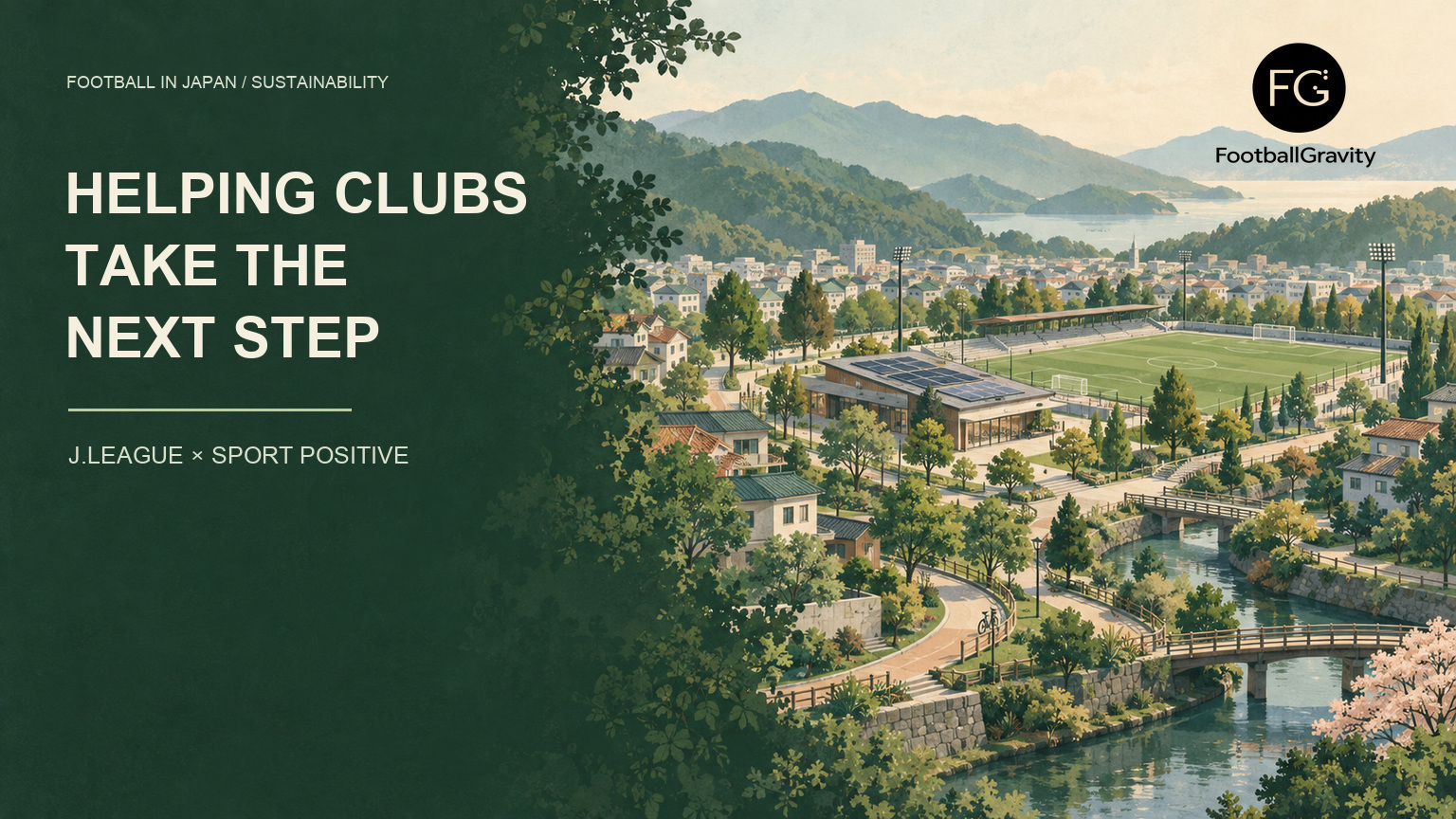
Featured image: AI-generated conceptual editorial illustration, with the official FootballGravity logo added separately. It depicts no actual club, stadium or project.
Part of Football in Japan — What can football learn from Japan?