
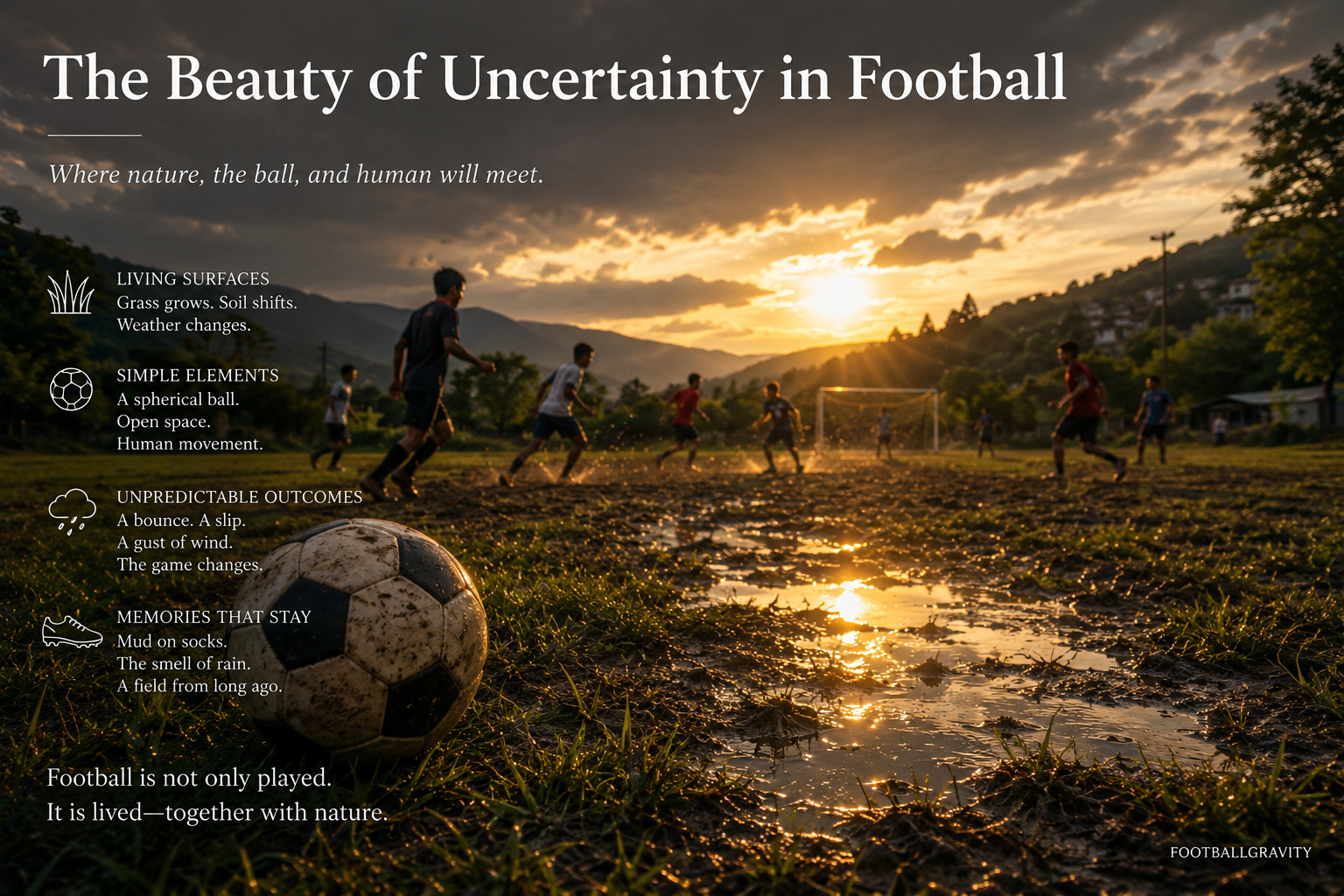
Football is shaped not only by players and tactics, but by grass, rain, soil, wind, and the unpredictable movement of a simple ball across living ground.
Some of the strongest memories in football are not only about goals.
They are about places.
The smell of wet grass after rain.
Dust rising from dry ground in summer.
Mud on socks.
Sand inside boots.
The sound of a ball bouncing differently on uneven soil.
Football has always existed slightly closer to nature than many modern sports.
And perhaps that connection is one reason the game still feels alive.
Football Is Played on Living Surfaces
Football is unusual because it is played directly on changing natural environments.
Grass grows. Soil shifts. Water changes movement. Wind alters trajectories.
Even at the highest level, football remains dependent on surfaces that are never completely identical from one day to the next.
That uncertainty influences everything.
Ball speed.
Passing rhythm.
Player balance.
Decision-making.
Ground conditions are not simply background scenery.
They participate in the match itself.
In some stadiums, grass is cut shorter to increase passing speed. In heavy rain, the game slows into physical struggle. On dry pitches, the ball moves unpredictably across rough surfaces.
Football constantly negotiates with the physical world around it.
The Ball, the Field, and Uncertainty
At its core, football is surprisingly simple.
A spherical ball.
Open space.
Human movement.
And yet from those simple elements emerges endless unpredictability.
Perhaps this is part of football’s beauty.
The ball never moves perfectly. The surface is never completely controlled. The environment always introduces small variations beyond human intention.
A wet patch changes a pass.
A bounce changes a goal.
Wind changes timing by fractions of a second.
Modern football increasingly relies on analysis, precision, and optimization.
But football never becomes fully programmable.
Nature still interrupts the system.
And maybe that interruption is essential.
Artificial Perfection — and What Gets Lost
Artificial turf reduces uncertainty.
The bounce becomes more predictable. Maintenance becomes easier. Conditions become more standardized.
In many situations, that consistency is practical and necessary.
Yet something subtle also disappears.
Perfectly controlled surfaces often reduce the strange emotional texture that natural environments create.
The game becomes cleaner.
More manageable.
More optimized.
But perhaps slightly less alive.
Because football has never been only about technical perfection.
It is also about adaptation.
Players responding to conditions they cannot fully control.
Teams negotiating rain, mud, friction, noise, fatigue, and atmosphere together in real time.
Natural imperfection creates part of the drama.
Why Football Memories Feel Physical
When people remember playing football as children, they rarely remember statistics.
They remember environments.
A local dirt field at sunset.
Grass stains on knees.
Cold air in winter training.
The uneven bounce that ruined or created a goal.
Football memories often remain tied to texture, weather, light, and landscape.
Perhaps this happens because football is experienced not only mentally, but physically through the environment itself.
The game enters memory through the senses.
And unlike many increasingly digital experiences, football still depends on contact with real surfaces, changing conditions, and uncontrollable surroundings.
Football is often described through tactics, data, and systems.
But underneath all of those structures remains something older and simpler:
a ball moving across living ground.
Perhaps that is why football continues to feel universal across generations and cultures.
Because despite all modern technology, the game still depends on uncertainty.
Grass grows differently. Rain changes rhythm. Soil shifts beneath movement.
And somewhere between human intention, physical law, and the unpredictability of nature, football finds its beauty.