Part three of Between Club and Country, FootballGravity’s series on the changing international calendar.
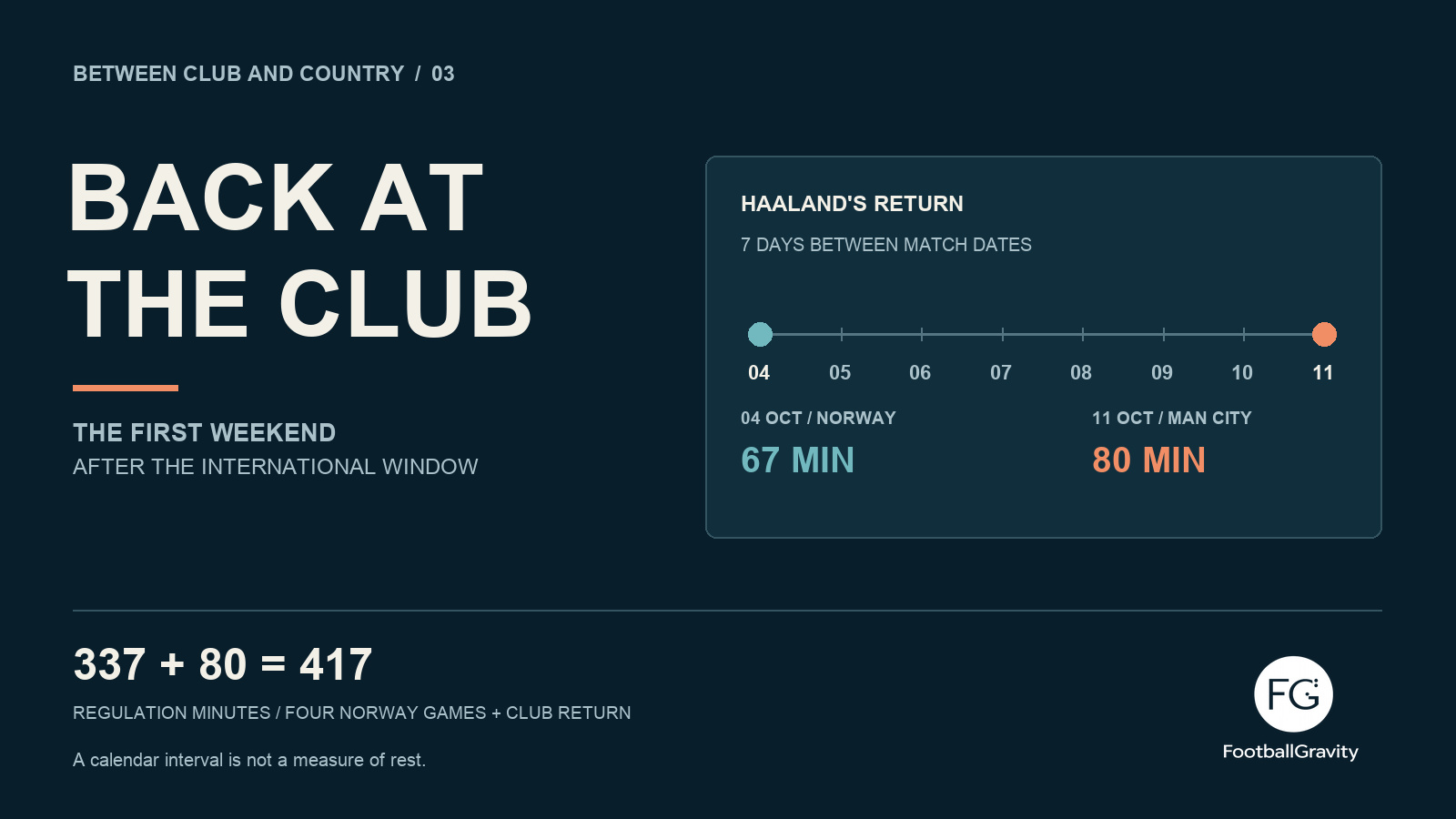
A week after leaving Norway’s final international match in the 67th minute, Erling Haaland started at Anfield. He scored Manchester City’s opening goal and was substituted after 80 minutes in a 3–0 victory over Liverpool on 11 October. The club season had resumed, and he was contributing again.
At the end of the international break, he had asked to come off after becoming exhausted. In his first game back at the club, he helped secure a win. The week between those appearances gives the story of his international workload a necessary next chapter.
Seven days between matches
His last Norway match was against Portugal on 4 October. His club return came on 11 October. Six calendar dates lay between them, but a gap in the fixture list is not a record of uninterrupted rest. A return journey, club training and preparation for the next opponent also have to fit around recovery. A player’s work continues on days without a match.
A goal cannot tell us whether all his fatigue had cleared. Equally, exhaustion at the end of a national-team camp does not predict a poor performance the following week. Time and recovery work sit between those moments. His substitution in Portugal and his goal at Anfield belong to the same continuing season.
The club calendar starts moving again on a set date. Players return with different demands behind them: their national-team minutes, journeys and accumulated workload vary. Some go straight into the opening line-up; others are given more time.
Haaland’s start and the two Paris players’ rest involved different people and circumstances. They offer no basis for ranking the clubs’ decisions. They do make visible the individual choices that accompany the handover from country to club.
An absence can reflect a decision to prioritise recovery for the games ahead. A start follows the work of preparing a player to compete. Behind the names included in a weekend squad—and those left out—there is a process of adjustment.
One fewer journey, then time to return
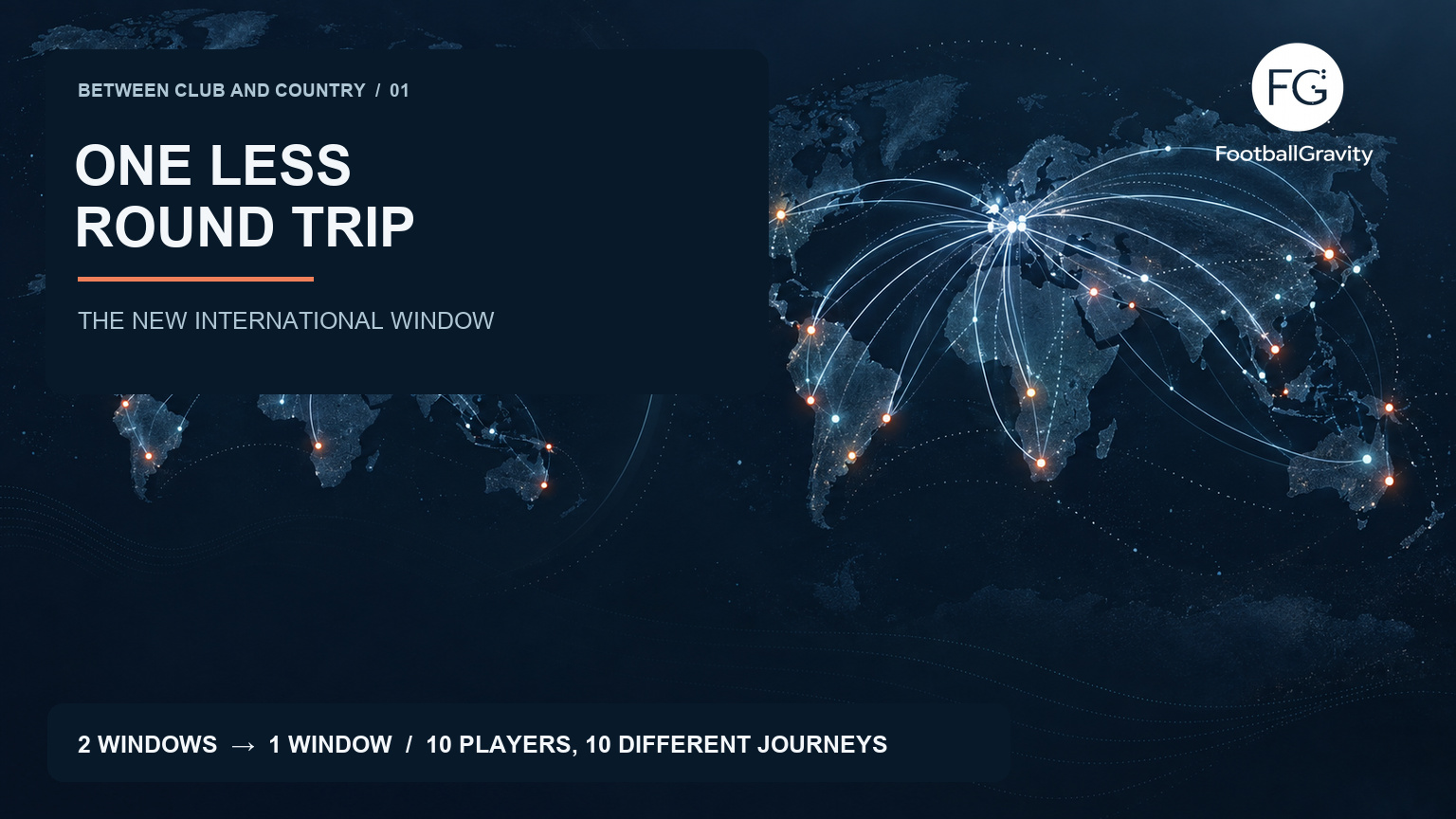
FIFA’s new calendar combines the former September and October periods into a 16-day window allowing up to four matches. Reducing two club-to-country cycles to one can remove a substantial journey, particularly for players crossing continents. Our first article modelled that change across ten internationals.
That benefit can coexist with a need for recovery after a concentrated run of national-team games.
After starting all four Norway matches, Haaland started for City a week later. In Paris, two internationals were given more room before resuming training. The way a new calendar reaches players can become visible in these club returns as well as in the national-team matches themselves.
One goal or one missed match cannot settle the merits of the whole system. The first weekend back nevertheless brings a familiar task into focus: clubs receive players with different needs and prepare them for what comes next.
The international window has a closing date. A player’s season continues across it.
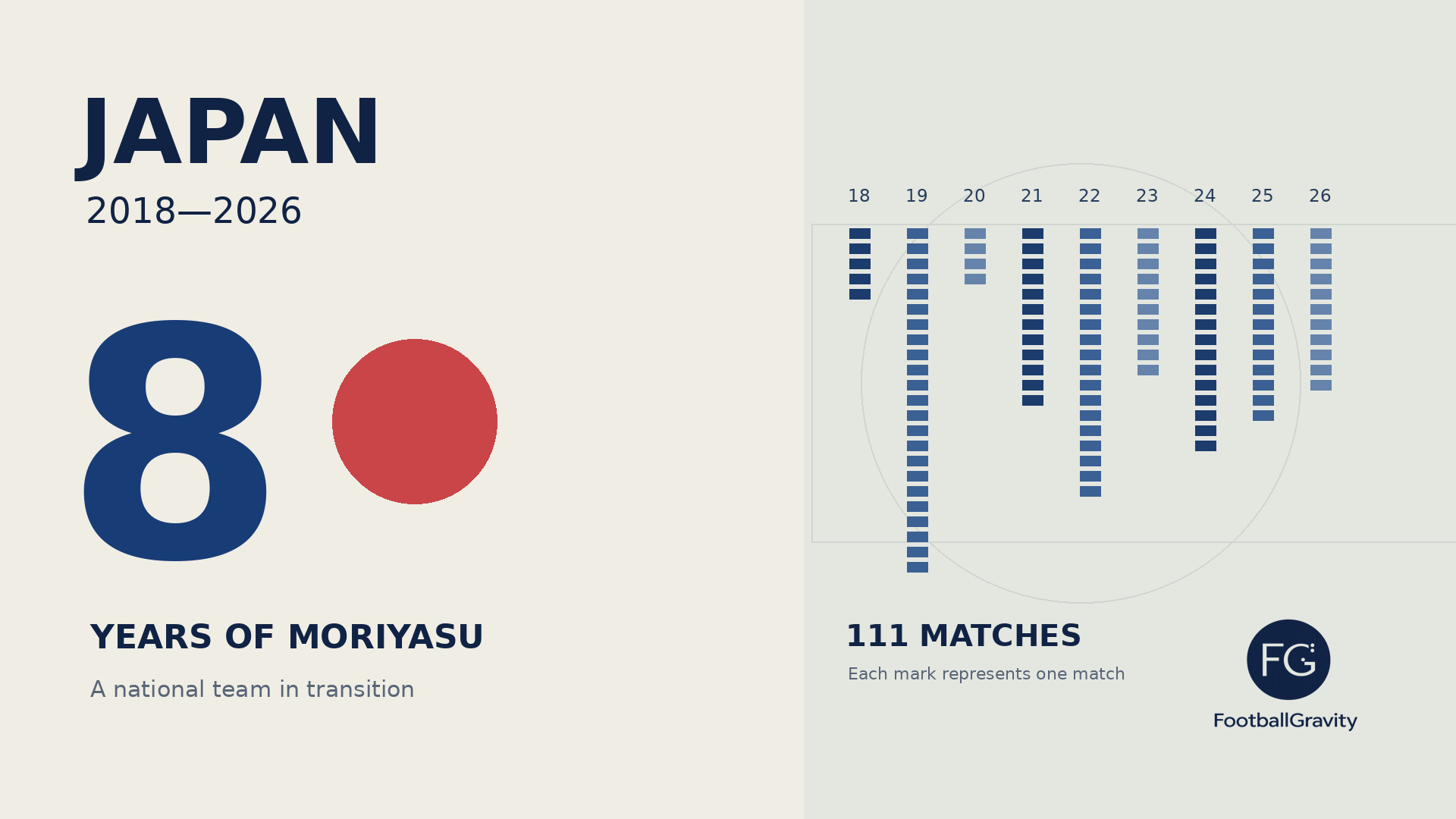
Across 111 matches, Japan's playing-time records reveal a broad pool of opportunity and a substantial change in the players carrying the team.
Eight years is a long time for a national team to live under one coach. The name on the touchline can become familiar enough to make the team itself seem continuous. The players' minutes tell a more complicated story.
FootballGravity has compiled Japan's official match records from Hajime Moriyasu's first game, against Costa Rica on 11 September 2018, through the New Zealand match on 5 October 2026. The dataset covers 111 played senior internationals. It offers a way to look beyond individual tournament results: who received opportunities, who became a regular presence, and where the team's workload moved.
The clearest finding is the change in Japan's core. Only three players appear in the ten highest playing-time totals in both the 2018–2022 and 2023–October 2026 periods: Wataru Endo, Junya Ito and Ritsu Doan.
That does not settle the question of whether every transition worked. It does establish that a long-serving coach presided over a team whose principal players changed considerably.
The players carrying the minutes
For this comparison, the first period runs through the end of 2022; the second begins in 2023. There are 62 matches in the first and 49 in the second. The table compares the leaders within each period, rather than treating a longer period's larger totals as evidence of greater importance.
Rank
2018–2022
Minutes
2023–5 October 2026
Minutes
1
Maya Yoshida
3,240
Zion Suzuki
2,648
2
Shuichi Gonda
3,135
Ritsu Doan
2,332
3
Takumi Minamino
2,919
Ko Itakura
2,278
4
Wataru Endo
2,750
Ayase Ueda
2,190
5
Gaku Shibasaki
2,699
Hiroki Ito
2,052
6
Takehiro Tomiyasu
2,688
Wataru Endo
2,020
7
Yuto Nagatomo
2,514
Takefusa Kubo
1,866
8
Junya Ito
2,350
Junya Ito
1,829
9
Hiroki Sakai
2,030
Daichi Kamada
1,805
10
Ritsu Doan
1,933
Keito Nakamura
1,750
Yoshida and Gonda head the first period. Suzuki and Itakura figure prominently in the second, while Ueda moves into the top five. The change reaches across the goalkeeper, defensive and attacking positions.
Doan is a particularly useful point of continuity. He ranks tenth in the first period, with 1,933 minutes, and second in the next, with 2,332. Remaining in the team and taking on a greater share of its work can happen together. Endo and Junya Ito provide other connections between the periods.
The ranking records a change in workload. Injuries, availability, competition formats and the composition of each squad also affect that workload. The figures cannot isolate how much of the change came from a deliberate succession plan. They do show where continuity was preserved while the surrounding team was renewed.
A wide door, followed by repeated choices
Across the full dataset, 154 different players appeared. That is a count of players who took the field, rather than a total of everyone called up. Of those 154, 31 made one appearance and 71 made between one and three.
Almost half of the playing pool therefore sits at the shorter end of the appearance distribution. A national team can offer many players a first look while concentrating its repeated selections around a much smaller group.
Those short stays need care in interpretation. A player with one appearance may have been an experimental selection, may have faced limited availability, or may have entered the team close to this dataset's cutoff. The count does not provide a failure rate for scouting or selection.
Tournament context matters too. The dataset includes nine matches from the EAFF E-1 championships. Japan used 128 different players in matches outside those tournaments. Separating the two gives a clearer picture of the breadth of the playing pool without treating every selection environment as equivalent.
For Japan, whose player pathways connect domestic clubs with teams abroad, these records make the point at which a player receives an opportunity visible. Understanding what happens next requires attention to both representative football and the player's club career. An international appearance alone cannot tell us whether a career has progressed.
Different ways to remain important
The cumulative leaders also show why appearances and minutes should be read together.
Player
Appearances
Starts
Minutes
Wataru Endo
61
54
4,770
Takumi Minamino
71
53
4,367
Ritsu Doan
73
50
4,265
Junya Ito
74
42
4,179
Takehiro Tomiyasu
46
40
3,662
Ko Itakura
44
40
3,527
Daichi Kamada
57
39
3,353
Maya Yoshida
41
38
3,254
Shuichi Gonda
35
35
3,135
Hidemasa Morita
40
33
2,861
Endo leads the minutes. Junya Ito leads the appearances, but started 42 of his 74 games. Tomiyasu's smaller appearance total includes 40 starts in 46 matches.
These are different forms of presence: accumulated time, frequent involvement, and a high proportion of starts when taking the field. A single league table of appearances would compress those differences.
Goals offer another view. Minamino leads this period with 26, followed by Ueda on 22, Yuya Osako on 17 and Junya Ito on 16. The overlap with the playing-time leaders shows that some of the most persistent contributors also carried a substantial scoring workload. It does not make total goals a complete measure of attacking quality: penalties, minutes and the matches in which those goals arrived still matter.
What a long tenure leaves visible
Moriyasu's eight years can be examined through the distribution of opportunity as well as the results. The records show a large number of players entering the team, a smaller group returning repeatedly, and a marked shift in the players receiving the most time across two World Cup cycles.
With the Asian Cup still ahead, this is an interim account of that work. It gives credit to continuity without making continuity itself a verdict. Endo, Junya Ito and Doan connect the two periods; the seven other places in each period's top ten show how much changed around them.
For a national team, maintaining a recognisable identity while changing the people responsible for it is part of the job. Japan's minutes provide a concrete record of that process—one that can be revisited as the next group takes on more of the team's work.
Data and sources
FootballGravity's calculations use the Japan Football Association's annual results and official match records, covering 11 September 2018–5 October 2026. The 2021 match against Japan's under-24 team and the unplayed March 2024 fixture against DPR Korea are excluded. E-1 games are included unless stated otherwise. Minutes use nominal substitution times, excluding added time but including extra time; penalty-shootout goals are excluded. The two periods contain different numbers of matches. These figures describe participation and workload, and do not establish a coaching effect on player development.
Part two of Between Club and Country, a FootballGravity series examining what happens when the international calendar changes shape.
In Porto, the most revealing number was not on the scoreboard. It was 67.
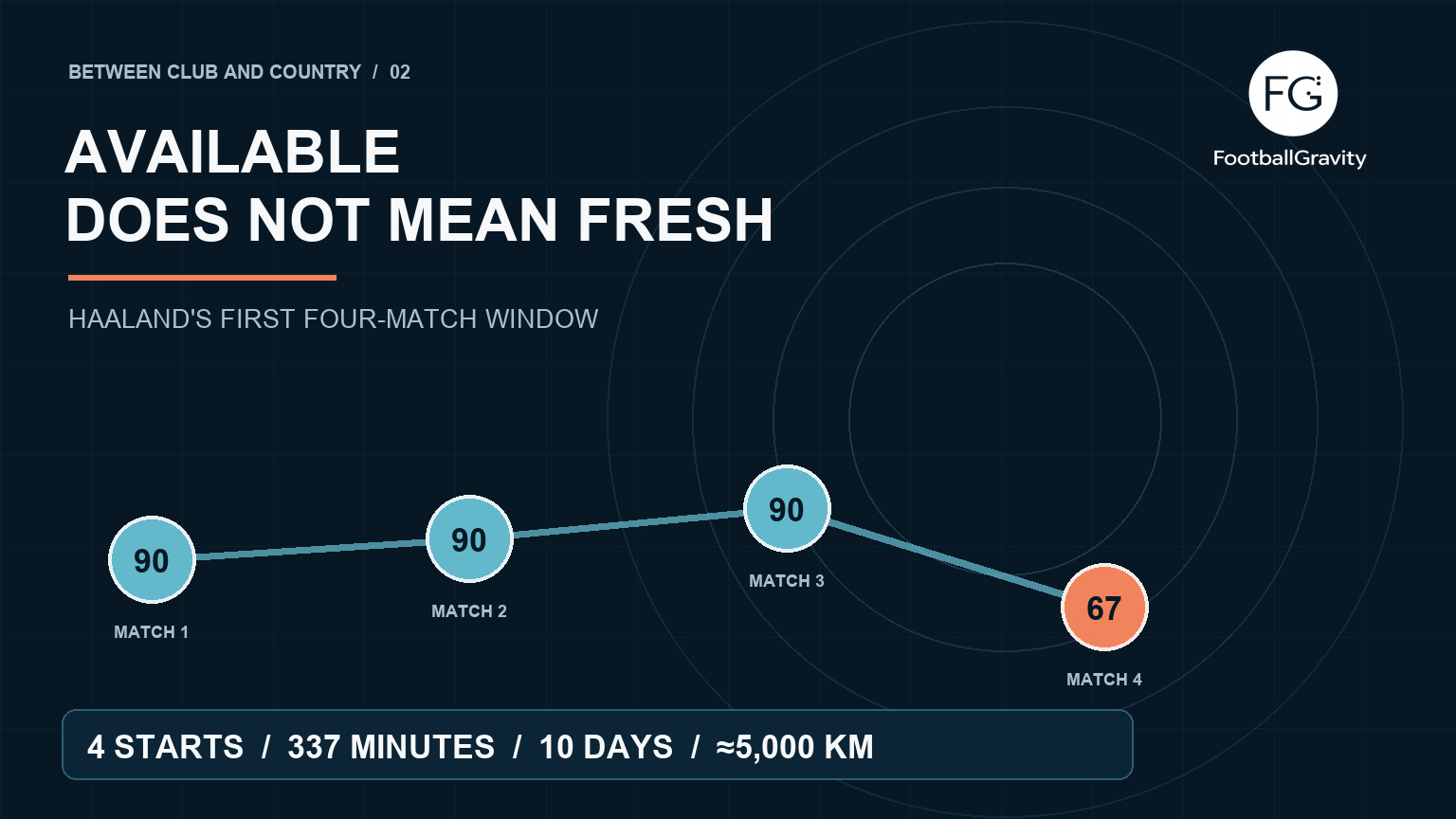
That was the minute Erling Haaland left Norway’s 2–1 defeat by Portugal on 4 October. He had started all four of Norway’s matches in the new extended international window. Before the last one, coach Ståle Solbakken and Haaland had discussed a target of roughly an hour. Haaland then asked to come off, and Solbakken said he was “thoroughly spent”.
No injury was announced. That distinction matters. Public discussions of player load often wait for an absence, a diagnosis or a damaged muscle. Porto offered a different kind of observation: a player remained available, started the match and still reached a point at which his minutes had to be managed.
This is not evidence that the new calendar caused Haaland’s fatigue, and it is not a medical assessment. It is something narrower: an unusually clear, public load-management signal at the end of the first 16-day, four-match international period.
Four starts, 337 minutes, one continuous camp
Date
Match
City
Haaland minutes
Full days before next match
24 Sep
Norway 3–2 Denmark
Oslo
90
2
27 Sep
Norway 1–2 Portugal
Oslo
90
3
1 Oct
Wales 2–1 Norway
Cardiff
90
2
4 Oct
Portugal 2–1 Norway
Porto
67
—
The four matches were played across 11 calendar dates, with ten elapsed days from the first kick-off to the last. Haaland completed 337 of the possible 360 regulation minutes. He also scored three goals, twice against Denmark and once in the first Portugal match.
The recovery pattern was 72 hours, 96 hours and 72 hours between kick-offs. Counting only complete calendar dates between games, Norway had two, then three, then two full days. Those days were not necessarily rest days. The Norwegian federation’s published programme included recovery, training, media activity and travel from Oslo to Cardiff and then Porto.
Using the same city-centre method as the first article in this series, Haaland’s modelled route is Manchester → Oslo → Cardiff → Porto → Manchester: about 5,000 km. It involves one club-to-country cycle and no intercontinental crossing. The sum of absolute time-zone changes is only two hours.
That is precisely why this case is useful. The travel geography is relatively modest beside the long-haul routes in our ten-player model. The match exposure is not. A shorter route can still contain four starts and a long uninterrupted period away from the club environment.
The load did not begin with Norway–Denmark
The international window was one section of a longer sequence. Norway played six matches at the 2026 World Cup and reached the quarter-finals, where its tournament ended against England on 11 July. The new Premier League season began for Manchester City in late August. By the international break, Haaland had played 90 minutes in each of City’s first five league matches.
Norway’s run therefore did not start from a clean seasonal reset. Solbakken described some of his players as having received only six or seven days of holiday after the summer, without saying that this exact number applied to Haaland. The Norwegian players’ union NISO said Haaland had entered the English season without a normal preparation period after Norway’s World Cup.
This wider sequence prevents a simple conclusion. The four-match window may concentrate national-team exposure, but the observed fatigue cannot be assigned to those four games alone. World Cup minutes, club minutes, training, travel, sleep, individual physiology and mental demand all sit inside the same accumulated load.
Availability is a poor yes-or-no measure
An injury register asks whether a player sustained a reportable health problem or lost time. That is essential information, but it does not capture every stage between full freshness and absence.
Sports-medicine consensus work treats load more broadly, distinguishing the work performed from the individual’s response to it. Match minutes and travel are forms of external exposure. Fatigue, soreness, sleep, perceived effort and readiness are part of the internal response. Two players can complete the same schedule and experience it differently.
Layer
What public data can show here
What remains private or unknown
Exposure
Four starts; 337 minutes; match spacing; modelled route
Training load; sprint distance; accelerations; collisions
Response
Player asked to come off; coach described him as spent
Clinical findings; later symptoms; future injury risk
Availability
Started all four Norway matches
Readiness for the next club match
Calling the Porto substitution “functional fatigue” can be useful as editorial shorthand, but it should not be mistaken for a validated diagnosis or a new binary statistic. A better description is a fatigue-signalled substitution: a visible management decision supported by the player’s request and the coach’s explanation.
If analysis counts only injuries, it misses that signal. If it labels every early substitution as fatigue, it invents information. The useful middle ground is to record observable events—planned minute limits, requests to come off, rest from training, omitted starts and delayed club returns—while stating exactly who explained them and what is still unknown.
NISO’s question is about the brake, not only the speed
NISO’s response moved the discussion beyond one striker. The union called for clearer workload and recovery rules covering time between matches, continuous rest periods, travel strain and recovery after a long season. Its central concern was that protection should not depend on a player being the person who finally says stop.
That position is consistent with a 2025 FIFPRO consensus exercise involving 70 medical and performance experts. Its 12 proposed safeguards included a four-week off-season, at least two completely commitment-free weeks, a four-week retraining period before competition and explicit consideration of travel burden.
These are proposals from player representatives and independent specialists, not the current rules of every competition. They also do not turn one substitution into proof that a calendar design has failed. They do identify the governance question exposed in Porto: where should collective safeguards sit when a player’s competitive instinct is to remain available?
What this case changes—and what it does not
Our first window analysis found a consistent structural benefit: replacing two separate September and October periods with one integrated window removes a club-to-country round trip. Haaland’s case does not reverse that result. It adds another dimension.
Fewer transitions can coexist with concentrated match exposure. Lower travel distance can coexist with fatigue. Continued availability can coexist with reduced freshness. Those are not contradictions; they are different measurements.
A single case cannot tell us whether players were more or less fatigued under the old two-window structure. It cannot establish injury risk, and it cannot show that Haaland would have felt fresher under a different schedule. A matched comparison would need completed minutes, recovery intervals, travel, off-season length, club return and later health outcomes across a much larger group.
It can, however, improve what that future dataset looks for. Injury should remain an outcome, but not the only one. The moments before absence—the conversation about a minute limit, the player asking to leave, the coach changing the plan—belong in the record too.
Manchester City are scheduled to visit Liverpool on 11 October, seven calendar dates after the Portugal match. Whether Haaland trains, starts or plays is a follow-up observation, not a conclusion available today. The responsible approach is to record it when it happens.
Method note: National-team minutes and substitutions come from official NFF match records. “Full days” counts calendar dates strictly between matches. The route uses standardised city-centre coordinates and the haversine formula: Manchester → Oslo → Cardiff → Porto → Manchester, summed before rounding to the nearest 100 km. Time-zone shift is the sum of absolute UTC-offset changes on each leg at local noon, including daylight-saving time. It is a comparison proxy, not a measurement of jet lag. No airport, flight, hotel, training-base or personal movement is inferred. Research cutoff: 6 October 2026, 15:00 JST.
Manchester United produced record revenue without European football in 2025/26. The accounts show an operating recovery taking shape as the club prepares to invest in its next phase.
Manchester United’s latest accounts bring together several parts of the club’s current transition. Revenue reached a club record of £677.6 million, the operating result returned to profit and operating cash generation improved substantially. The year also ended with a £43.0 million loss.
These figures describe different layers of the same year. None, on its own, captures the club’s position particularly well.
The audited accounts for the year to 30 June 2026 show an operating business that has become lighter and more productive. They also show a club carrying substantial debt, paying for past and current squad investment, and beginning to commit capital to a proposed 100,000-seat stadium. Cash was generated. More cash was then directed towards players and property than the business produced during the year.
Taken together, the figures show a club creating more capacity in its day-to-day operations while investing in two connected priorities: the team that must compete now, and the infrastructure intended to support United for decades.
The operating recovery is real
United achieved their record revenue despite the men’s team not playing in a UEFA competition. A third-place Premier League finish lifted broadcasting revenue to £206.8 million, partly offsetting falls in commercial and matchday income. The club hosted ten fewer home matches than in the previous season.
£m
FY2024
FY2025
FY2026
Revenue
661.8
666.5
677.6
Operating profit/(loss)
(69.4)
(18.4)
22.6
Loss for the year
(113.2)
(33.0)
(43.0)
Net operating cash inflow
85.7
72.7
178.7
Employee benefit expense
364.7
313.3
302.0
Source: Manchester United plc audited consolidated financial statements. Figures rounded to one decimal place.
Operating expenses fell by £31.8 million. Employee benefit expenses decreased by £11.2 million to £302.0 million, reflecting changes to the first-team squad and the headcount reductions introduced over the previous two financial years. Other operating expenses fell by another £11.2 million. Adjusted EBITDA, the club’s preferred non-IFRS measure of underlying performance, rose 18.4 per cent to £216.4 million.
The result was a £22.6 million operating profit, following losses of £18.4 million in 2025 and £69.4 million in 2024. Any assessment of the restructuring’s human and institutional consequences should not be reduced to a line in the accounts. Financially, however, the direction over these three years is clear.
From operating profit to the final result
Football accounting places several different decisions into the same income statement. United recorded £211.8 million of amortisation, principally relating to player registrations. This is the accounting cost of spreading transfer fees and directly associated acquisition costs across contract lengths; it is not the amount paid for players in cash during the year.
At 30 June, the unamortised value of registrations was £452.3 million. Of that amount, £156.1 million was scheduled to be charged in FY2027 before taking account of the summer’s subsequent arrivals, departures and contract changes. United also recognised £46.9 million of profit on player disposals and £8.2 million of exceptional costs, including costs associated with Ruben Amorim’s departure and the closing stages of the operational restructuring.
Below operating profit, net finance costs reached £69.6 million, up from £21.2 million. That change requires care. Interest on the term loan, secured notes and revolving facilities was £35.6 million, almost unchanged from the previous year. Cash interest paid increased only slightly, from £37.2 million to £38.9 million.
The wider finance line also included an £18.9 million unwinding of discounts on player-registration liabilities, a £10.0 million unrealised foreign-exchange loss on unhedged US-dollar borrowings, transfer-receivable costs and hedge movements. The comparison was made more dramatic by £22.9 million of foreign-exchange gains and £11.4 million of hedge-related income in FY2025. It would therefore be misleading to say that United’s debt interest simply rose from £21 million to £70 million.
After those finance costs and a £4.0 million tax credit, the club reported its £43.0 million loss.
Cash was generated, then invested
The cash-flow statement gives the year a different shape. Net cash generated by operating activities was £178.7 million, more than double the previous year’s £72.7 million. United were not a business unable to turn revenue into cash.
FY2026 cash movement
£m
Net operating cash inflow
+178.7
Cash paid for player registrations and other intangibles
(292.3)
Cash received from registration disposals
+148.6
Property, plant and equipment
(85.9)
Net financing inflow
+35.3
Exchange-rate effect
(3.3)
Change in cash
(18.9)
Registration cash flows include players and key football-management staff. Totals may differ slightly because of rounding.
The net cash outflow on registrations was £143.7 million, close to the club’s five-year annual average of £146.1 million. A further £85.9 million went into property, plant and equipment. That included £7.7 million at Old Trafford, £14.7 million at Carrington and £63.5 million for freehold property connected to the proposed new stadium.
The accounts do not identify one particular borrowing as the source of the land purchase. Operating cash, player-sale proceeds and financing form a common pool. What can be said is that United generated £178.7 million from operations, spent £229.6 million net on investing activities and ended the year with £67.2 million in cash, £18.9 million less than they had started with.
Extending the financial horizon
At 30 June, United carried £689.0 million of borrowings at book value and reported net debt of £621.7 million. The club had £110 million drawn from a £400 million revolving credit facility, leaving £290 million available.
In June, the club refinanced $425 million of senior secured notes with $550 million of new notes carrying a fixed 5.36 per cent coupon and maturing in 2031. The $225 million term loan was also extended to 2031. This was not a reduction in debt. It moved a maturity away, increased the principal amount of the notes and gave the club more time and liquidity for its next phase.
The transfer balance sheet adds another layer. Recognised payables for registrations stood at £375.0 million, of which £156.7 million was due after more than one year. A further maximum £122.8 million could become payable if specified performance conditions are met. These figures describe instalments and conditional obligations; they are not evidence of overdue payments.
After the year-end, United committed £191.7 million to player and football-staff registrations and contract extensions, payable across the following five years. The revolving facility was drawn further during July and August and partly repaid in September, leaving £200 million outstanding on 21 September. The timing is consistent with a club using its liquidity through a summer transfer cycle, but the filing does not assign individual drawdowns to particular signings.
A stadium project before the financing model
The £63.5 million land purchase is important because it turns the stadium ambition into a balance-sheet commitment. It does not yet tell us how a new ground will be financed, what it will cost or when it will open.
Other European clubs illustrate why that missing architecture matters. Tottenham’s stadium debt is large, but more than 90 per cent of its £851.7 million borrowings were fixed at an average rate of 3.07 per cent in its FY2025 accounts, with an average maturity of 17.6 years. Real Madrid reported €1.108 billion drawn for the Bernabéu project at June 2026; the redeveloped stadium was already producing €363 million of revenue, more than twice its pre-renovation level. Barcelona, still navigating construction and delays, approved €510 million of additional financing within the wider Espai Barça structure, including media notes secured against future broadcasting income.
These are not entries in a financial league table. They are projects at different stages, owned under different structures and reported under different accounting definitions. The useful comparison concerns duration, interest-rate exposure, security and the asset’s eventual earning power.
United remain before that decision. The club has secured land and extended existing debt, but has not published a complete stadium-finance model. Until it does, the land purchase should be read as evidence of intent rather than proof that the project is fully funded.
The next test is what Champions League revenue enables
For FY2027, United forecast revenue of £740 million to £760 million and adjusted EBITDA of £205 million to £225 million. Revenue is expected to rise by between 9.2 and 12.2 per cent; adjusted EBITDA may finish slightly below or slightly above FY2026.
The guidance includes the return of Champions League football and the associated increase in player-staff costs. It does not separate the UEFA effect from new sponsorships, domestic performance, matchday income or retail growth. Calling the entire expected increase “Champions League money” would overstate what the company has disclosed.
The narrow EBITDA range may instead express something fundamental about football economics. Higher revenue is not always intended to become higher profit. Some of it buys the players, wages and depth required to remain in the competition that created the revenue in the first place.
Manchester United’s cultural value cannot be read from net debt, EBITDA or a transfer-payables note. The club matters because of its history, its supporters, its academy, its teams and its place in the city. Finance matters because it determines how securely those things can be carried forward.
FY2026 shows progress, pressure and ambition in the same set of accounts. The operating recovery has given United more capacity to act. The club has begun using that capacity on the squad and the first piece of a possible new home. The next few years will show how successfully those investments support a shared long-term plan.
Method note: Manchester United figures are taken from the audited FY2026 Form 20-F, approved on 24 September 2026, and the company’s FY2026 results release. Adjusted EBITDA is a company-defined non-IFRS measure. Cross-club stadium comparisons use each club’s own published definitions and are not intended as like-for-like rankings.
Part one of Between Club and Country, a FootballGravity series on how the international calendar is experienced from different points on the map.
For a Europe-based Japan international, September and October 2025 contained two distinct journeys. In September, Japan played Mexico in Oakland and the United States in Columbus. After the players returned to their clubs, the October window brought matches against Paraguay in Osaka and Brazil in Tokyo. Each international window began at the player’s club city and ended there again.
The equivalent period in 2026 has a different shape. FIFA’s men’s calendar replaces the two nine-day, two-match windows with one 16-day window in which a national team may play up to four matches. Japan’s published programme runs from Miyagi to Hiroshima, Yokohama and Tokyo. For a player based in Europe, that means one long club-to-country cycle instead of two.
How much does that alter the journey? FootballGravity modelled ten leading internationals, holding each player’s 2026 club city constant across both calendars. Every route became shorter. The reduction ranged from 16.6% to 46.3%. The common change was simpler still: four switches between club and national-team environments became two.
Ten players, one calendar change, ten different results
The comparison is deliberately standardised. It begins in the player’s 2026 club home city, joins the host cities in fixture order and returns to the same club city. The 2025 side of the model does not use the club the player represented at the time. That removes transfers from the comparison: Son Heung-min is anchored to Los Angeles in both years, for example, and Ayase Ueda to Lille.
Player
National team
Fixed club city
2025 model
2026 model
Change
Daichi Kamada
Japan
London
37,600 km
20,500 km
−17,200 km (−45.6%)
Ayase Ueda
Japan
Lille
38,000 km
20,400 km
−17,600 km (−46.3%)
Takefusa Kubo
Japan
San Sebastián
40,100 km
22,200 km
−18,000 km (−44.7%)
Vinícius Júnior
Brazil
Madrid
41,900 km
34,900 km
−7,000 km (−16.6%)
Julián Álvarez
Argentina
Madrid
37,500 km
20,800 km
−16,700 km (−44.5%)
Son Heung-min
Korea Republic
Los Angeles
27,200 km
19,800 km
−7,400 km (−27.1%)
Kim Min-jae
Korea Republic
Munich
32,500 km
17,800 km
−14,700 km (−45.2%)
Kylian Mbappé
France
Madrid
10,300 km
6,400 km
−3,900 km (−37.8%)
Harry Kane
England
Munich
7,600 km
4,700 km
−2,900 km (−38.3%)
Nicolas Jackson
Senegal
Birmingham
31,100 km
19,400 km
−11,700 km (−37.6%)
These are great-circle distances between standardised city-centre points, rounded to the nearest 100 km for publication. They are not the kilometres a player actually flew. No airport, connection, hotel, training base or personal movement has been inferred. The names identify recognisable club-and-country geographies; they do not turn the exercise into individual tracking.
Japan shows what the missing round trip is worth
The three Japan players sit in a remarkably narrow band. Kamada’s model falls from about 37,600 km to 20,500 km. Ueda’s falls from 38,000 km to 20,400 km, and Kubo’s from 40,100 km to 22,200 km. Each reduction is roughly 45%.
The small differences among London, Lille and San Sebastián matter less than the deleted gateway journey. In 2025, the model sends each player from Europe to the United States and back, then from Europe to Japan and back. In 2026, there is one Europe-to-Japan cycle. Travel between Japan’s four host cities contributes about 1,600 km; the long-haul entry and exit contribute most of the total.
Álvarez presents a similar pattern. With Madrid fixed as the club base, his two 2025 windows run through Buenos Aires and Guayaquil, then Miami twice. The 2026 programme stays in Argentina, moving from Córdoba to Buenos Aires. The resulting reduction is about 16,700 km. The calculation also shows why final venues matter: Argentina’s second October 2025 friendly was originally announced for Chicago, but the AFA later moved it to Miami. The model uses the match as played, not the first announcement.
One camp can still contain an enormous journey
Vinícius is the clearest counterexample to a simple “one window means less travel” story. His total still falls, but only from about 41,900 km to 34,900 km. Brazil’s 2026 programme begins with two matches in Australia and continues in Kolkata. In the model, Townsville to Brisbane to Kolkata creates about 10,000 km of travel inside the national-team camp. The equivalent between-match component across Brazil’s two 2025 windows was about 3,800 km.
The merged window removes a second departure from and return to Madrid. It does not remove the geography chosen within the remaining camp. Those two effects pull in opposite directions, leaving Vinícius with the smallest percentage reduction in the sample and the largest 2026 total.
Jackson’s route makes the same point on a different map. His Birmingham gateway distance almost halves, but Senegal’s published sequence still runs through Maputo, Bahir Dar and Marseille. The three match cities contribute nearly 8,900 km between them. “One camp” describes an administrative period, not a compact location.
The player and the national team bring different maps
Son and Kim follow exactly the same Korea Republic fixtures in this model. Their results are different because they begin elsewhere. Korea’s September 2025 matches were in the United States, relatively close to Son’s fixed Los Angeles base. October then required the long trip to Seoul. From Munich, Kim crossed between Europe, North America and Korea across the two windows.
Under the 2026 schedule, Korea plays all four matches at home. Son’s distance falls by 27.1%; Kim’s falls by 45.2%. The calendar rule is the same, and the national-team itinerary is the same. The club location changes the effect.
Mbappé and Kane show why percentages need kilometres beside them. Their totals decline by about 38%, close to Jackson’s proportional change. In absolute terms, however, Mbappé’s reduction is around 3,900 km and Kane’s 2,900 km. The Europe-based national-team routes were already much smaller than the long-haul examples. A large percentage does not automatically describe a large journey.
Fewer transitions are not a verdict on player load
One conclusion is uniform across all ten cases. Two 2025 windows create four club↔national-team transitions: club to country and country to club, twice. The 2026 window creates two. That means fewer repeated departures, arrivals and returns to the club environment. It also means a longer uninterrupted national-team camp.
The match spacing is less uniform. Counting only complete calendar dates between national-team matches, Argentina’s 2026 schedule provides two full days between each game. Korea has three each time. Senegal has three, then four. Japan’s shortest interval remains two full days, the same minimum as in 2025. The new design permits a longer sequence of matches without forcing every team into the same rhythm.
Distance is therefore not a synonym for load, recovery or welfare. The model does not know minutes played, training intensity, sleep timing, route connections, cabin conditions, medical decisions or how quickly a player re-enters club competition. Much of the 2026 window was still to be played at the publication cutoff, so representative minutes belong in a later update using completed match reports.
What the numbers establish is narrower and useful. The integrated window reliably removes one club-to-country cycle. For many long-haul players, that deletes a substantial gateway journey. The size of the gain then depends on two pieces of geography: the player’s club base and the national team’s route inside the window. The next articles in this series will separate those maps more closely, beginning with the contrasting Korea routes and the travel that remains inside a single camp.
Method note: FootballGravity modelled routes from each player’s 2026 club home city to his national team’s published September and October host cities, in fixture order, and back to the same club city. The 2025 comparison uses that same 2026 club base to remove transfer effects. Distances use the haversine formula and standardised city-centre coordinates; totals are summed before being rounded to the nearest 100 km. “Full rest days” are calendar dates strictly between matches. The routes do not reconstruct actual travel, and scheduled 2026 fixtures may change. Research cutoff: 26 September 2026.
For many children, football does not begin in a stadium, an academy or even a club. It begins at school: a ball in a playground, a teacher with a simple game and a chance to join without already belonging to the sport.
UEFA has tried to make that first experience available at continental scale. Its Football in Schools programme reported 7.2 million children introduced to the game during its first cycle from 2020 to September 2024. It involved 41,500 schools, trained 111,000 teachers and reached more than three million girls. UEFA also recorded 15,500 volunteers, 4,400 festivals and events, and 830 new links between schools and clubs across all 55 member associations.
Those figures describe an unusual achievement in reach. By the end of 2025, UEFA’s running total had risen to 7.6 million children. The organisation has committed a further €11 million for 2024–28, taking its own investment across the programme’s first eight years to €22 million.
The next opportunity is to follow the journey beyond the first session. How often does an introduction become a habit? Does a school programme lead to more movement across the whole day, a welcoming route into a club or a stronger sense of belonging? These are not objections to counting participation. They are the questions that become possible because UEFA and its associations have built something large enough to follow.
Schools make the first step more open
A club is not an equally easy starting point for every family. Membership fees, travel, equipment, confidence and knowledge of the local system can all affect access. A school is different. Children are already there, the setting is familiar and an activity can reach those who would not have sought out football on their own.
That is why Football in Schools is best understood as more than a talent pathway. UEFA describes its aim as providing a safe and positive experience regardless of ability, gender, ethnicity or religion. The programme also promotes physical activity and values including cooperation, respect, fair play and leadership. Its national forms are delivered through partnerships among football associations, schools, education authorities, teachers and local clubs.
At this scale, football begins to resemble social infrastructure: not because every session produces a measurable social benefit, but because the game supplies people, places and relationships through which regular activity can happen. The important unit is not only the child reached on one day. It is also the teacher who can run another session, the school that keeps equipment available and the local organisation ready to welcome a child who wants to continue.
Different countries are building different bridges
The variety inside the European programme is one of its strengths. A UEFA review published during Grassroots Week 2026 shows national associations working on several stages of the journey rather than repeating one model.
In Sweden, Skolbollen serves children from preschool to Year 9. Participating schools receive equipment, training and a guide containing more than 100 adaptable games. More than 2,100 schools take part, and nearly a third have established a partnership with a local club. This combines broad access with a possible next step into organised football.
Lithuania’s Futboliukas offers an eight-month programme for children aged three to seven. Around 30,000 children participate each year through more than 400 institutions. Monthly plans and digital resources allow teachers without a football background to lead activities, while club links give interested children somewhere to go afterwards. The design values repetition: football returns through the school year rather than arriving as a single festival.
Switzerland’s Doppelpass starts explicitly with the connection between school and club. Its latest iteration recorded 28 new links; half included after-school sport and ten were designed specifically for girls. The number is modest beside the Europe-wide reach figure, yet it describes a different kind of output: an institutional relationship that may support continued participation.
None of these measures answers every question. A partnership on paper does not tell us how many children use it, how welcome they feel or how long they remain involved. It does, however, bring the programme closer to the next stage of measurement.
Malta shows what an outcome study can add
The clearest example so far comes from Malta. The Malta Football Association’s Fun Fit 5 programme used Football in Schools support for daily 45-minute physical-activity sessions in primary schools. MCAST researchers followed Year 4 pupils during the 2022–23 school year, comparing three treatment classes with three control classes across three state primary schools.
The research report found that children in the treatment group took an average of 5,836 steps during school hours, compared with 4,239 in the control group. The difference — 1,597 steps, or about 38% — was statistically significant (p = .049).
The result needs its full context. The study did not find a statistically significant increase in total daily steps: the treatment group’s daily total was lower by an estimated 1,788 steps, but the difference could not be distinguished from chance (p = .34). Nor did the intervention produce a significant difference in the change in academic performance between groups (p = .70). The careful conclusion is therefore useful and limited: the daily programme increased movement during school hours, while the study found no significant academic disadvantage; it did not demonstrate an increase in movement across the whole day.
The researchers also state the boundaries of their work. Classes could not be randomly assembled, the pedometer sample was small and the one-year study could not establish long-term effects. That candour is part of the value. A serious outcome study can reveal a positive result, a neutral result and an uncertainty at the same time.
From reach to social outcome
A practical measurement chain for Football in Schools could have four stages.
Reach: who was offered the programme, where, how often and at what cost?
Experience: did children feel safe, included and eager to return?
Continuation: did they keep playing at school, join a club or choose another form of regular physical activity?
Social outcome: did activity levels, wellbeing, confidence, friendship or access improve, and for whom?
The sequence matters. It prevents a participation count from being asked to prove more than it can. It also avoids treating club registration as the only successful destination. A child may become more active without joining a team. Another may enjoy football for a term, build confidence and move towards a different sport. For a programme that presents itself as inclusive and educational, those routes deserve to be visible too.
Europe-wide reporting could begin with a small shared set of measures: repeat participation, frequency and duration of sessions, girls’ participation, school-to-club transitions, accessibility by place and socioeconomic background, and follow-up after six or twelve months. National associations would still need room to measure what matters in their own settings. Sweden’s school network, Lithuania’s eight-month rhythm and Switzerland’s club links should not be flattened into a single league table.
The value of returning later
UEFA’s reach is already meaningful. Millions of children have been offered an experience that the club system alone might not have provided, and teachers across Europe have gained tools to make football part of the school day. The national examples show that the programme can become locally rooted rather than remain a sequence of central events.
It is too early to describe Europe-wide continuation or long-term social effects. That makes this a starting point rather than a verdict. As the second funding cycle develops, the most revealing number may be the one that connects today’s first kick with what a child is still doing a year later.
Football in Schools has established reach. Malta has shown that outcome research is possible, including results that resist a simple success story. Sweden, Lithuania and Switzerland are building bridges from a school session towards regular participation. Taken together, they suggest the next chapter: protect the joy and openness of the first experience, then learn carefully what it allows children and communities to sustain.
Method note: UEFA figures in this article are reported programme totals and are attributed to UEFA; FootballGravity has not independently audited participant counting across 55 associations. The Fun Fit 5 findings come from MCAST’s mixed-method, quasi-experimental report and are not generalised here to all countries or age groups. “Football as social infrastructure” is FootballGravity’s analytical frame, not an official UEFA designation or a claim that long-term effects have already been established.
Part one of Milan, Between Eras, a club study in FootballGravity’s How Teams Change series, examining how AC Milan once renewed great teams without severing the knowledge that made them great.
AC Milan’s summer of 2012 is easy to remember as a sale. Thiago Silva and Zlatan Ibrahimović went to Paris Saint-Germain within days of one another. The image is clean, dramatic and financially legible: a world-class defender and Serie A’s leading scorer leaving the same club for the same destination.
The deeper rupture had begun before either transfer was completed. On 13 May, Milan beat Novara in the final game of the league season. Gennaro Gattuso, Filippo Inzaghi, Alessandro Nesta, Clarence Seedorf, Gianluca Zambrotta and Mark van Bommel all made their last Milan appearances. Inzaghi scored the winner from a Seedorf pass. It was an almost excessively perfect farewell scene, followed two months later by the departure of the team’s best defender and most decisive forward.
What Milan lost that summer was larger than a list of names. For more than two decades, the club had been unusually good at making greatness overlap. One generation did not disappear before the next one learned how Milan worked. Players, coaches and habits crossed the boundary together. The question raised by 2012 is therefore not simply why so much quality left. It is why the next Milan had so little time beside the previous one.
The first inheritance was a way of playing
Arrigo Sacchi’s Milan is often recalled through the Dutch trio, and reasonably so. Ruud Gullit and Marco van Basten arrived in 1987; Frank Rijkaard followed a year later. Yet the team that beat Steaua București 4–0 in the 1989 European Cup final was built from two kinds of knowledge. The Dutchmen gave Milan force, technique and a new international horizon. Franco Baresi, Paolo Maldini, Mauro Tassotti and Alessandro Costacurta gave the defence an Italian spine that already understood the club.
Sacchi’s real inheritance was collective. Milan compressed the pitch, defended forward and asked gifted players to submit their movement to a shared geometry. The club’s official history calls the game itself an “extra man”. The phrase matters because it explains how the team survived individual change. A star could leave, decline or be unavailable; a method could be taught.
Fabio Capello inherited much of that platform and altered its emphasis. His Milan were more pragmatic and, over time, less dependent on the Dutch attack. The 1993/94 season provides the sharpest evidence. Gullit and Rijkaard had left, Van Basten’s ankle had effectively ended his career, and Baresi and Costacurta were suspended for the Champions League final. Milan still beat Johan Cruyff’s Barcelona 4–0, with Filippo Galli and Christian Panucci entering a defensive structure that remained recognisable.
This was renewal without theatrical reinvention. Capello added Marcel Desailly, Zvonimir Boban and Dejan Savićević, while Maldini, Tassotti, Baresi, Costacurta, Roberto Donadoni and Demetrio Albertini carried standards between teams. Four Scudetti in five seasons, three consecutive European finals and a 58-match unbeaten league run were produced by continuity that still allowed difference.
Ancelotti rebuilt the centre of the team
Carlo Ancelotti’s Milan did not recreate Sacchi’s football. It recreated the club’s ability to assemble exceptional players around a coherent idea. The connection to the old Milan was personal as well as tactical: Ancelotti had played in Sacchi’s midfield; Maldini and Costacurta remained in the squad; Massimo Ambrosini had arrived in 1995. Around them, Milan built a new centre.
Andrea Pirlo came in 2001 and was moved away from his earlier attacking-midfield position to become the deep playmaker. Seedorf joined from Inter in 2002. Nesta arrived at the end of the same window, adding a defender able to protect space and begin possession. Rui Costa, Gattuso, Inzaghi and Andriy Shevchenko supplied different forms of invention, resistance and finishing. Kaká arrived in 2003 and immediately accelerated the team without making it abandon the ball.
The familiar team sheet can obscure how unusual the construction was. Pirlo, Seedorf, Rui Costa and Kaká were all players who wanted to interpret the game rather than merely occupy a lane. Ancelotti found roles that allowed their intelligence to coexist. Gattuso and Ambrosini gave the midfield its recoveries and duels; Maldini and Nesta provided authority behind it; Inzaghi and Shevchenko converted its control into depth and goals.
European champion
What remained
What changed
Knowledge carrier
1988/89
Baresi and an emerging Maldini
The Dutch trio inside Sacchi’s collective game
Baresi
1993/94
The defensive culture and senior core
Capello’s control; Desailly, Boban and Savićević
Maldini
2002/03
Maldini, Costacurta and the memory of earlier winners
Pirlo’s deeper role; Seedorf, Nesta and a new technical midfield
Maldini and Ancelotti
2006/07
Seven starters from the 2003 final
Kaká as the central accelerator; a narrower Christmas-tree shape
Maldini, Seedorf and the midfield core
The “knowledge carrier” column is FootballGravity’s editorial interpretation: it identifies people who connected successful sides through long service or lived experience, rather than assigning formal responsibility for club culture.
Athens was another version, not a reunion
Seven of Milan’s starters in the 2007 Champions League final had also started the 2003 final: Dida, Nesta, Maldini, Gattuso, Pirlo, Seedorf and Inzaghi. That figure sounds like preservation. The football says something more subtle.
Kaká had become the team’s vertical force and the competition’s leading scorer. Seedorf played higher, close enough to combine with him. Ambrosini added an extra midfielder, while Inzaghi occupied the centre-backs alone. The 4-3-2-1 of Athens distributed responsibility differently from the 4-3-1-2 that had started at Old Trafford four years earlier. Familiar players had changed jobs as the team aged and its most dangerous talent changed.
This may be the most useful definition of Milan’s old succession strength. The club did not always find a direct replacement. It found a new arrangement before the old one had entirely vanished. Kaká learned inside a team still led by Maldini. Pirlo’s new position was protected by midfielders who understood its risks. Nesta joined a defensive tradition while one of its defining figures was still beside him.
The last bridge still carried a title
The 2010/11 Scudetto can look like a late encore from the Berlusconi era. It was also a credible act of transition. Allegri kept Nesta, Gattuso, Seedorf, Ambrosini and Pirlo around a newer core. Thiago Silva had become the defence’s future. Ibrahimović gave the attack a reference point. Kevin-Prince Boateng and Robinho added running and flexibility, while Mark van Bommel arrived in January and immediately helped stabilise midfield.
The title-winning team against Roma contained both sides of the bridge: Nesta next to Thiago Silva, Gattuso and Seedorf around van Bommel, Ibrahimović ahead of Boateng and Robinho. Milan finished on 82 points, six clear of Inter, and secured the title with two matches remaining. The old group had not prevented renewal. It had given the new group context.
A year later, Milan finished second and scored more than 100 goals in all competitions. Ibrahimović was Serie A’s leading scorer with 28 league goals. The team was still competitive. That is what makes the summer of 2012 historically awkward: Milan were not dismantling an exhausted side that had already stopped mattering.
One summer removed the team and its memory
Gattuso, Inzaghi, Nesta, Seedorf, Zambrotta and van Bommel left after the Novara match. Pirlo had gone to Juventus the previous summer. Then PSG signed Thiago Silva and Ibrahimović in July. The departures belonged to different categories—retirement, expiring contracts, sporting choices and major sales—and should not be flattened into one decision. Their combined effect was still extraordinary.
Milan lost experience from almost every zone of the pitch, two current reference points and much of the group that could explain what elite Milan looked like from inside the dressing room. Philippe Mexès, Antonio Nocerino, Boateng, Robinho, Alexandre Pato and Stephan El Shaarawy were not without quality. What they inherited was a thinner institution.
It would be too convenient to make that summer the single cause of everything that followed. Italian football’s revenues were changing relative to its European rivals. Milan’s ownership model, wage structure, recruitment and later corporate transitions each deserve their own examination. Even the reported fees for Ibrahimović and Thiago Silva tell only part of the financial story; transfer income can protect accounts without constructing a successor.
Still, 2012 remains the hinge because it interrupted Milan’s old timing. Sacchi’s team had passed defenders, leaders and a method to Capello. Maldini had carried that memory into Ancelotti’s European champions. The 2011 title side still placed new authority beside old authority. After the summer of 2012, the next Milan had to learn with fewer witnesses.
The question is succession, not nostalgia
Great names can make this history feel like a museum. That is the wrong lesson. Milan’s best teams were alive because they changed: Sacchi’s pressing became Capello’s control; Ancelotti moved Pirlo and built through a crowded, intelligent midfield; Allegri won with a more physical side organised around Ibrahimović and Thiago Silva.
The continuity was human. Someone remained who knew the level, while someone new arrived who could alter it. Milan’s first chapter therefore ends with a question that reaches beyond one club. When a successful team grows old, how much ability must be replaced—and how much memory must be kept long enough to teach the replacement?
The next article will examine the years after the hinge: how Milan spent, what kinds of players it pursued, and why buying talent did not immediately restore the chain that had once connected one great team to another.
Method note: The four-team table compares European Cup-winning line-ups from 1989, 1994, 2003 and 2007 using AC Milan’s official match records. “Knowledge carrier” is a qualitative measure based on overlap, longevity and role; it does not claim access to private dressing-room influence. Reported 2012 transfer fees are intentionally omitted from the body because the clubs announced the moves without disclosing a combined official fee.
Part five of The Weight of the Draw, a five-part FootballGravity series examining opponent strength, fixture congestion, travel, playing conditions and the human ties hidden inside the 2026–27 Champions League schedule.
A Champions League draw does not only assign clubs to one another. It sends people back into their own histories. Manchester United will walk into Sporting CP’s stadium with Bruno Fernandes. Manchester City will welcome Paris Saint-Germain with Gianluigi Donnarumma in goal. Arsenal’s schedule connects Martin Ødegaard to Real Madrid and Héctor Bellerín to the club where he spent most of his senior career.
These are not sentimental footnotes pasted onto the football. They can change the week around a match: the questions at the press conference, the requests for tickets, the noise inside a stadium, the amount of local knowledge available in the dressing room and the emotional work required before kick-off. None of that guarantees an advantage. Familiarity may make a place easier to read while making the occasion harder to keep ordinary.
Bruno Fernandes returns to the club that launched him
The clearest homecoming in the English draw belongs to Manchester United. On 25 November, United visit Sporting CP, the club from which they signed Bruno Fernandes in January 2020. Sporting was not a brief stop in his career. It was where he became captain, a prolific midfielder and the player United were prepared to build around.
The practical benefit is easy to imagine but difficult to measure. Fernandes knows the city, the stadium and the emotional temperature of the club. He can explain how the night may feel to team-mates who have never played there. The cost is the reverse side of the same knowledge. A return creates interviews, reunions and divided attention. The player most qualified to make the occasion familiar is also the person least able to experience it as routine.
Donnarumma faces Paris from the other side
Manchester City’s home match against Paris Saint-Germain on 14 October carries a different kind of reunion. Gianluigi Donnarumma joined City from PSG in 2025 after four seasons in Paris and a Champions League triumph. By the 2026–27 season he wears City’s number one shirt. The opponent is recent enough that many of the voices, habits and finishing patterns will still be recognisable.
Goalkeepers make this case especially interesting. Familiarity may help with the preferences of former team-mates, but the information moves in both directions: they have trained against him too. The reunion is therefore not a secret tactical code. It is a shared archive. City can use Donnarumma’s knowledge; PSG can use theirs.
PSG’s visit to Aston Villa on 8 December adds a managerial echo. Unai Emery was PSG’s coach before his work at Arsenal, Villarreal and Villa. This is not his first meeting with the Paris club since leaving, so the useful point is not novelty. It is that a fixture can bring institutional memory into the preparation room even when the current squads have changed.
Arsenal’s draw contains two versions of the past
Arsenal host Real Madrid on 9 December. Martin Ødegaard joined Real as a teenager, spent years under contract there and eventually found permanence in north London. This is not a return to the Bernabéu: Madrid come to the Emirates. Yet the human connection remains. The former prospect now leads Arsenal as captain against the club that once represented his future.
On 20 January, Arsenal travel to Real Betis, where Héctor Bellerín provides the mirror image. Bellerín left Arsenal after more than a decade connected to the club and later made Betis his home. For Arsenal, an away match now places a familiar former team-mate inside the opponent’s dressing room. For Bellerín, the visiting badge carries years of friendships and professional memory.
The two fixtures show why “former club” is too broad a label. Ødegaard faces an early chapter that never became a settled senior home. Bellerín faces the club that shaped most of his adult career. Both matches have a personal history, but not the same one.
A country can be familiar without the opponent being familiar
Liverpool’s trip to Inter on 19 January offers a lighter connection. Federico Chiesa is not returning to a former club, but he is returning to Italy, where he developed at Fiorentina and played for Juventus before joining Liverpool. The language, media environment and football culture are familiar; the opponent’s dressing room is not.
That distinction matters. A home-country fixture may reduce some friction around travel and communication without carrying the same emotional weight as facing former team-mates. It can still increase attention around one player, particularly from national media. Human ties operate by degree, not as a yes-or-no category.
English club
Strongest personal connection in the draw
What it may change
Arsenal
Ødegaard against Real Madrid; Bellerín against Arsenal for Betis
Two different former-club stories bring extra attention and unusually rich mutual knowledge.
Aston Villa
Emery against former club PSG
Managerial memory can inform preparation, while the narrative expands beyond the players.
Liverpool
Chiesa back in Italy to face Inter
Familiar language and football culture, but not a direct former-club reunion.
Manchester City
Donnarumma against PSG
Recent, two-way familiarity between a goalkeeper and many former team-mates.
Manchester United
Fernandes away at Sporting
The strongest homecoming atmosphere, with local knowledge and emotional demands arriving together.
Familiarity is useful; emotion is not a forecast
There is a tempting story available in every reunion: the former player who “had to score”, the old coach who “knew exactly how to win”, the returning captain who would either rise to the occasion or be overwhelmed by it. Those stories are powerful because they can be written before the match. That is also why they require caution.
A personal connection can supply information and motivation. It can just as easily create distraction, or make no observable difference at all. Team selection may remove the player from the match. A transfer before January may remove the connection entirely. The responsible use of this layer is not to predict a goal or result. It is to identify which ordinary Champions League weeks are unlikely to feel ordinary to the people inside them.
The draw is a map with people on it
Across five parts, The Weight of the Draw has moved from the visible list to the hidden workload. Opponent strength showed why famous names are an incomplete measure. The domestic calendar placed each European night between other demands. Travel added distance and recovery. Conditions changed what preparation means after arrival. Human ties complete the picture by showing that clubs do not travel as blank organisations. They carry former homes, relationships and memories with them.
That does not make the fifth layer more important than the first four. It makes the draw more truthful. A fixture is an opponent, a date, a journey and a place. It is also a room full of people who have been somewhere before.
Method note: Fixtures follow UEFA’s published 2026–27 league-phase schedule. Club roles, squad status and biographical links were checked against official club sources on 23 September 2026. Transfers, injuries and team selection can change whether a named person takes part. The connections described here are context for preparation and attention; they are not used to predict performance or results.
Part one of Manchester City, Rewritten, a club study in FootballGravity’s How Teams Change series, examining how Pep Guardiola’s City changed its players, shape and leadership without losing the idea that held it together.
When Pep Guardiola’s Manchester City is recalled, the image usually arrives already framed: Rodri on the grass in Istanbul, a blue crowd behind him, the European Cup finally in the club’s hands. The Treble is an irresistible ending. It is also an incomplete way to remember the team.
Guardiola’s City did not spend a decade protecting one perfect side. It changed the goalkeeper’s function, rebuilt both full-back positions, replaced a century of striker instinct with a false nine, then brought in Erling Haaland and found a new way to occupy the middle of the pitch. Its captains changed. Its senior players changed. The principles were recognisable; the solutions rarely stood still.
That is why this series begins with a deliberately simple question: how many times did Guardiola complete Manchester City? The answer is not a ranking. It is a small correction to the instinct that treats 2022/23 as the only summit.
Five peaks, five different teams
City’s Premier League record is the clearest place to begin. Across Guardiola’s ten seasons, the club collected 865 league points with a goal difference of +576, winning six titles. The seven seasons from 2017/18 to 2023/24 averaged 91.1 points and produced six championships. That is not the shape of a single extraordinary year. It is sustained reinvention under the pressure of being expected to win again.
Season
League record
What it achieved
The footballing answer
2017/18
100 points 106–27, +79
Premier League and League Cup
Width, pace and a relentless 3-2-5
2018/19
98 points 95–23, +72
England’s domestic four-trophy sweep
Control with greater tactical flexibility
2020/21
86 points 83–32, +51
Premier League, League Cup and first Champions League final
False nine, patience and defensive rest control
2022/23
89 points 94–33, +61
Premier League, FA Cup and Champions League
Haaland ahead of a Stones–Rodri box
2023/24
91 points 96–34, +62
A fourth consecutive Premier League title
A bigger, more adaptable title-winning side
League points and goals are Premier League records. European stages are recorded by UEFA. The tactical descriptions are FootballGravity’s interpretation of the cited season reviews; formations describe tendencies in possession, not a fixed team-sheet.
The first complete answer was the 100-point team
The 2017/18 side remains the league’s purest statistical monument. One hundred points, 106 goals and a +79 goal difference were the outward evidence of a more profound change. Ederson made the goalkeeper an extra passing option. Kyle Walker gave the right side recovery speed and width. Kevin De Bruyne and David Silva could drift into the spaces behind the first press because Raheem Sterling and Leroy Sané stretched the pitch to its edges.
The shape was often described as 4-3-3, but the important picture came after possession had been secured: three behind the ball, two in front of them, five spread across the final line and half-spaces. It asked defenders to make decisions with the ball, wingers to run beyond it, and opponents to defend a pitch that suddenly felt too wide. This was the team that made Guardiola’s idea in Manchester look fully inhabited for the first time.
It was not, however, the team that won everything available in England. That came a year later.
The domestic four was a different kind of mastery
The 2018/19 title race with Liverpool ended at 98 points, not 100. De Bruyne missed much of the league season. Yet City also won the FA Cup, League Cup and Community Shield, becoming the first English men’s side to hold the four domestic honours in a single campaign. The achievement mattered because it asked for a different kind of depth: decisive cup nights, rotation without a loss of control, and a capacity to absorb absence.
Bernardo Silva moved closer to midfield. İlkay Gündoğan and David Silva offered different ways to govern a match. Sterling’s goals arrived from increasingly central positions. The football still had the sky-blue velocity of the previous season, but it had become less dependent on one route to the penalty area. Its distinction is not that it was somehow better than the Centurions. It solved a different problem, with less margin for error.
When control became quieter
The next transformation is easier to miss because it looked slower. Rodri’s arrival, Rúben Dias’s authority in defence and João Cancelo’s movement into midfield changed the geometry of City’s possession. During 2020/21, Guardiola often played without a conventional centre-forward. A false nine would drop away from the centre-backs; midfielders would arrive into the spaces he left; the ball would travel through the match with more patience.
The Premier League’s own tactical review measured a sharp fall in City’s direct speed from Guardiola’s first season to 2020/21, alongside a rise in the passes opponents were allowed before a defensive action. Those are imperfect measures, but they help name a visible shift. City had learned to make a match smaller: fewer uncontrolled transitions, fewer invitations to race, more time spent arranging the next attack. They won the league and reached their first Champions League final with a side that felt less like a sprint than a long possession of the room.
The Treble was a variant, not the destination
Haaland’s arrival in 2022 did not restore an old-fashioned City. It forced another solution. His presence offered a permanent threat between centre-backs, but it also removed one midfielder from the old false-nine picture. Guardiola’s answer was John Stones: nominally a centre-back, increasingly a second midfielder beside Rodri once City had the ball. The resulting 3-2-4-1 could protect against counterattacks while still feeding Haaland in the box.
UEFA’s technical observers named Stones to their 2022/23 Champions League Team of the Season and described the hybrid role he had made visible. Haaland finished the campaign with 57 big chances, more than twice the highest individual total among City’s previous Premier League title-winning seasons in the same comparison. The Treble side was overwhelming, but its greatness came from adaptation: a team associated with midfield abundance had created room for an exceptional finisher without surrendering its defensive balance.
Then came the fourth title in a row. City recorded 91 points and a +62 goal difference in 2023/24, becoming the first side in English top-flight history to win four consecutive league championships. The squad was changing again—larger defenders, new wide options, Julián Álvarez closer to Haaland at times—and still the standard held. If the Treble was the European peak, four in a row was perhaps the clearest proof of domestic durability.
What the decade asks us to remember
There is no need to flatten these teams into one argument. The Centurions carried the highest points total. The 2018/19 side collected every domestic prize. The false-nine team brought City to its first European final. The 2022/23 team completed the Treble. The following year made a record that may be even harder to repeat.
What binds them is less a formation than a habit: City kept treating success as a reason to revise the team, rather than preserve it in glass. That habit now makes the post-Guardiola transition more interesting than a simple before-and-after. The next article will follow the players and roles that disappeared from the league-minute core, and ask what a club has to retain when the people who carried its standards begin to leave.
Method note: This opening article uses Premier League season records for points, goals and goals conceded, and UEFA’s club history and technical report for European outcomes and the Stones role. “Five peaks” is an editorial selection, not a statistical model. It is intended to compare distinct successful versions of City, rather than declare a single best side.
Part one of Barcelona, In Transition, a club study in FootballGravity’s How Teams Change series, examining how Barcelona rebuilt its squad, its relationships and its room to act after the end of MSN.
There are transfers that alter a team, and there are transfers that alter the calendar around a team. Neymar’s departure from FC Barcelona belonged to the second category. On 3 August 2017, his legal representatives paid the €222 million release clause that ended his contract. The number became football’s loudest shorthand for the summer that followed: a fortune received, a fortune spent, a familiar warning about what came next.
But money is a poor clock. It tells us how large an event was, not how much time it left behind.
Barcelona had not merely lost a brilliant left-sided forward. It had lost one third of a frontline that had grown into a shared language. Lionel Messi, Luis Suárez and Neymar did not need to be identical players to make one another legible. One could run beyond; one could hold a defender in place; one could arrive in the space that opened. Their 2014/15 treble is usually where the memory begins, but the more durable achievement was the familiarity that followed: opponents had to defend not three names, but a sequence of decisions already in motion.
A release clause is not a succession plan
The clause gave Barcelona a precise sum. It did not provide a ready-made successor, a settled tactical role or a patient market. The club had to respond inside the closing weeks of a transfer window while every prospective seller knew the scale of the payment. That context does not make every subsequent choice correct. It does make the usual before-and-after story too tidy.
Ousmane Dembélé arrived from Borussia Dortmund later that month. Philippe Coutinho followed in January. Both were gifted footballers, both were signed at an age when their best years plausibly lay ahead, and neither was simply a player-shaped replacement for Neymar. Dembélé offered pace, width and unpredictability from either flank. Coutinho brought a different kind of invention: a midfielder-forward who wanted touches between lines and the freedom to turn toward goal. The difficulty was not that either player lacked a case for being admired. It was that a famous vacancy encouraged Barcelona to read several needs as one.
A player can be excellent, expensive and still asked to solve the wrong problem. The post-Neymar years repeatedly returned to that uncomfortable possibility. Barcelona were searching at once for a left-sided threat, a future centre of creativity, a way to reduce the burden on Messi, and a route back to European control. Those are four different briefs. They do not always fit inside one shirt, one fee or one coach’s system.
The cost of replacing a relationship
The tempting version of this history treats the €222 million as a pile of cash placed on a table, then judges each purchase against it. Football does not work so cleanly. Transfer fees are only one part of a long decision: contracts distribute cost through time; wages set a club’s future flexibility; injuries change the value of a season; a manager’s needs can change before a signing has learned the language of the side.
Nor was the pre-2017 Barcelona squad an empty canvas. Messi and Suárez remained extraordinary reference points. Andrés Iniesta, Sergio Busquets and Gerard Piqué still carried institutional memory. New arrivals were joining a team with expectations already written into its passing patterns and its public imagination. The task was not to make a new Barcelona from nothing. It was to change a living one without making it unrecognisable.
That is why the later careers of departing players deserve care. Dembélé’s development elsewhere should not be used as a cheap verdict on his years in Catalonia. Players mature; injuries ease or recur; coaches define roles differently; teams grant different permissions. His story is valuable precisely because it resists a simple label. It asks whether a club and a player met at the right moment, with the right surrounding structure, and for long enough to let the answer emerge.
What Barcelona still had
Looking back from the current Barça makes it easy to search the intervening years only for mistakes. That would miss the more interesting continuity. The club retained the capacity to attract ambitious players. It retained a footballing identity strong enough to make a role in midfield feel like a proposition rather than a job description. And, most importantly, it retained La Masia: not as a sentimental answer to every financial question, but as a place where players could learn the club’s rhythms before the first team asked them to carry them.
Gavi, Fermín López, Pau Cubarsí and Lamine Yamal belong to a later chapter, and their rise should not be projected backwards as if it were inevitable. Still, their presence changes how this decade can be read. A squad transition is rarely one transfer window. It is a long negotiation between the players a club buys, the players it keeps, the players it lets go, and the players who are already walking through its own doors.
A better question than “what did Barcelona buy?”
There will be a place in this series for the difficult parts: contracts, wages, accounting, registration rules and the decisions that narrowed Barcelona’s options. They matter, and they should be reported with precision. They are not, however, the whole subject. The club’s recent revival has also been built from patient development, well-chosen talent and the return of a younger internal core. A serious account has room for both truths.
So the €222 million is best understood as an opening question, not a verdict. What did Barcelona need to replace after Neymar? A winger? Goals? A partnership? Time? The answer moved as the club moved. In the next article, we will follow the first wave of replacements and examine how their roles changed as the managers, the squad and the financial horizon changed around them.
Method note: This article distinguishes the €222 million release-clause payment from Barcelona’s later transfer spending, contracts and squad costs. It does not treat them as one pool of money. Subsequent articles will use audited club accounts, league registration materials and confirmed transfer announcements alongside independent reporting.
Crest credit: The official FC Barcelona crest was supplied by the club’s Communications Department and is reproduced with permission for editorial use only. FootballGravity’s reporting remains independent; this permission does not imply endorsement of the article.