
International friendly matches before a World Cup are often difficult to interpret.
Some fans saw Japan’s narrow victory over Iceland as a worrying performance from a World Cup-qualified side. Others simply felt Iceland were stronger and more organized than expected. But the statistics reveal something more interesting: not panic, but a clearer picture of where Japan still needs to improve before the tournament begins.
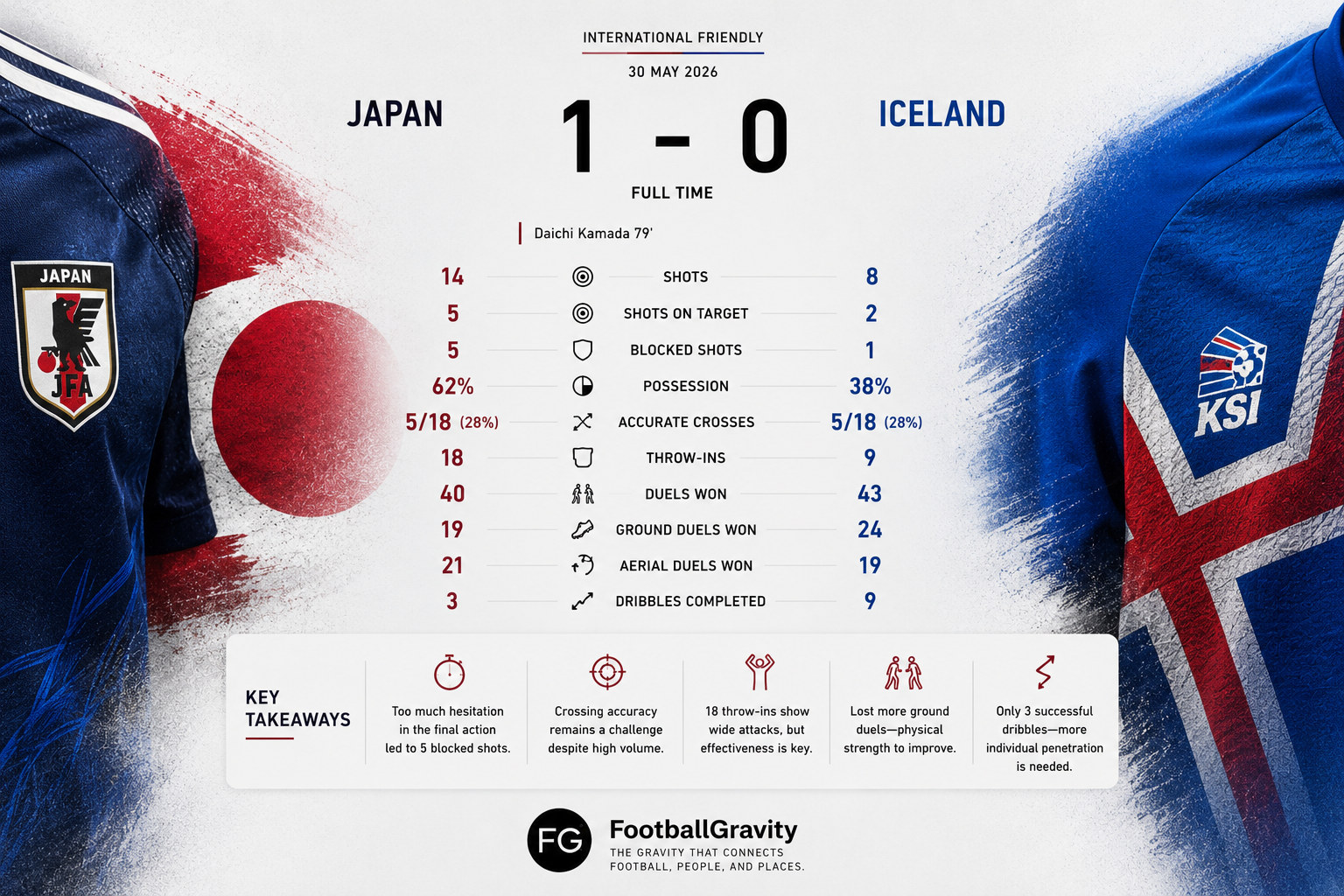
At first glance, Japan controlled many of the game’s core metrics. They recorded more shots, more shots on target, and more possession. Yet despite that territorial advantage, the match rarely felt fully comfortable.
One number stands out immediately: five blocked shots.
That suggests Japan were reaching dangerous areas, but often taking too long to create clean shooting angles or separation inside the box. Against physically compact European defenses, even a fraction of hesitation can be enough for defenders to close space. The issue may not have been chance creation itself, but the speed and sharpness of the final action.
Crossing efficiency also remains an important topic.
Both teams completed five accurate crosses, but Japan required many more attempts to reach that number. A 28% crossing accuracy rate is not disastrous, but at World Cup level, wide attacks often depend on precision rather than volume. Improving timing, positioning, and delivery quality could make Japan’s possession far more dangerous.
Another quietly revealing statistic was throw-ins.
Japan recorded 18 throw-ins — nearly double Iceland’s total. That indicates Japan spent long periods advancing play into wide areas, but it also raises the question of whether those situations were converted into meaningful attacking momentum. Modern football increasingly treats throw-ins as structured attacking phases rather than simple restarts, especially against compact defensive blocks.
Perhaps the most important concern, however, came from the duel numbers.
Japan lost the overall duel battle 40–43, and more notably struggled in ground duels. Interestingly, their aerial duel numbers were relatively competitive, which may surprise many observers given common assumptions about European physical superiority. The larger issue appeared to be second-ball reactions, body positioning, and direct physical resistance in tight spaces.
Dribble success was also limited. Japan completed only three successful dribbles during the match. The absence of Kaoru Mitoma naturally changes the attacking profile of the team, but it also highlighted how heavily Japan sometimes depends on individual progressive carries to destabilize defenses.
Still, this is precisely why matches like this matter before a World Cup.
The performance did not expose fatal weaknesses. Instead, it clarified the margins Japan must sharpen: quicker decision-making near goal, cleaner delivery from wide areas, stronger ground duels, and more individual penetration in transition moments.
The encouraging part is that many of these are adjustable details rather than structural problems.
Japan already showed organization, patience, and enough technical quality to control large portions of the match. What remains is transforming control into efficiency against opponents who are physically disciplined and tactically compact — exactly the type of teams they are likely to face on football’s biggest stage.
In that sense, Iceland may have provided Japan with something more valuable than an easy victory: a realistic reminder of the intensity still waiting at the World Cup.