
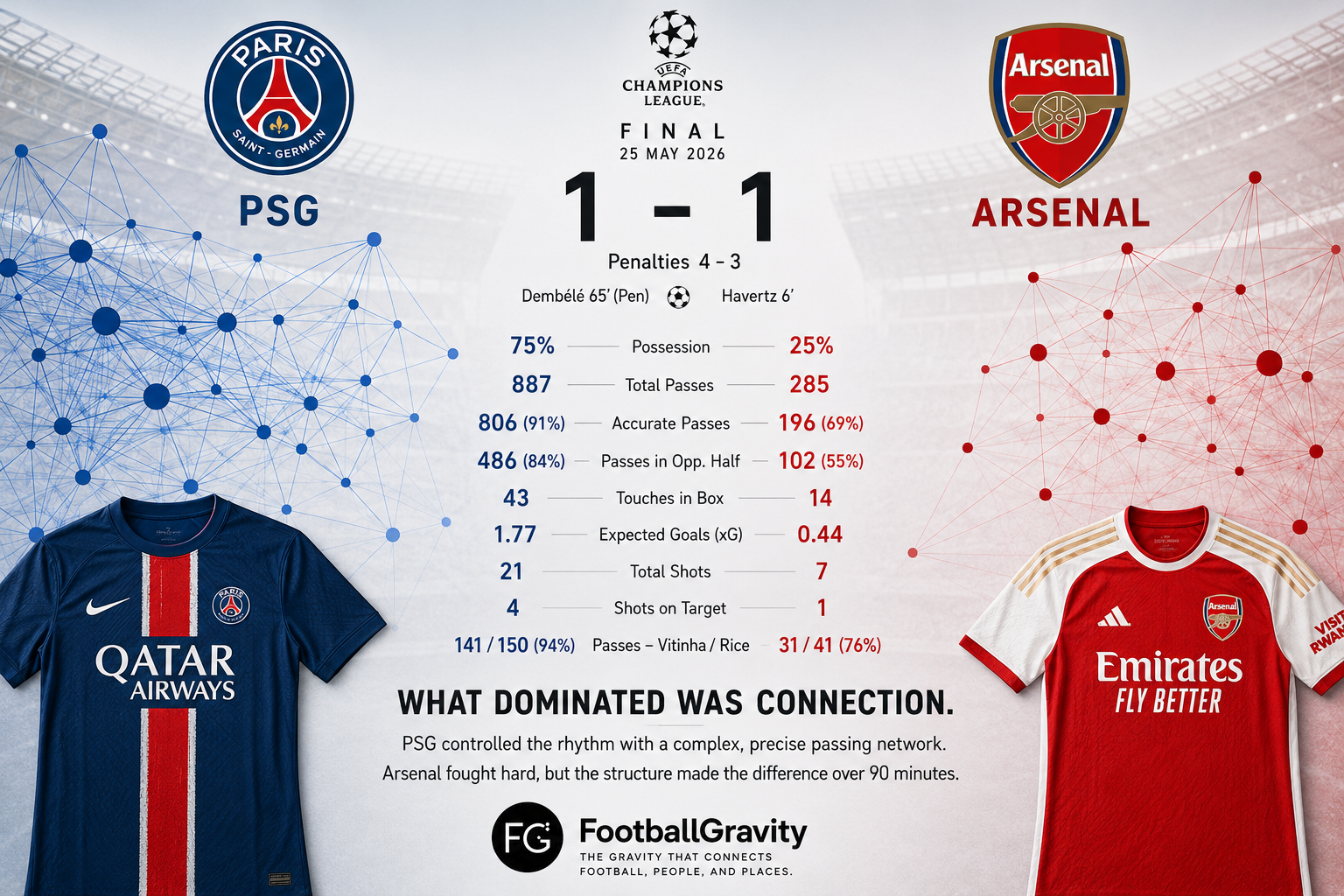
Paris Saint-Germain and Arsenal ended the Champions League final level on the scoreboard.
The match eventually went to penalties.
But beneath the drama, the data tells a very different story.
This was not a balanced game that happened to finish 1-1.
It was a match in which PSG controlled the rhythm, geography, and mental tempo of football itself.
And the clearest symbol of that control may have been Vitinha.
The Match Was Played Inside PSG’s Network
At first glance, Arsenal defended bravely.
They limited clear chances.
They survived long stretches without collapsing.
Declan Rice fought aggressively, covered space, and tried to slow transitions.
But PSG gradually created something more exhausting than pressure.
They created permanence.
- 75% possession
- 887 total passes
- 806 accurate passes (91%)
- 486 successful passes in Arsenal’s half
- 43 touches inside Arsenal’s box
These are not simply attacking numbers.
They describe territorial occupation.
PSG did not only move the ball.
They moved Arsenal.
Every pass forced another defensive shift.
Another rotation.
Another sprint without recovery.
Football fatigue is often invisible.
Sometimes players become tired not from running forward, but from chasing shadows.
Vitinha Was the Center of Gravity
Vitinha completed 141 passes.
Declan Rice completed 31.
The difference is extraordinary, especially considering both players operated near the center of midfield.
Even accounting for different tactical roles, the gap reflects something deeper:
PSG’s midfield existed as a connected circulation system.
Arsenal’s midfield existed as a reaction system.
Vitinha’s heatmap tells the story clearly.
He was everywhere:
- receiving from defenders,
- escaping pressure,
- progressing the ball,
- recycling possession,
- controlling tempo.
Rice, meanwhile, spent much of the match compressing space, defending transitions, and responding to PSG’s positioning.
This is not criticism of Rice.
In many ways, Rice performed heroically.
But one player was dictating the geometry of the game.
The other was trying to survive it.
That difference matters.
PSG’s Passing Network Became Psychological Pressure
One of the most interesting numbers is not xG.
It is pass accuracy.
- PSG: 91%
- Arsenal: 69%
At elite level football, this gap is enormous.
High possession alone is not always meaningful.
Teams can circulate harmlessly.
But PSG’s passing was progressive, positional, and multidirectional.
Vitinha, João Neves, Fabián Ruiz, Hakimi, and Marquinhos constantly formed new passing triangles.
The ball rarely stayed still.
Arsenal could not lock onto stable reference points.
And when defending becomes mentally unstable, physical fatigue follows.
This is why PSG’s dominance felt larger than the scoreline.
Arsenal Still Threatened Through Chaos
And yet, football remains football.
Despite the control gap:
- Arsenal still scored,
- still created moments,
- and still reached penalties.
That is important.
Football is not chess.
A team can dominate territory, possession, and rhythm — and still remain vulnerable to a single transition, set piece, rebound, or mistake.
That uncertainty is part of the sport’s beauty.
Arsenal’s approach relied less on control and more on compression, verticality, and isolated moments.
In another universe, perhaps one decisive counterattack changes everything.
Football always leaves room for alternative realities.
The Final Was About More Than Possession
This match may ultimately be remembered not for penalties, but for structure.
PSG looked like a team operating through interconnected movement and spatial intelligence.
Arsenal looked like a team fighting against a constantly shifting network.
Vitinha’s 141 passes are not just statistics.
They are evidence of a team turning football into circulation.
Not simply attacking.
Not simply defending.
But controlling the emotional and physical rhythm of the match itself.
And for long stretches of this final, Arsenal were not chasing the ball.
They were chasing PSG’s idea of football.