
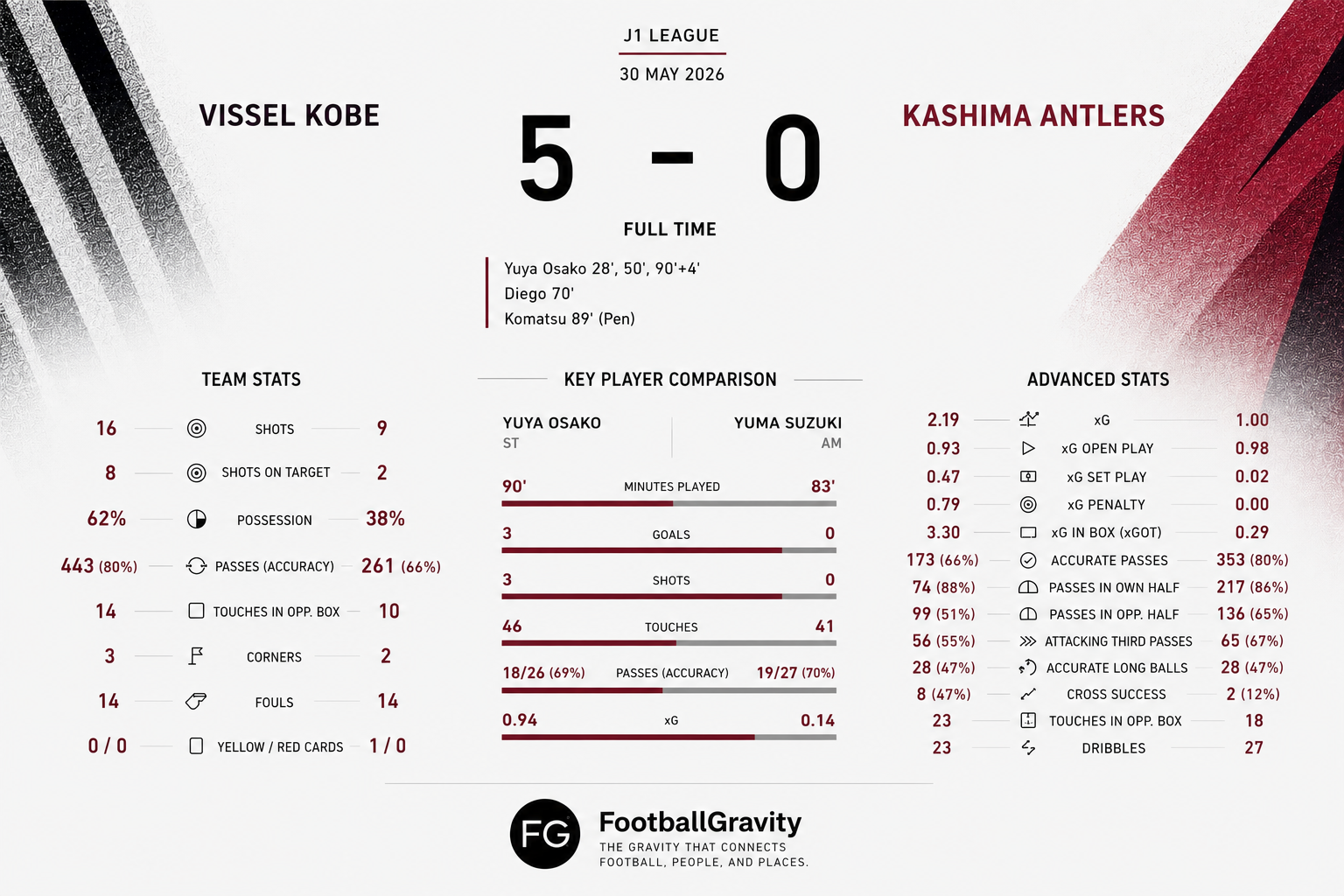
Reading Kobe vs Kashima Through the Data
On May 30, 2026, Vissel Kobe defeated Kashima Antlers 5-0 in one of the most surprising results of the J.League season. Before kickoff, many expected Kashima — last season’s champions and dominant leaders of the East League — to control the match. Instead, football produced something far less predictable.
The Match Everyone Expected — and the One That Actually Happened
Before kickoff, the atmosphere around the game leaned naturally toward Kashima.
Defensive stability.
Organized structure.
Physical intensity.
And an attack built around Yuma Suzuki.
Kobe, meanwhile, possessed experience and individual quality, but many still viewed Kashima as the more complete and reliable side.
Ninety minutes later, however, the scoreboard showed 5-0.
And perhaps most surprisingly, the match did not feel like a random collapse caused by a red card or chaotic counterattacks.
There were long stretches where Kobe appeared fully in control.
The Two Aces
Yuya Osako vs Yuma Suzuki
The clearest contrast in the match came through the two strikers.
Yuya Osako (Kobe)
- 3 goals
- xG: 0.94
- xGOT: 1.64
- 3 shots on target
- 50% shot conversion
- 7 touches inside the box
- 2/2 successful long balls
- Defensive contribution: 2
Meanwhile:
Yuma Suzuki (Kashima)
- 0 goals
- xG: 0.14
- xGOT: 0.00
- 0 shots on target
- Ground duel success: 22%
- Aerial duel success: 0%
The difference was extreme.
Osako Was More Than Clinical
One of the most interesting details is that Osako’s xG (0.94) was not unusually high for a player who scored three times.
In other words, Kobe did not simply create endless open chances.
Instead:
Osako converted a limited number of high-value moments with extraordinary efficiency.
The most revealing number may actually be:
xGOT: 1.64
This metric reflects shot placement quality — how dangerous the shot became after leaving the foot.
Osako’s finishing precision was exceptional.
He repeatedly:
- arrived in the correct space,
- timed his movements perfectly,
- and directed shots into difficult areas for the goalkeeper.
This was not only a striker scoring goals.
It was an elite center-forward controlling decisive moments.
What Happened to Yuma Suzuki?
In contrast, Yuma Suzuki was effectively removed from dangerous areas.
His heatmap shows him dropping deeper and deeper in search of the ball.
But the numbers reveal the larger problem:
- 4 touches inside the box
- 0 shots on target
- xG: 0.14
Kobe prevented him from operating where he is most dangerous.
Even more significant were the duels:
- Ground duel success: 22%
- Aerial duel success: 0%
Kobe’s center-backs consistently won the physical battles, preventing Kashima from establishing a stable attacking reference point.
As a result, Kashima struggled to:
- progress forward cleanly,
- retain possession in advanced areas,
- and recover second balls consistently.
The attack never stabilized.
Kashima Were Not Actually Terrible
Despite the 5-0 scoreline, the data suggests Kashima were not completely dominated.
For example:
- xG: Kashima 1.00
- Total shots: 9
- Shots inside the box: 7
- Touches inside opponent box: 18
This indicates that Kashima still reached relatively dangerous attacking positions.
Their open-play xG (0.98) was also respectable.
But the decisive gap appeared in:
xGOT
Kobe: 3.30
Kashima: 0.29
The difference was not simply chance creation.
It was finishing quality.
Kobe transformed chances into highly accurate shots. Kashima reached promising areas, but failed to produce dangerous final execution.
Why Kobe Won
Not Through Chaos — But Through Maturity
Kobe did not win this match through relentless pressing alone.
What stood out instead was:
- game management,
- positional balance,
- ball retention,
- timing,
- and emotional control.
At the center of all of it was Yuya Osako.
An especially fascinating layer to this story is that Osako himself was once Kashima’s great striker.
Several players on the pitch knew each other well.
And yet, Osako seemed to understand the emotional rhythm of a “final-like” match better than anyone else on the field.
Was 5-0 an Accident?
Probably not entirely.
But it would also be misleading to say the true gap between the teams was five goals.
Football occasionally creates scorelines where:
- finishing efficiency,
- confidence,
- momentum,
- psychology,
- and atmosphere
suddenly amplify everything.
This felt like one of those matches.
The game tilted heavily toward Kobe, and once the emotional balance shifted, the scoreline expanded rapidly.
Football sometimes produces results that feel impossible to fully explain.
Data helps organize the match.
But numbers alone cannot completely capture:
- tension,
- confidence,
- momentum,
- memory,
- familiarity,
- or the instinctive feeling of an elite striker in decisive moments.
5-0.
Behind that score existed something more complicated than luck or simple superiority.
It was a match where football’s emotional and psychological forces amplified reality itself.