
The FIFA World Cup group stage often produces entertaining matches.
Sometimes, however, it offers something more valuable: a glimpse into what may come later.
Brazil versus Morocco was one of those matches.
A 1–1 draw between two teams capable of reaching the quarterfinals, semifinals, or even beyond. For Japan, the match carried additional significance, as both nations have frequently appeared in projections as potential Round of 16 opponents.
More importantly, it provided the first real tournament data point. Qualification campaigns and friendly matches belong to the past. The World Cup creates its own environment, pressures, and rhythms.
This was the first opportunity to observe how two elite teams perform when the stakes become real.
A Duel on the Right Flank
The match featured an intriguing individual battle.
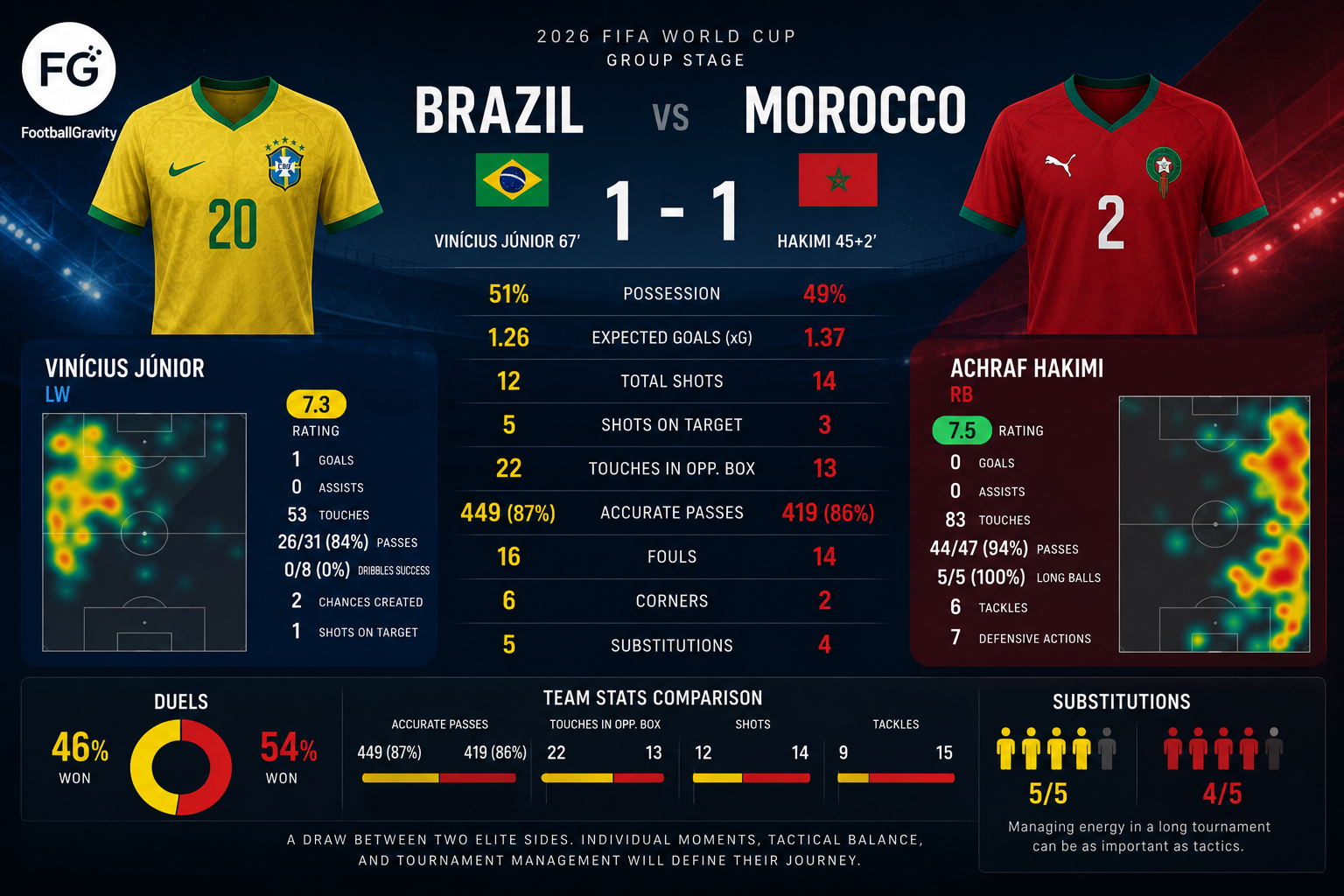
Brazil’s Vinícius Júnior and Morocco’s Achraf Hakimi are among the world’s most recognizable players. Both play for European giants. Both influence matches through speed and attacking transitions. And both often operate in overlapping spaces along Brazil’s left and Morocco’s right.
On paper, Vinícius delivered the decisive moment.
He scored Brazil’s equalizer and once again demonstrated why elite attackers require only a single opportunity to influence a match.
Yet the broader statistical picture tells a different story.
Hakimi’s heat map covered an extraordinary amount of ground. His presence stretched from defensive areas to advanced attacking positions throughout the ninety minutes. He completed every long ball attempted, recorded six tackles, won the majority of his duels, and accumulated strong defensive contributions while remaining an attacking threat.
The contrast was fascinating.
One player changed the scoreline.
The other seemed to influence almost every area of the pitch.
Small Margins, Elite Teams
The overall statistics reflected how evenly matched the teams were.
Brazil slightly led possession with 51%.
Morocco produced a marginally higher expected goals figure (1.37 vs 1.26).
Brazil generated more touches inside the opposition penalty area (22 vs 13).
Morocco won more duels overall and displayed greater success in defensive actions.
Neither side appeared dominant. Neither side appeared vulnerable.
Instead, both demonstrated the characteristics that separate elite international teams from the rest of the field: balance, adaptability, and resilience.
The match also highlighted an increasingly important reality of modern tournament football.
Winning individual moments often matters more than controlling every statistic.
The Management of a Long Tournament
One overlooked detail was the substitution pattern.
Brazil used five substitutions.
Morocco used four.
In previous eras, such decisions might have been viewed purely as tactical adjustments.
Today they are also part of tournament management.
The 2026 World Cup is expected to challenge players with heat, travel, recovery demands, and a congested schedule. Managing energy may become as important as managing tactics.
A team that peaks too early risks fading later.
A team that conserves resources without sacrificing results gains an advantage.
This match suggested that both coaching staffs understand that reality.
The World Cup is not a sprint.
It is a month-long endurance test.
What Does It Mean for Japan?
For Japan, this match offered more questions than answers.
How would defenders such as Tomiyasu, Ito, or Suzuki approach Vinícius in one-on-one situations?
How should Japan respond to the relentless overlapping runs of a player like Hakimi?
Can Japan maintain its pressing intensity against opponents capable of circulating possession under pressure?
These questions are no longer hypothetical.
The tournament has begun.
Every match now creates new evidence.
Every performance becomes part of a growing database that coaches, analysts, and supporters will study.
Brazil versus Morocco ended in a draw.
Yet its significance may extend far beyond the result itself.
The World Cup has entered a new phase.
Not the phase of qualification.
Not the phase of prediction.
The phase of observation.
And for teams with ambitions of reaching the later rounds, that may be the most important stage of all.