The Soundtrack of Football

Football stadium atmosphere with music and supporters during the World Cup

From Queen to Bon Jovi, from England to Dallas

Football has never been only a game of feet.

It is also a game of voices.

Before kickoff, after the final whistle, during a hydration break, on the way back from the stadium, in pubs, trains, fan zones and living rooms, football is always surrounded by music.

At the FIFA World Cup 2026, that feeling has become especially visible.

Songs echo through stadiums not simply as background entertainment, but as part of the tournament itself.

Bon Jovi’s “Livin’ on a Prayer” has become one of the most joyful stadium moments of this World Cup. It is not a football song in a literal sense. Yet somehow, when tens of thousands of people sing it together, it becomes one.

That is the strange power of football music.

Football does not simply borrow songs.

It gives them a second life.

Why Rock Fits Football

The connection between football and music is not accidental.

In England, where the modern game was born, football and rock music have long shared similar social roots.

Both grew from working-class culture.

Both belong to crowds.

Both understand hope, frustration, resistance and release.

That is why songs such as “Wonderwall” by Oasis or “We Will Rock You” by Queen feel so natural in football spaces. They are not tactical. They are emotional.

Football is full of moments when ordinary people believe something extraordinary might happen.

Rock music has always understood that feeling.

The underdog.

The comeback.

The last-minute goal.

The impossible night.

In that sense, football and rock have always spoken the same language.

Stadium Classics

Some songs become football songs not because they were written for football, but because football crowds adopted them.

“You’ll Never Walk Alone” is the clearest example. From Liverpool to stadiums far beyond England, it has become a song of belonging.

“Seven Nation Army” by The White Stripes has travelled even further. Its riff became a universal chant, crossing clubs, countries and languages.

“Freed From Desire” by Gala became another modern stadium anthem, while “Sweet Caroline” has turned into a collective release for England supporters and many others.

These songs work because they are simple enough to share.

A chant.

A rhythm.

A phrase.

A feeling.

Football crowds do not need perfect singing.

They need something to sing together.

World Cup Memories

The World Cup has also created its own official soundtrack.

Ricky Martin’s “The Cup of Life” still carries the bright energy of France 1998.

Shakira’s “Waka Waka” remains perhaps the most globally recognised World Cup song of the modern era.

K’naan’s “Wavin’ Flag” captured another kind of tournament emotion: not just celebration, but longing, movement and global connection.

For Japanese fans, Vangelis’ “Anthem” from the 2002 World Cup carries a special memory. It belongs to the moment when the tournament came to Japan and Korea, and when the World Cup felt physically close for the first time.

The older FIFA Anthem, familiar from the 1990s and early 2000s, also remains deeply connected to the ritual of international football. Even without words, it could make a stadium feel official.

In 2026, Shakira and Burna Boy’s “Dai Dai” continues that tradition, reminding us that World Cup music is no longer tied to one region or one genre. It is global by design.

Japan’s Football Songs

Every football country has its own soundtrack.

Japan is no exception.

UKASUKA-G, the unit formed by Kazutoshi Sakurai of Mr.Children and GAKU-MC, created music closely associated with the Japan national team. “Shori no Emi wo Kimi to” became a familiar song of support for many Japanese fans.

Superfly’s “Tamashii Revolution” is another song that instantly evokes football in Japan. For many supporters, it belongs to the emotional memory of watching the national team on television.

Dragon Ash’s “Fantasista” is different again. It carries the energy of Japanese rock and street culture at the turn of the century, when football was becoming more global, more stylish and more connected to youth culture.

In 2026, Kenshi Yonezu’s “Karasu” adds a new layer as NHK’s soccer theme, showing that Japan continues to create new songs for each football generation.

These songs may not all be known globally.

But that is exactly the point.

Football music is universal because every country has its own version.

Football in Advertising

Some football songs arrive through television rather than stadiums.

Nike’s legendary “Good vs Evil” commercial from the 1990s remains one of the most memorable examples.

Eric Cantona, Ronaldo, Maldini and other stars appeared in a dramatic football fantasy, soundtracked by “Mas Que Nada.”

The song itself was not new.

But the advertisement gave it a football image for a generation of fans.

This is another way football works with music.

It does not always create new songs.

Sometimes it changes how we remember old ones.

A FootballGravity Playlist

This is not a ranking.

It is a matchday journey.

Matchday Warm-up

  • “Livin’ on a Prayer” — Bon Jovi
  • “Don’t Stop Me Now” — Queen
  • “Fantasista” — Dragon Ash
  • “Tamashii Revolution” — Superfly
  • “Shori no Emi wo Kimi to” — UKASUKA-G

Stadium Anthems

  • “You’ll Never Walk Alone” — Gerry & The Pacemakers
  • “Seven Nation Army” — The White Stripes
  • “Wonderwall” — Oasis
  • “We Will Rock You” — Queen
  • “Freed From Desire” — Gala
  • “Sweet Caroline” — Neil Diamond

World Cup Memories

  • “The Cup of Life” — Ricky Martin
  • “Waka Waka” — Shakira feat. Freshlyground
  • “Wavin’ Flag” — K’naan
  • “Dai Dai” — Shakira & Burna Boy
  • “Anthem” — Vangelis
  • “FIFA Anthem” — Franz Lambert
  • “John Denver” – Take Me Home, Country Roads

Victory, Defeat, and the Road Home

  • “We Are the Champions” — Queen
  • “Breakthru” — Queen
  • “Mas Que Nada” — Sérgio Mendes
  • “Karasu” — Kenshi Yonezu
  • “Fix You” — Coldplay

Listen while reading:

Apple Music Playlist
YouTube Playlist

One More Song Before Kickoff

Football needs tactics.

It needs data.

It needs training, scouting, travel, climate control, stadium design and recovery science.

But it also needs songs.

A song can turn a neutral stadium into a shared place.

A song can give courage to a nervous crowd.

A song can heal defeat.

A song can follow supporters long after the match has ended.

Whether your team is still dreaming of the trophy or already heading home, football always leaves us one more thing to carry.

A melody.

Enjoy the soundtrack of this World Cup.

And remember that football has never been only ninety minutes.

Listen While Reading

Music is part of football culture.

We’ve collected the songs featured in this article so you can continue the matchday atmosphere wherever you are.
🎵 Apple Music Playlist

The Lessons of Doha: How Japan Stayed Calm Against the Netherlands

The Netherlands and Japan was one of the most anticipated group-stage matches of the 2026 FIFA World Cup.

Both nations arrived in the tournament with genuine ambitions of reaching the latter stages. The Netherlands entered as one of Europe’s most consistent contenders, while Japan carried growing expectations after its remarkable performances in recent World Cups.

The match delivered.

A dramatic 2-2 draw combined technical quality, tactical discipline, and moments of individual brilliance. More importantly, it revealed something about how this Japanese team has evolved.

Numbers Favored the Netherlands

The statistics suggested a Dutch advantage.

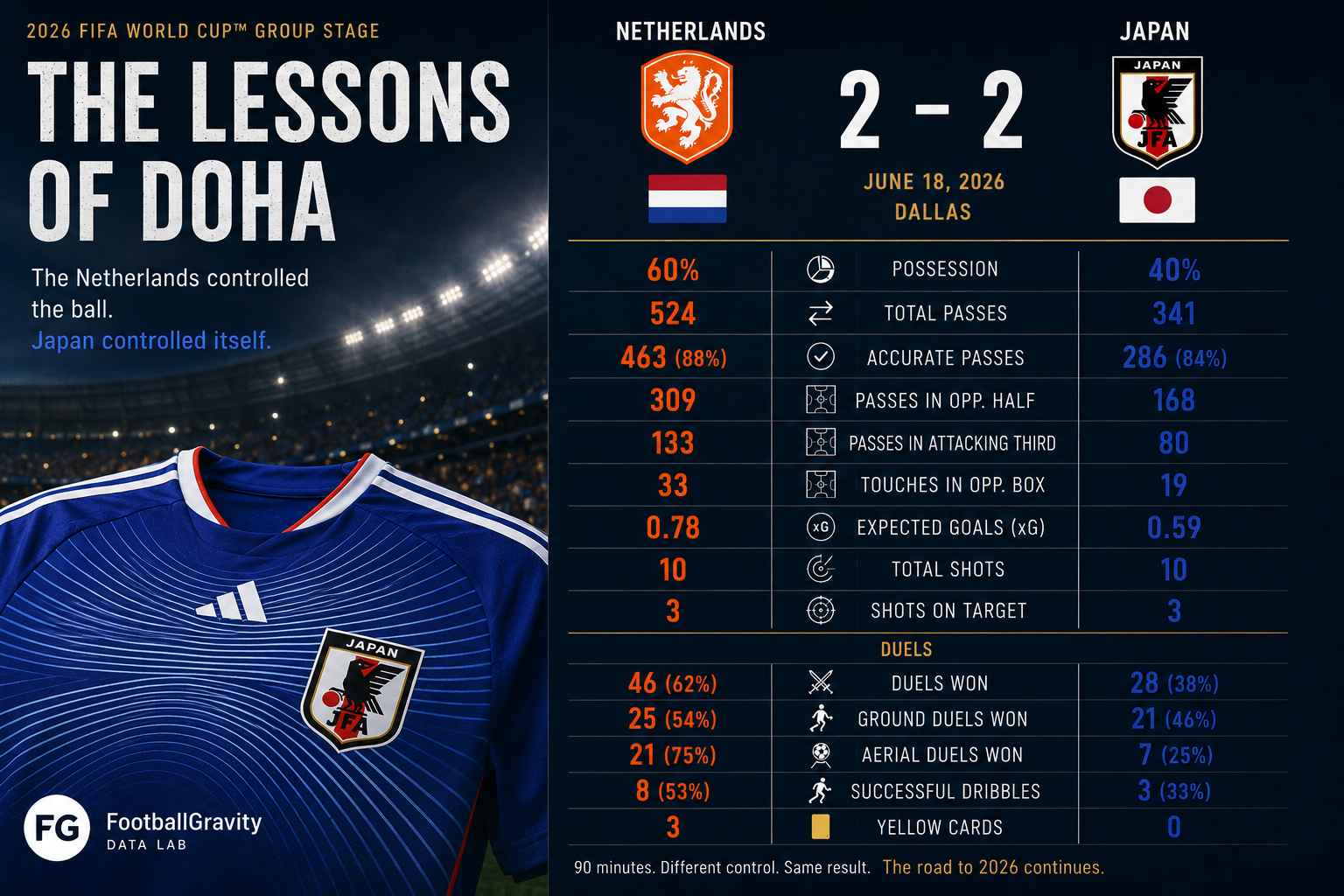
The Netherlands controlled 60 percent of possession, completed more than 500 passes, and generated slightly more territorial control throughout the match. They entered Japan’s penalty area more frequently and dictated long stretches of the game’s rhythm.

On paper, it was the Netherlands who controlled the match.

Yet the contest never felt one-sided.

Japan accepted periods without the ball, remained organized, and repeatedly found ways to respond whenever momentum appeared to swing against them.

That may have been the most important statistic of all.

A Match Played in Quarters

The Texas heat created an unusual dynamic.

Cooling breaks effectively divided the match into shorter segments, making the game feel closer to a four-quarter contest than a traditional ninety-minute match.

For some teams, interruptions can disrupt momentum.

For Japan, they seemed to provide opportunities.

Players gathered frequently, exchanged information, and recalibrated their positioning. The team appeared to treat every restart as a chance to reset collectively.

Combined with halftime and the moments immediately following each conceded goal, Japan effectively received multiple opportunities to reorganize and refocus.

Each time, they returned looking composed.

The Difference Between Panic and Control

One of the most striking aspects of the match was what did not happen.

After conceding goals, there were no visible signs of frustration. No blaming teammates. No emotional collapse. No rush to abandon the game plan.

The reactions looked almost routine.

As if difficult moments had already been anticipated and rehearsed.

This was not a team trying to avoid mistakes.

It was a team prepared for them.

That distinction matters at a World Cup.

Tournament football is rarely won by teams that avoid adversity. It is often won by teams that know how to respond when adversity inevitably arrives.

Japan looked ready.

The Long Shadow of Doha

Japanese football has carried the memory of Doha for more than three decades.

The “Agony of Doha” in 1993 remains one of the defining moments in the nation’s football history. A World Cup dream disappeared in stoppage time, leaving lessons about concentration, game management, and emotional control that shaped an entire generation.

One of the players on the pitch that night was Hajime Moriyasu.

Today, he stands on the touchline as Japan’s head coach.

His team also carries another Doha memory.

In 2022, Japan produced one of the greatest achievements in its history by overturning Germany and Spain at the World Cup in Qatar.

The agony and the joy were born in the same city.

Both experiences appear woven into the identity of this team.

Watching Japan calmly navigate difficult moments against the Netherlands, it was difficult not to see traces of those lessons.

There was no sign of panic.

There was no sign of complacency.

A team shaped by both disappointment and triumph tends to understand that matches are never over until they truly are.

More Than a Draw

A 2-2 draw against the Netherlands will not define this tournament.

But it offered an important reference point.

The Netherlands may have controlled more of the ball.

They may have completed more passes and spent more time in advanced areas.

Japan controlled something else.

Themselves.

As the knockout stage approaches, that quality may prove just as valuable as any tactical system or statistical advantage.

From Doha to Dallas, Japanese football continues to carry its lessons forward.

And on one of the biggest stages in world football, those lessons were visible once again.

Brazil vs Morocco: A New Benchmark for the Knockout Stage

The FIFA World Cup group stage often produces entertaining matches.

Sometimes, however, it offers something more valuable: a glimpse into what may come later.

Brazil versus Morocco was one of those matches.

A 1–1 draw between two teams capable of reaching the quarterfinals, semifinals, or even beyond. For Japan, the match carried additional significance, as both nations have frequently appeared in projections as potential Round of 16 opponents.

More importantly, it provided the first real tournament data point. Qualification campaigns and friendly matches belong to the past. The World Cup creates its own environment, pressures, and rhythms.

This was the first opportunity to observe how two elite teams perform when the stakes become real.

A Duel on the Right Flank

The match featured an intriguing individual battle.

Brazil’s Vinícius Júnior and Morocco’s Achraf Hakimi are among the world’s most recognizable players. Both play for European giants. Both influence matches through speed and attacking transitions. And both often operate in overlapping spaces along Brazil’s left and Morocco’s right.

On paper, Vinícius delivered the decisive moment.

He scored Brazil’s equalizer and once again demonstrated why elite attackers require only a single opportunity to influence a match.

Yet the broader statistical picture tells a different story.

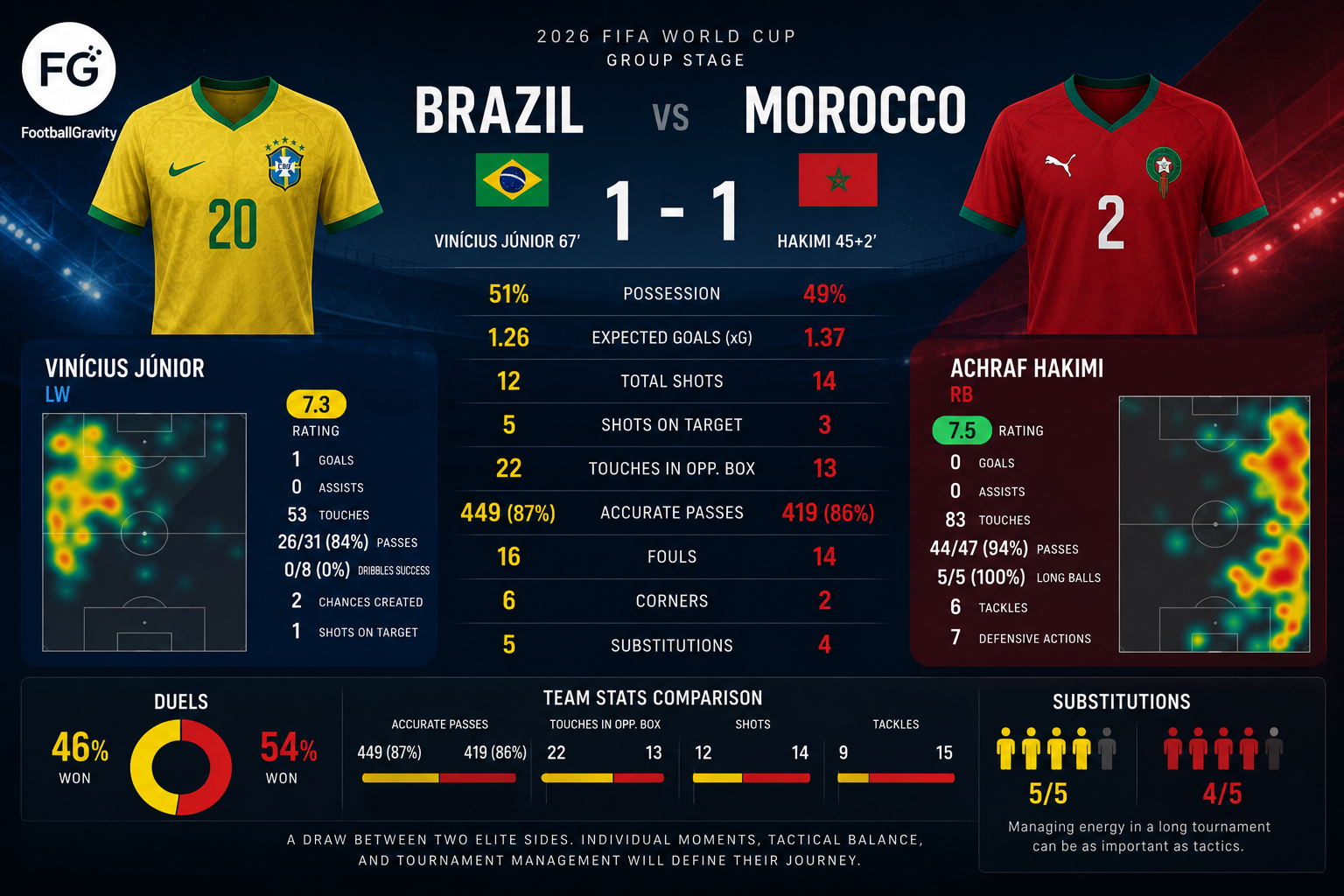
Hakimi’s heat map covered an extraordinary amount of ground. His presence stretched from defensive areas to advanced attacking positions throughout the ninety minutes. He completed every long ball attempted, recorded six tackles, won the majority of his duels, and accumulated strong defensive contributions while remaining an attacking threat.

The contrast was fascinating.

One player changed the scoreline.

The other seemed to influence almost every area of the pitch.

Small Margins, Elite Teams

The overall statistics reflected how evenly matched the teams were.

Brazil slightly led possession with 51%.

Morocco produced a marginally higher expected goals figure (1.37 vs 1.26).

Brazil generated more touches inside the opposition penalty area (22 vs 13).

Morocco won more duels overall and displayed greater success in defensive actions.

Neither side appeared dominant. Neither side appeared vulnerable.

Instead, both demonstrated the characteristics that separate elite international teams from the rest of the field: balance, adaptability, and resilience.

The match also highlighted an increasingly important reality of modern tournament football.

Winning individual moments often matters more than controlling every statistic.

The Management of a Long Tournament

One overlooked detail was the substitution pattern.

Brazil used five substitutions.

Morocco used four.

In previous eras, such decisions might have been viewed purely as tactical adjustments.

Today they are also part of tournament management.

The 2026 World Cup is expected to challenge players with heat, travel, recovery demands, and a congested schedule. Managing energy may become as important as managing tactics.

A team that peaks too early risks fading later.

A team that conserves resources without sacrificing results gains an advantage.

This match suggested that both coaching staffs understand that reality.

The World Cup is not a sprint.

It is a month-long endurance test.

What Does It Mean for Japan?

For Japan, this match offered more questions than answers.

How would defenders such as Tomiyasu, Ito, or Suzuki approach Vinícius in one-on-one situations?

How should Japan respond to the relentless overlapping runs of a player like Hakimi?

Can Japan maintain its pressing intensity against opponents capable of circulating possession under pressure?

These questions are no longer hypothetical.

The tournament has begun.

Every match now creates new evidence.

Every performance becomes part of a growing database that coaches, analysts, and supporters will study.

Brazil versus Morocco ended in a draw.

Yet its significance may extend far beyond the result itself.

The World Cup has entered a new phase.

Not the phase of qualification.

Not the phase of prediction.

The phase of observation.

And for teams with ambitions of reaching the later rounds, that may be the most important stage of all.

Going to America, 32 Years Later

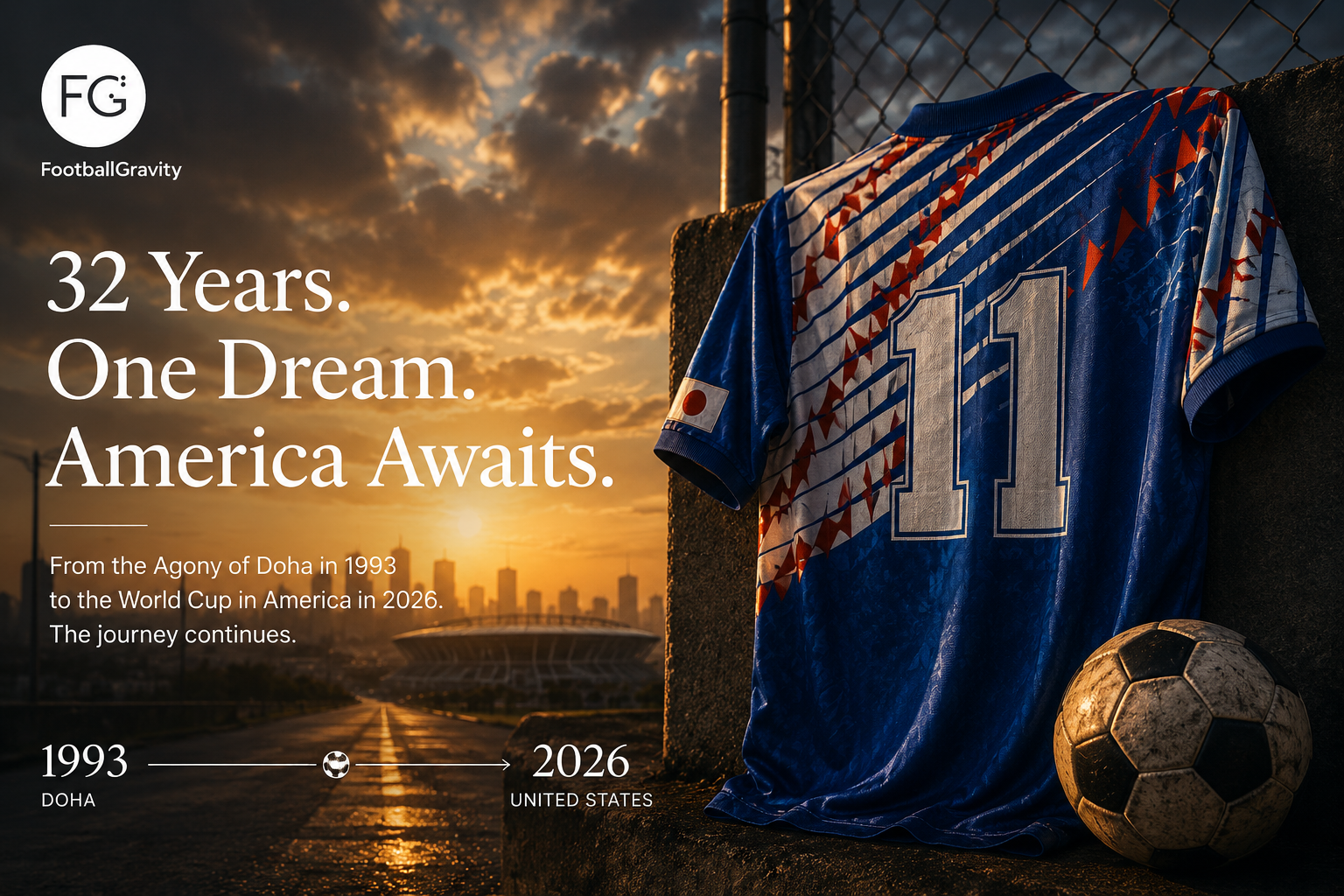
A football supporter wearing a vintage number 11 jersey looking toward a distant stadium under an American sunset sky

The Dream That Stopped in Doha

On October 28, 1993, Japan stood only minutes away from history.

A victory against Iraq would have sent the nation to its first FIFA World Cup.

Instead, a late equalizer arrived from a short corner.

2–2.

The final whistle followed.

And a dream disappeared.

Japanese football remembers that night simply as “The Agony of Doha.”

For those who watched it, the memory never really left.


One More Step

Football history is often measured in goals.

But sometimes it is measured in centimeters.

In Doha, there were moments that came down to one final step.

One final touch.

One final clearance.

Among the players desperately trying to close down the cross was a young midfielder named Hajime Moriyasu.

Nearby was Japan’s star forward, Kazuyoshi Miura — KAZU — the face of Japanese football.

Both were close.

Not close enough.

History rarely explains how painful “almost” can be.


Before World Cups Became Normal

Today, Japan has qualified for eight consecutive World Cups.

For younger supporters, qualification can almost feel expected.

In 1993, it was the opposite.

Japan had never appeared on football’s biggest stage.

The J.League had only recently begun.

Captain Tsubasa had taught an entire generation to dream about the World Cup.

But dreams remained dreams.

The tournament existed somewhere far away, on television screens and magazine pages.

America felt unimaginably distant.


The Heroes Who Never Went

That Doha squad contained many of the defining figures of Japanese football.

Masami Ihara.
Tetsuji Hashiratani.
Shigetatsu Matsunaga.
Kenta Hasegawa.
Masashi Nakayama.
Ramos Ruy.
Kazu.

Some became legends.

Some became coaches.

Some became memories.

Yet none of them reached the World Cup that year.

Their generation built the foundation of Japanese football without receiving the reward they had spent their careers chasing.

That may be one of the cruelest truths in sport.


The Quiet Player Who Stayed

Among those stars stood Moriyasu.

He was not the most famous player.

Not the most marketable.

Not the headline.

Few people in 1993 would have predicted that he would become the most influential figure from that generation.

Yet history often favors patience.

Thirty-two years later, it is Moriyasu who leads Japan back toward America.

Not as a player.

As the manager of the national team.


Football’s Long Memory

Sport moves quickly.

Football remembers slowly.

The players on Japan’s 2026 squad were not even born when Doha happened.

Many grew up watching entirely different generations.

Yet football cultures carry memories across decades.

The lessons.

The scars.

The ambitions.

The unfinished journeys.

In that sense, every World Cup team carries more people than the twenty-six names listed on the squad sheet.


Going to America

There is something poetic about the destination.

America.

The World Cup Japan nearly reached in 1993.

The World Cup KAZU dreamed of.

The World Cup that slipped away.

And now, after thirty-two years, Japan returns.

This time as one of the strongest teams in Asia.

This time with genuine ambitions.

This time led by a man who knows exactly how quickly dreams can disappear.

No one understands complacency less than Hajime Moriyasu.

He has already lived the consequences.


More Than a Tournament

For some supporters, this World Cup is not simply another competition.

It is a continuation.

A journey paused in Doha and resumed three decades later.

Some will travel to the United States wearing modern shirts.

Others may wear old ones.

Perhaps even the number 11.

Not because football can rewrite history.

But because football allows history to travel with us.

And somewhere between Doha and America, between 1993 and 2026, between KAZU and the next generation, a dream continues moving forward.

Thirty-two years later.

America is finally waiting.


With old No.11

This summer, I will travel to America wearing an old No.11 shirt.

Not because football owes us anything.

But because some journeys deserve to be completed.