
Dallas Files #1

More Than a Stadium

What AT&T Stadium Teaches About the Future of Football

Most stadium reviews begin with seats, food, or atmosphere.

AT&T Stadium deserves a different approach.

After spending an entire matchday there during the FIFA World Cup 2026, one thing became clear:

This is not simply a stadium.

It is an ecosystem.

Before You Even Enter

The experience begins long before the ticket gates.

Instead of surrounding visitors with endless parking lots and concrete roads, the stadium opens into something unexpected.

Wide green spaces.

Walking paths.

Small waterways.

Trees.

Open lawns where families gather and supporters relax before kickoff.

It feels less like approaching a sports venue and more like arriving at a public park.

Supporters naturally slow down.

They walk.

They sit.

They talk.

The World Cup begins well before the referee blows the whistle.

A Festival Rather Than an Entrance

Beyond the security gates, the atmosphere changes again.

Food trucks.

Music.

Outdoor seating.

Large grassy areas.

Fans from different countries eating together under the Texas sun.

Children kicking footballs.

Groups taking photos.

Rather than simply waiting for kickoff, people spend hours enjoying the place itself.

The stadium is not merely a destination.

It is an all-day festival.

That distinction matters.

Great tournaments are remembered not only for ninety minutes of football, but for the experiences surrounding those ninety minutes.

AT&T Stadium understands this perfectly.

Designed Around the Spectator

Inside, the architecture continues to impress.

The most iconic feature is the enormous centre-hung video board, manufactured by Mitsubishi Electric.

Unlike traditional stadiums, where replay screens sit high behind one goal, this display hangs directly above the centre circle.

The difference is surprisingly significant.

Supporters never need to turn completely away from the pitch.

The action, the replays and the atmosphere remain connected.

Rather than interrupting the match experience, the technology becomes part of it.

Combined with the stadium’s powerful sound system, the effect is closer to a live concert than a conventional football match.

Every goal celebration feels immersive.

Every pre-match sequence feels cinematic.

It is entertainment without sacrificing football itself.

Small Details That Matter

The stadium’s scale is extraordinary, yet movement inside rarely feels stressful.

Restrooms remained remarkably accessible.

Food and drink outlets were distributed throughout the concourses.

Even with tens of thousands of spectators, congestion was surprisingly limited.

These details rarely appear in highlight videos.

Yet they shape the overall experience just as much as the match itself.

The best stadiums succeed because thousands of small design decisions quietly disappear into the background.

More Than Home Advantage

For Japan, there may also be a competitive benefit.

Playing two Group F matches in the same stadium means familiarity.

The climate is controlled beneath the roof.

Players become accustomed to the lighting, the pitch, the sightlines and even the rhythm of the venue.

These are subtle advantages, but tournament football is often decided by subtle margins.

A Stadium That Belongs to the City

AT&T Stadium is frequently described as one of the world’s greatest sporting venues.

After spending an entire day there, that reputation feels deserved.

What impressed me most was not its size.

It was the way architecture, public space, football and everyday life blended into one continuous experience.

Many stadiums host matches.

Few become part of the city itself.

Perhaps the future of football is not simply about building bigger stadiums.

Perhaps it is about building better places.

And AT&T Stadium offers a compelling blueprint for what that future might look like.
Reading Group F Through Two Matches

Group F analysis comparing Japan and the Netherlands at the 2026 FIFA World Cup

Not Just Winning, But Controlling

The second round of Group F offered an intriguing comparison.

Japan defeated Tunisia convincingly.
The Netherlands comfortably handled Sweden.

On paper, the results simply reinforced what many observers already suspected: Japan and the Netherlands have emerged as the two strongest teams in the group.

Yet the more interesting story lies beneath the scorelines.

These matches did not merely reveal who won.
They revealed how they won.

And perhaps, they also revealed why the opening 2–2 draw between Japan and the Netherlands now looks even more impressive than it did at the time.

The Myth of Physical Dominance

Football often rewards a simple narrative.

The stronger team wins more duels.
The stronger team runs harder.
The stronger team overwhelms the weaker one physically.

But the statistics from both matches suggest something different.

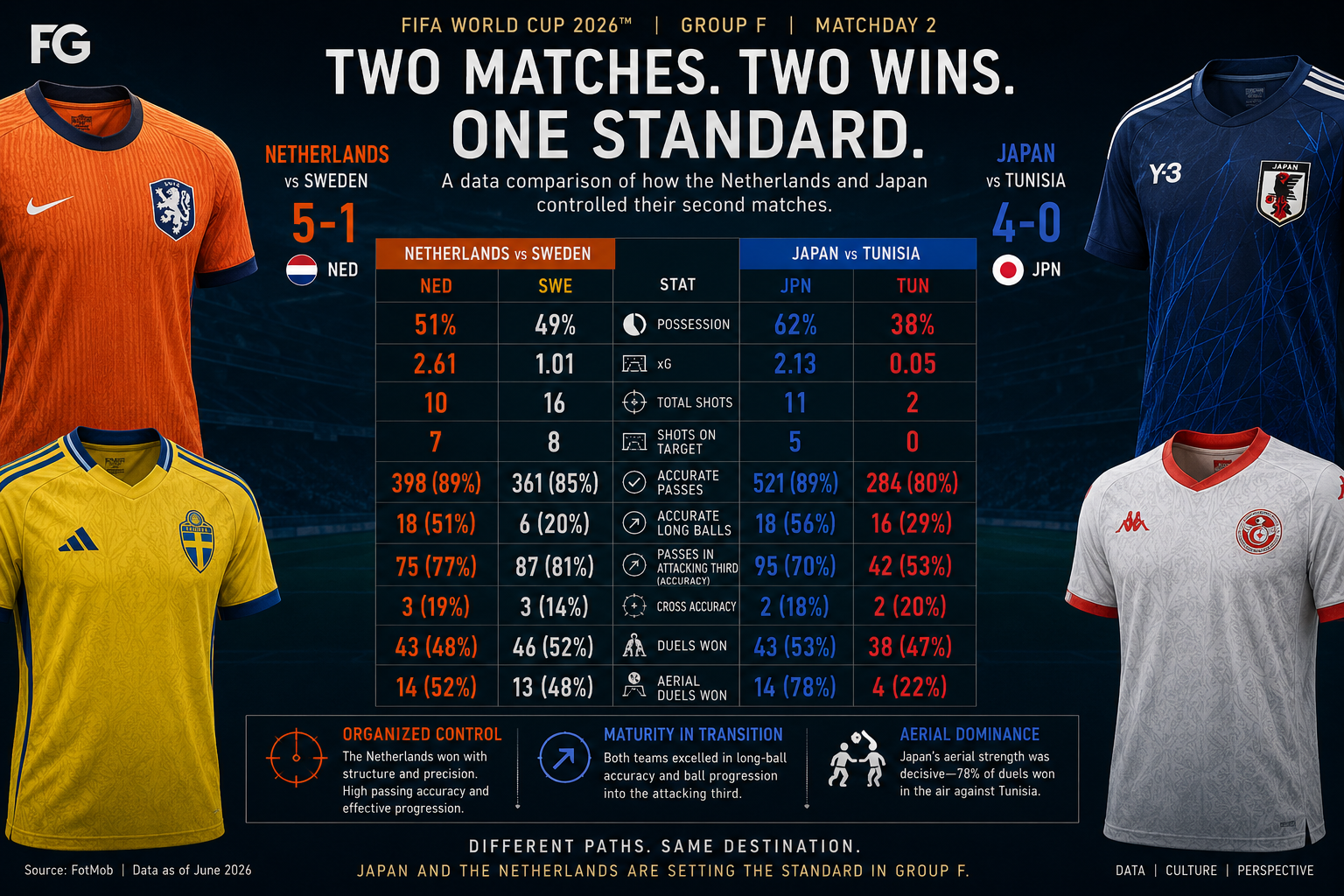
Japan defeated Tunisia 4–0 while winning only 53 percent of total duels.

The Netherlands beat Sweden 5–1 despite actually losing the overall duel count by a narrow margin.

Yet neither match felt close.

That difference matters.

The strongest teams are not necessarily the teams that win every battle.

They are often the teams that decide where the battles take place.

Japan and the Netherlands consistently placed themselves in situations where they needed fewer desperate actions, fewer emergency tackles, and fewer physical recoveries.

Control is often invisible until it is compared with chaos.

A Shared Strength: Precision in Advanced Areas

One statistic stands out across both teams.

Neither side produced particularly remarkable crossing numbers.

Japan completed just 18 percent of its crosses.
The Netherlands completed 19 percent.

Crosses remain an important weapon, but they were not the primary reason these teams created danger.

Instead, two other categories deserve attention.

First, long-ball accuracy.

Japan completed 56 percent of its accurate long balls.
The Netherlands completed 51 percent.

These numbers are not spectacular on their own, but they become significant when viewed alongside what happened next.

Second, and more importantly, both teams maintained exceptional passing quality in advanced areas.

Japan completed 70 percent of its passes in the attacking third.

The Netherlands recorded 77 percent.

Even Sweden, despite defeat, managed 81 percent.

These are unusually high numbers for the most congested and difficult part of the pitch.

They suggest teams capable not merely of reaching dangerous areas, but of remaining composed once they arrive.

The Netherlands have long been associated with this style. Their football tradition combines patient circulation with the ability to switch play instantly through accurate longer passes.

Japan’s presence in the same conversation is more surprising.

And perhaps more significant.

How Japan Has Changed

For many years, Japan’s strengths were easy to identify.

Technical quality.
Collective movement.
Short passing combinations.

Yet there were also recurring limitations.

Long passes often lacked precision.
Attacking moves frequently stalled in the final third.
Possession could be maintained, but not always converted into danger.

Against Tunisia, signs of evolution were visible.

Japan moved the ball forward more directly when necessary.

Longer passes connected with greater consistency.

Most importantly, combinations in advanced areas survived under pressure.

The result was not simply a victory.

It was evidence of a team that has expanded its toolbox.

A team that can now solve different problems in different ways.

The Air Above the Pitch

One category deserves special mention.

Aerial duels.

Japan won 78 percent of them against Tunisia.

That number is extraordinary at World Cup level.

It is also a reminder of how much Japanese football has changed.

Players such as Tomiyasu, Itakura, and Ito have developed in elite European environments where physical confrontation is unavoidable.

Midfielders such as Sano add another layer of athletic presence.

But this is about more than height.

It reflects a broader shift in the profile of Japanese football.

Technical excellence is no longer arriving alone.

It is increasingly accompanied by physical robustness and tactical maturity.

Why the Netherlands–Japan Draw Looks Different Now

Group F is beginning to resemble a familiar pattern.

Two teams separating themselves from the rest.

Two teams capable of controlling matches through structure rather than emotion.

That context changes how we view the opening match between Japan and the Netherlands.

A 2–2 draw initially looked like an entertaining result.

Now it looks like a meeting between two of the group’s most complete teams.

The statistics from Matchday Two reinforce that impression.

Neither side overwhelmed opponents through individual brilliance alone.

Neither side relied purely on physical superiority.

Instead, both demonstrated something more difficult to build.

The Netherlands controlled Sweden despite near-even possession and a slight deficit in total duels.

Japan controlled Tunisia through overwhelming superiority in possession, passing quality, and aerial dominance.

Different routes.

The same destination.

Collective control.

And in modern tournament football, that may be the most valuable quality of all.

World Cup Extra Time: The Match After the Match

Sometimes the most memorable football of a World Cup is not played inside the stadium.

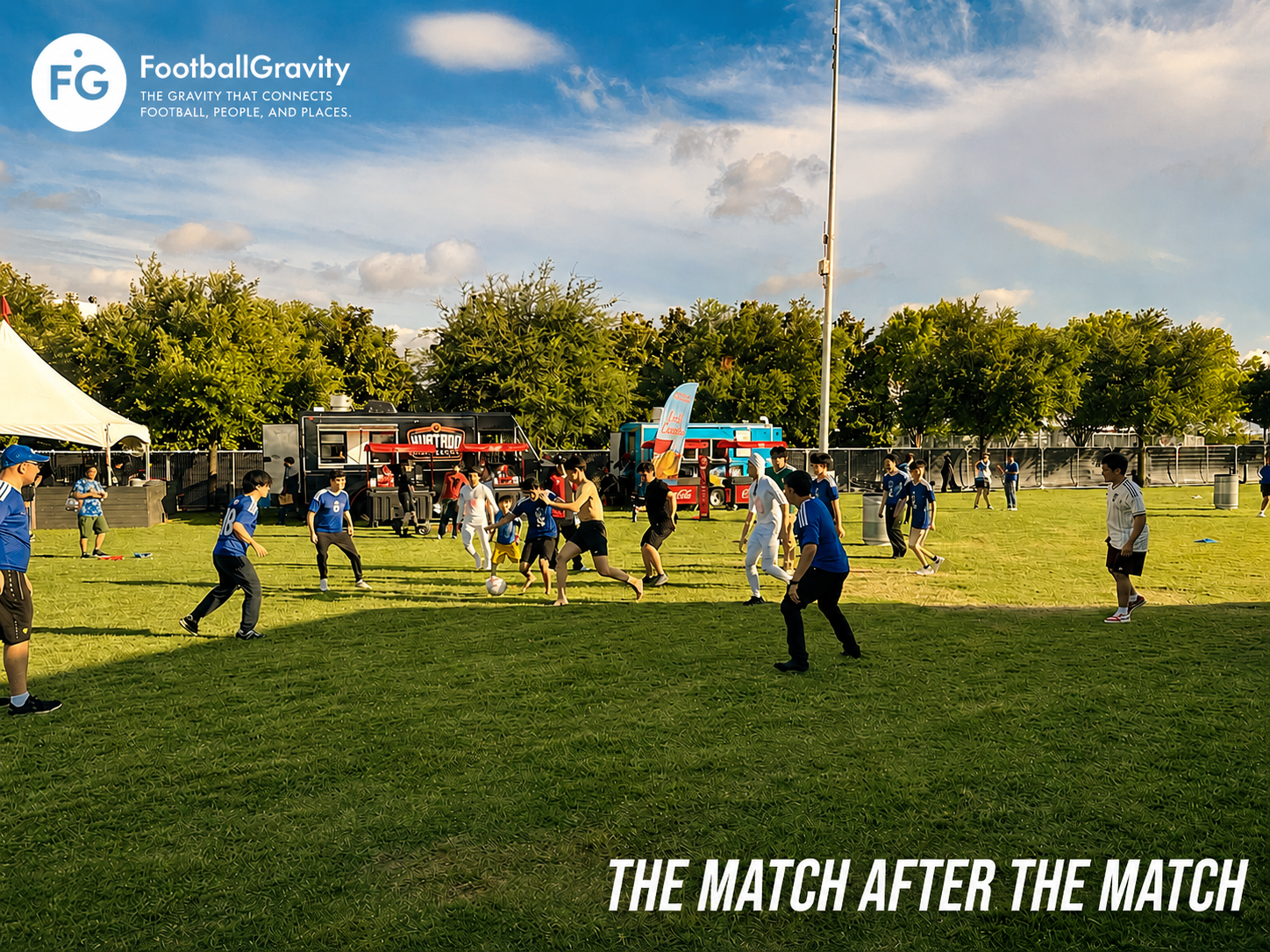
After Japan and the Netherlands delivered one of the tournament’s most captivating matches, thousands of supporters slowly streamed out into the vast grounds surrounding the stadium in Dallas. The game itself had been excellent. The atmosphere was electric. Most people would have been satisfied to take photos, buy souvenirs, and head home carrying the memories of a thrilling evening.

Instead, something else happened.

A ball appeared.

And football began again.

One Ball, No Rules, No Borders

The match took place not inside the stadium, but in the open supporter zone beyond the gates—a space reserved for ticket holders, filled with food trucks, merchandise stands, bars, and places to relax before and after the game.

There were no referees.

No organized teams.

No official goals.

No registration.

No language requirements.

Just a group of strangers who looked at a football and instinctively understood what to do next.

Within minutes, Japanese supporters, Dutch supporters, Americans, and Mexican fans had become teammates and opponents at the same time. Some wore national-team shirts. Others had simply wandered over after hearing laughter and seeing a crowd gather around the ball.

Names were unknown.

Languages were different.

Football was enough.

The Universal Language

One of football’s great strengths is its simplicity.

You do not need expensive equipment. You do not need a carefully prepared pitch. You do not even need shared words.

A pass communicates intention.

A run communicates possibility.

A raised hand communicates gratitude.

Within a few minutes, everyone understands who likes to dribble, who prefers to pass, who defends aggressively, and who plays with quiet elegance. Football reveals personality remarkably quickly.

Watching the scene unfold in Dallas, it became clear that the sport’s greatest power may not be its professional competitions, but its ability to create instant communities.

The World Cup gathers nations.

A football creates connections.

The Best Match of the Day?

The official match had featured elite athletes, tactical preparation, and global attention.

The unofficial match featured none of those things.

Yet the joy felt remarkably similar.

Many of the participants had spent ninety minutes passionately supporting their countries inside one of the world’s most celebrated stadiums. Moments later, they were chasing the same ball together, laughing at mistakes, applauding good plays, and celebrating goals that nobody would ever record.

There was no scoreboard.

No statistics.

No highlights package.

Only football.

In some ways, it captured the essence of the game more clearly than the professional spectacle that preceded it.

A Stadium Designed for People

This scene was only possible because the environment allowed it.

The stadium precinct offered more than transportation and security. It provided space for people to stay, gather, interact, and create their own experiences.

That is an often-overlooked aspect of football infrastructure.

Great stadiums are not merely places to watch matches. They are places where football culture can emerge organically.

How many major venues around the world would welcome an impromptu multinational kickabout after a World Cup match?

How many would have the space, atmosphere, and sense of trust required for it to happen naturally?

Dallas deserves credit for creating the conditions.

The supporters supplied the rest.

Football Beyond the Final Whistle

The World Cup is often described as a competition between nations.

Yet moments like this suggest something different.

Perhaps the tournament’s greatest achievement is not deciding a champion, but reminding millions of people that they already share something in common.

A ball.

A game.

A language that requires no translation.

Long after the result of Japan versus the Netherlands fades from memory, many supporters may remember a different match—the one played on a patch of grass outside the stadium, among strangers who became teammates for an evening.

That, too, was the World Cup.

The Lessons of Doha: How Japan Stayed Calm Against the Netherlands

The Netherlands and Japan was one of the most anticipated group-stage matches of the 2026 FIFA World Cup.

Both nations arrived in the tournament with genuine ambitions of reaching the latter stages. The Netherlands entered as one of Europe’s most consistent contenders, while Japan carried growing expectations after its remarkable performances in recent World Cups.

The match delivered.

A dramatic 2-2 draw combined technical quality, tactical discipline, and moments of individual brilliance. More importantly, it revealed something about how this Japanese team has evolved.

Numbers Favored the Netherlands

The statistics suggested a Dutch advantage.

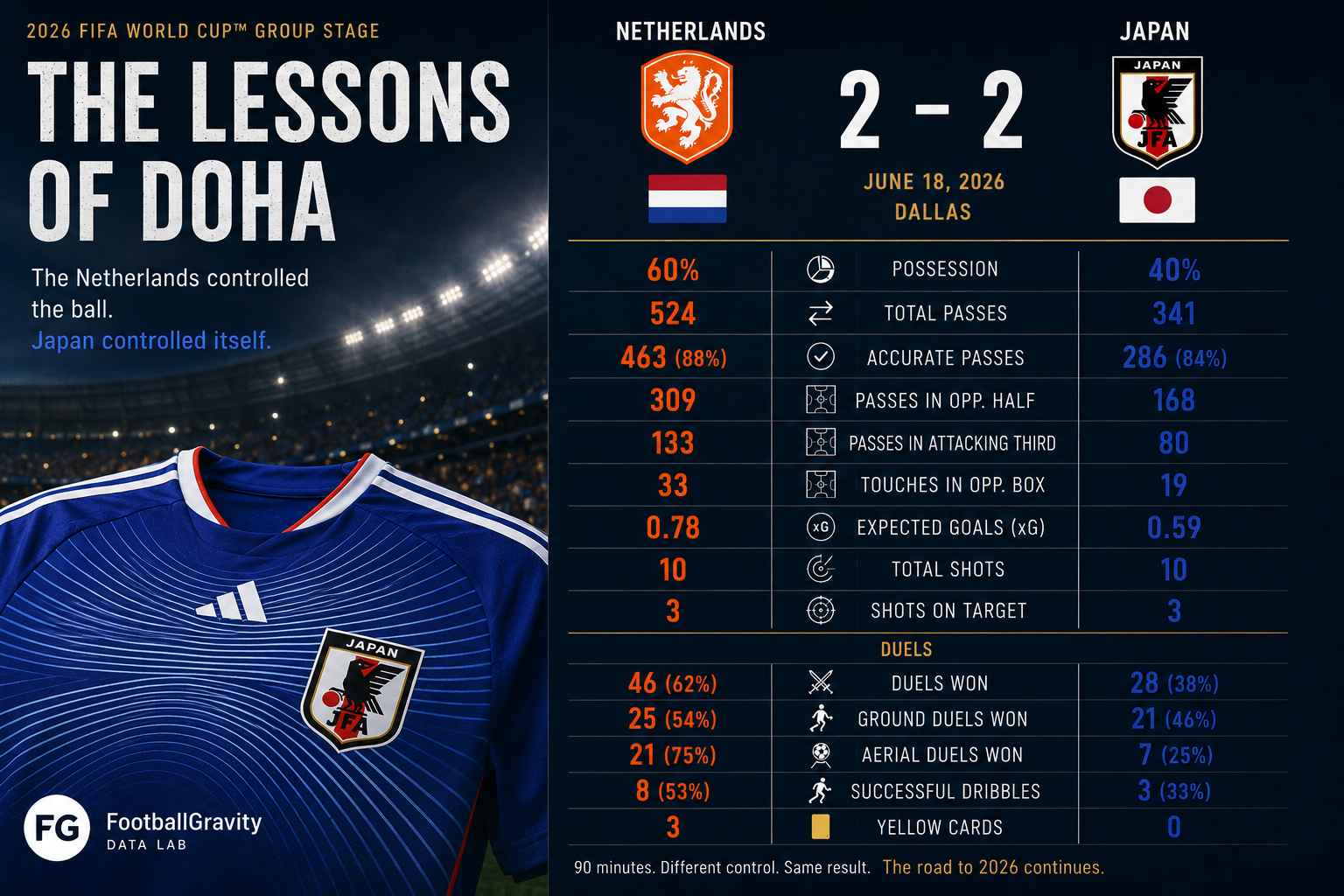
The Netherlands controlled 60 percent of possession, completed more than 500 passes, and generated slightly more territorial control throughout the match. They entered Japan’s penalty area more frequently and dictated long stretches of the game’s rhythm.

On paper, it was the Netherlands who controlled the match.

Yet the contest never felt one-sided.

Japan accepted periods without the ball, remained organized, and repeatedly found ways to respond whenever momentum appeared to swing against them.

That may have been the most important statistic of all.

A Match Played in Quarters

The Texas heat created an unusual dynamic.

Cooling breaks effectively divided the match into shorter segments, making the game feel closer to a four-quarter contest than a traditional ninety-minute match.

For some teams, interruptions can disrupt momentum.

For Japan, they seemed to provide opportunities.

Players gathered frequently, exchanged information, and recalibrated their positioning. The team appeared to treat every restart as a chance to reset collectively.

Combined with halftime and the moments immediately following each conceded goal, Japan effectively received multiple opportunities to reorganize and refocus.

Each time, they returned looking composed.

The Difference Between Panic and Control

One of the most striking aspects of the match was what did not happen.

After conceding goals, there were no visible signs of frustration. No blaming teammates. No emotional collapse. No rush to abandon the game plan.

The reactions looked almost routine.

As if difficult moments had already been anticipated and rehearsed.

This was not a team trying to avoid mistakes.

It was a team prepared for them.

That distinction matters at a World Cup.

Tournament football is rarely won by teams that avoid adversity. It is often won by teams that know how to respond when adversity inevitably arrives.

Japan looked ready.

The Long Shadow of Doha

Japanese football has carried the memory of Doha for more than three decades.

The “Agony of Doha” in 1993 remains one of the defining moments in the nation’s football history. A World Cup dream disappeared in stoppage time, leaving lessons about concentration, game management, and emotional control that shaped an entire generation.

One of the players on the pitch that night was Hajime Moriyasu.

Today, he stands on the touchline as Japan’s head coach.

His team also carries another Doha memory.

In 2022, Japan produced one of the greatest achievements in its history by overturning Germany and Spain at the World Cup in Qatar.

The agony and the joy were born in the same city.

Both experiences appear woven into the identity of this team.

Watching Japan calmly navigate difficult moments against the Netherlands, it was difficult not to see traces of those lessons.

There was no sign of panic.

There was no sign of complacency.

A team shaped by both disappointment and triumph tends to understand that matches are never over until they truly are.

More Than a Draw

A 2-2 draw against the Netherlands will not define this tournament.

But it offered an important reference point.

The Netherlands may have controlled more of the ball.

They may have completed more passes and spent more time in advanced areas.

Japan controlled something else.

Themselves.

As the knockout stage approaches, that quality may prove just as valuable as any tactical system or statistical advantage.

From Doha to Dallas, Japanese football continues to carry its lessons forward.

And on one of the biggest stages in world football, those lessons were visible once again.

Football Beyond Tactics: Why the World Cup Feels Different in Every Country

The World Cup is not only a tournament of football.It is a collision of histories, personalities, aesthetics, and national identities.


Every World Cup feels familiar.

And yet, every World Cup feels completely different.

Different rhythms.
Different emotions.
Different atmospheres.

Some teams appear calm and structured. Others feel chaotic, improvisational, emotional, or explosive.

Supporters sing differently. Players celebrate differently. Even the movement of teams across the pitch often reflects deeper cultural tendencies.

The World Cup is not only a tournament between nations.

It is a meeting point between different ways of seeing the world.

And perhaps that diversity is one reason football continues to feel uniquely global.


Football as Cultural Expression

Football is often discussed through tactics and results.

But international football has always carried something larger than sport.

National teams become temporary expressions of identity.

Not in a simplistic sense, but through atmosphere, style, rhythm, emotional behavior, and collective psychology.

Some countries value structure and discipline. Others celebrate improvisation and individuality. Some emphasize collective synchronization. Others rely on moments of genius.

Of course, modern football is increasingly globalized. Players train abroad. Coaches move internationally. Tactical systems spread rapidly.

Yet even today, traces of cultural personality still remain visible.

And supporters around the world continue to recognize them intuitively.


Germany: Precision, Physicality, and Resilience

Few football cultures carry a stronger historical identity than Germany.

German football has long been associated with structure, physical strength, tactical organization, and psychological resilience.

Even during difficult matches, German teams often appear emotionally stable. They continue pressing forward with discipline and intensity.

For decades, international football has attached almost mythological language to Germany:

“German efficiency.”
“The machine.”
“Never give up.”

These stereotypes are sometimes exaggerated, yet they emerged for a reason.

Germany repeatedly built teams capable of combining athletic power with strategic control.

From Franz Beckenbauer — “Der Kaiser” — to modern high-intensity pressing systems, German football often projects authority through organization.

Physically, German teams have also historically embodied a recognizable image:

high stamina,
strong duels,
powerful running,
and aerial dominance.

But perhaps the defining characteristic is mental.

Germany often appears most dangerous when matches become psychologically difficult.

Because resilience itself has become part of the football identity.


The Netherlands: Innovation, Individuality, and Beautiful Risk

If Germany represents structure, the Netherlands often represents imagination.

Dutch football has consistently produced ideas that changed the sport globally.

Total Football.
Positional fluidity.
The offside trap.
Technical spatial play.

For a relatively small country, the Netherlands has had an extraordinary tactical influence on world football.

And perhaps that influence reflects something broader within Dutch culture itself:

openness,
experimentation,
and a willingness to challenge convention.

The visual identity is equally distinctive.

Orange crowds.
Minimalist aesthetics.
Tall silhouettes moving fluidly across space.

Dutch football often feels stylish even before kickoff.

At the same time, Dutch football history is filled with strong personalities.

Johan Cruyff.
Marco van Basten.
Dennis Bergkamp.
Arjen Robben.

Many of these players possessed not only technical brilliance, but highly individual ways of interpreting the game.

Dutch teams can appear intellectually creative and emotionally fragile at the same time.

Moments of beauty coexist with moments of internal tension.

And perhaps that contradiction is part of what makes Dutch football endlessly fascinating.

The multicultural influence of migration — including players with Surinamese roots — has also shaped modern Dutch football identity in profound ways.

Technique, athleticism, rhythm, and creativity merged into something globally recognizable, yet difficult to replicate.


Why Difference Creates Beauty

Modern football is becoming increasingly interconnected.

Tactical ideas spread instantly online. Elite players move constantly between leagues. Training methods become standardized.

Yet during the World Cup, national differences still feel visible.

Not perfectly.
Not scientifically.
But emotionally.

And that emotional contrast matters.

Because football becomes more compelling when styles collide.

Control versus improvisation.
Structure versus freedom.
Collective discipline versus individual genius.

The World Cup is powerful not because every team is the same.

But because every team carries different histories, climates, social structures, and emotional cultures into the same tournament.

Football transforms those invisible differences into something visible on the pitch.


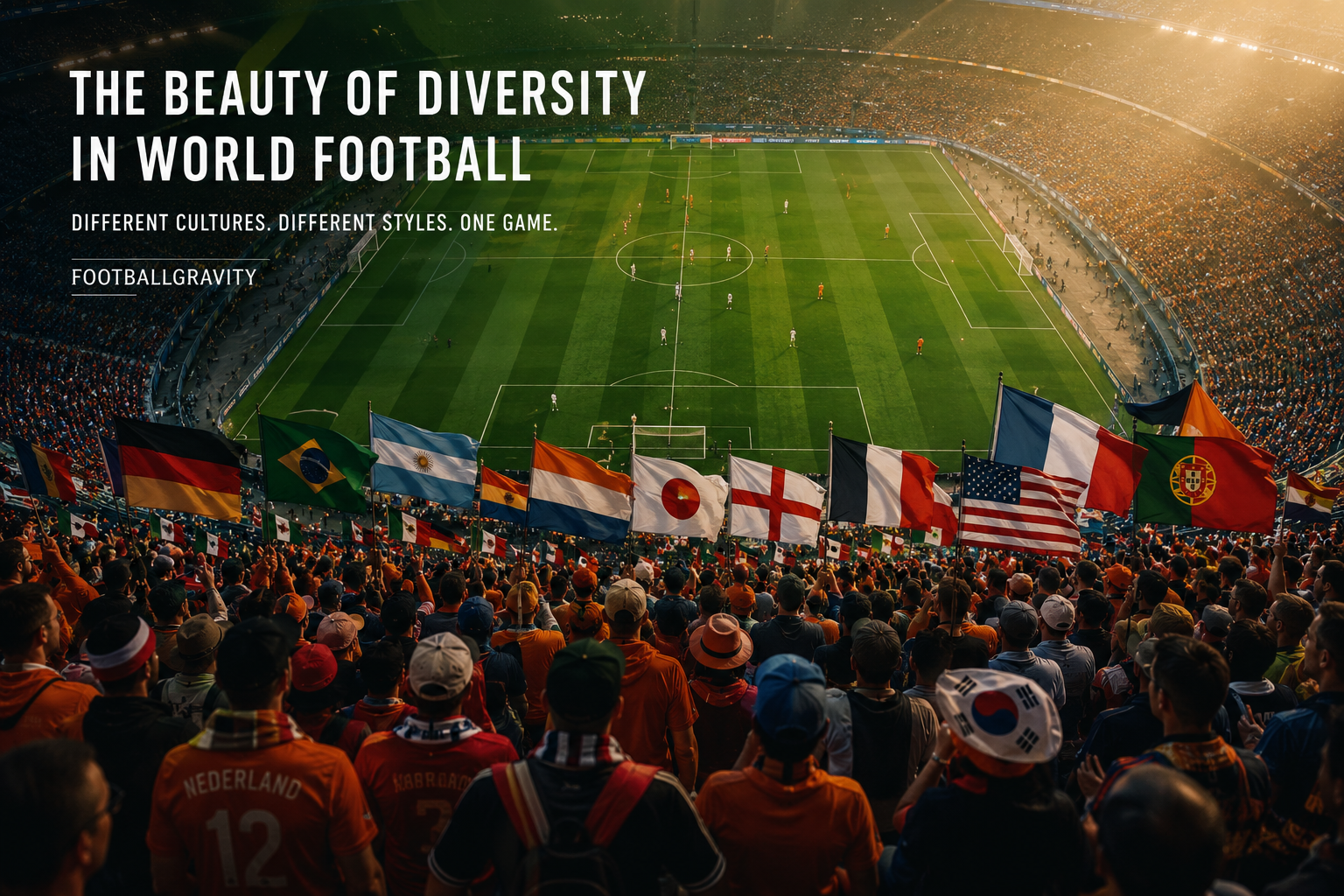
Perhaps the World Cup is ultimately a celebration of human diversity.

Different languages.
Different movements.
Different ideas of beauty.

And for a few weeks, those differences gather inside the same stadiums.

That is why the tournament feels larger than sport.

It becomes a global conversation played through atmosphere, identity, and movement.

And maybe that is the deepest gravity of football:

it allows the world to remain different — while still sharing the same game.