
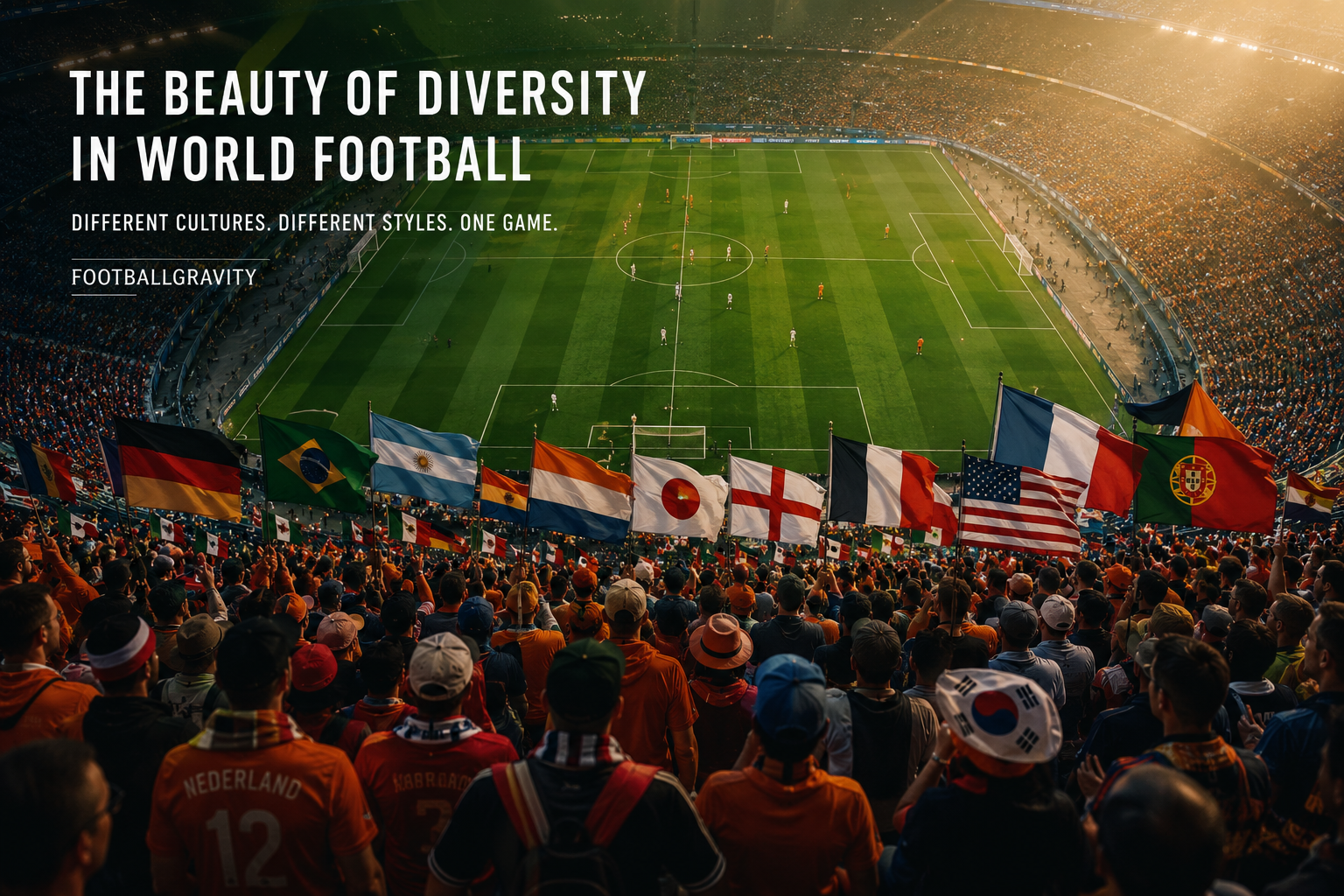
The World Cup is not only a tournament of football. It is a collision of histories, personalities, aesthetics, and national identities.
Every World Cup feels familiar.
And yet, every World Cup feels completely different.
Different rhythms.
Different emotions.
Different atmospheres.
Some teams appear calm and structured. Others feel chaotic, improvisational, emotional, or explosive.
Supporters sing differently. Players celebrate differently. Even the movement of teams across the pitch often reflects deeper cultural tendencies.
The World Cup is not only a tournament between nations.
It is a meeting point between different ways of seeing the world.
And perhaps that diversity is one reason football continues to feel uniquely global.
Football as Cultural Expression
Football is often discussed through tactics and results.
But international football has always carried something larger than sport.
National teams become temporary expressions of identity.
Not in a simplistic sense, but through atmosphere, style, rhythm, emotional behavior, and collective psychology.
Some countries value structure and discipline. Others celebrate improvisation and individuality. Some emphasize collective synchronization. Others rely on moments of genius.
Of course, modern football is increasingly globalized. Players train abroad. Coaches move internationally. Tactical systems spread rapidly.
Yet even today, traces of cultural personality still remain visible.
And supporters around the world continue to recognize them intuitively.
Germany: Precision, Physicality, and Resilience
Few football cultures carry a stronger historical identity than Germany.
German football has long been associated with structure, physical strength, tactical organization, and psychological resilience.
Even during difficult matches, German teams often appear emotionally stable. They continue pressing forward with discipline and intensity.
For decades, international football has attached almost mythological language to Germany:
“German efficiency.”
“The machine.”
“Never give up.”
These stereotypes are sometimes exaggerated, yet they emerged for a reason.
Germany repeatedly built teams capable of combining athletic power with strategic control.
From Franz Beckenbauer — “Der Kaiser” — to modern high-intensity pressing systems, German football often projects authority through organization.
Physically, German teams have also historically embodied a recognizable image:
high stamina,
strong duels,
powerful running,
and aerial dominance.
But perhaps the defining characteristic is mental.
Germany often appears most dangerous when matches become psychologically difficult.
Because resilience itself has become part of the football identity.
The Netherlands: Innovation, Individuality, and Beautiful Risk
If Germany represents structure, the Netherlands often represents imagination.
Dutch football has consistently produced ideas that changed the sport globally.
Total Football.
Positional fluidity.
The offside trap.
Technical spatial play.
For a relatively small country, the Netherlands has had an extraordinary tactical influence on world football.
And perhaps that influence reflects something broader within Dutch culture itself:
openness,
experimentation,
and a willingness to challenge convention.
The visual identity is equally distinctive.
Orange crowds.
Minimalist aesthetics.
Tall silhouettes moving fluidly across space.
Dutch football often feels stylish even before kickoff.
At the same time, Dutch football history is filled with strong personalities.
Johan Cruyff.
Marco van Basten.
Dennis Bergkamp.
Arjen Robben.
Many of these players possessed not only technical brilliance, but highly individual ways of interpreting the game.
Dutch teams can appear intellectually creative and emotionally fragile at the same time.
Moments of beauty coexist with moments of internal tension.
And perhaps that contradiction is part of what makes Dutch football endlessly fascinating.
The multicultural influence of migration — including players with Surinamese roots — has also shaped modern Dutch football identity in profound ways.
Technique, athleticism, rhythm, and creativity merged into something globally recognizable, yet difficult to replicate.
Why Difference Creates Beauty
Modern football is becoming increasingly interconnected.
Tactical ideas spread instantly online. Elite players move constantly between leagues. Training methods become standardized.
Yet during the World Cup, national differences still feel visible.
Not perfectly.
Not scientifically.
But emotionally.
And that emotional contrast matters.
Because football becomes more compelling when styles collide.
Control versus improvisation.
Structure versus freedom.
Collective discipline versus individual genius.
The World Cup is powerful not because every team is the same.
But because every team carries different histories, climates, social structures, and emotional cultures into the same tournament.
Football transforms those invisible differences into something visible on the pitch.
Perhaps the World Cup is ultimately a celebration of human diversity.
Different languages.
Different movements.
Different ideas of beauty.
And for a few weeks, those differences gather inside the same stadiums.
That is why the tournament feels larger than sport.
It becomes a global conversation played through atmosphere, identity, and movement.
And maybe that is the deepest gravity of football:
it allows the world to remain different — while still sharing the same game.