
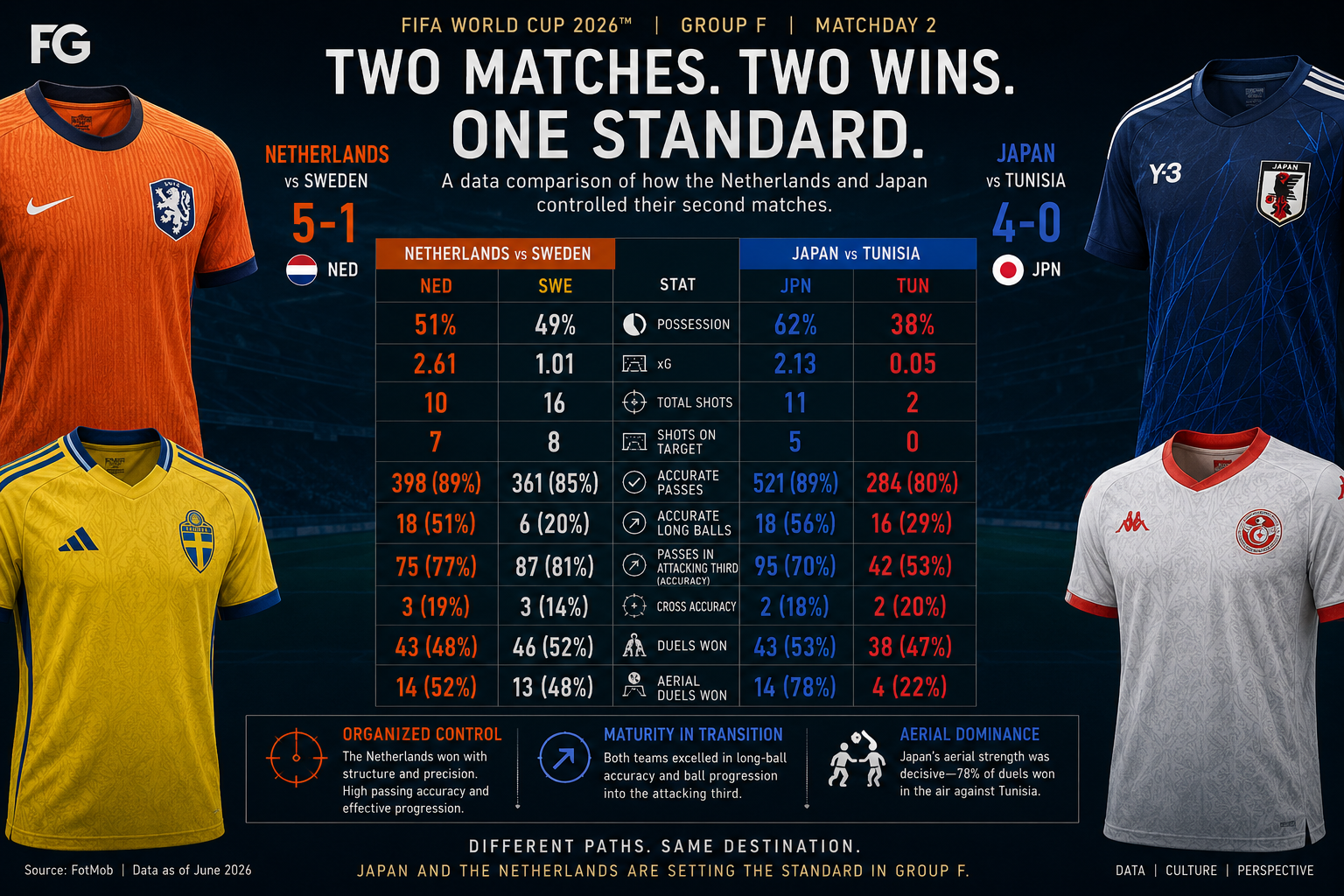
Not Just Winning, But Controlling
The second round of Group F offered an intriguing comparison.
Japan defeated Tunisia convincingly.
The Netherlands comfortably handled Sweden.
On paper, the results simply reinforced what many observers already suspected: Japan and the Netherlands have emerged as the two strongest teams in the group.
Yet the more interesting story lies beneath the scorelines.
These matches did not merely reveal who won.
They revealed how they won.
And perhaps, they also revealed why the opening 2–2 draw between Japan and the Netherlands now looks even more impressive than it did at the time.
The Myth of Physical Dominance
Football often rewards a simple narrative.
The stronger team wins more duels.
The stronger team runs harder.
The stronger team overwhelms the weaker one physically.
But the statistics from both matches suggest something different.
Japan defeated Tunisia 4–0 while winning only 53 percent of total duels.
The Netherlands beat Sweden 5–1 despite actually losing the overall duel count by a narrow margin.
Yet neither match felt close.
That difference matters.
The strongest teams are not necessarily the teams that win every battle.
They are often the teams that decide where the battles take place.
Japan and the Netherlands consistently placed themselves in situations where they needed fewer desperate actions, fewer emergency tackles, and fewer physical recoveries.
Control is often invisible until it is compared with chaos.
A Shared Strength: Precision in Advanced Areas
One statistic stands out across both teams.
Neither side produced particularly remarkable crossing numbers.
Japan completed just 18 percent of its crosses.
The Netherlands completed 19 percent.
Crosses remain an important weapon, but they were not the primary reason these teams created danger.
Instead, two other categories deserve attention.
First, long-ball accuracy.
Japan completed 56 percent of its accurate long balls.
The Netherlands completed 51 percent.
These numbers are not spectacular on their own, but they become significant when viewed alongside what happened next.
Second, and more importantly, both teams maintained exceptional passing quality in advanced areas.
Japan completed 70 percent of its passes in the attacking third.
The Netherlands recorded 77 percent.
Even Sweden, despite defeat, managed 81 percent.
These are unusually high numbers for the most congested and difficult part of the pitch.
They suggest teams capable not merely of reaching dangerous areas, but of remaining composed once they arrive.
The Netherlands have long been associated with this style. Their football tradition combines patient circulation with the ability to switch play instantly through accurate longer passes.
Japan’s presence in the same conversation is more surprising.
And perhaps more significant.
How Japan Has Changed
For many years, Japan’s strengths were easy to identify.
Technical quality.
Collective movement.
Short passing combinations.
Yet there were also recurring limitations.
Long passes often lacked precision.
Attacking moves frequently stalled in the final third.
Possession could be maintained, but not always converted into danger.
Against Tunisia, signs of evolution were visible.
Japan moved the ball forward more directly when necessary.
Longer passes connected with greater consistency.
Most importantly, combinations in advanced areas survived under pressure.
The result was not simply a victory.
It was evidence of a team that has expanded its toolbox.
A team that can now solve different problems in different ways.
The Air Above the Pitch
One category deserves special mention.
Aerial duels.
Japan won 78 percent of them against Tunisia.
That number is extraordinary at World Cup level.
It is also a reminder of how much Japanese football has changed.
Players such as Tomiyasu, Itakura, and Ito have developed in elite European environments where physical confrontation is unavoidable.
Midfielders such as Sano add another layer of athletic presence.
But this is about more than height.
It reflects a broader shift in the profile of Japanese football.
Technical excellence is no longer arriving alone.
It is increasingly accompanied by physical robustness and tactical maturity.
Why the Netherlands–Japan Draw Looks Different Now
Group F is beginning to resemble a familiar pattern.
Two teams separating themselves from the rest.
Two teams capable of controlling matches through structure rather than emotion.
That context changes how we view the opening match between Japan and the Netherlands.
A 2–2 draw initially looked like an entertaining result.
Now it looks like a meeting between two of the group’s most complete teams.
The statistics from Matchday Two reinforce that impression.
Neither side overwhelmed opponents through individual brilliance alone.
Neither side relied purely on physical superiority.
Instead, both demonstrated something more difficult to build.
The Netherlands controlled Sweden despite near-even possession and a slight deficit in total duels.
Japan controlled Tunisia through overwhelming superiority in possession, passing quality, and aerial dominance.
Different routes.
The same destination.
Collective control.
And in modern tournament football, that may be the most valuable quality of all.