
Eight years of Moriyasu: how Japan’s core changed

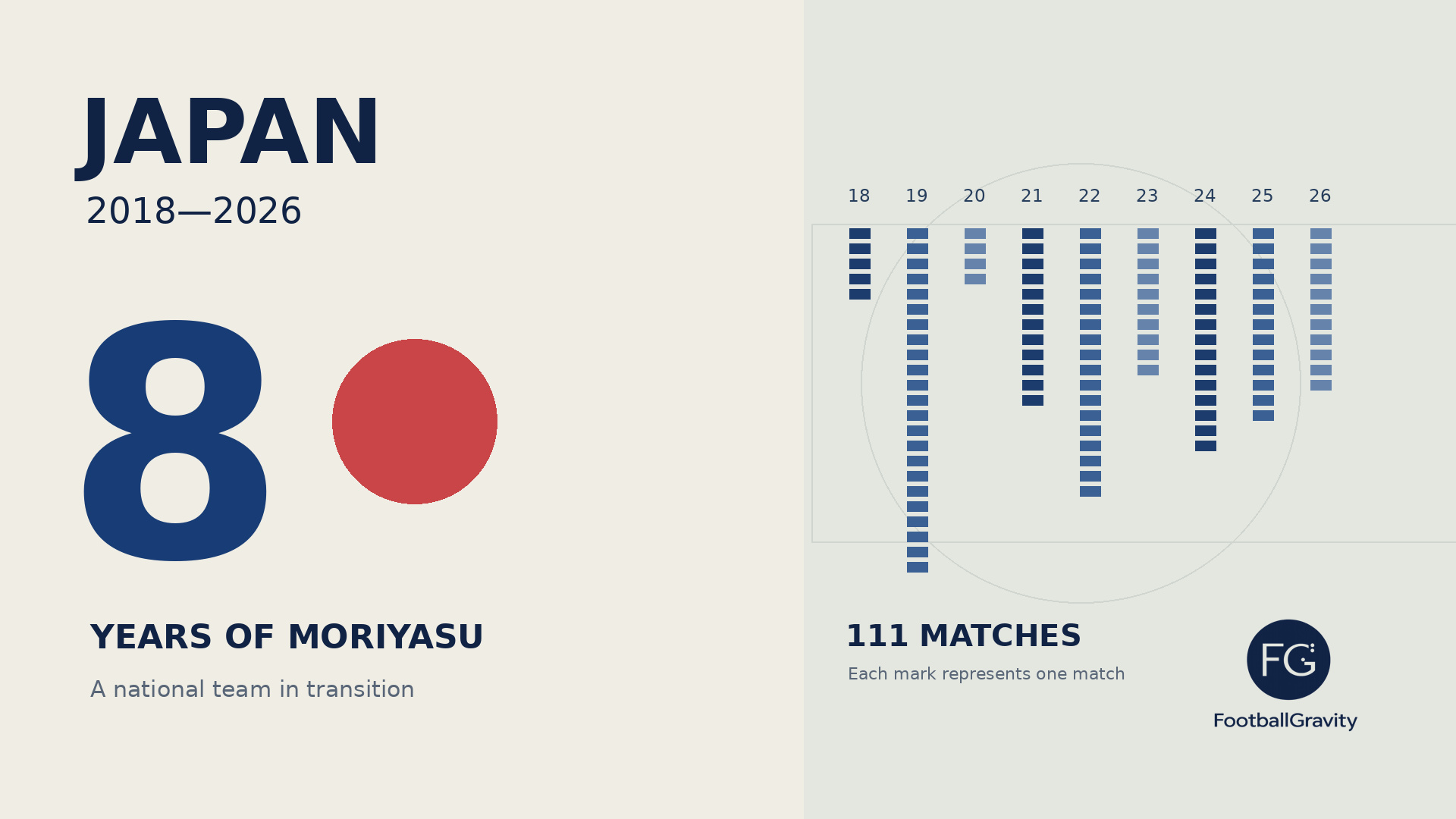
Ivory FootballGravity cover showing Japan 2018–2026, a large blue 8, a red circle, and 111 match marks grouped by year.

Across 111 matches, Japan's playing-time records reveal a broad pool of opportunity and a substantial change in the players carrying the team.

Eight years is a long time for a national team to live under one coach. The name on the touchline can become familiar enough to make the team itself seem continuous. The players' minutes tell a more complicated story.

FootballGravity has compiled Japan's official match records from Hajime Moriyasu's first game, against Costa Rica on 11 September 2018, through the New Zealand match on 5 October 2026. The dataset covers 111 played senior internationals. It offers a way to look beyond individual tournament results: who received opportunities, who became a regular presence, and where the team's workload moved.

The clearest finding is the change in Japan's core. Only three players appear in the ten highest playing-time totals in both the 2018–2022 and 2023–October 2026 periods: Wataru Endo, Junya Ito and Ritsu Doan.

That does not settle the question of whether every transition worked. It does establish that a long-serving coach presided over a team whose principal players changed considerably.

The players carrying the minutes

For this comparison, the first period runs through the end of 2022; the second begins in 2023. There are 62 matches in the first and 49 in the second. The table compares the leaders within each period, rather than treating a longer period's larger totals as evidence of greater importance.

Rank2018–2022Minutes2023–5 October 2026Minutes
1Maya Yoshida3,240Zion Suzuki2,648
2Shuichi Gonda3,135Ritsu Doan2,332
3Takumi Minamino2,919Ko Itakura2,278
4Wataru Endo2,750Ayase Ueda2,190
5Gaku Shibasaki2,699Hiroki Ito2,052
6Takehiro Tomiyasu2,688Wataru Endo2,020
7Yuto Nagatomo2,514Takefusa Kubo1,866
8Junya Ito2,350Junya Ito1,829
9Hiroki Sakai2,030Daichi Kamada1,805
10Ritsu Doan1,933Keito Nakamura1,750

Yoshida and Gonda head the first period. Suzuki and Itakura figure prominently in the second, while Ueda moves into the top five. The change reaches across the goalkeeper, defensive and attacking positions.

Doan is a particularly useful point of continuity. He ranks tenth in the first period, with 1,933 minutes, and second in the next, with 2,332. Remaining in the team and taking on a greater share of its work can happen together. Endo and Junya Ito provide other connections between the periods.

The ranking records a change in workload. Injuries, availability, competition formats and the composition of each squad also affect that workload. The figures cannot isolate how much of the change came from a deliberate succession plan. They do show where continuity was preserved while the surrounding team was renewed.

A wide door, followed by repeated choices

Across the full dataset, 154 different players appeared. That is a count of players who took the field, rather than a total of everyone called up. Of those 154, 31 made one appearance and 71 made between one and three.

Almost half of the playing pool therefore sits at the shorter end of the appearance distribution. A national team can offer many players a first look while concentrating its repeated selections around a much smaller group.

Those short stays need care in interpretation. A player with one appearance may have been an experimental selection, may have faced limited availability, or may have entered the team close to this dataset's cutoff. The count does not provide a failure rate for scouting or selection.

Tournament context matters too. The dataset includes nine matches from the EAFF E-1 championships. Japan used 128 different players in matches outside those tournaments. Separating the two gives a clearer picture of the breadth of the playing pool without treating every selection environment as equivalent.

For Japan, whose player pathways connect domestic clubs with teams abroad, these records make the point at which a player receives an opportunity visible. Understanding what happens next requires attention to both representative football and the player's club career. An international appearance alone cannot tell us whether a career has progressed.

Different ways to remain important

The cumulative leaders also show why appearances and minutes should be read together.

PlayerAppearancesStartsMinutes
Wataru Endo61544,770
Takumi Minamino71534,367
Ritsu Doan73504,265
Junya Ito74424,179
Takehiro Tomiyasu46403,662
Ko Itakura44403,527
Daichi Kamada57393,353
Maya Yoshida41383,254
Shuichi Gonda35353,135
Hidemasa Morita40332,861

Endo leads the minutes. Junya Ito leads the appearances, but started 42 of his 74 games. Tomiyasu's smaller appearance total includes 40 starts in 46 matches.

These are different forms of presence: accumulated time, frequent involvement, and a high proportion of starts when taking the field. A single league table of appearances would compress those differences.

Goals offer another view. Minamino leads this period with 26, followed by Ueda on 22, Yuya Osako on 17 and Junya Ito on 16. The overlap with the playing-time leaders shows that some of the most persistent contributors also carried a substantial scoring workload. It does not make total goals a complete measure of attacking quality: penalties, minutes and the matches in which those goals arrived still matter.

What a long tenure leaves visible

Moriyasu's eight years can be examined through the distribution of opportunity as well as the results. The records show a large number of players entering the team, a smaller group returning repeatedly, and a marked shift in the players receiving the most time across two World Cup cycles.

With the Asian Cup still ahead, this is an interim account of that work. It gives credit to continuity without making continuity itself a verdict. Endo, Junya Ito and Doan connect the two periods; the seven other places in each period's top ten show how much changed around them.

For a national team, maintaining a recognisable identity while changing the people responsible for it is part of the job. Japan's minutes provide a concrete record of that process—one that can be revisited as the next group takes on more of the team's work.

Data and sources

FootballGravity's calculations use the Japan Football Association's annual results and official match records, covering 11 September 2018–5 October 2026. The 2021 match against Japan's under-24 team and the unplayed March 2024 fixture against DPR Korea are excluded. E-1 games are included unless stated otherwise. Minutes use nominal substitution times, excluding added time but including extra time; penalty-shootout goals are excluded. The two periods contain different numbers of matches. These figures describe participation and workload, and do not establish a coaching effect on player development.
The New View Was Already There

Why the world applauded Japan after defeat

Japan lost.

That is the simplest sentence.

Brazil advanced. Japan went home. Another World Cup knockout match ended without Japan’s first victory beyond the group stage.

And yet, after the final whistle, the conversation did not feel like a simple story of failure.

Around the world, Japan were not spoken of merely as brave losers. They were discussed as a team that had shown something rare: a national side capable of making Brazil look human, not through luck, not through chaos, but through collective intelligence.

That may be why this defeat felt different.

For years, Hajime Moriyasu had spoken about “a new view.”

Perhaps many imagined that view would mean a quarter-final, a semi-final, or even something more ambitious.

Those results did not arrive.

But against Brazil, something else did.

The football world saw Japan differently.

The Cruelest Path

The first knockout round was especially unforgiving for Group F.

Japan faced Brazil.

The Netherlands faced Morocco.

Sweden faced France.

All three teams that advanced from Group F were eliminated.

That does not erase their defeats. But it does change the frame.

Japan did not fall against an ordinary opponent. The Netherlands were pushed out by a Morocco side that looked like one of the most complete teams in the tournament. Sweden were beaten by France, a side whose individual quality and tournament experience remain among the highest in world football.

Group F had produced competitive teams.

But the next path was brutal.

Japan’s loss belonged to that context.

And still, among the three defeated sides, Japan seemed to leave the strongest impression.

Why?

It Was Never Only About the Result

Football usually remembers winners.

Paraguay, for example, achieved something Japan could not: they took Germany to penalties and won. That deserves full respect.

But global admiration does not always follow the scoreboard alone.

Japan were praised because of how they played.

They did not appear to be a team simply waiting for Brazil to make a mistake.

They did not defend as if survival was the only plan.

They defended as if defending itself could be a way of attacking.

That distinction matters.

Japan were not trying only to reach penalties.

They were trying to win.

Against Brazil.

The Mystery the World Wanted to Solve

Japan are no longer an unknown football nation.

The old assumption that European or South American teams could underestimate Japan no longer works.

This is the country that beat Germany and Spain in Qatar. The country that later defeated Germany again. The country that has shown, repeatedly, that its best football belongs on the same pitch as elite opposition.

The question has changed.

It is no longer:

Can Japan compete?

It is now:

Why have Japan become so difficult to play against?

Against Brazil, the answer became clearer.

It was not only technique.

It was not only discipline.

It was synchronisation.

Eleven Players, One Organism

International football usually favours individual quality.

National teams do not train together like clubs. They do not have months to build mechanisms, pressing traps, defensive distances, or shared habits.

That is why knockout football often belongs to individual brilliance.

A winger beats a defender.

A striker finds half a yard.

A midfielder breaks the structure with one pass.

Japan proposed another answer.

Collective movement.

The back line moved together.

The midfield moved together.

The wing-backs adjusted together.

Even the forwards defended as part of the same structure.

At times, Japan looked less like eleven separate players and more like one organism responding to the ball, the space and the opponent at the same time.

That is rare in international football.

And that is what many observers seemed to recognise.

Brazil Did Not Become Ordinary

There is a danger in misreading the match.

Brazil did not suddenly become ordinary.

Japan simply prevented Brazil from looking extraordinary.

That may be the greatest compliment a defensive structure can receive.

The best attacking teams usually make opponents look reactive. They stretch the pitch, isolate defenders, and create the impression that danger can appear from anywhere.

Against Japan, Brazil were forced to think.

They had to adjust.

They had to suffer.

They had to wait until the final moments.

That was not because Brazil lacked quality.

It was because Japan denied them rhythm.

Not Defensive Football, But Winning Football

Japan’s structure was defensive in shape, but not defensive in spirit.

There is a difference between protecting a score and refusing to play.

Japan did not simply sit low and hope.

They pressed.

They shifted.

They tried to create moments.

They looked for the chance that would turn control into shock.

This is why the performance felt attractive, even without attacking fluency.

Japan’s injuries mattered. Several important attacking options were missing or limited. The final combinations were not always clean.

But the intention was visible.

This was not football designed only to avoid defeat.

It was football designed to find a path to victory against a superior collection of individual talent.

That is why it resonated.

Why Coaches Understand It

Some performances are appreciated first by fans.

Others are understood most deeply by coaches, former players and analysts.

Japan’s performance belonged to the second category.

Anyone can admire a dribble.

Anyone can celebrate a goal.

But collective coordination is harder to see.

It requires watching distances, timing, cover, body orientation and the relationship between players who may never touch the ball.

Against Brazil, Japan showed that a national team can still build something close to club-level collective behaviour.

That is not easy.

It is not accidental.

And it is not simply “hard work.”

It is design.

A New View

Moriyasu’s phrase, “a new view,” will always carry the sadness of unfinished ambition.

Japan wanted more.

The players wanted more.

The supporters wanted more.

A first knockout victory was close enough to touch, and then gone.

But perhaps the phrase does not belong only to the result.

Perhaps a new view can also be the moment when the world looks at Japanese football and no longer sees an outsider.

Not a surprise.

Not a guest.

Not a romantic underdog.

But a serious football nation with its own method, its own intelligence, and its own way of making the game difficult for anyone.

The players saw it.

The coach saw it.

The supporters felt it.

And perhaps, for the first time, the world saw it too.

The new view was already there.

The Lessons of Doha: How Japan Stayed Calm Against the Netherlands

The Netherlands and Japan was one of the most anticipated group-stage matches of the 2026 FIFA World Cup.

Both nations arrived in the tournament with genuine ambitions of reaching the latter stages. The Netherlands entered as one of Europe’s most consistent contenders, while Japan carried growing expectations after its remarkable performances in recent World Cups.

The match delivered.

A dramatic 2-2 draw combined technical quality, tactical discipline, and moments of individual brilliance. More importantly, it revealed something about how this Japanese team has evolved.

Numbers Favored the Netherlands

The statistics suggested a Dutch advantage.

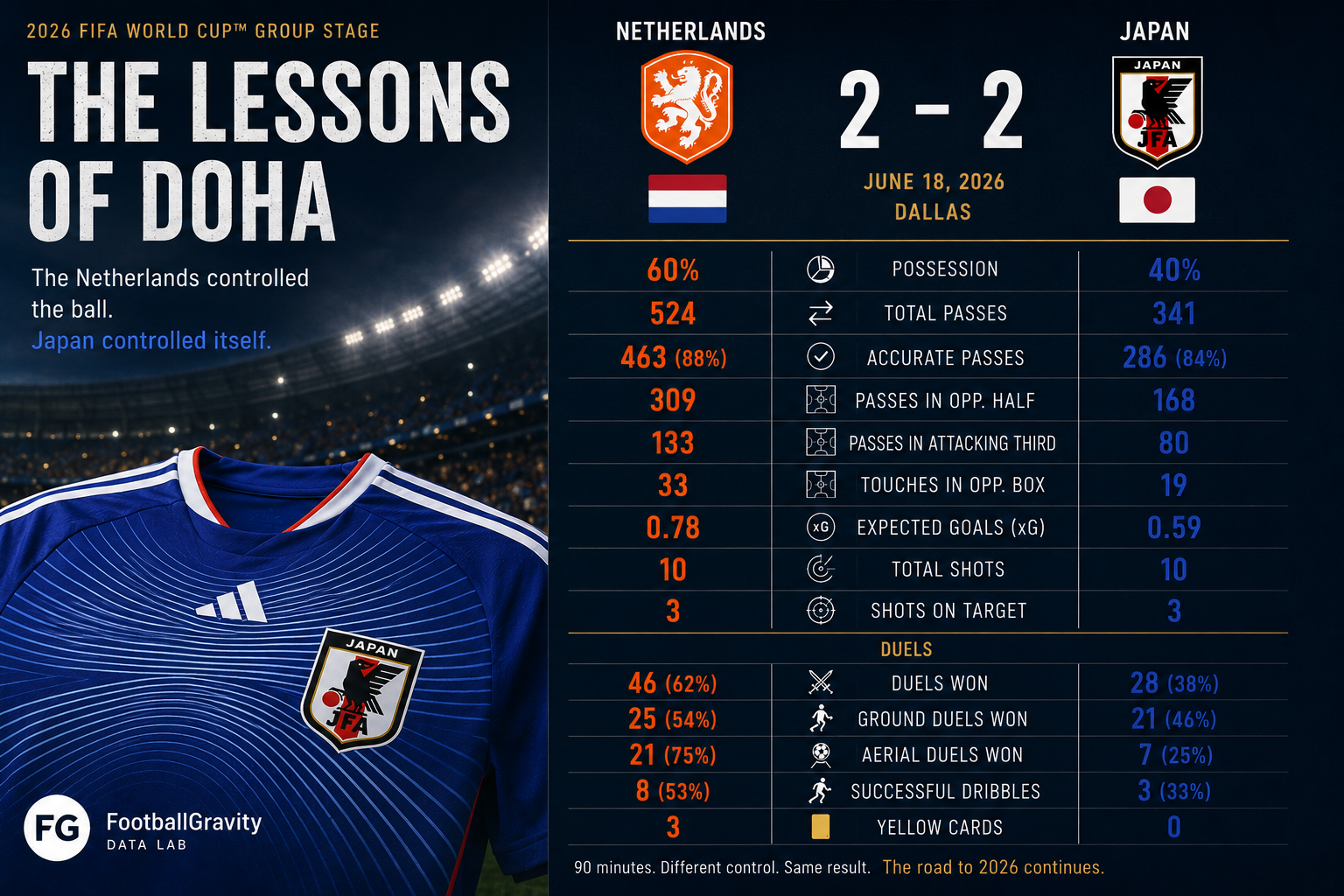
The Netherlands controlled 60 percent of possession, completed more than 500 passes, and generated slightly more territorial control throughout the match. They entered Japan’s penalty area more frequently and dictated long stretches of the game’s rhythm.

On paper, it was the Netherlands who controlled the match.

Yet the contest never felt one-sided.

Japan accepted periods without the ball, remained organized, and repeatedly found ways to respond whenever momentum appeared to swing against them.

That may have been the most important statistic of all.

A Match Played in Quarters

The Texas heat created an unusual dynamic.

Cooling breaks effectively divided the match into shorter segments, making the game feel closer to a four-quarter contest than a traditional ninety-minute match.

For some teams, interruptions can disrupt momentum.

For Japan, they seemed to provide opportunities.

Players gathered frequently, exchanged information, and recalibrated their positioning. The team appeared to treat every restart as a chance to reset collectively.

Combined with halftime and the moments immediately following each conceded goal, Japan effectively received multiple opportunities to reorganize and refocus.

Each time, they returned looking composed.

The Difference Between Panic and Control

One of the most striking aspects of the match was what did not happen.

After conceding goals, there were no visible signs of frustration. No blaming teammates. No emotional collapse. No rush to abandon the game plan.

The reactions looked almost routine.

As if difficult moments had already been anticipated and rehearsed.

This was not a team trying to avoid mistakes.

It was a team prepared for them.

That distinction matters at a World Cup.

Tournament football is rarely won by teams that avoid adversity. It is often won by teams that know how to respond when adversity inevitably arrives.

Japan looked ready.

The Long Shadow of Doha

Japanese football has carried the memory of Doha for more than three decades.

The “Agony of Doha” in 1993 remains one of the defining moments in the nation’s football history. A World Cup dream disappeared in stoppage time, leaving lessons about concentration, game management, and emotional control that shaped an entire generation.

One of the players on the pitch that night was Hajime Moriyasu.

Today, he stands on the touchline as Japan’s head coach.

His team also carries another Doha memory.

In 2022, Japan produced one of the greatest achievements in its history by overturning Germany and Spain at the World Cup in Qatar.

The agony and the joy were born in the same city.

Both experiences appear woven into the identity of this team.

Watching Japan calmly navigate difficult moments against the Netherlands, it was difficult not to see traces of those lessons.

There was no sign of panic.

There was no sign of complacency.

A team shaped by both disappointment and triumph tends to understand that matches are never over until they truly are.

More Than a Draw

A 2-2 draw against the Netherlands will not define this tournament.

But it offered an important reference point.

The Netherlands may have controlled more of the ball.

They may have completed more passes and spent more time in advanced areas.

Japan controlled something else.

Themselves.

As the knockout stage approaches, that quality may prove just as valuable as any tactical system or statistical advantage.

From Doha to Dallas, Japanese football continues to carry its lessons forward.

And on one of the biggest stages in world football, those lessons were visible once again.

Going to America, 32 Years Later

A football supporter wearing a vintage number 11 jersey looking toward a distant stadium under an American sunset sky

The Dream That Stopped in Doha

On October 28, 1993, Japan stood only minutes away from history.

A victory against Iraq would have sent the nation to its first FIFA World Cup.

Instead, a late equalizer arrived from a short corner.

2–2.

The final whistle followed.

And a dream disappeared.

Japanese football remembers that night simply as “The Agony of Doha.”

For those who watched it, the memory never really left.


One More Step

Football history is often measured in goals.

But sometimes it is measured in centimeters.

In Doha, there were moments that came down to one final step.

One final touch.

One final clearance.

Among the players desperately trying to close down the cross was a young midfielder named Hajime Moriyasu.

Nearby was Japan’s star forward, Kazuyoshi Miura — KAZU — the face of Japanese football.

Both were close.

Not close enough.

History rarely explains how painful “almost” can be.


Before World Cups Became Normal

Today, Japan has qualified for eight consecutive World Cups.

For younger supporters, qualification can almost feel expected.

In 1993, it was the opposite.

Japan had never appeared on football’s biggest stage.

The J.League had only recently begun.

Captain Tsubasa had taught an entire generation to dream about the World Cup.

But dreams remained dreams.

The tournament existed somewhere far away, on television screens and magazine pages.

America felt unimaginably distant.


The Heroes Who Never Went

That Doha squad contained many of the defining figures of Japanese football.

Masami Ihara.
Tetsuji Hashiratani.
Shigetatsu Matsunaga.
Kenta Hasegawa.
Masashi Nakayama.
Ramos Ruy.
Kazu.

Some became legends.

Some became coaches.

Some became memories.

Yet none of them reached the World Cup that year.

Their generation built the foundation of Japanese football without receiving the reward they had spent their careers chasing.

That may be one of the cruelest truths in sport.


The Quiet Player Who Stayed

Among those stars stood Moriyasu.

He was not the most famous player.

Not the most marketable.

Not the headline.

Few people in 1993 would have predicted that he would become the most influential figure from that generation.

Yet history often favors patience.

Thirty-two years later, it is Moriyasu who leads Japan back toward America.

Not as a player.

As the manager of the national team.


Football’s Long Memory

Sport moves quickly.

Football remembers slowly.

The players on Japan’s 2026 squad were not even born when Doha happened.

Many grew up watching entirely different generations.

Yet football cultures carry memories across decades.

The lessons.

The scars.

The ambitions.

The unfinished journeys.

In that sense, every World Cup team carries more people than the twenty-six names listed on the squad sheet.


Going to America

There is something poetic about the destination.

America.

The World Cup Japan nearly reached in 1993.

The World Cup KAZU dreamed of.

The World Cup that slipped away.

And now, after thirty-two years, Japan returns.

This time as one of the strongest teams in Asia.

This time with genuine ambitions.

This time led by a man who knows exactly how quickly dreams can disappear.

No one understands complacency less than Hajime Moriyasu.

He has already lived the consequences.


More Than a Tournament

For some supporters, this World Cup is not simply another competition.

It is a continuation.

A journey paused in Doha and resumed three decades later.

Some will travel to the United States wearing modern shirts.

Others may wear old ones.

Perhaps even the number 11.

Not because football can rewrite history.

But because football allows history to travel with us.

And somewhere between Doha and America, between 1993 and 2026, between KAZU and the next generation, a dream continues moving forward.

Thirty-two years later.

America is finally waiting.


With old No.11

This summer, I will travel to America wearing an old No.11 shirt.

Not because football owes us anything.

But because some journeys deserve to be completed.