
Where Football Lives #05 — Seville: Two Ways to Belong

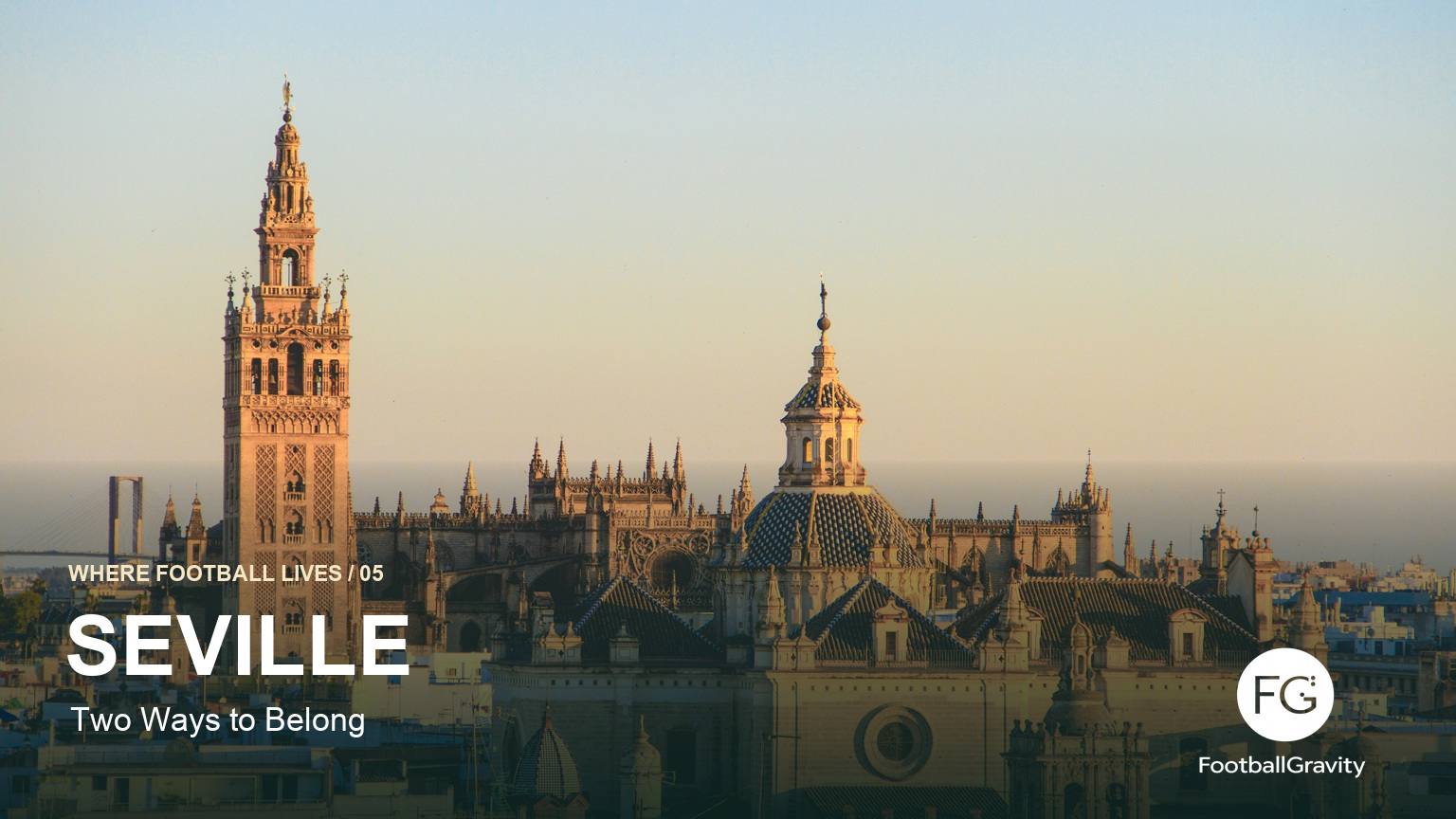
Seville Cathedral and the Giralda in warm evening light, with Seville series typography and the official FootballGravity logo.

With Real Betis playing temporarily at La Cartuja and Sevilla FC rooted in Nervión, football offers a way into a city whose attachments reach well beyond its famous centre.

For someone planning a football weekend in Seville, Real Betis currently presents an instructive complication. The stadium most closely associated with the club is not where the first team plays its home matches.

The Benito Villamarín stands in Heliópolis, south of the historic centre. While it is being redeveloped, Betis are playing at La Cartuja, in another part of the city. The club’s own history records the 2025/26 season as the beginning of that temporary stay. Real Betis club history

A ticket tells a visitor where to go. Understanding why the other address still matters takes longer.

That distance between a match venue and a sense of home is a useful place to begin in Seville. Across the city, Sevilla FC has its own enduring association with Nervión and the Ramón Sánchez-Pizjuán. Following these clubs takes a visitor beyond the cathedral precinct and into neighbourhoods that give football a more particular address.

Heliópolis, even from elsewhere

The Benito Villamarín belongs to a period when Seville was extending and remaking itself. The stadium opened in 1929 as part of the urban programme associated with the Ibero-American Exposition. The exhibition’s footprint reached through María Luisa Park and the city’s southern expansion towards what is now Heliópolis. Seville Tourism: stadium history, regionalist architecture guide

Betis established its home there after the Spanish Civil War, in 1939. The club had already arranged to lease the ground before the war; ownership followed in 1961. Those dates describe a gradual attachment: a stadium built for a major civic event became a place shaped by the repeated use of a football club and its supporters. Real Betis: the return of league football, the stadium purchase
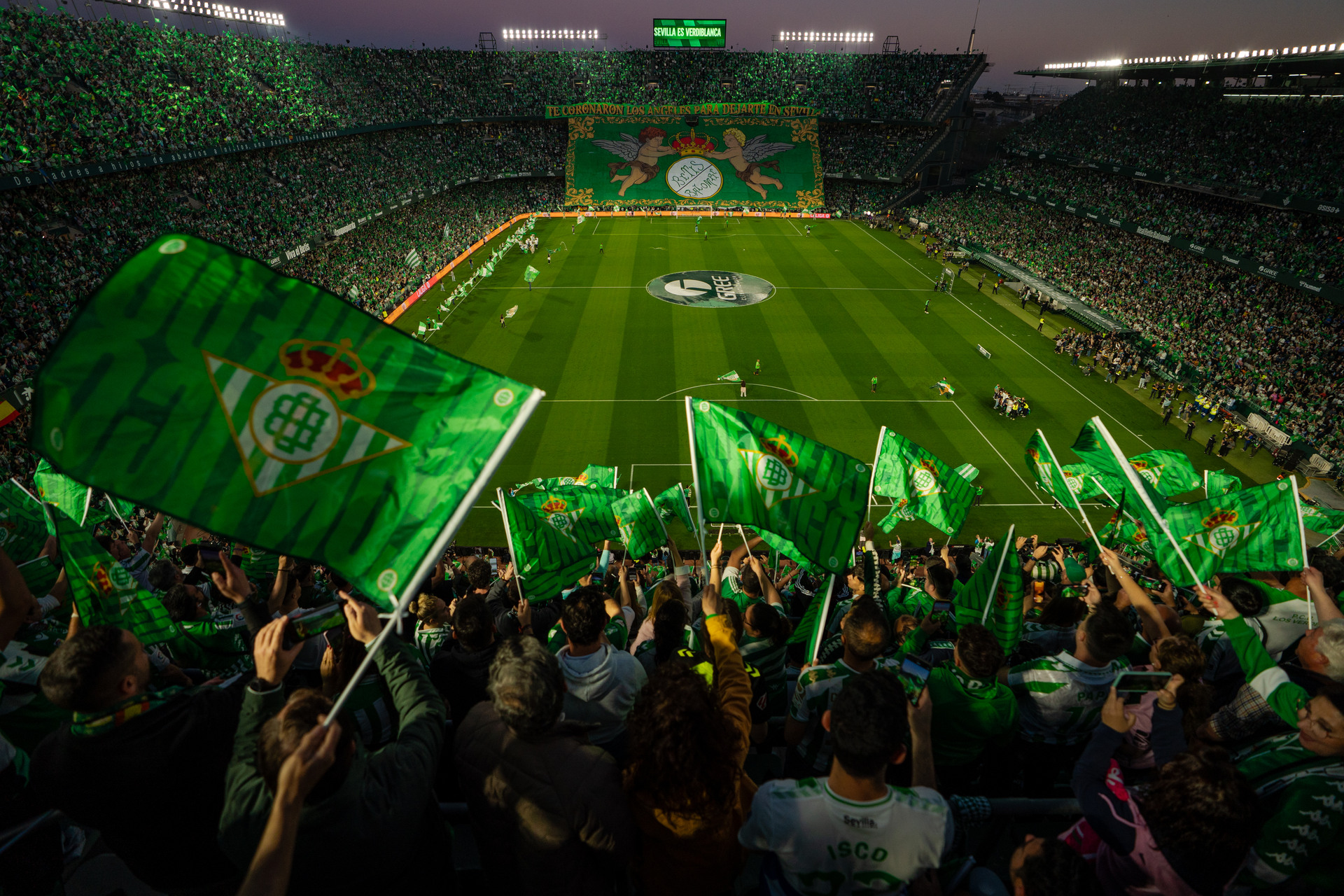
Supporters waving green-and-white Real Betis flags inside the Benito Villamarín stadium in Heliópolis.
Supporters and green-and-white flags at the Benito Villamarín before the current redevelopment. Image supplied by Real Betis Balompié. This archive photograph shows Heliópolis, not the team’s current temporary home at La Cartuja.

A neighbourhood acquires meaning through repetition. A familiar approach to the ground, a meeting place, the journey with someone who first brought you: these are modest things individually. Over many seasons, they become part of what going to football means.

The temporary move to La Cartuja makes that relationship easier to notice. Betis can organise home fixtures elsewhere in Seville while Heliópolis remains central to the club’s identity. Supporting the team now involves making room for a different journey without discarding the old one.

For a visitor, the distinction matters in practical terms too. A photograph of the Benito Villamarín is not a guide to the present matchday destination. Betis confirmed in October 2026 that its home games are being played at La Cartuja. The current fixture and access information should determine the journey.

It also changes what a visit to Heliópolis can offer. With the first team playing elsewhere, the district remains part of the story: a place to understand how closely a club’s identity can become tied to a particular piece of the city.

Nervión has its own address

Sevilla FC leads the visitor east, towards Nervión.

The Ramón Sánchez-Pizjuán opened in 1958. Its setting places the club within the everyday city, with the Nervión and Gran Plaza metro stops serving the area. The surrounding district is part of the approach to the match, rather than a view glimpsed only from the stadium entrance. Seville Tourism: Ramón Sánchez-Pizjuán, stadium access

Music gives that attachment another form. Sevilla’s centenary anthem, composed by Javier Labandón, known as El Arrebato, emerged in 2005 and became an important expression of the club’s support. It is a relatively recent addition to a much longer history, a reminder that football traditions continue to be made. Sevilla FC: club and anthems

The rivalry with Betis gives these places additional intensity. It also creates a temptation for the visiting writer: to assign each club a fixed personality and divide the whole city neatly between them.

The stadium map cannot carry that explanation. It identifies important roots, without telling us where every supporter lives or how every family chose its club. Heliópolis and Nervión provide starting points for understanding attachment. They leave room for lives that cross those boundaries.

The city around the football

Seville rewards time away from the stadiums.

The Giralda began as an Almohad minaret and later became the cathedral’s bell tower. In the Alcázar, Islamic remains coexist with later building, including the Mudéjar palace of Pedro I. These are substantial histories of construction, conquest and adaptation, visible within the same urban fabric. UNESCO: Seville’s monumental complex

They help explain why Seville feels different from Valencia, the Spanish city visited earlier in this series. They do not provide a shortcut to explaining how Sevillians support a football club.

Music deserves the same care. Flamenco has a strong Andalusian setting and an essential contribution from Gitano communities. UNESCO describes its transmission through families, social groups and local associations. Seville’s own cultural guide points visitors towards neighbourhood peñas as well as performance venues and festivals. UNESCO: flamenco, Seville Tourism: flamenco

There is something useful here for a football visitor: an invitation to pay attention to how people sustain a shared practice. Songs depend on people who know them, teach them and find occasions to perform them. A stadium anthem and flamenco have their own histories, but both reward listening to the communities around the sound.

Food offers a quieter introduction. Espinacas con garbanzos—spinach with chickpeas, seasoned with ingredients including cumin and garlic—is among the city’s established tapas. A meal before travelling to the ground can give the day a local rhythm without requiring an elaborate itinerary. Seville Tourism: espinacas con garbanzos

The river, Triana, the historic centre and the southern districts need more time than the gaps between two appointments. Leave part of the day unfilled.

Finding the right ground

A visitor can begin with a few simple decisions: which club, which fixture, which stadium.

For Betis, that means checking La Cartuja information rather than following an old route to the Benito Villamarín. For Sevilla FC, it means looking at the current arrangements for the Sánchez-Pizjuán. Tickets and match-specific travel instructions should come from official club channels; a derby requires particular attention to the arrangements for that fixture.

Beyond those practicalities, a weekend here can accommodate different kinds of attention. There is the concentrated time of a match, and the slower work of learning where a neighbourhood sits within the city.

Seville gives this series a chance to examine both. Betis’s temporary move makes the persistence of Heliópolis especially visible. Sevilla’s association with Nervión offers another way to follow a club through its surroundings.

For someone arriving from abroad, learning the correct stadium address is the first step. Learning why another address still matters is part of getting to know the city.

Reporting note: This feature was prepared with AI assistance, reviewed by a human editor, and based on published sources and background information supplied by Real Betis Balompié’s Communications Department. It is not an account of an on-site visit. Real Betis supplied a stadium photograph and crest for editorial use; editorial responsibility remains with FootballGravity.

Featured image: Seville Cathedral and the Giralda. Photograph by Henrique Ferreira / Unsplash, published 5 November 2017. Editorial layout and official logo: FootballGravity. No generative editing.

Explore Where Football Lives →

Where Football Lives #02 — Valencia: Before the Move

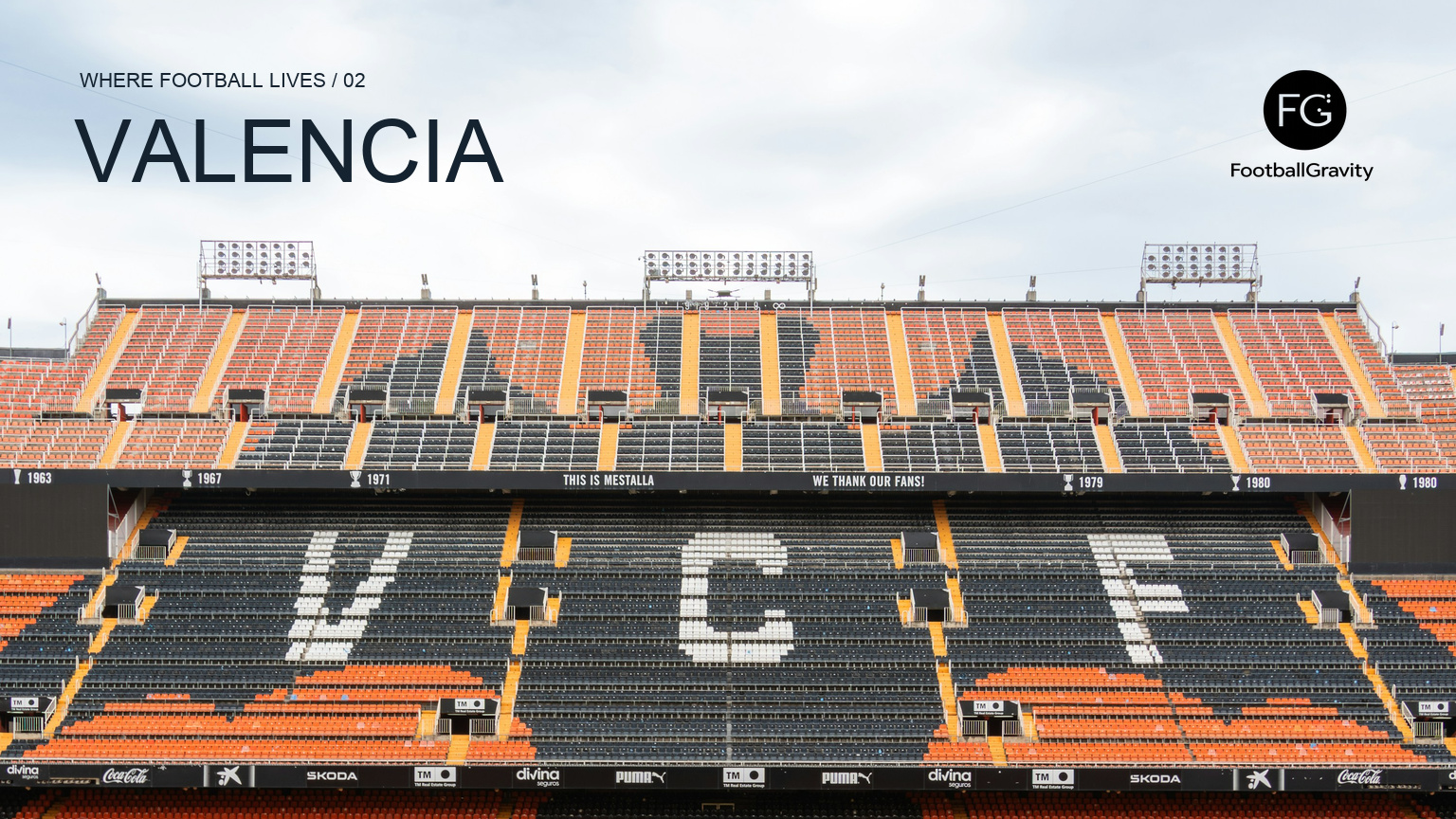
An empty Mestalla stand spelling VCF, with Valencia series typography and the FootballGravity logo.

Where Football Lives / 02. In Valencia, the walk to a football ground is also a way of reading the city’s next chapter.

Mestalla has the proportions of a stadium that has spent a century learning the streets around it. Its steep stands rise among apartment blocks and cafés, north-east of Valencia’s old centre. On a matchday, the approach is not a ceremonial march through a sports district. It is a change in the rhythm of an ordinary neighbourhood: the sound from bars carries a little further, orange and white scarves appear at corners, and the ground arrives without much warning.

For Japanese readers, Ryunosuke Sato’s arrival has supplied a fresh reason to look towards Valencia. The club announced his transfer from FC Tokyo on 7 July 2026, on a five-season contract, and described him as the first Japanese player registered with its men’s first team. The announcement placed a young Japanese player inside one of Spanish football’s older civic institutions.

That is a useful entrance to the city, but it is not the whole story. Valencia CF is approaching a move that will alter how supporters reach their football and how the club sits within Valencia. The future Nou Mestalla is taking shape across town, with the club’s 2024/25 sustainability report listing an expected opening in the 2027/28 season. Until then, the old ground remains the place where the relationship between club and city can be felt at close range.

A name from the water

Mestalla was inaugurated on 20 May 1923, for a friendly against Levante. Valencia’s own history says the ground took its name from an irrigation canal that once ran beside it. That detail makes the stadium feel less like an object set down in the city than part of an older working landscape: water, farmland and the routes that connected them.

The club’s history traces football in Valencia to people involved in the citrus trade who had travelled to Britain, and to British sailors playing in the port. Valencia Football Club was founded in 1919. Its first home, Algirós, soon became too small, so the club bought the Mestalla site in January 1923. The new ground opened with room for 17,000 people; today the club lists its capacity as 49,419.

Numbers explain growth, but not the particular pressure of the old stadium. Mestalla has hosted more La Liga matches than any other ground, according to the club, and marked its 103rd anniversary in May 2026. It survived Civil War damage, hosted Spain at the 1982 World Cup and held major European nights for Valencia. The archive is present in the building’s shape. Spectators are close to the pitch, and the sightlines make every collective reaction seem to arrive early.

The city beyond the turnstiles

Valencia is easier to understand by following the Turia than by treating its landmarks as separate stops. After the devastating flood of 1957, the river was diverted south of the city. The old riverbed became the Turia Gardens, a long public park that now runs through Valencia. Visit València describes more than nine kilometres of paths, sports spaces, bridges and gardens linking the city from west to east.

The stadium lies a short distance from this green corridor. A visitor can begin in the old centre, cross the former riverbed near Puente de las Flores or the Aragón area, then move towards Mestalla through streets that remain residential and busy. It is a route with no need for a football-only itinerary. The city is already doing the work: cafés, bakeries, university buildings, apartment balconies and the park create the texture around the match.

That everyday density matters in a place known internationally for bigger images: the City of Arts and Sciences, the beach, paella and the Fallas. During Fallas, Valencia’s neighbourhood commissions fill streets and squares with temporary sculptures, music, fireworks and the scent of gunpowder. The festival is not a matchday accessory, but it shows a city used to bringing public space, local affiliation and noise together. Mestalla belongs to the same civic habit of gathering.

Before the move

The move to Nou Mestalla has been discussed for so long that it is tempting to write as if the old ground has already become a museum piece. It has not. The club says construction resumed in January 2025, and its current reporting describes work on the roof structure, façade and interior areas. Its published plan gives the new stadium a capacity of 70,044 and places it on Avenida de las Cortes Valencianas. Those are the club’s plans and targets, not yet a completed matchday reality.

A new stadium will offer space, accessibility and commercial possibilities that a century-old city ground struggles to provide. The club has also described a public square and municipal sports facilities within the development. The questions worth following are more intimate. Which pre-match routes will survive? Where will people meet when a familiar walk no longer ends at the same gates? What does a supporter lose, and gain, when a stadium leaves a neighbourhood that has grown around it?

These questions do not require nostalgia to be serious. Valencia is a city that has repeatedly altered its physical shape, including the redirection of the Turia itself. Change can create valued public space. A stadium move can do the same, but it asks a football culture to carry its habits across the city and make them live in a different setting.

A new connection

Sato’s arrival belongs to this moment without defining it. A first Japanese player in Valencia’s men’s first team makes the club newly legible to supporters in Japan. It may bring more readers, viewers and visitors to a stadium whose name they have known through old highlights, Champions League memories or Spanish football broadcasts. The value of the connection is not only that it points outward. It can also encourage people to look closely at the place that has received him.

For someone visiting Valencia for a match, that begins with allowing enough time for the city to remain visible. Walk through the Turia Gardens. Eat before the game somewhere that belongs to the neighbourhood rather than a generic stadium concourse. Check the club’s ticket and travel information close to the date, especially as fixtures and access arrangements can change. Then arrive early enough to notice what is still there: the slope of the stands, the narrowness of the streets, and the way football enters the evening without ever separating itself from the city.

Como showed the pleasures of a stadium beside a lake. Valencia offers a different kind of proximity. At Mestalla, football is set within the daily density of a Mediterranean city and a century of accumulated expectation. The next ground is rising elsewhere. For now, the old one still tells the clearest version of where Valencia’s football lives.

This draft was prepared from published sources with AI assistance; it is not a report from an on-site visit. Stadium construction, access arrangements and fixtures should be checked again before publication.

The Sound of Resistance: How Cape Verde Stopped Spain

Spain vs Cape Verde World Cup match featuring defensive resistance and key match statistics

The FIFA World Cup always produces surprises.

But few expected one of the tournament’s biggest stories to arrive this early.

Spain, widely regarded as one of the strongest teams in the competition alongside France, were held to a draw by Cape Verde — a nation that many football fans around the world had rarely followed before this tournament.

On paper, the gap was enormous.

Spain dominated possession, completed more than 800 passes at over 90 percent accuracy, and spent long stretches circulating the ball with the confidence of a title contender.

Yet when the final whistle arrived, the scoreboard told a different story.

Football does not reward possession.

Football rewards outcomes.

And that is why the World Cup remains the most compelling sporting event on Earth.

More Than Numbers

The statistics tell part of the story.

Spain recorded 27 shots.

Cape Verde produced 46 clearances, 18 tackles, 15 interceptions, and numerous blocks.

The difference in squad value, reputation, and tournament expectations was immense.

Yet for ninety minutes, Cape Verde refused to disappear.

Every clearance carried meaning.

Every interception bought time.

Every tackle extended belief.

This was not simply a defensive performance.

It was an act of collective resistance.

The Match You Could Hear

One detail made this match feel different.

Not what we saw.

What we heard.

Modern football broadcasts have become visually stunning, but this tournament seems to have taken another step forward in audio production.

The sound of the ball striking a defender.

The impact of a blocked shot.

The collision of bodies competing for space.

All of it echoed through the stadium and through television speakers around the world.

Perhaps new microphone technology has been introduced.

Perhaps production crews have refined their methods.

Whatever the reason, the effect is remarkable.

Football feels louder.

More physical.

More immediate.

And nowhere was that more evident than in Spain versus Cape Verde.

Again and again, Spain attacked.

Again and again, a Cape Verde defender stepped into the path of the ball.

A sharp thud.

A collective gasp.

Then applause.

Not only from Cape Verde supporters, but from neutral fans who could recognize courage when they saw it.

Or heard it.

The World Cup’s Greatest Power

The World Cup has always been about more than football.

It introduces nations to one another.

It creates stories that would never emerge elsewhere.

Before this match, many viewers may not have known much about Cape Verde.

After this match, millions do.

For one evening, Cape Verde occupied the center of the football world.

That alone is part of what makes the World Cup extraordinary.

The giants may dominate the ball.

But the game still belongs to anyone brave enough to challenge them.

And on this night, the sound of football belonged to Cape Verde.