
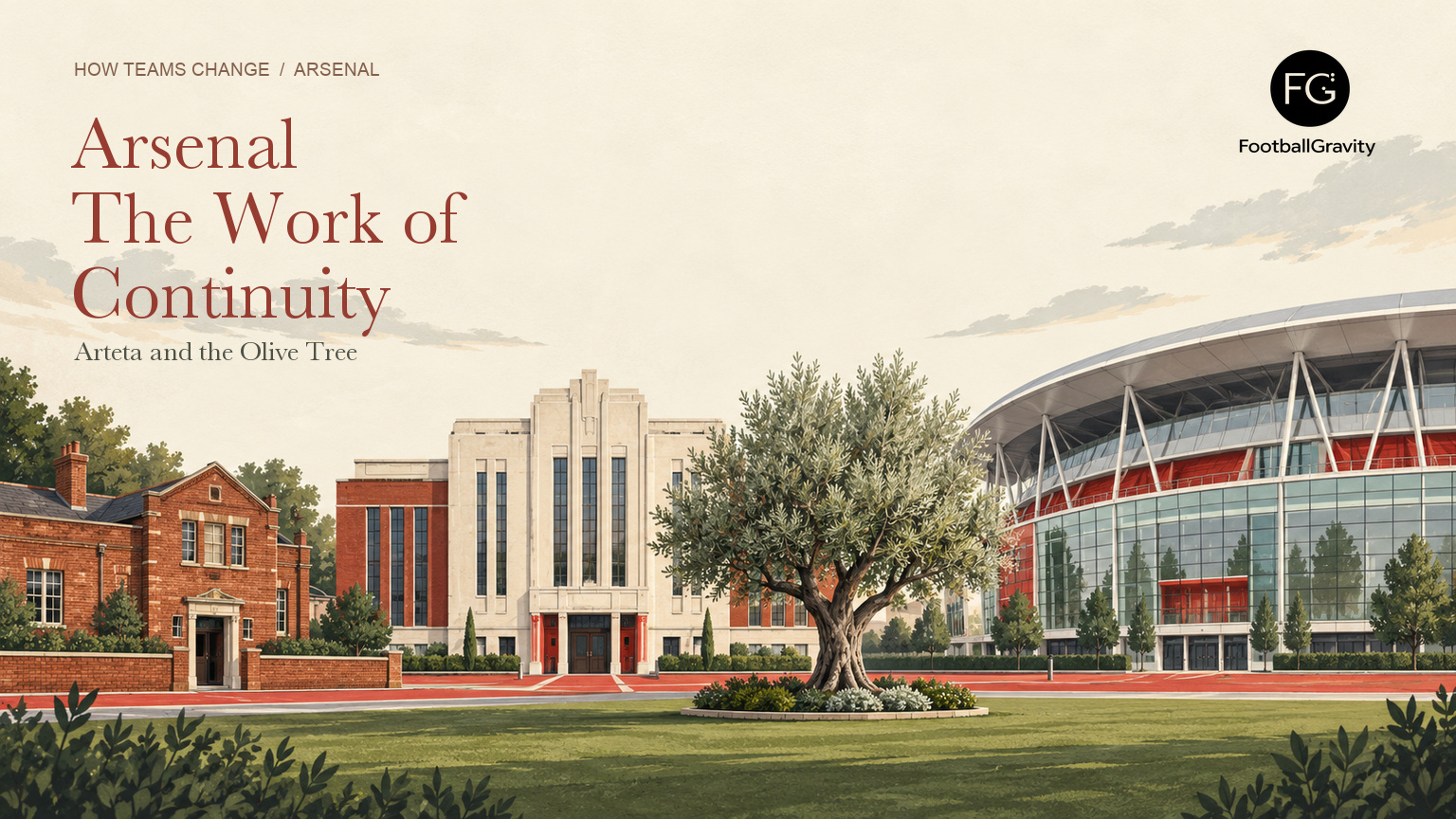
An old olive tree at the training ground offers a way into a larger question: how does a club give change enough time to take root?
The opening Arsenal study in FootballGravity’s How Teams Change series, examining the relationship between managerial trust, squad renewal and the care of a club’s identity.
At Arsenal’s training ground, Mikel Arteta placed an old olive tree between his office and the pitches. In a 2023 interview with GQ, it was described as around 150 years old: something the manager could see each day and the players would pass on their way to work.
An ancient tree is an appealing emblem for a football club. It suggests survival, deep roots and a life extending beyond any individual season. Arteta’s explanation, however, placed the emphasis on responsibility. Speaking in May 2023, he said its roots needed daily care and protection from damage. The age of the tree made that work more meaningful; it did not make the work unnecessary.
Arsenal’s decision to extend his contract until June 2030, following the 2025/26 Premier League title, gives the image a fresh context. A manager appointed in December 2019 has been offered the possibility of leading the club for more than a decade. A contract cannot guarantee that future. It can give the people building it a clearer horizon.
The more revealing episode came before the league championship. In 2022, Arsenal committed to Arteta when the immediate evidence was uncomfortable. That decision, together with the changes he made inside the club, helps explain what continuity can involve: time granted to a direction, and permission to alter the people and practices carrying it.
Trust during a losing run
In April 2022, Arsenal lost successive league matches to Crystal Palace, Brighton and Southampton. Arteta later said the club offered him his new contract after those defeats. “The club offered me the contract when we lost three matches,” he told reporters. By the announcement on 6 May, Arsenal had won their next three games, but the offer, in his account, preceded that recovery. The contemporary report preserves that distinction.
The sequence matters. Renewing a successful coach can simply confirm what the league table already says. Renewing one during a damaging run requires a view of his work that reaches beyond the most recent results. Arsenal’s owners were accepting the risk that their judgement might be wrong.
From outside, that judgement cannot be reconstructed in full. Yet the decision itself had practical value. Players considering their futures, coaches planning their work and those recruiting for the next season could act with greater confidence about who would lead the team. Stability changes the conditions in which decisions are made.
This is a useful distinction when discussing patience. Waiting can be passive. Extending a contract commits a club to a particular course and gives others reason to commit alongside it. It also raises the responsibility of those making the decision: they must keep examining whether the work justifies the time they have provided.
Understanding the people around the team
Arteta’s own account of changing Arsenal’s culture begins with listening. In a December 2024 press conference, he described employing a specialist to ask players and staff across different roles how it felt to work at the club. Their responses, he said, clarified the need for change. He wanted to move beyond his own impression of the environment.
The account gives the olive tree a more substantial setting. A symbol can make an idea memorable, but understanding a workplace requires attention to the experiences of the people within it. A manager who asks about relationships, communication and responsibility is looking at conditions that a match report rarely captures.
That exercise was Arteta’s description of his approach, rather than an independent measure of its effectiveness. Still, it suggests a useful way of assessing the cultural work of a coach. Can he identify problems beyond the starting XI? Can the people around the team understand their contribution? Do daily decisions reinforce the standards he asks others to follow?
These questions become especially relevant during a long tenure. Familiarity can help colleagues communicate more easily. It can also allow grievances or ineffective routines to settle into the background. Keeping a manager provides an opportunity to accumulate knowledge of the organisation; continuing to listen determines whether that knowledge stays useful.
Wenger and the different uses of time
Arsenal had already lived through another long managerial relationship. Looking back in his final press briefing in 2018, Arsène Wenger said he had accepted more limited resources during the stadium project and had chosen to remain through that challenge. He described debt repayment alongside competition from clubs with greater outside resources.
The club’s 2016/17 annual report recorded the end of 19 consecutive seasons in the Champions League and, in the same report, Wenger’s reappointment for another two years. European continuity had been a substantial achievement. Its interruption also exposed the difficulty of deciding when a trusted relationship should change.
Wenger’s era should not be compressed into a story of thrift. The stadium years had particular constraints, and his time at Arsenal encompassed different sporting and financial circumstances. His longevity likewise offers no automatic proof that every extension was the right decision. A club can value a manager’s contribution while still debating whether the next phase requires another person.
Arteta’s reconstruction has received a different kind of support. Arsenal’s accounts for the year ended 31 May 2024 recorded £255.7 million in additions to player registrations and stated that KSE UK provided funding for transfers and working capital. That accounting figure is distinct from cash paid in a single transfer window. It establishes that trust in the sporting project was accompanied by substantial resources.
The comparison makes Arsenal more interesting than a simple tale of a patient club. Time helped Wenger manage a period of financial constraint. Time and investment gave Arteta room to remake the team. Continuity has depended on what the club enabled its manager to do.
A club can keep its direction while changing its people
There are limits to any claim about Arsenal’s inherent patience. Unai Emery, appointed after Wenger in 2018, was dismissed in November 2019 after seven matches without a win. The club has been capable of ending a managerial project quickly. The different treatment of Emery and Arteta makes the criteria for trust more interesting than a general label of loyalty.
Arteta’s tenure has also included sharp changes of personnel. In May 2023, Arsenal renewed Aaron Ramsdale’s contract. That August, David Raya arrived on loan; in July 2024, Arsenal made his transfer permanent, following a season in which he made 32 Premier League appearances. Within a continuing managerial project, the goalkeeper position had changed.
Such decisions carry a human cost. A player who has helped a team improve may reasonably expect to remain central to it. The demands of the next team can lead the manager elsewhere. Claims about a shared culture therefore have to be judged alongside the way a club handles people whose roles diminish, as well as those whose careers advance.
For How Teams Change, Arsenal brings the question of succession inside the tenure of one coach. Barcelona and Manchester City invite us to examine how a team finds new configurations. Arsenal also asks how a club creates the conditions for that work to continue through disappointment, and how it distinguishes persistence from drift.
The 2030 contract extends Arteta’s opportunity to shape those conditions. It leaves a further question open: how much of the understanding being built around him will eventually belong to the club itself? That will depend on the people who carry standards into new roles, the decisions made under pressure and the ways newcomers learn what is expected of them.
An olive tree can remain beside the pitches for years. The responsibility represented by it has to pass from one group of people to the next.