
The Cup Keeps the Door Open: South Melbourne and the Joy of Competing

Original editorial artwork reading “The cup keeps the door open”, beside an abstract football pitch with an opening in its touchline.

South Melbourne’s giant-killing win over Melbourne Victory, and a Japanese university’s memorable cup run, reveal the joy of competing across football’s divisions.

South Melbourne pulled off a landmark giant-killing on 10 October 2026: a community-rooted club outside Australia’s top professional league beat A-League heavyweight Melbourne Victory to win the Australia Cup. Their 4–3 penalty shootout victory made them the first club from outside the A-League Men to lift the trophy.

Max Mikkola’s equaliser arrived in the 117th minute. South were three minutes from the end of extra time, a goal behind Victory, when the substitute brought them back into the match and sent the final to penalties.

The official match report records a 1–1 draw after extra time and an attendance of 29,911 at AAMI Park. Victory’s Denis Genreau had opened the scoring in the 95th minute. South goalkeeper Javier Lopez received the Mark Viduka Medal after a shootout in which he saved Harrison Sawyer’s penalty, then saved the retake too.

For supporters following a club beyond the top division, a cup offers a particular kind of anticipation. An opponent usually seen on television becomes a team to prepare for. The familiar shirt belongs in the same fixture. South Melbourne carried that possibility all the way to a trophy, giving Australian football an occasion worth looking at far beyond the usual European centres of attention.

A club with a long memory

South Melbourne’s place outside the A-League needs context. Founded in 1959, the club emerged from the merger of Hellenic, Yarra Park and South Melbourne United. Its identity is deeply connected to Melbourne’s Greek community. It was a founding member of the National Soccer League, competing throughout that league’s existence from 1977 to 2004, and won four national league championships.

When the A-League began in 2005, South continued in Victorian competition. By the time of this cup final, its ambitions had acquired further outlets: it had won the inaugural Australian Championship in December 2025, and reached the OFC Pro League final in May 2026. The club was also included in the 2026 Australian Championship.

South’s achievements gave them a formidable history to draw on. They still entered this final as the challengers from outside the country’s top professional league, facing one of its most successful clubs. Their victory was a cup upset with deep roots: a community institution that had once helped define the national game beating a leading club of its modern top flight.

Ange Postecoglou supplied a more personal account before the final. In a Football Australia interview, the former South player and coach recalled the club as a social hub for migrant families. Of his own connection, he said: “it sustained me on a personal level because all my meaningful relationships came from the football club.”

That memory helps explain how a club can remain significant through changes in its competitive position. A family’s connection to football may begin with a place where parents feel at home; children inherit the habit of going, then make friendships of their own. A national final gives that everyday attachment a much larger stage.

The pleasure of sharing a fixture

Melbourne Victory brought its own history to AAMI Park. An inaugural A-League club, it built a substantial following and won the league’s Premiership and Championship doubles in 2007 and 2009. Postecoglou later coached Victory as well as South. The official final preview also noted connections across the squads: South’s Paulo Retre and Sebastian Pasquali had played for Victory, while Victory’s Harrison Sawyer had played for South.

Those crossings make it difficult to draw a clean cultural border between the two teams. Professional football has its own communities and inherited loyalties. A cup can bring them into contact with clubs whose histories developed along a different route. Supporting a successful A-League and valuing the clubs beyond it belong comfortably within the same vision for the game.

The attraction extends to teams that never reach a final. A university side or regional club can prepare for a genuine competitive test against professionals, with elimination at stake for both. Selection, training and the journey to the ground acquire a different scale. Even a defeat can become part of a club’s shared memory. Winning is the exceptional possibility that makes the fixture compelling; access to the contest is the condition that makes it possible.

A Japanese university takes its chance

Japan’s Emperor’s Cup offers a useful comparison. The JFA describes eligibility across its registered senior teams, professional and amateur. Its 2026 national field comprises 88 teams: 20 from J1, 20 from J2, one amateur seed and 47 prefectural representatives. Prefectural competitions create routes into that field for teams outside the two leading professional divisions.

In 2017, the University of Tsukuba made that opportunity tangible. Representing Ibaraki, it beat J1 side Vegalta Sendai 3–2 on 21 June. Kaoru Mitoma scored twice, in the sixth and 73rd minutes; Seiya Nakano scored the other goal. On 12 July, Nakano scored both goals in a 2–1 third-round win over J2 side Avispa Fukuoka.

Tsukuba’s run ended with a 2–0 defeat by J1 club Omiya Ardija in the round of 16. That ending matters. South Melbourne won a national cup; Tsukuba won memorable matches and reached the last 16. A university team and a former national league champion also occupy different places in their countries’ football cultures. The comparison concerns the opportunity to compete across those divisions, rather than equivalence between the teams or their achievements.

Mitoma’s name gives overseas readers an entry into the Japanese story, but Nakano’s four goals across the Sendai and Fukuoka matches keep the achievement in its proper collective frame. The university team earned its results together. Its players could test their football against professional opponents while still representing the institution in which they were developing.

South Melbourne · 2026University of Tsukuba · 2017
Club context
Former NSL champion; 2025 Australian Championship winner; 2026 OFC Pro League finalist.
Club context
University team; Ibaraki prefectural representative in 2017.
Selected results
Final: 1–1 after extra time; 4–3 on penalties against Melbourne Victory.
Selected results
3–2 vs Vegalta Sendai (J1); 2–1 vs Avispa Fukuoka (J2).
Campaign outcome
2026 Australia Cup champions.
Campaign outcome
Round of 16: lost 0–2 to Omiya Ardija (J1).
Different achievements, a shared opportunity. Selected fixtures, not complete cup paths. Sources: Australia Cup, Australian Championship, OFC and JFA; specific Japanese match records are linked above.

What can last beyond the cup

Football’s long-term health depends in part on whether these places of belonging remain open to the next generation. Clubs give people a way to remain involved, whether as players, supporters or those doing the work that allows another match to take place. A cup can make those connections visible to a wider audience and give sporting ambition somewhere to go.

South Melbourne’s final demonstrates that such a meeting can command attention. The crowd figure measures attendance on one night. Whether that attention becomes regular support or a lasting financial benefit will take longer to establish. The result alone tells us nothing about the club’s environmental footprint.

What the competition has already delivered is concrete enough: a serious contest between two Melbourne clubs, a late equaliser and a champion from beyond the A-League. Japan’s university players have their own version of that invitation, with a different history and a different outcome. For everyone else entering a national cup, there is still the next draw, the next opponent, and the work of getting ready.
Arsenal and the Work of Continuity

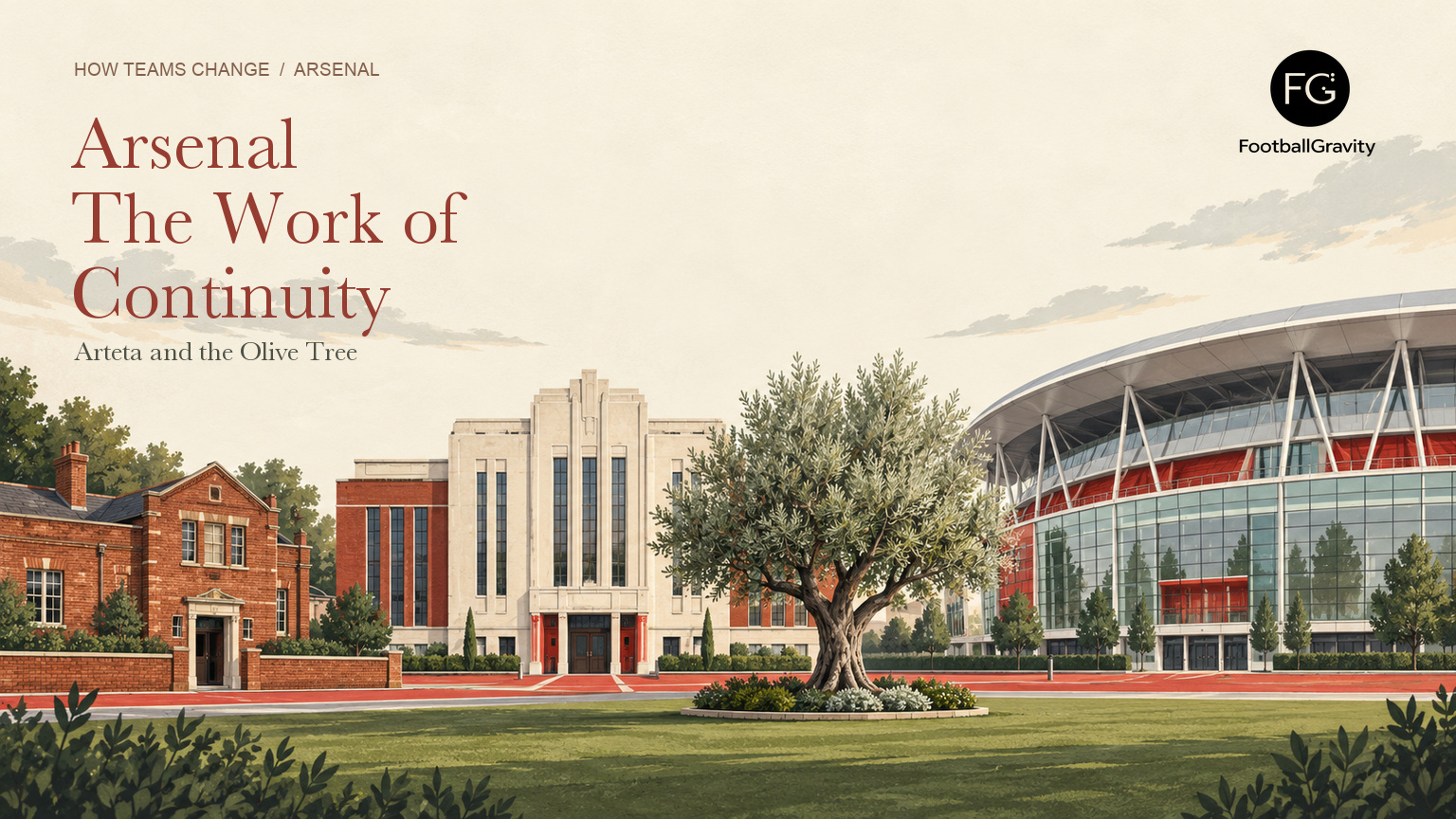
Conceptual illustration showing an early red-brick pavilion, a white Art Deco stadium facade and a modern curved stadium from left to right, with an olive tree in the foreground and Arsenal and the Work of Continuity typography.

An old olive tree at the training ground offers a way into a larger question: how does a club give change enough time to take root?

The opening Arsenal study in FootballGravity’s How Teams Change series, examining the relationship between managerial trust, squad renewal and the care of a club’s identity.

At Arsenal’s training ground, Mikel Arteta placed an old olive tree between his office and the pitches. In a 2023 interview with GQ, it was described as around 150 years old: something the manager could see each day and the players would pass on their way to work.

An ancient tree is an appealing emblem for a football club. It suggests survival, deep roots and a life extending beyond any individual season. Arteta’s explanation, however, placed the emphasis on responsibility. Speaking in May 2023, he said its roots needed daily care and protection from damage. The age of the tree made that work more meaningful; it did not make the work unnecessary.

Arsenal’s decision to extend his contract until June 2030, following the 2025/26 Premier League title, gives the image a fresh context. A manager appointed in December 2019 has been offered the possibility of leading the club for more than a decade. A contract cannot guarantee that future. It can give the people building it a clearer horizon.

The more revealing episode came before the league championship. In 2022, Arsenal committed to Arteta when the immediate evidence was uncomfortable. That decision, together with the changes he made inside the club, helps explain what continuity can involve: time granted to a direction, and permission to alter the people and practices carrying it.

Trust during a losing run

In April 2022, Arsenal lost successive league matches to Crystal Palace, Brighton and Southampton. Arteta later said the club offered him his new contract after those defeats. “The club offered me the contract when we lost three matches,” he told reporters. By the announcement on 6 May, Arsenal had won their next three games, but the offer, in his account, preceded that recovery. The contemporary report preserves that distinction.

The sequence matters. Renewing a successful coach can simply confirm what the league table already says. Renewing one during a damaging run requires a view of his work that reaches beyond the most recent results. Arsenal’s owners were accepting the risk that their judgement might be wrong.

From outside, that judgement cannot be reconstructed in full. Yet the decision itself had practical value. Players considering their futures, coaches planning their work and those recruiting for the next season could act with greater confidence about who would lead the team. Stability changes the conditions in which decisions are made.

This is a useful distinction when discussing patience. Waiting can be passive. Extending a contract commits a club to a particular course and gives others reason to commit alongside it. It also raises the responsibility of those making the decision: they must keep examining whether the work justifies the time they have provided.

Understanding the people around the team

Arteta’s own account of changing Arsenal’s culture begins with listening. In a December 2024 press conference, he described employing a specialist to ask players and staff across different roles how it felt to work at the club. Their responses, he said, clarified the need for change. He wanted to move beyond his own impression of the environment.

The account gives the olive tree a more substantial setting. A symbol can make an idea memorable, but understanding a workplace requires attention to the experiences of the people within it. A manager who asks about relationships, communication and responsibility is looking at conditions that a match report rarely captures.

That exercise was Arteta’s description of his approach, rather than an independent measure of its effectiveness. Still, it suggests a useful way of assessing the cultural work of a coach. Can he identify problems beyond the starting XI? Can the people around the team understand their contribution? Do daily decisions reinforce the standards he asks others to follow?

These questions become especially relevant during a long tenure. Familiarity can help colleagues communicate more easily. It can also allow grievances or ineffective routines to settle into the background. Keeping a manager provides an opportunity to accumulate knowledge of the organisation; continuing to listen determines whether that knowledge stays useful.

Wenger and the different uses of time

Arsenal had already lived through another long managerial relationship. Looking back in his final press briefing in 2018, Arsène Wenger said he had accepted more limited resources during the stadium project and had chosen to remain through that challenge. He described debt repayment alongside competition from clubs with greater outside resources.

The club’s 2016/17 annual report recorded the end of 19 consecutive seasons in the Champions League and, in the same report, Wenger’s reappointment for another two years. European continuity had been a substantial achievement. Its interruption also exposed the difficulty of deciding when a trusted relationship should change.

Wenger’s era should not be compressed into a story of thrift. The stadium years had particular constraints, and his time at Arsenal encompassed different sporting and financial circumstances. His longevity likewise offers no automatic proof that every extension was the right decision. A club can value a manager’s contribution while still debating whether the next phase requires another person.

Arteta’s reconstruction has received a different kind of support. Arsenal’s accounts for the year ended 31 May 2024 recorded £255.7 million in additions to player registrations and stated that KSE UK provided funding for transfers and working capital. That accounting figure is distinct from cash paid in a single transfer window. It establishes that trust in the sporting project was accompanied by substantial resources.

The comparison makes Arsenal more interesting than a simple tale of a patient club. Time helped Wenger manage a period of financial constraint. Time and investment gave Arteta room to remake the team. Continuity has depended on what the club enabled its manager to do.

A club can keep its direction while changing its people

There are limits to any claim about Arsenal’s inherent patience. Unai Emery, appointed after Wenger in 2018, was dismissed in November 2019 after seven matches without a win. The club has been capable of ending a managerial project quickly. The different treatment of Emery and Arteta makes the criteria for trust more interesting than a general label of loyalty.

Arteta’s tenure has also included sharp changes of personnel. In May 2023, Arsenal renewed Aaron Ramsdale’s contract. That August, David Raya arrived on loan; in July 2024, Arsenal made his transfer permanent, following a season in which he made 32 Premier League appearances. Within a continuing managerial project, the goalkeeper position had changed.

Such decisions carry a human cost. A player who has helped a team improve may reasonably expect to remain central to it. The demands of the next team can lead the manager elsewhere. Claims about a shared culture therefore have to be judged alongside the way a club handles people whose roles diminish, as well as those whose careers advance.

For How Teams Change, Arsenal brings the question of succession inside the tenure of one coach. Barcelona and Manchester City invite us to examine how a team finds new configurations. Arsenal also asks how a club creates the conditions for that work to continue through disappointment, and how it distinguishes persistence from drift.

The 2030 contract extends Arteta’s opportunity to shape those conditions. It leaves a further question open: how much of the understanding being built around him will eventually belong to the club itself? That will depend on the people who carry standards into new roles, the decisions made under pressure and the ways newcomers learn what is expected of them.

An olive tree can remain beside the pitches for years. The responsibility represented by it has to pass from one group of people to the next.