
A Champions League Draw Is Also a Reunion

An AI-generated editorial map of Europe connected by luminous routes and memory-like ticket fragments, with The Weight of the Draw title, a large UEFA Champions League mark and the FootballGravity logo.

Part five of The Weight of the Draw, a five-part FootballGravity series examining opponent strength, fixture congestion, travel, playing conditions and the human ties hidden inside the 2026–27 Champions League schedule.

A Champions League draw does not only assign clubs to one another. It sends people back into their own histories. Manchester United will walk into Sporting CP’s stadium with Bruno Fernandes. Manchester City will welcome Paris Saint-Germain with Gianluigi Donnarumma in goal. Arsenal’s schedule connects Martin Ødegaard to Real Madrid and Héctor Bellerín to the club where he spent most of his senior career.

These are not sentimental footnotes pasted onto the football. They can change the week around a match: the questions at the press conference, the requests for tickets, the noise inside a stadium, the amount of local knowledge available in the dressing room and the emotional work required before kick-off. None of that guarantees an advantage. Familiarity may make a place easier to read while making the occasion harder to keep ordinary.

Bruno Fernandes returns to the club that launched him

The clearest homecoming in the English draw belongs to Manchester United. On 25 November, United visit Sporting CP, the club from which they signed Bruno Fernandes in January 2020. Sporting was not a brief stop in his career. It was where he became captain, a prolific midfielder and the player United were prepared to build around.

The practical benefit is easy to imagine but difficult to measure. Fernandes knows the city, the stadium and the emotional temperature of the club. He can explain how the night may feel to team-mates who have never played there. The cost is the reverse side of the same knowledge. A return creates interviews, reunions and divided attention. The player most qualified to make the occasion familiar is also the person least able to experience it as routine.

Donnarumma faces Paris from the other side

Manchester City’s home match against Paris Saint-Germain on 14 October carries a different kind of reunion. Gianluigi Donnarumma joined City from PSG in 2025 after four seasons in Paris and a Champions League triumph. By the 2026–27 season he wears City’s number one shirt. The opponent is recent enough that many of the voices, habits and finishing patterns will still be recognisable.

Goalkeepers make this case especially interesting. Familiarity may help with the preferences of former team-mates, but the information moves in both directions: they have trained against him too. The reunion is therefore not a secret tactical code. It is a shared archive. City can use Donnarumma’s knowledge; PSG can use theirs.

PSG’s visit to Aston Villa on 8 December adds a managerial echo. Unai Emery was PSG’s coach before his work at Arsenal, Villarreal and Villa. This is not his first meeting with the Paris club since leaving, so the useful point is not novelty. It is that a fixture can bring institutional memory into the preparation room even when the current squads have changed.

Arsenal’s draw contains two versions of the past

Arsenal host Real Madrid on 9 December. Martin Ødegaard joined Real as a teenager, spent years under contract there and eventually found permanence in north London. This is not a return to the Bernabéu: Madrid come to the Emirates. Yet the human connection remains. The former prospect now leads Arsenal as captain against the club that once represented his future.

On 20 January, Arsenal travel to Real Betis, where Héctor Bellerín provides the mirror image. Bellerín left Arsenal after more than a decade connected to the club and later made Betis his home. For Arsenal, an away match now places a familiar former team-mate inside the opponent’s dressing room. For Bellerín, the visiting badge carries years of friendships and professional memory.

The two fixtures show why “former club” is too broad a label. Ødegaard faces an early chapter that never became a settled senior home. Bellerín faces the club that shaped most of his adult career. Both matches have a personal history, but not the same one.

A country can be familiar without the opponent being familiar

Liverpool’s trip to Inter on 19 January offers a lighter connection. Federico Chiesa is not returning to a former club, but he is returning to Italy, where he developed at Fiorentina and played for Juventus before joining Liverpool. The language, media environment and football culture are familiar; the opponent’s dressing room is not.

That distinction matters. A home-country fixture may reduce some friction around travel and communication without carrying the same emotional weight as facing former team-mates. It can still increase attention around one player, particularly from national media. Human ties operate by degree, not as a yes-or-no category.

English clubStrongest personal connection in the drawWhat it may change
ArsenalØdegaard against Real Madrid; Bellerín against Arsenal for BetisTwo different former-club stories bring extra attention and unusually rich mutual knowledge.
Aston VillaEmery against former club PSGManagerial memory can inform preparation, while the narrative expands beyond the players.
LiverpoolChiesa back in Italy to face InterFamiliar language and football culture, but not a direct former-club reunion.
Manchester CityDonnarumma against PSGRecent, two-way familiarity between a goalkeeper and many former team-mates.
Manchester UnitedFernandes away at SportingThe strongest homecoming atmosphere, with local knowledge and emotional demands arriving together.

Familiarity is useful; emotion is not a forecast

There is a tempting story available in every reunion: the former player who “had to score”, the old coach who “knew exactly how to win”, the returning captain who would either rise to the occasion or be overwhelmed by it. Those stories are powerful because they can be written before the match. That is also why they require caution.

A personal connection can supply information and motivation. It can just as easily create distraction, or make no observable difference at all. Team selection may remove the player from the match. A transfer before January may remove the connection entirely. The responsible use of this layer is not to predict a goal or result. It is to identify which ordinary Champions League weeks are unlikely to feel ordinary to the people inside them.

The draw is a map with people on it

Across five parts, The Weight of the Draw has moved from the visible list to the hidden workload. Opponent strength showed why famous names are an incomplete measure. The domestic calendar placed each European night between other demands. Travel added distance and recovery. Conditions changed what preparation means after arrival. Human ties complete the picture by showing that clubs do not travel as blank organisations. They carry former homes, relationships and memories with them.

That does not make the fifth layer more important than the first four. It makes the draw more truthful. A fixture is an opponent, a date, a journey and a place. It is also a room full of people who have been somewhere before.

Method note: Fixtures follow UEFA’s published 2026–27 league-phase schedule. Club roles, squad status and biographical links were checked against official club sources on 23 September 2026. Transfers, injuries and team selection can change whether a named person takes part. The connections described here are context for preparation and attention; they are not used to predict performance or results.

Can Football Clubs Become Social Infrastructure?

An AI-generated editorial illustration of an abstract Japanese town where a railway station, community buildings and football pitches are linked by public paths.

Part one of FootballGravity’s What can football learn from Japan? series looks at SHAREN!, the J.League’s framework for social collaboration, through a small station project in Kagoshima.

At Kiire station in Kagoshima, coffee is now served in a room that used to be part of the station office. The space also sells Kagoshima United FC merchandise and handles bicycle rental. Commuters, local residents, visitors and football supporters all have a reason to pass through the same small place.

There is nothing grand about the idea. That is part of its appeal. Community infrastructure is often made from ordinary places that remain useful between events. In Kiire, a football club has become one of the organisations responsible for keeping such a place open.

The project offers a clear way into SHAREN!, the J.League’s name for social collaboration between clubs and local partners. It also raises a question with relevance beyond Japan: what can a club contribute when the work is for a town, including people who may never attend a match?

What SHAREN! means

J.League clubs have carried out hometown activities since the competition’s early years. In 2018, the league gave a more specific name to work in which clubs join other organisations in addressing a social or local issue. Its official description of SHAREN! envisages at least three collaborators creating shared value together.

Those collaborators may include residents, companies, non-profits, schools and public authorities. The point is not simply that a club supports a good cause. It is that different partners bring different things: a place, local knowledge, public responsibility, operational experience, communications or the ability to bring people together.

This makes SHAREN! useful to an international audience. The individual projects are rooted in Japanese towns, but the underlying question travels well. How can the attention and relationships around a football club become useful in everyday local life?

A new use for part of a station

Kiire is on JR Kyushu’s Ibusuki Makurazaki Line, south of central Kagoshima. Kagoshima United says the station had been without permanently stationed staff since May 2000. The railway continued to serve the town, but part of the former station office was available for another use.

The result was Unibase Kiire, which opened on 14 April 2025. JR Kyushu describes it as an approximately eight-tsubo community space created by renovating part of the former office. One tsubo is about 3.3 square metres, making the room roughly 26 square metres.

The operating arrangement matters as much as the size. Kagoshima City commissioned a joint venture formed by Kagoshima Pro Sports Project, the company that operates Kagoshima United, and local company NK Customize. JR Kyushu provided the station setting. The club’s opening announcement described the intended users as local residents, tourists and supporters.

The community space did not restore staffed railway services: ticket sales, ticket collection and railway enquiries are not provided there. Its role is different. It sells drinks and food, carries official club merchandise and acts as the reception point for bicycle rental.

The project also continued after the April opening. Kagoshima City completed improvements to the station waiting area on 20 August 2025 and began a rental service with two electric-assist bicycles on the same day. Before the unveiling, 21 people joined a public workshop that included local children and finished the paintwork on four wooden benches. A local high school student supplied the calligraphy for a station entrance curtain made by JR Kyushu’s Kagoshima branch.

These details give the project its character. The club name is visible, but the space is tied to waiting for a train, having a drink, travelling onward by bicycle and taking part in the making of the station itself. Football is present without being the only reason for the place to exist.

A partnership, not a club acting alone

Kiire also shows why the word “collaboration” matters. The city refurbished the facilities and commissioned the operation. JR Kyushu made railway space part of its wider ekinico initiative for bringing new activity to underused station areas. The joint venture runs the community space, and the company behind Kagoshima United is one of its two members.

In May 2026, the J.League gave the Kiire project its Social Challenger Award at the SHAREN! Awards. The league’s selection comment presented unmanned stations as a challenge shared by communities across Japan and praised the decision to form a joint venture and reuse the station as a gathering place. That recognition shows how the league understands the project; it should not be read as independent evidence of its long-term impact.

What can be seen already is a practical division of roles. A public authority, a railway, a local business and a football club have each contributed something the others could not provide alone. The result is modest in scale, but it is part of daily life rather than limited to a matchday campaign.

What football can learn from Kiire

Kiire offers a principle rather than a template. Its arrangement belongs to its own town, partners and transport network. What others can take from it is the way the partnership starts with a real place and gives each organisation a recognisable job.

The phrase “social infrastructure” earns its meaning through use. A club moves closer to that role when its name, relationships and staff help sustain something that people can use in ordinary life.

Unibase Kiire is still a young project, and it is too early to know how it will shape local life over time. What the public record does show is the structure: a small part of a station, reopened for community use through a partnership in which a football club has an operational role. That is a useful first answer to what football can learn from Japan.

Method note: This article is an independent, document-based analysis using material published by the J.League, Kagoshima United FC, Kagoshima City and JR Kyushu. FootballGravity has not interviewed operators or users. “Social infrastructure” is FootballGravity’s analytical frame, not an official SHAREN! designation or a claim that long-term impact has already been established.

Manchester City, Rewritten: The Many Peaks of Pep’s City

An AI-generated abstract editorial illustration of ten evolving vertical panels in Manchester sky blue and midnight navy, with a rising line and the title Manchester City, Rewritten.

Part one of Manchester City, Rewritten, a club study in FootballGravity’s How Teams Change series, examining how Pep Guardiola’s City changed its players, shape and leadership without losing the idea that held it together.

When Pep Guardiola’s Manchester City is recalled, the image usually arrives already framed: Rodri on the grass in Istanbul, a blue crowd behind him, the European Cup finally in the club’s hands. The Treble is an irresistible ending. It is also an incomplete way to remember the team.

Guardiola’s City did not spend a decade protecting one perfect side. It changed the goalkeeper’s function, rebuilt both full-back positions, replaced a century of striker instinct with a false nine, then brought in Erling Haaland and found a new way to occupy the middle of the pitch. Its captains changed. Its senior players changed. The principles were recognisable; the solutions rarely stood still.

That is why this series begins with a deliberately simple question: how many times did Guardiola complete Manchester City? The answer is not a ranking. It is a small correction to the instinct that treats 2022/23 as the only summit.

Five peaks, five different teams

City’s Premier League record is the clearest place to begin. Across Guardiola’s ten seasons, the club collected 865 league points with a goal difference of +576, winning six titles. The seven seasons from 2017/18 to 2023/24 averaged 91.1 points and produced six championships. That is not the shape of a single extraordinary year. It is sustained reinvention under the pressure of being expected to win again.

SeasonLeague recordWhat it achievedThe footballing answer
2017/18100 points
106–27, +79
Premier League and League CupWidth, pace and a relentless 3-2-5
2018/1998 points
95–23, +72
England’s domestic four-trophy sweepControl with greater tactical flexibility
2020/2186 points
83–32, +51
Premier League, League Cup and first Champions League finalFalse nine, patience and defensive rest control
2022/2389 points
94–33, +61
Premier League, FA Cup and Champions LeagueHaaland ahead of a Stones–Rodri box
2023/2491 points
96–34, +62
A fourth consecutive Premier League titleA bigger, more adaptable title-winning side

League points and goals are Premier League records. European stages are recorded by UEFA. The tactical descriptions are FootballGravity’s interpretation of the cited season reviews; formations describe tendencies in possession, not a fixed team-sheet.

The first complete answer was the 100-point team

The 2017/18 side remains the league’s purest statistical monument. One hundred points, 106 goals and a +79 goal difference were the outward evidence of a more profound change. Ederson made the goalkeeper an extra passing option. Kyle Walker gave the right side recovery speed and width. Kevin De Bruyne and David Silva could drift into the spaces behind the first press because Raheem Sterling and Leroy Sané stretched the pitch to its edges.

The shape was often described as 4-3-3, but the important picture came after possession had been secured: three behind the ball, two in front of them, five spread across the final line and half-spaces. It asked defenders to make decisions with the ball, wingers to run beyond it, and opponents to defend a pitch that suddenly felt too wide. This was the team that made Guardiola’s idea in Manchester look fully inhabited for the first time.

It was not, however, the team that won everything available in England. That came a year later.

The domestic four was a different kind of mastery

The 2018/19 title race with Liverpool ended at 98 points, not 100. De Bruyne missed much of the league season. Yet City also won the FA Cup, League Cup and Community Shield, becoming the first English men’s side to hold the four domestic honours in a single campaign. The achievement mattered because it asked for a different kind of depth: decisive cup nights, rotation without a loss of control, and a capacity to absorb absence.

Bernardo Silva moved closer to midfield. İlkay Gündoğan and David Silva offered different ways to govern a match. Sterling’s goals arrived from increasingly central positions. The football still had the sky-blue velocity of the previous season, but it had become less dependent on one route to the penalty area. Its distinction is not that it was somehow better than the Centurions. It solved a different problem, with less margin for error.

When control became quieter

The next transformation is easier to miss because it looked slower. Rodri’s arrival, Rúben Dias’s authority in defence and João Cancelo’s movement into midfield changed the geometry of City’s possession. During 2020/21, Guardiola often played without a conventional centre-forward. A false nine would drop away from the centre-backs; midfielders would arrive into the spaces he left; the ball would travel through the match with more patience.

The Premier League’s own tactical review measured a sharp fall in City’s direct speed from Guardiola’s first season to 2020/21, alongside a rise in the passes opponents were allowed before a defensive action. Those are imperfect measures, but they help name a visible shift. City had learned to make a match smaller: fewer uncontrolled transitions, fewer invitations to race, more time spent arranging the next attack. They won the league and reached their first Champions League final with a side that felt less like a sprint than a long possession of the room.

The Treble was a variant, not the destination

Haaland’s arrival in 2022 did not restore an old-fashioned City. It forced another solution. His presence offered a permanent threat between centre-backs, but it also removed one midfielder from the old false-nine picture. Guardiola’s answer was John Stones: nominally a centre-back, increasingly a second midfielder beside Rodri once City had the ball. The resulting 3-2-4-1 could protect against counterattacks while still feeding Haaland in the box.

UEFA’s technical observers named Stones to their 2022/23 Champions League Team of the Season and described the hybrid role he had made visible. Haaland finished the campaign with 57 big chances, more than twice the highest individual total among City’s previous Premier League title-winning seasons in the same comparison. The Treble side was overwhelming, but its greatness came from adaptation: a team associated with midfield abundance had created room for an exceptional finisher without surrendering its defensive balance.

Then came the fourth title in a row. City recorded 91 points and a +62 goal difference in 2023/24, becoming the first side in English top-flight history to win four consecutive league championships. The squad was changing again—larger defenders, new wide options, Julián Álvarez closer to Haaland at times—and still the standard held. If the Treble was the European peak, four in a row was perhaps the clearest proof of domestic durability.

What the decade asks us to remember

There is no need to flatten these teams into one argument. The Centurions carried the highest points total. The 2018/19 side collected every domestic prize. The false-nine team brought City to its first European final. The 2022/23 team completed the Treble. The following year made a record that may be even harder to repeat.

What binds them is less a formation than a habit: City kept treating success as a reason to revise the team, rather than preserve it in glass. That habit now makes the post-Guardiola transition more interesting than a simple before-and-after. The next article will follow the players and roles that disappeared from the league-minute core, and ask what a club has to retain when the people who carried its standards begin to leave.

Method note: This opening article uses Premier League season records for points, goals and goals conceded, and UEFA’s club history and technical report for European outcomes and the Stones role. “Five peaks” is an editorial selection, not a statistical model. It is intended to compare distinct successful versions of City, rather than declare a single best side.

The €222m Question: When Barcelona Lost Its Timetable

An abstract editorial illustration in midnight blue, burgundy and gold about Barcelona’s squad transition, featuring the official FC Barcelona crest and the FootballGravity logo.

Part one of Barcelona, In Transition, a club study in FootballGravity’s How Teams Change series, examining how Barcelona rebuilt its squad, its relationships and its room to act after the end of MSN.

There are transfers that alter a team, and there are transfers that alter the calendar around a team. Neymar’s departure from FC Barcelona belonged to the second category. On 3 August 2017, his legal representatives paid the €222 million release clause that ended his contract. The number became football’s loudest shorthand for the summer that followed: a fortune received, a fortune spent, a familiar warning about what came next.

But money is a poor clock. It tells us how large an event was, not how much time it left behind.

Barcelona had not merely lost a brilliant left-sided forward. It had lost one third of a frontline that had grown into a shared language. Lionel Messi, Luis Suárez and Neymar did not need to be identical players to make one another legible. One could run beyond; one could hold a defender in place; one could arrive in the space that opened. Their 2014/15 treble is usually where the memory begins, but the more durable achievement was the familiarity that followed: opponents had to defend not three names, but a sequence of decisions already in motion.

A release clause is not a succession plan

The clause gave Barcelona a precise sum. It did not provide a ready-made successor, a settled tactical role or a patient market. The club had to respond inside the closing weeks of a transfer window while every prospective seller knew the scale of the payment. That context does not make every subsequent choice correct. It does make the usual before-and-after story too tidy.

Ousmane Dembélé arrived from Borussia Dortmund later that month. Philippe Coutinho followed in January. Both were gifted footballers, both were signed at an age when their best years plausibly lay ahead, and neither was simply a player-shaped replacement for Neymar. Dembélé offered pace, width and unpredictability from either flank. Coutinho brought a different kind of invention: a midfielder-forward who wanted touches between lines and the freedom to turn toward goal. The difficulty was not that either player lacked a case for being admired. It was that a famous vacancy encouraged Barcelona to read several needs as one.

A player can be excellent, expensive and still asked to solve the wrong problem. The post-Neymar years repeatedly returned to that uncomfortable possibility. Barcelona were searching at once for a left-sided threat, a future centre of creativity, a way to reduce the burden on Messi, and a route back to European control. Those are four different briefs. They do not always fit inside one shirt, one fee or one coach’s system.

The cost of replacing a relationship

The tempting version of this history treats the €222 million as a pile of cash placed on a table, then judges each purchase against it. Football does not work so cleanly. Transfer fees are only one part of a long decision: contracts distribute cost through time; wages set a club’s future flexibility; injuries change the value of a season; a manager’s needs can change before a signing has learned the language of the side.

Nor was the pre-2017 Barcelona squad an empty canvas. Messi and Suárez remained extraordinary reference points. Andrés Iniesta, Sergio Busquets and Gerard Piqué still carried institutional memory. New arrivals were joining a team with expectations already written into its passing patterns and its public imagination. The task was not to make a new Barcelona from nothing. It was to change a living one without making it unrecognisable.

That is why the later careers of departing players deserve care. Dembélé’s development elsewhere should not be used as a cheap verdict on his years in Catalonia. Players mature; injuries ease or recur; coaches define roles differently; teams grant different permissions. His story is valuable precisely because it resists a simple label. It asks whether a club and a player met at the right moment, with the right surrounding structure, and for long enough to let the answer emerge.

What Barcelona still had

Looking back from the current Barça makes it easy to search the intervening years only for mistakes. That would miss the more interesting continuity. The club retained the capacity to attract ambitious players. It retained a footballing identity strong enough to make a role in midfield feel like a proposition rather than a job description. And, most importantly, it retained La Masia: not as a sentimental answer to every financial question, but as a place where players could learn the club’s rhythms before the first team asked them to carry them.

Gavi, Fermín López, Pau Cubarsí and Lamine Yamal belong to a later chapter, and their rise should not be projected backwards as if it were inevitable. Still, their presence changes how this decade can be read. A squad transition is rarely one transfer window. It is a long negotiation between the players a club buys, the players it keeps, the players it lets go, and the players who are already walking through its own doors.

A better question than “what did Barcelona buy?”

There will be a place in this series for the difficult parts: contracts, wages, accounting, registration rules and the decisions that narrowed Barcelona’s options. They matter, and they should be reported with precision. They are not, however, the whole subject. The club’s recent revival has also been built from patient development, well-chosen talent and the return of a younger internal core. A serious account has room for both truths.

So the €222 million is best understood as an opening question, not a verdict. What did Barcelona need to replace after Neymar? A winger? Goals? A partnership? Time? The answer moved as the club moved. In the next article, we will follow the first wave of replacements and examine how their roles changed as the managers, the squad and the financial horizon changed around them.

Method note: This article distinguishes the €222 million release-clause payment from Barcelona’s later transfer spending, contracts and squad costs. It does not treat them as one pool of money. Subsequent articles will use audited club accounts, league registration materials and confirmed transfer announcements alongside independent reporting.

Crest credit: The official FC Barcelona crest was supplied by the club’s Communications Department and is reproduced with permission for editorial use only. FootballGravity’s reporting remains independent; this permission does not imply endorsement of the article.

Where Football Lives #03 — Marseille: The City Takes Its Seat

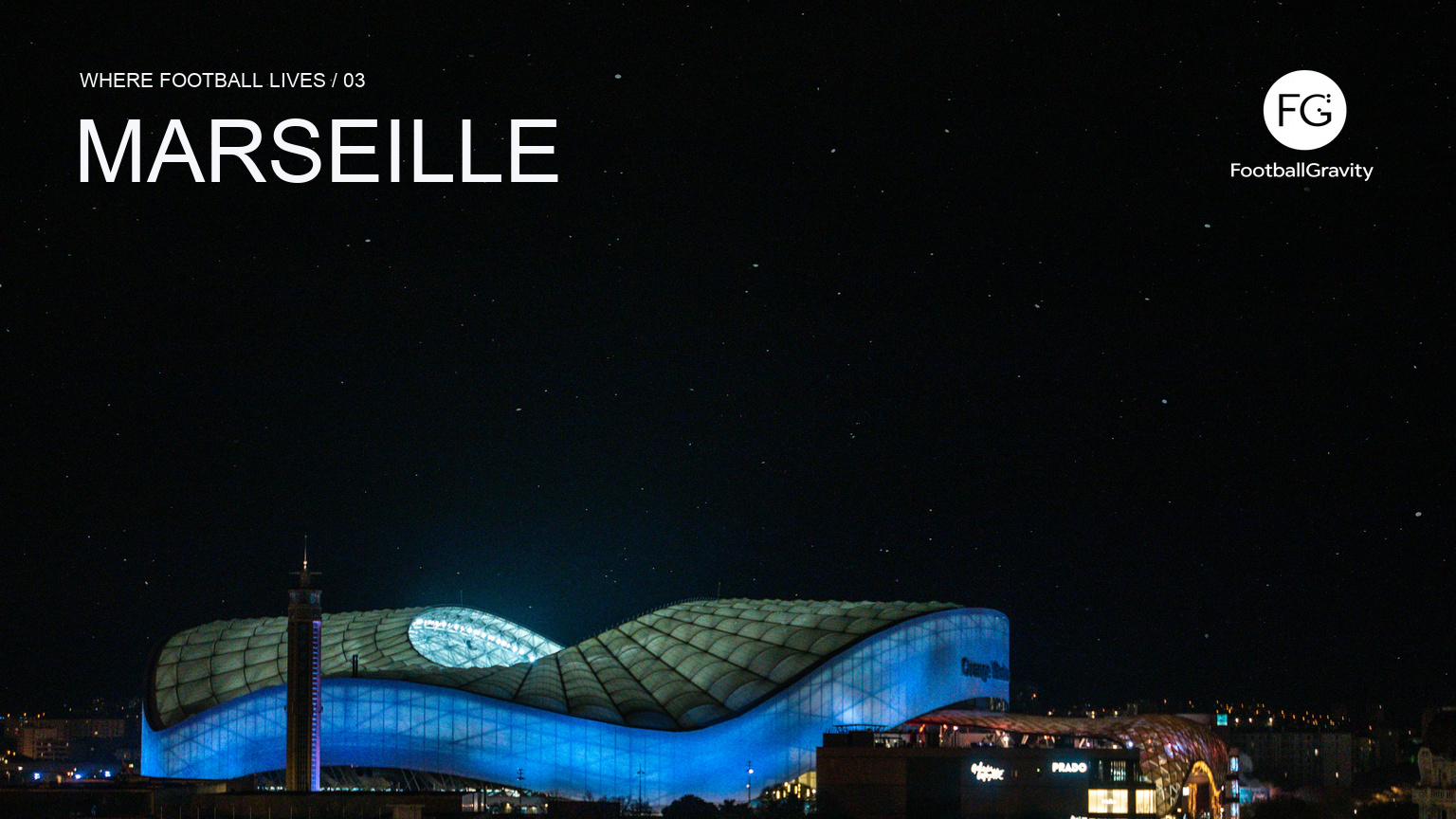
The illuminated roof of Stade Vélodrome above Marseille at night, with Marseille series typography and the FootballGravity logo.

Where Football Lives / 03. In Marseille, the stadium is not a separate destination. It is one of the places where a large, restless city gathers to hear itself.

The Vélodrome stands in Marseille’s eighth arrondissement, south of the old port and west of the sea. Its roof is visible from a long way off, but it does not sit alone on an open plain. The ground shares its surroundings with housing, the Chanot exhibition complex, a sports clinic, shops and the routes that carry people across the city. The stadium is large enough to dominate a map; the city around it keeps it from feeling isolated.

Olympique de Marseille has played there since 1937. The City of Marseille describes the stadium as a symbol of Marseille culture and the setting for sporting victories, concerts, international matches and events across generations. That language can sound promotional, yet it points to something useful for a visitor: the Vélodrome is part of the city’s public calendar, not only a venue that switches on for football.

For the third instalment of Where Football Lives, Marseille is less a guide to the famous image of the port than a look at how a football club becomes an address system. Supporters organise from different parts of the city. Metro Line 2 brings people to the gates from Rond-Point du Prado and Sainte-Marguerite Dromel. Inside, the two virages turn a crowd into a visible, audible part of the game. The ground becomes the place where many separate journeys arrive at once.

A stadium built for a growing city

Marseille’s first decades of organised football did not begin at the Vélodrome. OM’s official history dates the club to 31 August 1899 and records a home at the Stade de l’Huveaune from 1902 to 1937. The Vélodrome opened in June 1937, as the club’s support and ambitions outgrew that earlier setting. The ground’s name remembers its original purpose: it was designed to include a cycling track as well as football.

The stadium has changed more than once since then. Its most recent major reconfiguration was completed ahead of Euro 2016. The city now lists 67,354 covered seats, while OM’s stadium information uses the simpler figure of 67,000. The exact marketing number matters less than the scale: a home match can bring an arena-sized audience into a residential and commercial district without moving the club away from the city it represents.

That scale creates practical demands. The city lists both Métro 2 stations as access points and describes an urban redevelopment zone of about twenty hectares around the stadium. The development includes housing, offices, hotels, a shopping centre and other facilities. A football ground can be a district’s busiest building without being its only reason to exist. That is one reason the Vélodrome reads differently from a stadium built beyond a motorway interchange: it is threaded into uses that continue through the week.

The city arrives from many directions

It is easy to speak of “the Marseille supporter” as if a city of more than a million people could have one voice. OM’s own supporter directory offers a more useful picture. Its listed groups have addresses in the first, third, fourth, seventh, ninth and tenth arrondissements, as well as beyond Marseille itself. The addresses do not measure devotion, but they show how the club’s organised life is distributed through the city rather than contained by the stadium neighbourhood.

The club describes the Virage Nord as the stadium’s beating heart and the Virage Sud as a place of tifos and constant energy. These are the club’s words, and they should not be mistaken for an ethnographic account of every matchday. Still, they identify the architecture of attention. At the Vélodrome, the crowd is not merely behind the play. The two ends of the ground have their own histories, associations and responsibilities for the atmosphere.

For an arriving supporter, this changes what it means to watch. The point is not to seek a dramatic scene on demand or to imitate local rituals from a distance. It is to notice that the songs, flags and pre-match movement have organisations behind them. The noise belongs to people who have arranged transport, meetings, displays and away travel over many seasons. A visitor can respect that work by treating the stadium as a shared home rather than a backdrop.

From the port to the pitch

Marseille can make a football day feel geographically larger than the distance between a hotel and a stadium. The Vieux-Port offers the city’s familiar opening: boats, quays and the movement between water and old streets. From there, a trip south on the metro gradually changes the frame. The match is not played beside the port, and that separation is part of the point. A club associated so strongly with the whole city asks people to cross it.

There is no need to turn this into a rigid itinerary. Marseille Tourism’s stadium page presents the Vélodrome as a place whose history includes cycling, athletics, boxing and concerts alongside football. A day can leave space for the city before the gates open: a walk around the port, time in a neighbourhood café, a meal with the pace to talk rather than rush. The stadium gives the afternoon a fixed destination; Marseille supplies the long approach.

That approach is worth protecting from cliché. Marseille is more than a postcard of the Mediterranean, and OM is more than a ready-made soundtrack of intensity. The city has different districts, languages, histories and pressures. Football can create a strong shared identification without erasing those differences. The most interesting matchday experience leaves room for both: the common pull of the club and the sense that everyone has arrived with their own route behind them.

A ground used beyond football

The Vélodrome also makes a useful case study in the demands placed on modern stadia. The City of Marseille says rainwater is recycled for non-drinking uses, including the pitch, sanitation and cleaning, and that heating and cooling demand has been reduced through energy recovered from the nearby wastewater-treatment plant. These details do not make a stadium environmentally simple. They do show that its relationship with the city includes systems of water, energy, transport and maintenance that continue when no football is being played.

OM’s community platform, Treizième Homme, says the club renewed its ISO 20121 certification for responsible-event management in 2024 and completed a second carbon assessment at the end of 2025. The assessment includes matchdays at the Vélodrome as well as the club’s other sites. Such claims are the club’s own reporting, not an independent verdict on its impact. They are nevertheless a reminder that a football city is sustained by workers, infrastructure and decisions that rarely appear in the highlights.

The right distance

Como’s stadium sat beside the lake. Valencia’s old Mestalla stood in the dense fabric of a city preparing for a move. Marseille gives this series a third relationship between football and place: a vast stadium that collects a city’s many neighbourhoods while remaining tied to one of them.

The best way to visit is with the right distance. Check the club’s ticket, stadium-entry and transport information close to the fixture date. Follow the instructions of stewards and supporter groups. Make room for Marseille before and after the game, but avoid treating anyone else’s attachment as an attraction staged for outsiders. The Vélodrome can be memorable precisely because it asks a visitor to enter an ongoing relationship between a club and a city, rather than a performance made for one evening.

At the final whistle, the journeys reverse. The metro fills, groups re-form, and the stadium slowly gives people back to their separate parts of Marseille. The club remains a shared reference point. Where football lives here is not only in the roar beneath the roof. It is in the routes that lead there, and in the many districts that send people home.

This article was prepared from published sources with AI assistance; it is not a report from an on-site visit. Ticketing, entry rules, transport conditions and stadium naming should be checked close to the fixture date.

Where Football Lives #02 — Valencia: Before the Move

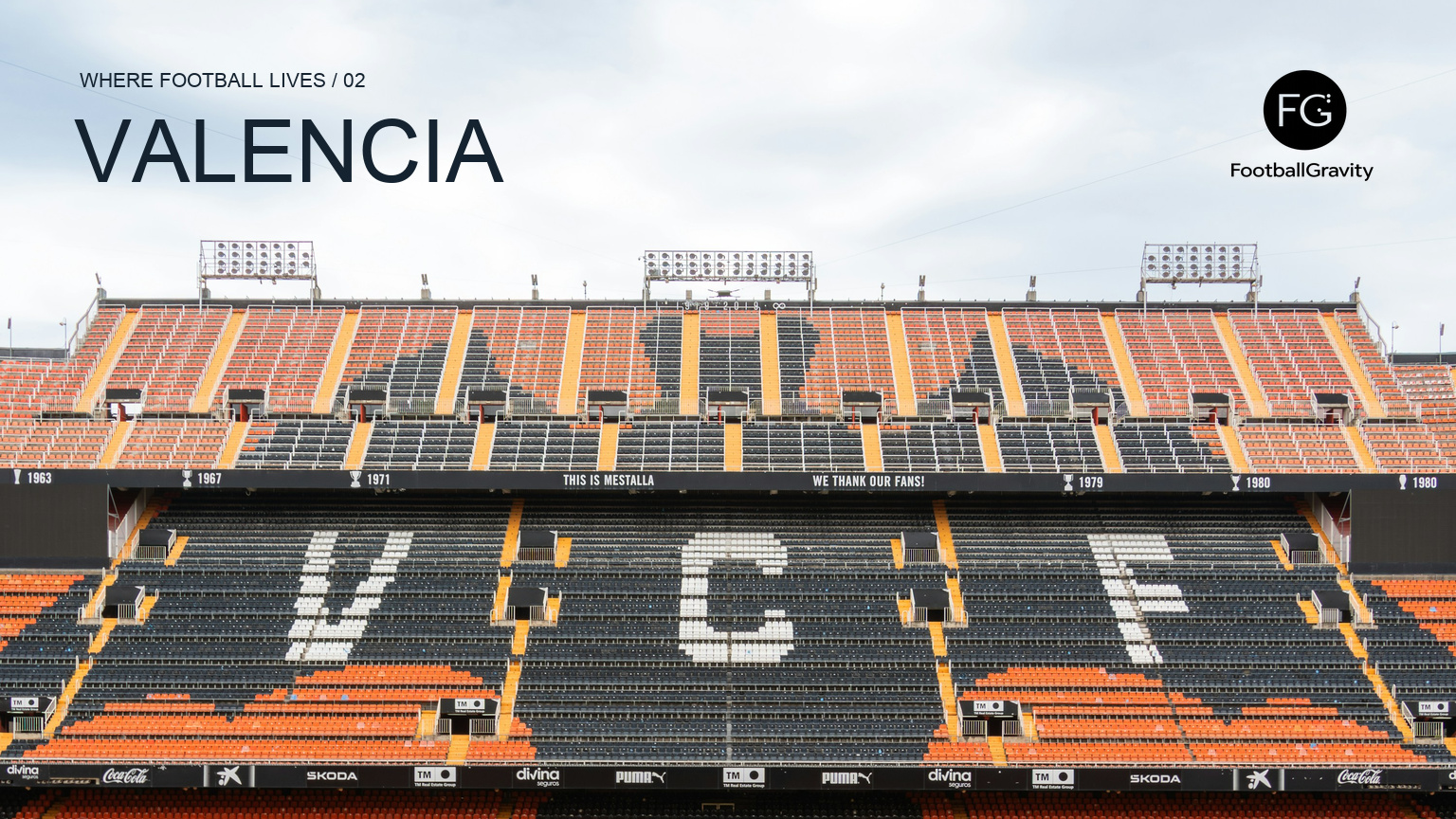
An empty Mestalla stand spelling VCF, with Valencia series typography and the FootballGravity logo.

Where Football Lives / 02. In Valencia, the walk to a football ground is also a way of reading the city’s next chapter.

Mestalla has the proportions of a stadium that has spent a century learning the streets around it. Its steep stands rise among apartment blocks and cafés, north-east of Valencia’s old centre. On a matchday, the approach is not a ceremonial march through a sports district. It is a change in the rhythm of an ordinary neighbourhood: the sound from bars carries a little further, orange and white scarves appear at corners, and the ground arrives without much warning.

For Japanese readers, Ryunosuke Sato’s arrival has supplied a fresh reason to look towards Valencia. The club announced his transfer from FC Tokyo on 7 July 2026, on a five-season contract, and described him as the first Japanese player registered with its men’s first team. The announcement placed a young Japanese player inside one of Spanish football’s older civic institutions.

That is a useful entrance to the city, but it is not the whole story. Valencia CF is approaching a move that will alter how supporters reach their football and how the club sits within Valencia. The future Nou Mestalla is taking shape across town, with the club’s 2024/25 sustainability report listing an expected opening in the 2027/28 season. Until then, the old ground remains the place where the relationship between club and city can be felt at close range.

A name from the water

Mestalla was inaugurated on 20 May 1923, for a friendly against Levante. Valencia’s own history says the ground took its name from an irrigation canal that once ran beside it. That detail makes the stadium feel less like an object set down in the city than part of an older working landscape: water, farmland and the routes that connected them.

The club’s history traces football in Valencia to people involved in the citrus trade who had travelled to Britain, and to British sailors playing in the port. Valencia Football Club was founded in 1919. Its first home, Algirós, soon became too small, so the club bought the Mestalla site in January 1923. The new ground opened with room for 17,000 people; today the club lists its capacity as 49,419.

Numbers explain growth, but not the particular pressure of the old stadium. Mestalla has hosted more La Liga matches than any other ground, according to the club, and marked its 103rd anniversary in May 2026. It survived Civil War damage, hosted Spain at the 1982 World Cup and held major European nights for Valencia. The archive is present in the building’s shape. Spectators are close to the pitch, and the sightlines make every collective reaction seem to arrive early.

The city beyond the turnstiles

Valencia is easier to understand by following the Turia than by treating its landmarks as separate stops. After the devastating flood of 1957, the river was diverted south of the city. The old riverbed became the Turia Gardens, a long public park that now runs through Valencia. Visit València describes more than nine kilometres of paths, sports spaces, bridges and gardens linking the city from west to east.

The stadium lies a short distance from this green corridor. A visitor can begin in the old centre, cross the former riverbed near Puente de las Flores or the Aragón area, then move towards Mestalla through streets that remain residential and busy. It is a route with no need for a football-only itinerary. The city is already doing the work: cafés, bakeries, university buildings, apartment balconies and the park create the texture around the match.

That everyday density matters in a place known internationally for bigger images: the City of Arts and Sciences, the beach, paella and the Fallas. During Fallas, Valencia’s neighbourhood commissions fill streets and squares with temporary sculptures, music, fireworks and the scent of gunpowder. The festival is not a matchday accessory, but it shows a city used to bringing public space, local affiliation and noise together. Mestalla belongs to the same civic habit of gathering.

Before the move

The move to Nou Mestalla has been discussed for so long that it is tempting to write as if the old ground has already become a museum piece. It has not. The club says construction resumed in January 2025, and its current reporting describes work on the roof structure, façade and interior areas. Its published plan gives the new stadium a capacity of 70,044 and places it on Avenida de las Cortes Valencianas. Those are the club’s plans and targets, not yet a completed matchday reality.

A new stadium will offer space, accessibility and commercial possibilities that a century-old city ground struggles to provide. The club has also described a public square and municipal sports facilities within the development. The questions worth following are more intimate. Which pre-match routes will survive? Where will people meet when a familiar walk no longer ends at the same gates? What does a supporter lose, and gain, when a stadium leaves a neighbourhood that has grown around it?

These questions do not require nostalgia to be serious. Valencia is a city that has repeatedly altered its physical shape, including the redirection of the Turia itself. Change can create valued public space. A stadium move can do the same, but it asks a football culture to carry its habits across the city and make them live in a different setting.

A new connection

Sato’s arrival belongs to this moment without defining it. A first Japanese player in Valencia’s men’s first team makes the club newly legible to supporters in Japan. It may bring more readers, viewers and visitors to a stadium whose name they have known through old highlights, Champions League memories or Spanish football broadcasts. The value of the connection is not only that it points outward. It can also encourage people to look closely at the place that has received him.

For someone visiting Valencia for a match, that begins with allowing enough time for the city to remain visible. Walk through the Turia Gardens. Eat before the game somewhere that belongs to the neighbourhood rather than a generic stadium concourse. Check the club’s ticket and travel information close to the date, especially as fixtures and access arrangements can change. Then arrive early enough to notice what is still there: the slope of the stands, the narrowness of the streets, and the way football enters the evening without ever separating itself from the city.

Como showed the pleasures of a stadium beside a lake. Valencia offers a different kind of proximity. At Mestalla, football is set within the daily density of a Mediterranean city and a century of accumulated expectation. The next ground is rising elsewhere. For now, the old one still tells the clearest version of where Valencia’s football lives.

This draft was prepared from published sources with AI assistance; it is not a report from an on-site visit. Stadium construction, access arrangements and fixtures should be checked again before publication.

Where Football Lives #01 — Como: Football at the Edge of the Lake

Oil-painting-style illustration of Lake Como, mountains, a lakeside town and a vintage football, with the FootballGravity logo and Where Football Lives #01 — Como: Football at the Edge of the Lake typography.

Where Football Lives / 01. Lake Como has long drawn visitors. Beside the water, a football club is giving them another reason to come.

At the western edge of Como’s centre, Stadio Giuseppe Sinigaglia fits between the city and the lake. Across the water, houses climb the hills. The stands, floodlights and strip of green belong to the same view as the boats. Football occupies a piece of the waterfront that a visitor might otherwise associate with a promenade or a hotel.

The location has always been remarkable. What has changed is the scale of the football being played there. On 10 September 2026, Como beat Leipzig 4–1 on their Champions League debut, with Cesc Fàbregas’s side making an emphatic entrance. UEFA’s match report records a result that would have been difficult to imagine when the club was working its way through Italy’s lower divisions.

Como qualified by finishing fourth in Serie A in 2025/26. They had returned to the top division only in 2024, ending an absence that stretched back to 2003. This is their first season in European competition. For a city already familiar to travellers around the world, that creates a different kind of arrival: people coming for the football, then finding the place around it.

A ground inside the city

The lake runs through the club’s own account of its beginnings. Its official history describes a match on the shore in 1906 between members of the local rowing club and people travelling with Buffalo Bill’s circus. Como Football Club was founded the following year. Even allowing for the distance between a club’s origin story and the present, the setting is strikingly familiar.

Sinigaglia’s position gives the stadium a place in an ordinary walk through Como. From the historic centre, the waterfront leads towards the ground; the journey stays within the city’s most recognisable landscape. The approach matters. It lets a visitor understand the club’s surroundings at walking speed, with time to register how little space separates the football from the water.

That intimacy also complicates expansion. In February 2025, Como, the municipality and architecture practice Populous presented initial redevelopment concepts. The announcement envisaged phased construction from 2027 and an ambition to make the site accessible beyond matchdays. Those were proposals and an anticipated timetable, rather than a completed design or a guarantee of delivery.

The planning problem is easy to grasp from the location. A larger ground would have to accommodate more people while remaining part of a waterfront used by residents and visitors throughout the week. Capacity can be counted. The effect on a familiar route through town is harder to measure, yet it will help determine whether the redevelopment feels like an improvement to Como itself.

A destination with a football club

The club’s recent climb began far from this level. Como restarted in Serie D in 2017/18, and SENT Entertainment acquired the club in April 2019. Promotions brought them to Serie C, then Serie B and, in 2024, Serie A. The club’s history of that recovery emphasises investment in the organisation and its facilities alongside results on the pitch.

Rapid success changes who encounters a club. A television audience discovers the ground. New supporters look for tickets. A visit that once required a particular attachment to the team begins to appeal to people planning a holiday. In Como, these changes take place in a city whose name already carries considerable value abroad.

The club has made that connection explicit. Its matchday experiences combine football with lakeside hospitality, stadium access and, in some packages, a boat trip. The lake becomes part of what the club can sell. A match ticket can sit within a day whose other pleasures are already familiar to the international visitor.

There is a persuasive commercial logic here. Football supplies a date and a reason to travel; the destination gives a companion who cares less about the result reasons to come along. It can also encourage a supporter to stay longer. The risk is that a club becomes easiest to describe through its most expensive experiences, leaving the everyday habits of its followers in the background.

The walk from Jean Caffè

A small kiosk near the Duomo and Teatro Sociale offers another starting point. In a profile published by Como 1907, Jean Caffè co-owner Mattia Cairoli describes supporters meeting there for drinks before heading to the stadium together, then returning after the game. His own attachment began with visits to the old Curva Ovest alongside his father and grandfather in the 1990s.

That account puts the match into the shape of a day: a meeting place, a shared walk, somewhere to return to afterwards. The football extends beyond the time spent inside the ground. A ticket admits a visitor to the ground; learning where the match sits in other people’s lives takes more attention.

Como-born Alessio Iovine provides a longer view. Asked by the club about his favourite match as a supporter, he recalled a lower-league playoff victory at Alessandria that took Como up from the old Serie C2. He had been in the away end, celebrating with the players. In the same interview, he described the pride he felt in Como’s growing visibility and its relationship with the community.

His memories make room for both experiences: the supporters who travelled in the lower divisions and the pleasure of seeing the club recognised abroad. They are a useful corrective to the assumption that local attachment and international interest must always pull apart. The practical question is how much room the growing club continues to leave for people whose commitment predates its appeal as a destination.

Time around the match

For someone arriving from outside, Como’s compact centre offers a way to spend that time without an elaborate itinerary. The old streets lead to Piazza Cavour and the waterfront. Above the city is Brunate, connected by a funicular that opened in 1894. A visit up the hill gives the lake and the city a different scale; the walk towards Sinigaglia brings them close again.

Food carries the geography indoors. The club’s guide to local cooking points to risotto with perch and missoltini with polenta. Lake fish and the ingredients of the surrounding region offer a way into Como that extends beyond its luxury image. There is enough here to let lunch become part of the visit, rather than an interval to be filled before kick-off.

Milan makes the city accessible within a wider journey through northern Italy. Trenord advertises a direct Como San Giovanni–Milan service of around 68 minutes; that is a guide for the listed route, not a journey time for every Milan station or train. Match tickets, kick-off times and the return service deserve checking together before a visit is booked, especially for an evening game.

A day might begin in the old centre, leave time for the water and finish at the stadium. The appeal lies partly in how little needs to be added. The football gives the day a fixed point while the hours around it remain available to the city.

Who gets to belong?

As Como’s audience grows, access will be an important measure of the project. The availability of ordinary tickets, the place of established supporters and the use of the redeveloped waterfront will say more about its relationship with the city than the attractiveness of a hospitality brochure. These are questions to follow, rather than evidence that a particular outcome has already occurred.

There is also an opportunity for visitors to encounter a Como they would otherwise miss. Someone drawn by the lake can discover the club’s lower-league past. A supporter arriving because of Fàbregas can learn about the city through its food or the walk to the ground. The exchange works best when the place is given enough time to become more than the view behind a photograph.

For the first instalment of Where Football Lives, Como offers an unusually direct introduction. The ground is there beside the water, close enough to become part of the same afternoon. After the final whistle, the walk back towards the centre remains part of the matchday.

Featured image: Lake Como-inspired editorial illustration, created with AI assistance by FootballGravity, with the official FootballGravity logo. It is not a documentary photograph or an exact representation of the stadium. This article was prepared from published sources with AI assistance; it is not a report from an on-site visit.

A Champions League Draw Has a Climate

An AI-generated editorial illustration of abstract European weather systems and a luminous football-pitch grid at night, with The Weight of the Draw title, a large UEFA Champions League mark and the FootballGravity logo.

Part four of The Weight of the Draw, a five-part FootballGravity series examining opponent strength, fixture congestion, travel, playing conditions and the human ties hidden inside the 2026–27 Champions League schedule.

By the time a Champions League team reaches the stadium, the draw has already imposed its first three tests: the opponent, the calendar and the journey. Then the football begins in a particular kind of air. A September night in Naples is not a January night in Prague. Milan, Bruges and Istanbul are all European away days, but the coach does not prepare for them with one generic folder marked “away”.

The environmental layer is also the easiest one to exaggerate. A forecast cannot be written in September for a match in January. Rain, wind and the state of a pitch belong to the week of the game. This fourth part therefore looks at the stable parts of the assignment: season, latitude, coastal or continental setting, and altitude. They are prompts for preparation, not predictions of performance.

This is not a draw of extreme environments

The five English clubs have avoided the competition’s most obvious environmental shock: a high-altitude away match. Manchester United’s October trip to Atlético de Madrid is the highest-setting fixture in their group of away cities, but Madrid is still well below the altitudes at which the football literature usually examines clear reductions in running output. The larger research examples begin above 1,000 metres, and often much higher.

That matters because it sets the scale. Madrid deserves a different preparation conversation from Lisbon or Bruges: its elevation and drier inland setting are real features of the place. It does not turn United’s visit into a Bolivia-style altitude assignment. The sensible conclusion is restraint. No English club has drawn an environmental impossibility; several have drawn places that make an ordinary European week less interchangeable.

ClubEnvironmental contrast in the away listThe preparation question
ArsenalNaples in September; Munich and Prague in autumn; Seville in JanuaryHow quickly can the group move from early-season Mediterranean conditions to a colder central-European night, then back to southern Spain?
Aston VillaBruges in September; Barcelona and Istanbul in November; Prague in JanuaryThe widest late-season swing: a relatively mild coastal calendar ends with a midwinter Central European trip.
LiverpoolLinz in October; Istanbul and Bruges in November; Milan in JanuaryThere is no hot-weather outlier, but the final third shifts steadily toward colder nights and a dense January.
Manchester CityPorto in September; Leipzig in November; Barcelona in December; Lens in JanuaryA compact travel route still crosses four seasonal settings, from Atlantic early autumn to northern France in winter.
Manchester UnitedMadrid and Como in October; Lisbon in November; Villarreal in JanuaryProbably the mildest seasonal profile, with Madrid’s altitude the notable exception rather than the dominant story.

Prague in January is a different football week

Villa’s final league-phase match at Slavia Praha on 27 January is the clearest environmental marker in the English schedule. It arrives at the end of the league phase, when a club may be protecting a top-eight place or scrambling for it, and it is followed by a Premier League weekend. The significance is not that cold automatically favours the home side. Elite players know cold. It is that the warm-up, clothing, hydration, pitch preparation and recovery plan have to be specific at the very moment the calendar is least forgiving.

Liverpool’s January match at Inter and United’s trip to Villarreal sit in the same calendar corridor but create different questions. Milan can demand a midwinter preparation; Villarreal’s Mediterranean setting is less likely to make temperature the headline. Arsenal travel to Real Betis a week earlier. Part three measured the routes. Part four adds the simple point that a route does not end when the plane lands.

The beginning of the season has its own friction

September is not neutral. Arsenal open away at Napoli, City open at Porto and Villa begin in Bruges. The difference is not a claim about a temperature on a particular night; that information will only be useful close to kick-off. It is about the training block that precedes the match. A squad still finding its domestic rhythm has to decide whether it trains for the high-tempo familiarity of England or for a southern European away night that may ask for a different pace, fluid plan and rotation of intensity.

The research on professional football is suitably cautious here. Temperature, humidity and altitude can affect physical output, but the effects vary, and technical performance does not move in a single neat direction. Players and teams adjust their pacing. That is exactly why the draw should be read as preparation rather than fate. A good staff can reduce the cost of an unfamiliar setting; it cannot make the setting disappear.

The useful advantage is familiarity, not mythology

It is tempting to call any continental difference an advantage for the home side. The evidence does not support that kind of shortcut, and the 2026–27 draw does not need it. Porto, Barcelona, Lisbon and Bruges are all places well known to English clubs and their analysts. The more useful question is smaller: which match asks the fewest adjustments in the same week as a demanding domestic fixture?

On that measure, Manchester City’s away geography again looks manageable. Lens in January and Leipzig in November can be difficult football matches, but they do not present the biggest seasonal contrast in the English list. Villa’s Prague finish and Liverpool’s Istanbul assignment carry more changes at once. Arsenal’s draw moves through several settings without a single dramatic environmental outlier. United’s Madrid visit is distinctive, yet the rest of their away calendar stays in comparatively temperate places.

Conditions turn the draw into a staff problem

The earlier articles asked who the clubs meet, when they meet them and how far they travel. This one asks what has to change once they arrive. The answer is rarely a grand tactical reinvention. It is the accumulation of details: the extra kit decision, the timing of the walk-through, the recovery drink waiting on the coach, the way a pressing session is shortened or moved indoors. In a league phase decided by fine margins, those details are part of the draw’s weight.

The final part will leave the physical environment for the human one. A fixture can also change shape because it returns a player to a former club, a familiar city or a national team connection. The map has people on it as well as distances and temperatures.

Method note: UEFA’s published league-phase fixtures determine the opponents, dates and venues. This article assesses stable environmental context—season, broad regional climate setting and city altitude—not forecasts for individual match nights. It makes no claim that one venue will cause a particular result. The altitude literature cited concerns substantially higher settings than Madrid; it is used to set scale, not to project a physiological effect for this fixture.

A Champions League Draw Is Also a Route Map

An AI-generated editorial illustration of abstract night routes over Europe, with The Weight of the Draw title, a large UEFA Champions League mark and the FootballGravity logo.

Part three of The Weight of the Draw, a five-part FootballGravity series examining opponent strength, fixture congestion, travel, playing conditions and the human ties hidden inside the 2026–27 Champions League schedule.

A Champions League away match is often described by its destination: Istanbul, Milan, Prague. For the player, the destination is only the beginning of the workload. There is a flight out, a hotel night, a match played on somebody else’s clock, a journey back and the quiet reduction of the week at the training ground. By Saturday, the itinerary has become part of the team selection.

Every English club has four league-phase away games. That symmetry is deceptive. Manchester City’s four trips are comparatively compact; Liverpool and Manchester United carry the two largest city-to-city totals. Aston Villa have both the shortest single journey and one of the longest. Travel is not a substitute for judging opponents or the calendar. It is the layer that explains why two three-day gaps are rarely the same thing.

The distance hidden inside an away draw

Using straight-line distances from each club’s home city to the host city, then doubling them for a return journey, Liverpool’s four away fixtures add up to roughly 11,600 km. United are almost level at 11,700 km. Villa are close behind at 10,900 km, Arsenal at 10,400 km. City’s route, at about 8,700 km, is markedly shorter.

ClubAway destinationsApprox. return distanceWhat the route says
LiverpoolLinz, Istanbul, Bruges, Milan11,600 kmThe longest overall route; Istanbul is the outlier, Bruges the useful short reset.
Manchester UnitedMadrid, Como, Lisbon, Villarreal11,700 kmFour southbound trips and no nearby continental release valve.
Aston VillaBruges, Barcelona, Istanbul, Prague10,900 kmOne very short trip is balanced by two long east/south-east assignments.
ArsenalNaples, Munich, Prague, Seville10,400 kmEvenly demanding rather than defined by one extreme journey.
Manchester CityPorto, Leipzig, Barcelona, Lens8,700 kmStill substantial, but the most compact English travel schedule.

The table is deliberately modest. It does not pretend that a charter flight follows a great circle, or that a kilometre measures recovery. It excludes the transfer to the airport, security, waiting, hotel logistics and the final drive home. In that sense, these are floor figures: a clean way to see the shape of the burden, not a claim to know each club’s private travel plan.

Istanbul changes the week

Liverpool’s trip to Fenerbahçe on 4 November is the most revealing itinerary in the English draw. The match is scheduled at 18:45 CET, which is 20:45 in Istanbul. Liverpool had hosted Arsenal on the preceding Sunday, then must return from a city almost 2,750 km away by the direct city-to-city measure. The next domestic fixture may shift, but the useful preparation days are already spoken for.

Villa’s Galatasaray visit on 24 November carries a similar eastern pull. It follows a home league match against Sunderland and comes before a scheduled trip to Ipswich. Istanbul in late November is three hours ahead of the UK. That does not turn a footballer into a different person, but it moves the end of the working night and compresses the return into the next day. The opponent’s rating cannot show that.

The short trip is a competitive resource

Bruges is the clearest counterexample. Villa open their league phase there; Liverpool go there in late November. From Birmingham it is roughly 380 km as the crow flies, from Liverpool roughly 490 km. A continental away day still requires a full operation, but the travel geography is familiar and compact. There is no long-haul-style body-clock adjustment, and the trip does not consume the same part of a recovery cycle as Istanbul or the Iberian peninsula.

City have the strongest version of that advantage. Lens, their January away game, is their shortest continental journey; Leipzig is also a relatively direct central-European trip. Porto and Barcelona are real flights, but City avoid Turkey, Scandinavia and the far eastern edge of the league phase. That does not make Napoli, Paris or Barcelona easier opponents. It gives the staff a slightly more usable week around the away fixtures.

January makes Milan and Villarreal heavier

Distance becomes most expensive when the calendar has already narrowed. Liverpool travel to Inter on 19 January, between Premier League fixtures against Crystal Palace and Manchester United. The return distance to Milan is about 2,500 km. United’s final league-phase match at Villarreal on 27 January is a similar test: a roughly 3,000 km return journey sits between Liverpool and Brentford in the published league list.

These are not arguments that either club has been uniquely wronged. Every leading side plans for January. The point is more practical: an away match in the same country can have a different value depending on whether it arrives in an open week or inside a five-game run. In January, the aircraft door opening in Manchester or Liverpool is not the end of the Champions League fixture. It is the start of the next selection problem.

A draw becomes a route map

Part one found the lightest and heaviest opponent lists. Part two showed the Premier League weekends that load those lists. The travel map changes the emphasis again. City’s difficult opponents are paired with the least demanding away geography. Liverpool’s kinder opponent profile includes the series’ most disruptive single trip. United’s route offers no equivalent of Bruges or Lens to absorb a crowded week.

That is why the phrase “away in Europe” is too blunt for this season. Prague, Porto and Bruges may all be away matches, but they leave different amounts of a week intact. The next part will turn from the route to the place itself: temperature, altitude, surface and the local conditions that can change the football once the team has arrived.

Method note: UEFA’s published league-phase fixtures determine the four away destinations per club. Distances are approximate great-circle calculations from each club’s home city to the host city, rounded to the nearest 100 km after the outbound figures are doubled. They are a lower-bound comparison only: they do not model flight routing, airports, road transfers, departure times, weather, recovery protocols or later fixture amendments. The Premier League dates cited are subject to change.

The Champions League Draw Is a Calendar Problem

An AI-generated editorial illustration of a luminous football calendar and compressed match windows across an abstract European grid, with The Weight of the Draw title, the UEFA Champions League mark and the FootballGravity logo.

Special Report · The Weight of the Draw

Part two of The Weight of the Draw, a five-part FootballGravity series examining opponent strength, fixture congestion, travel, playing conditions and the human ties hidden inside the 2026–27 Champions League schedule.

The first reading of a Champions League draw asks who a club has drawn. The more consequential question is often when those opponents arrive. A difficult away night can be survivable with six clear days around it. A seemingly manageable home fixture becomes far more expensive when it is squeezed between two Premier League matches that demand the same players.

The 2026–27 league-phase calendar gives the five English clubs three distinct tests: the first week in November, the final week of November, and the two Champions League rounds in January. Liverpool’s friendly-looking opponent list from part one does not protect them from every one of those pressure points. Manchester City’s hard draw is not uniformly hard either; some of its most demanding evenings are buffered by home games or a little more space.

The calendar changes the meaning of a fixture

UEFA’s league phase begins on 8 September and ends on 27 January. The Premier League calendar supplies the weekend frame, but kick-off selections and domestic cup commitments can still move individual matches. That makes this an analysis of the confirmed dates, not a claim that every recovery window is fixed. Even so, the shape is already visible: the competition repeatedly places European midweeks between league weekends, then asks clubs to do it again seven days later.

Pressure windowWhat makes it differentWho feels it most
8–13 SeptemberEuropean opening week ends directly in Premier League fixturesMan United host Sabah on Thursday, then face Man City on Sunday; City travel to Porto before the derby
31 October–4 NovemberWeekend headline games flow straight into Matchday 4Liverpool v Arsenal precedes Fenerbahçe v Liverpool and Slavia Praha v Arsenal; Villa have Barcelona after a late Fulham fixture
21–28 NovemberFive clubs play league matches, Europe, then another major league round in eight daysArsenal v Man City lands four days after Dortmund v Arsenal and City v Napoli
2–9 DecemberMidweek league round, weekend round, then Matchday 6Arsenal go Brentford, Tottenham, Real Madrid; City go Leeds, Brentford, Barcelona
19–30 JanuaryTwo Champions League rounds are threaded through three league weekendsEvery English club has four fixtures in roughly 11–12 days before the January close

The opening week gives the Manchester derby a different temperature

Manchester United host Sabah on Thursday 10 September, then welcome City on Sunday 13 September. City have the longer trip: Porto away on Tuesday. Neither club enters the derby with a normal seven-day build-up. United have one fewer night between their European match and Sunday, while City have the travel and the earlier European kick-off to absorb.

That is the kind of detail a draw table hides. Sabah are the softest-looking opponent in United’s league phase, but the assignment can still influence selection and training before a derby. Porto are a much heavier opponent for City, but Tuesday-to-Sunday offers a slightly wider recovery runway. The advantage is not a verdict; it is a small piece of practical control.

The first real collision is Liverpool v Arsenal

Liverpool host Arsenal on Sunday 1 November. Three days later, Liverpool travel to Fenerbahçe while Arsenal travel to Slavia Praha. It is a useful reminder that the same league match can create two different European problems. Liverpool leave England for Istanbul; Arsenal leave for Prague. Part three will measure the journeys. Part two is about the simpler fact that neither coaching staff gets a normal week to reset after one of the season’s defining domestic games.

Villa’s Barcelona trip on 3 November has a different warning sign. Their Fulham fixture is listed for 20:00 on Saturday 31 October, a late slot already amended because of the Champions League. The adjustment acknowledges the European load, but it does not create a generous gap: Villa still face Barcelona on Tuesday. Fixture help is often a reduction of damage, not an escape from it.

Eight days in November can reorder the first article

The international break separates the early-November round from Matchday 5. Then the schedule compresses again. On 21 November, Liverpool host Manchester United, City host Fulham, Arsenal visit Newcastle and Villa host Sunderland. Between 24 and 25 November come Club Brugge v Liverpool, City v Napoli, Arsenal v Dortmund, Galatasaray v Villa and Sporting v United. On 28 November, Arsenal host City.

This is the first stretch in which the draw cannot be judged by ratings alone. City’s Napoli match is difficult, but it is at home. Arsenal’s Dortmund match is also at home, yet Arsenal must then play City four days later. Liverpool have the softer average draw, but a Saturday United match followed by Belgium in midweek gives them no reason to treat Brugge as a low-cost night. United have Sporting away after Villa, and then Brentford at Old Trafford. The middle of their draw is demanding because the calendar will not isolate it.

December is the most honest stress test

The Premier League schedules a full midweek round on 2 December and another round on 5 December. Matchday 6 follows on 8 and 9 December. Arsenal’s sequence is Brentford away, Tottenham away, then Real Madrid at home. City go Leeds at home, Brentford away, then Barcelona away. Liverpool have Sunderland at home, Chelsea away and Porto at home. Villa face Everton away, Crystal Palace at home and PSG at home. United have Newcastle away, Coventry at home and Leipzig at home.

Those chains do not make every fixture equally dangerous. They do make rotation a real decision rather than a slogan. A manager may decide to preserve a player for Real Madrid and accept risk at Tottenham, or do the reverse. In this window, the draw’s advantage belongs less to the club with the weakest opponent and more to the club that can change two or three players without changing its level.

January leaves no hiding place

January is the sharpest calendar test. The Premier League resumes on 16 January, Champions League Matchday 7 follows on 19 and 20 January, another league round arrives on 23 January, then Matchday 8 on 27 January and another league round on 30 January. Liverpool’s sequence is Crystal Palace, Inter away, Manchester United away, Lens, Everton. City have Nottingham Forest, Lens away, Brighton away, Sporting, Arsenal away. Arsenal go Hull, Real Betis away, Newcastle, Sabah, City away.

Villa and United are no better protected. Villa have Manchester United, Dortmund, Fulham, Slavia Praha and Ipswich. United have Villa, Bayern, Liverpool, Villarreal and Brentford. At this point the table position will decide what matters most, but the calendar has already removed the luxury of treating Matchday 8 as a separate event. A club chasing the top eight may need its first-choice side three times in seven days.

The draw is a calendar problem before it is a ranking

Part one identified Liverpool as the English club with the lightest average opposition and City as the club with the heaviest. Part two does not reverse that finding. It adds a more useful limit to it. Liverpool’s kind draw meets United, Arsenal and Chelsea-adjacent pressure points. City’s difficult draw includes major home fixtures and a few more controllable transitions. Arsenal’s split draw becomes especially volatile when Dortmund, Real Madrid and City arrive in the same month.

The next layer is distance. A Wednesday night in Prague and a Wednesday night in Istanbul are not interchangeable, even when the next match is on the same day. Part three will map the flights, time away from the training ground and the journeys that turn a three-day gap into something shorter.

Method note: Champions League dates and opponents are UEFA’s confirmed league-phase fixtures, published 3 September 2026. Premier League dates are the fixture list and subsequently announced amendments available on 5 September 2026. Kick-off times and dates can still change; domestic cup fixtures are not included. This article assesses calendar compression, not travel distance or team strength.


Continue with this special report

This is Part 2 of The Weight of the Draw. The series index brings each chapter together as it is published.

Read Part 1: Who Really Won the Champions League Draw? →

Explore The Weight of the Draw →