
The Champions League Draw Is a Calendar Problem

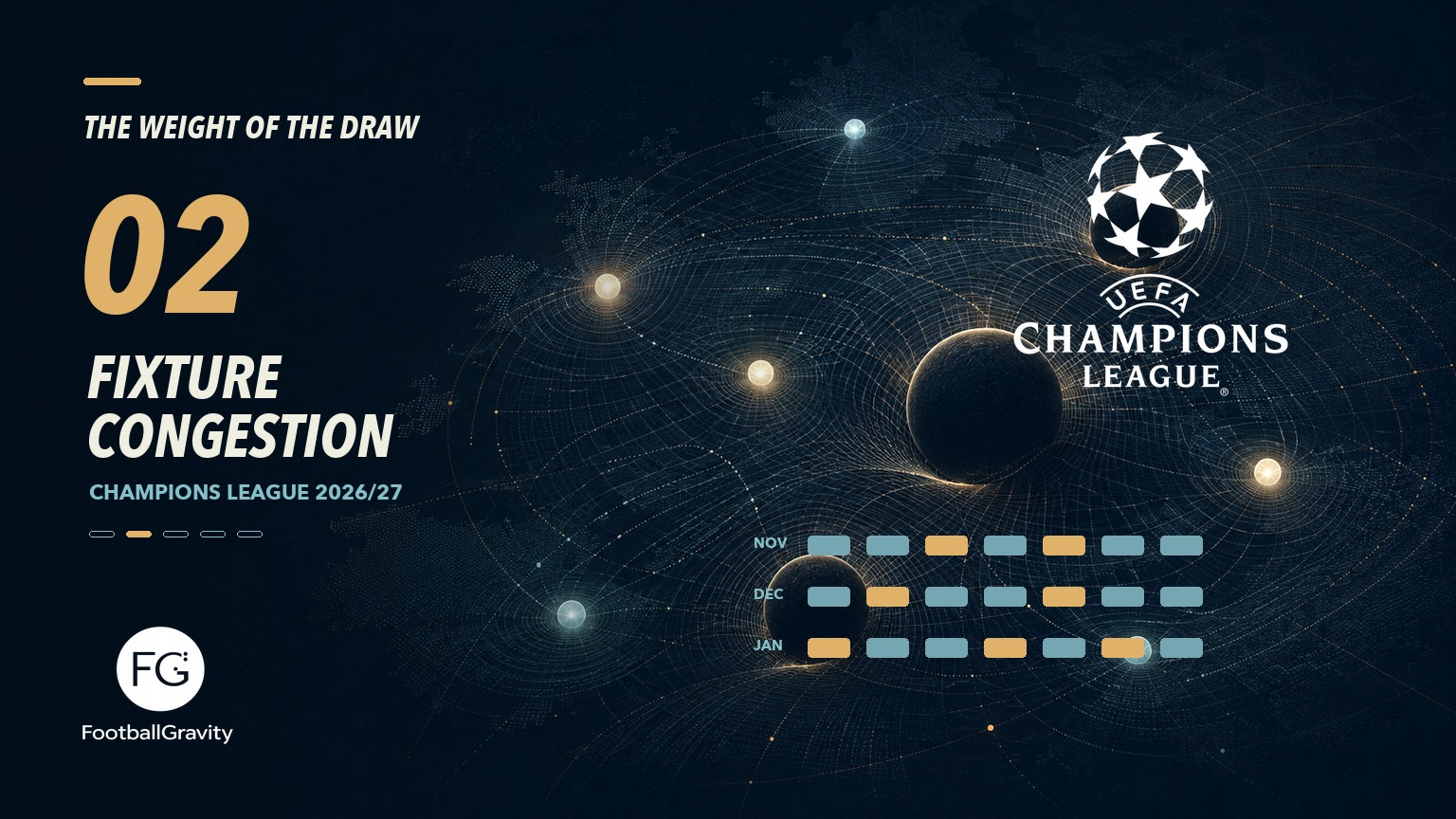
An AI-generated editorial illustration of a luminous football calendar and compressed match windows across an abstract European grid, with The Weight of the Draw title, the UEFA Champions League mark and the FootballGravity logo.

Special Report · The Weight of the Draw

Part two of The Weight of the Draw, a five-part FootballGravity series examining opponent strength, fixture congestion, travel, playing conditions and the human ties hidden inside the 2026–27 Champions League schedule.

The first reading of a Champions League draw asks who a club has drawn. The more consequential question is often when those opponents arrive. A difficult away night can be survivable with six clear days around it. A seemingly manageable home fixture becomes far more expensive when it is squeezed between two Premier League matches that demand the same players.

The 2026–27 league-phase calendar gives the five English clubs three distinct tests: the first week in November, the final week of November, and the two Champions League rounds in January. Liverpool’s friendly-looking opponent list from part one does not protect them from every one of those pressure points. Manchester City’s hard draw is not uniformly hard either; some of its most demanding evenings are buffered by home games or a little more space.

The calendar changes the meaning of a fixture

UEFA’s league phase begins on 8 September and ends on 27 January. The Premier League calendar supplies the weekend frame, but kick-off selections and domestic cup commitments can still move individual matches. That makes this an analysis of the confirmed dates, not a claim that every recovery window is fixed. Even so, the shape is already visible: the competition repeatedly places European midweeks between league weekends, then asks clubs to do it again seven days later.

Pressure windowWhat makes it differentWho feels it most
8–13 SeptemberEuropean opening week ends directly in Premier League fixturesMan United host Sabah on Thursday, then face Man City on Sunday; City travel to Porto before the derby
31 October–4 NovemberWeekend headline games flow straight into Matchday 4Liverpool v Arsenal precedes Fenerbahçe v Liverpool and Slavia Praha v Arsenal; Villa have Barcelona after a late Fulham fixture
21–28 NovemberFive clubs play league matches, Europe, then another major league round in eight daysArsenal v Man City lands four days after Dortmund v Arsenal and City v Napoli
2–9 DecemberMidweek league round, weekend round, then Matchday 6Arsenal go Brentford, Tottenham, Real Madrid; City go Leeds, Brentford, Barcelona
19–30 JanuaryTwo Champions League rounds are threaded through three league weekendsEvery English club has four fixtures in roughly 11–12 days before the January close

The opening week gives the Manchester derby a different temperature

Manchester United host Sabah on Thursday 10 September, then welcome City on Sunday 13 September. City have the longer trip: Porto away on Tuesday. Neither club enters the derby with a normal seven-day build-up. United have one fewer night between their European match and Sunday, while City have the travel and the earlier European kick-off to absorb.

That is the kind of detail a draw table hides. Sabah are the softest-looking opponent in United’s league phase, but the assignment can still influence selection and training before a derby. Porto are a much heavier opponent for City, but Tuesday-to-Sunday offers a slightly wider recovery runway. The advantage is not a verdict; it is a small piece of practical control.

The first real collision is Liverpool v Arsenal

Liverpool host Arsenal on Sunday 1 November. Three days later, Liverpool travel to Fenerbahçe while Arsenal travel to Slavia Praha. It is a useful reminder that the same league match can create two different European problems. Liverpool leave England for Istanbul; Arsenal leave for Prague. Part three will measure the journeys. Part two is about the simpler fact that neither coaching staff gets a normal week to reset after one of the season’s defining domestic games.

Villa’s Barcelona trip on 3 November has a different warning sign. Their Fulham fixture is listed for 20:00 on Saturday 31 October, a late slot already amended because of the Champions League. The adjustment acknowledges the European load, but it does not create a generous gap: Villa still face Barcelona on Tuesday. Fixture help is often a reduction of damage, not an escape from it.

Eight days in November can reorder the first article

The international break separates the early-November round from Matchday 5. Then the schedule compresses again. On 21 November, Liverpool host Manchester United, City host Fulham, Arsenal visit Newcastle and Villa host Sunderland. Between 24 and 25 November come Club Brugge v Liverpool, City v Napoli, Arsenal v Dortmund, Galatasaray v Villa and Sporting v United. On 28 November, Arsenal host City.

This is the first stretch in which the draw cannot be judged by ratings alone. City’s Napoli match is difficult, but it is at home. Arsenal’s Dortmund match is also at home, yet Arsenal must then play City four days later. Liverpool have the softer average draw, but a Saturday United match followed by Belgium in midweek gives them no reason to treat Brugge as a low-cost night. United have Sporting away after Villa, and then Brentford at Old Trafford. The middle of their draw is demanding because the calendar will not isolate it.

December is the most honest stress test

The Premier League schedules a full midweek round on 2 December and another round on 5 December. Matchday 6 follows on 8 and 9 December. Arsenal’s sequence is Brentford away, Tottenham away, then Real Madrid at home. City go Leeds at home, Brentford away, then Barcelona away. Liverpool have Sunderland at home, Chelsea away and Porto at home. Villa face Everton away, Crystal Palace at home and PSG at home. United have Newcastle away, Coventry at home and Leipzig at home.

Those chains do not make every fixture equally dangerous. They do make rotation a real decision rather than a slogan. A manager may decide to preserve a player for Real Madrid and accept risk at Tottenham, or do the reverse. In this window, the draw’s advantage belongs less to the club with the weakest opponent and more to the club that can change two or three players without changing its level.

January leaves no hiding place

January is the sharpest calendar test. The Premier League resumes on 16 January, Champions League Matchday 7 follows on 19 and 20 January, another league round arrives on 23 January, then Matchday 8 on 27 January and another league round on 30 January. Liverpool’s sequence is Crystal Palace, Inter away, Manchester United away, Lens, Everton. City have Nottingham Forest, Lens away, Brighton away, Sporting, Arsenal away. Arsenal go Hull, Real Betis away, Newcastle, Sabah, City away.

Villa and United are no better protected. Villa have Manchester United, Dortmund, Fulham, Slavia Praha and Ipswich. United have Villa, Bayern, Liverpool, Villarreal and Brentford. At this point the table position will decide what matters most, but the calendar has already removed the luxury of treating Matchday 8 as a separate event. A club chasing the top eight may need its first-choice side three times in seven days.

The draw is a calendar problem before it is a ranking

Part one identified Liverpool as the English club with the lightest average opposition and City as the club with the heaviest. Part two does not reverse that finding. It adds a more useful limit to it. Liverpool’s kind draw meets United, Arsenal and Chelsea-adjacent pressure points. City’s difficult draw includes major home fixtures and a few more controllable transitions. Arsenal’s split draw becomes especially volatile when Dortmund, Real Madrid and City arrive in the same month.

The next layer is distance. A Wednesday night in Prague and a Wednesday night in Istanbul are not interchangeable, even when the next match is on the same day. Part three will map the flights, time away from the training ground and the journeys that turn a three-day gap into something shorter.

Method note: Champions League dates and opponents are UEFA’s confirmed league-phase fixtures, published 3 September 2026. Premier League dates are the fixture list and subsequently announced amendments available on 5 September 2026. Kick-off times and dates can still change; domestic cup fixtures are not included. This article assesses calendar compression, not travel distance or team strength.


Continue with this special report

This is Part 2 of The Weight of the Draw. The series index brings each chapter together as it is published.
Read Part 1: Who Really Won the Champions League Draw? →

Explore The Weight of the Draw →

Who Really Won the Champions League Draw?

An AI-generated editorial illustration of eight football fixtures as unequal gravitational fields across an abstract map of Europe, with The Weight of the Draw title, the UEFA Champions League mark and the FootballGravity logo.

Special Report · The Weight of the Draw

Part one of The Weight of the Draw, a five-part FootballGravity series examining opponent strength, fixture congestion, travel, playing conditions and the human ties hidden inside the 2026–27 Champions League schedule.

A Champions League draw is first consumed as a list of names. The eye goes to Bayern Munich, Real Madrid and Paris Saint-Germain; then to the unfamiliar qualifiers lower down the page. Within minutes, clubs are labelled lucky or unlucky. The verdict feels obvious because the badges are familiar.

The league phase makes that instinct less reliable. Each of the 36 clubs plays eight different opponents, two from each seeding pot, with four matches at home and four away. No two schedules are identical. A draw can be gentle on average yet contain several nights that demand a full-strength side. It can look severe while placing the most difficult opponents at home, where the risk is easier to control.

For the five Premier League representatives, the first reading is clear enough. Liverpool received the kindest set of opponents. Manchester City received the hardest. Arsenal sit somewhere more interesting, with some of the most imposing names in Europe at one end of their schedule and one of the competition’s weakest entrants at the other. Aston Villa and Manchester United have fewer obvious places to breathe.

What the ratings see

Opta’s post-draw analysis used its global Power Rankings to calculate the average strength of every club’s eight opponents. On that measure, Liverpool’s average opponent rating was 90.0, the ninth-lowest in the 36-team field and the lowest among the English clubs. City’s was 91.7; only five teams were handed a higher average.

The figures are useful because the UEFA pots are built from five seasons of European results. They are a record of achievement, not a perfect description of how strong a team is in September 2026. A promoted or rapidly improving side may be more dangerous than its coefficient suggests. A famous club can retain a high seed after its present team has begun to decline. Power ratings offer a more current second lens.

ClubDraw profileMost demanding fixturesWhere control may be found
LiverpoolKindest English draw by average opponent ratingAtlético Madrid (H), Inter (A)LASK, Club Brugge and Lens; no meeting with the highest-rated superclubs
ArsenalSplit between an elite top end and a forgiving lower endBayern (A), Real Madrid (H), Dortmund (H), Napoli (A)Sabah at home in the final round
Manchester CityHardest English draw by average opponent ratingBarcelona (A), PSG (H), Napoli (H)AEK Athens at home; three major opponents come to Manchester
Aston VillaHeavy in Pots 1 and 2Barcelona (A), PSG (H), Dortmund (H), Club Brugge (A)Viking and Fenerbahçe at home
Manchester UnitedFew soft middle fixturesBayern (H), Atlético (A), Roma (H), Sporting CP (A)Sabah at home on Matchday 1

This is a snapshot, not a forecast of the final table. Ratings will move as the season develops, and an average does not know whether a difficult match is at Anfield or the San Siro. Still, it exposes an important feature of the draw: the pot number alone does not tell us the quality of the opponent inside it.

Liverpool’s quiet advantage

Liverpool avoided the two opponents that would have given an English club’s schedule its greatest immediate weight: Bayern Munich and Real Madrid. Their Pot 1 matches are Atlético Madrid at home and Inter away. Both are serious European assignments, but neither carries the same current rating as the very top of the field.

The rest of the list is manageable without being empty. Villarreal and Porto come to Anfield. Liverpool travel to LASK, Fenerbahçe and Club Brugge, then finish at home against Lens. There are awkward venues and tactically capable teams, yet no run of opponents that makes qualification feel dependent on an upset.

That distinction matters in the league-phase format. The leading eight clubs advance directly to the round of 16; those placed ninth to 24th must play an additional two-legged knockout play-off. Liverpool’s advantage is not that every match is easy. It is that their path contains fewer fixtures in which a strong performance may still produce no points. They have been given a better chance to turn competence into a top-eight finish.

Arsenal’s draw has two speeds

Arsenal’s eight opponents resist a single label. Bayern away and Real Madrid at home are close to the most difficult pair available from Pot 1. Dortmund, the highest-ranked Pot 2 side in Opta’s assessment at the time of the draw, also visit north London. The campaign opens away to Napoli.

Below that group, the pressure falls. Lille come to the Emirates; Slavia Prague and Real Betis are away; Sabah visit on the final night. Arsenal may not need to beat every heavyweight if they are disciplined against the rest. That creates a different kind of favourable draw from Liverpool’s. Liverpool have a flatter, more predictable schedule. Arsenal have a steeper one with clearer opportunities to bank points.

There is also a useful home bias inside Arsenal’s difficult matches. Real Madrid and Dortmund must come to the Emirates, while the final fixture against Sabah offers a possible release valve. If Arsenal have already secured their position by Matchday 8, the weakest-looking game arrives exactly when control over minutes may be most valuable. Whether that benefit survives the wider domestic calendar is the subject of the next article in this series.

City and Villa carry the top-end weight

Manchester City and Aston Villa drew the same Pot 1 pair: Barcelona and PSG. City face PSG at home and Barcelona away. Villa have the same geography. For City, Napoli are an unusually strong Pot 3 opponent, while Porto, Leipzig and Sporting CP leave very little room for a casual night.

The venue allocation softens the blow. PSG, Napoli and Sporting all play at the Etihad, as do AEK Athens. City’s schedule is difficult because of the football required, not because every major test has been pushed onto the road. It is possible to receive the hardest set of opponents and still retain some practical control.

Villa’s problem lies across the top two pots. Opta identified Club Brugge and Dortmund as the most difficult possible Pot 2 pairing available to them, adding those fixtures to Barcelona and PSG. Viking, Fenerbahçe, Galatasaray and Slavia Prague make the lower half less severe, but Villa have four matches against clubs with a strong recent European identity before the complications of travel or Premier League scheduling are counted.

United’s difficulty is in the middle

Manchester United begin with the clearest favourable fixture among the English clubs: Sabah at Old Trafford. After that, the floor rises quickly. Atlético Madrid, Como, Roma, Sporting CP, Leipzig, Bayern and Villarreal form a schedule with few matches that can safely be treated as rotation nights.

Como are the warning against reading the pots too literally. Opta rated them as the toughest possible Pot 4 opponent. Sporting and Roma were ranked 21st and 22nd in the world respectively in the same snapshot. United avoided City’s concentration of superclubs, but their middle six fixtures may demand a more consistent use of first-choice players.

A draw has more than one winner

If the question is simply which English club received the weakest opponents, Liverpool are the answer. If the question is which club has the clearest divide between matches to survive and matches to control, Arsenal have a strong case. City are the losers on opponent quality, although the home allocation prevents the draw from becoming quite as hostile as the headline rating suggests. Villa’s upper half is imposing. United’s danger is the absence of much softness after opening night.

Even this remains only the first layer. A club does not meet an average rating; it meets a particular opponent on a particular evening, often three days after another match and three days before the next one. In part two, The Weight of the Draw will place these Champions League fixtures inside the Premier League calendar. Several of today’s winners will look less fortunate once the weekends are restored.

Method note: Opponents and venues are taken from UEFA’s confirmed 2026–27 league-phase fixture list. Relative strength references use Opta Power Rankings as published on 28 August 2026. The ratings are a time-specific comparison, not a prediction, and do not include travel, rest, climate or personal factors. Those dimensions will be examined separately in this series.


Continue with this special report

This is Part 1 of The Weight of the Draw. The series index will bring together each chapter as it is published.

Continue to Part 2: The Champions League Draw Is a Calendar Problem →

Explore The Weight of the Draw →