
Where Football Lives / 01. Lake Como has long drawn visitors. Beside the water, a football club is giving them another reason to come.
At the western edge of Como’s centre, Stadio Giuseppe Sinigaglia fits between the city and the lake. Across the water, houses climb the hills. The stands, floodlights and strip of green belong to the same view as the boats. Football occupies a piece of the waterfront that a visitor might otherwise associate with a promenade or a hotel.
The location has always been remarkable. What has changed is the scale of the football being played there. On 10 September 2026, Como beat Leipzig 4–1 on their Champions League debut, with Cesc Fàbregas’s side making an emphatic entrance. UEFA’s match report records a result that would have been difficult to imagine when the club was working its way through Italy’s lower divisions.
Como qualified by finishing fourth in Serie A in 2025/26. They had returned to the top division only in 2024, ending an absence that stretched back to 2003. This is their first season in European competition. For a city already familiar to travellers around the world, that creates a different kind of arrival: people coming for the football, then finding the place around it.
A ground inside the city
The lake runs through the club’s own account of its beginnings. Its official history describes a match on the shore in 1906 between members of the local rowing club and people travelling with Buffalo Bill’s circus. Como Football Club was founded the following year. Even allowing for the distance between a club’s origin story and the present, the setting is strikingly familiar.
Sinigaglia’s position gives the stadium a place in an ordinary walk through Como. From the historic centre, the waterfront leads towards the ground; the journey stays within the city’s most recognisable landscape. The approach matters. It lets a visitor understand the club’s surroundings at walking speed, with time to register how little space separates the football from the water.
That intimacy also complicates expansion. In February 2025, Como, the municipality and architecture practice Populous presented initial redevelopment concepts. The announcement envisaged phased construction from 2027 and an ambition to make the site accessible beyond matchdays. Those were proposals and an anticipated timetable, rather than a completed design or a guarantee of delivery.
The planning problem is easy to grasp from the location. A larger ground would have to accommodate more people while remaining part of a waterfront used by residents and visitors throughout the week. Capacity can be counted. The effect on a familiar route through town is harder to measure, yet it will help determine whether the redevelopment feels like an improvement to Como itself.
A destination with a football club
The club’s recent climb began far from this level. Como restarted in Serie D in 2017/18, and SENT Entertainment acquired the club in April 2019. Promotions brought them to Serie C, then Serie B and, in 2024, Serie A. The club’s history of that recovery emphasises investment in the organisation and its facilities alongside results on the pitch.
Rapid success changes who encounters a club. A television audience discovers the ground. New supporters look for tickets. A visit that once required a particular attachment to the team begins to appeal to people planning a holiday. In Como, these changes take place in a city whose name already carries considerable value abroad.
The club has made that connection explicit. Its matchday experiences combine football with lakeside hospitality, stadium access and, in some packages, a boat trip. The lake becomes part of what the club can sell. A match ticket can sit within a day whose other pleasures are already familiar to the international visitor.
There is a persuasive commercial logic here. Football supplies a date and a reason to travel; the destination gives a companion who cares less about the result reasons to come along. It can also encourage a supporter to stay longer. The risk is that a club becomes easiest to describe through its most expensive experiences, leaving the everyday habits of its followers in the background.
The walk from Jean Caffè
A small kiosk near the Duomo and Teatro Sociale offers another starting point. In a profile published by Como 1907, Jean Caffè co-owner Mattia Cairoli describes supporters meeting there for drinks before heading to the stadium together, then returning after the game. His own attachment began with visits to the old Curva Ovest alongside his father and grandfather in the 1990s.
That account puts the match into the shape of a day: a meeting place, a shared walk, somewhere to return to afterwards. The football extends beyond the time spent inside the ground. A ticket admits a visitor to the ground; learning where the match sits in other people’s lives takes more attention.
Como-born Alessio Iovine provides a longer view. Asked by the club about his favourite match as a supporter, he recalled a lower-league playoff victory at Alessandria that took Como up from the old Serie C2. He had been in the away end, celebrating with the players. In the same interview, he described the pride he felt in Como’s growing visibility and its relationship with the community.
His memories make room for both experiences: the supporters who travelled in the lower divisions and the pleasure of seeing the club recognised abroad. They are a useful corrective to the assumption that local attachment and international interest must always pull apart. The practical question is how much room the growing club continues to leave for people whose commitment predates its appeal as a destination.
Time around the match
For someone arriving from outside, Como’s compact centre offers a way to spend that time without an elaborate itinerary. The old streets lead to Piazza Cavour and the waterfront. Above the city is Brunate, connected by a funicular that opened in 1894. A visit up the hill gives the lake and the city a different scale; the walk towards Sinigaglia brings them close again.
Food carries the geography indoors. The club’s guide to local cooking points to risotto with perch and missoltini with polenta. Lake fish and the ingredients of the surrounding region offer a way into Como that extends beyond its luxury image. There is enough here to let lunch become part of the visit, rather than an interval to be filled before kick-off.
Milan makes the city accessible within a wider journey through northern Italy. Trenord advertises a direct Como San Giovanni–Milan service of around 68 minutes; that is a guide for the listed route, not a journey time for every Milan station or train. Match tickets, kick-off times and the return service deserve checking together before a visit is booked, especially for an evening game.
A day might begin in the old centre, leave time for the water and finish at the stadium. The appeal lies partly in how little needs to be added. The football gives the day a fixed point while the hours around it remain available to the city.
Who gets to belong?
As Como’s audience grows, access will be an important measure of the project. The availability of ordinary tickets, the place of established supporters and the use of the redeveloped waterfront will say more about its relationship with the city than the attractiveness of a hospitality brochure. These are questions to follow, rather than evidence that a particular outcome has already occurred.
There is also an opportunity for visitors to encounter a Como they would otherwise miss. Someone drawn by the lake can discover the club’s lower-league past. A supporter arriving because of Fàbregas can learn about the city through its food or the walk to the ground. The exchange works best when the place is given enough time to become more than the view behind a photograph.
For the first instalment of Where Football Lives, Como offers an unusually direct introduction. The ground is there beside the water, close enough to become part of the same afternoon. After the final whistle, the walk back towards the centre remains part of the matchday.
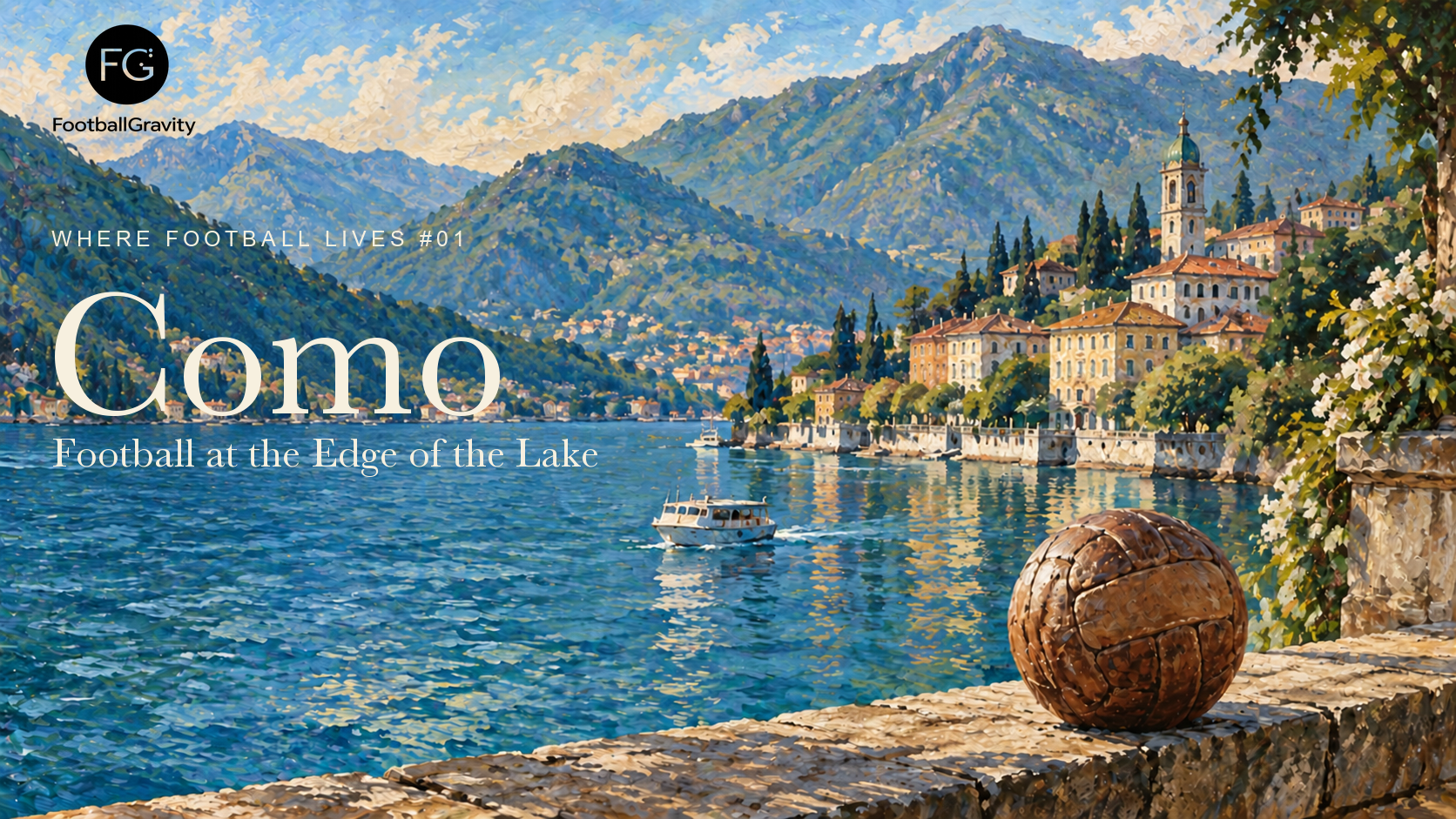
Featured image: Lake Como-inspired editorial illustration, created with AI assistance by FootballGravity, with the official FootballGravity logo. It is not a documentary photograph or an exact representation of the stadium. This article was prepared from published sources with AI assistance; it is not a report from an on-site visit.