
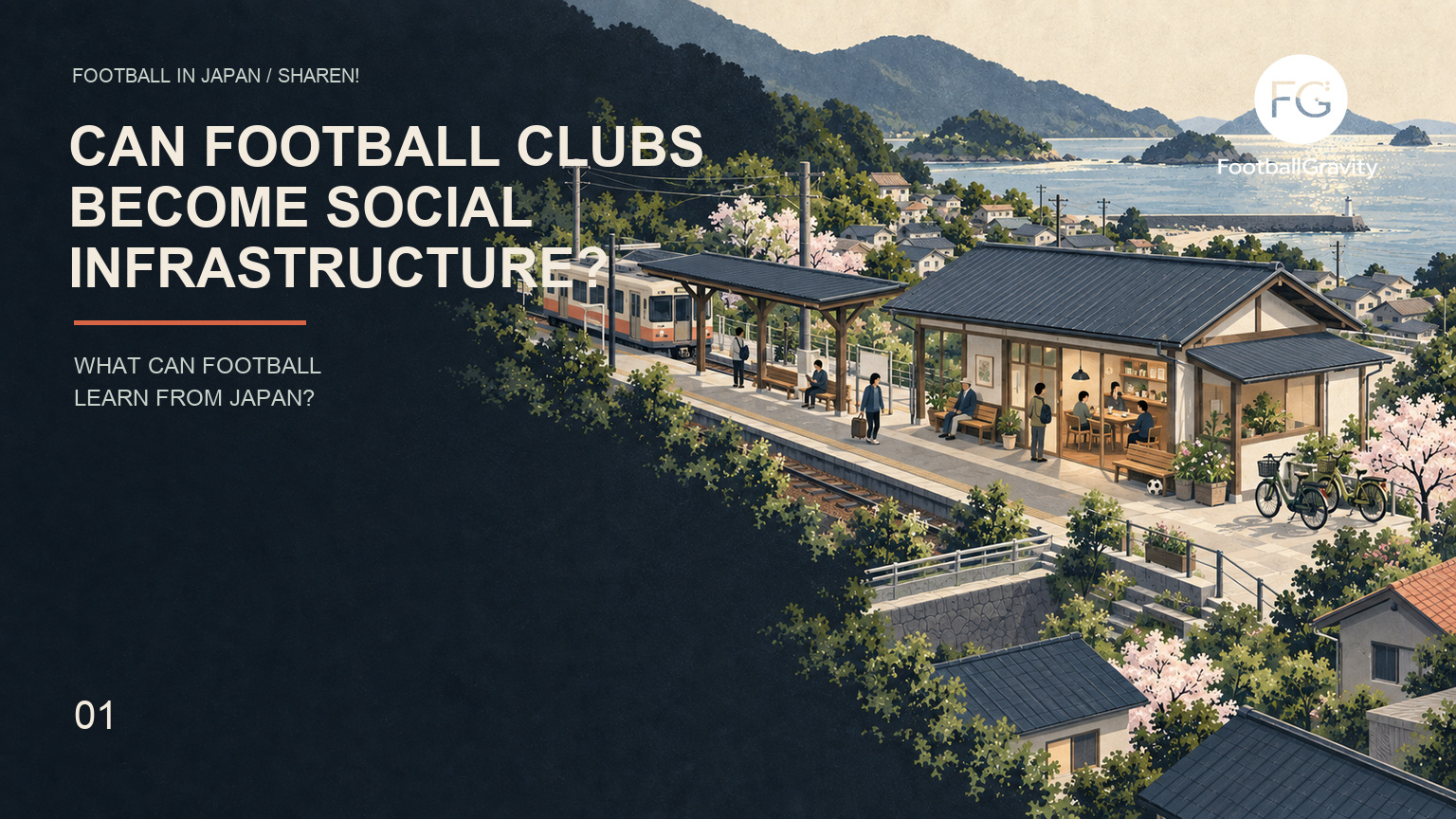
Part one of FootballGravity’s What can football learn from Japan? series looks at SHAREN!, the J.League’s framework for social collaboration, through a small station project in Kagoshima.
At Kiire station in Kagoshima, coffee is now served in a room that used to be part of the station office. The space also sells Kagoshima United FC merchandise and handles bicycle rental. Commuters, local residents, visitors and football supporters all have a reason to pass through the same small place.
There is nothing grand about the idea. That is part of its appeal. Community infrastructure is often made from ordinary places that remain useful between events. In Kiire, a football club has become one of the organisations responsible for keeping such a place open.
The project offers a clear way into SHAREN!, the J.League’s name for social collaboration between clubs and local partners. It also raises a question with relevance beyond Japan: what can a club contribute when the work is for a town, including people who may never attend a match?
What SHAREN! means
J.League clubs have carried out hometown activities since the competition’s early years. In 2018, the league gave a more specific name to work in which clubs join other organisations in addressing a social or local issue. Its official description of SHAREN! envisages at least three collaborators creating shared value together.
Those collaborators may include residents, companies, non-profits, schools and public authorities. The point is not simply that a club supports a good cause. It is that different partners bring different things: a place, local knowledge, public responsibility, operational experience, communications or the ability to bring people together.
This makes SHAREN! useful to an international audience. The individual projects are rooted in Japanese towns, but the underlying question travels well. How can the attention and relationships around a football club become useful in everyday local life?
A new use for part of a station
Kiire is on JR Kyushu’s Ibusuki Makurazaki Line, south of central Kagoshima. Kagoshima United says the station had been without permanently stationed staff since May 2000. The railway continued to serve the town, but part of the former station office was available for another use.
The result was Unibase Kiire, which opened on 14 April 2025. JR Kyushu describes it as an approximately eight-tsubo community space created by renovating part of the former office. One tsubo is about 3.3 square metres, making the room roughly 26 square metres.
The operating arrangement matters as much as the size. Kagoshima City commissioned a joint venture formed by Kagoshima Pro Sports Project, the company that operates Kagoshima United, and local company NK Customize. JR Kyushu provided the station setting. The club’s opening announcement described the intended users as local residents, tourists and supporters.
The community space did not restore staffed railway services: ticket sales, ticket collection and railway enquiries are not provided there. Its role is different. It sells drinks and food, carries official club merchandise and acts as the reception point for bicycle rental.
The project also continued after the April opening. Kagoshima City completed improvements to the station waiting area on 20 August 2025 and began a rental service with two electric-assist bicycles on the same day. Before the unveiling, 21 people joined a public workshop that included local children and finished the paintwork on four wooden benches. A local high school student supplied the calligraphy for a station entrance curtain made by JR Kyushu’s Kagoshima branch.
These details give the project its character. The club name is visible, but the space is tied to waiting for a train, having a drink, travelling onward by bicycle and taking part in the making of the station itself. Football is present without being the only reason for the place to exist.
A partnership, not a club acting alone
Kiire also shows why the word “collaboration” matters. The city refurbished the facilities and commissioned the operation. JR Kyushu made railway space part of its wider ekinico initiative for bringing new activity to underused station areas. The joint venture runs the community space, and the company behind Kagoshima United is one of its two members.
In May 2026, the J.League gave the Kiire project its Social Challenger Award at the SHAREN! Awards. The league’s selection comment presented unmanned stations as a challenge shared by communities across Japan and praised the decision to form a joint venture and reuse the station as a gathering place. That recognition shows how the league understands the project; it should not be read as independent evidence of its long-term impact.
What can be seen already is a practical division of roles. A public authority, a railway, a local business and a football club have each contributed something the others could not provide alone. The result is modest in scale, but it is part of daily life rather than limited to a matchday campaign.
What football can learn from Kiire
Kiire offers a principle rather than a template. Its arrangement belongs to its own town, partners and transport network. What others can take from it is the way the partnership starts with a real place and gives each organisation a recognisable job.
The phrase “social infrastructure” earns its meaning through use. A club moves closer to that role when its name, relationships and staff help sustain something that people can use in ordinary life.
Unibase Kiire is still a young project, and it is too early to know how it will shape local life over time. What the public record does show is the structure: a small part of a station, reopened for community use through a partnership in which a football club has an operational role. That is a useful first answer to what football can learn from Japan.
Method note: This article is an independent, document-based analysis using material published by the J.League, Kagoshima United FC, Kagoshima City and JR Kyushu. FootballGravity has not interviewed operators or users. “Social infrastructure” is FootballGravity’s analytical frame, not an official SHAREN! designation or a claim that long-term impact has already been established.