Helping Clubs Take the Next Step: The J.League and Sport Positive

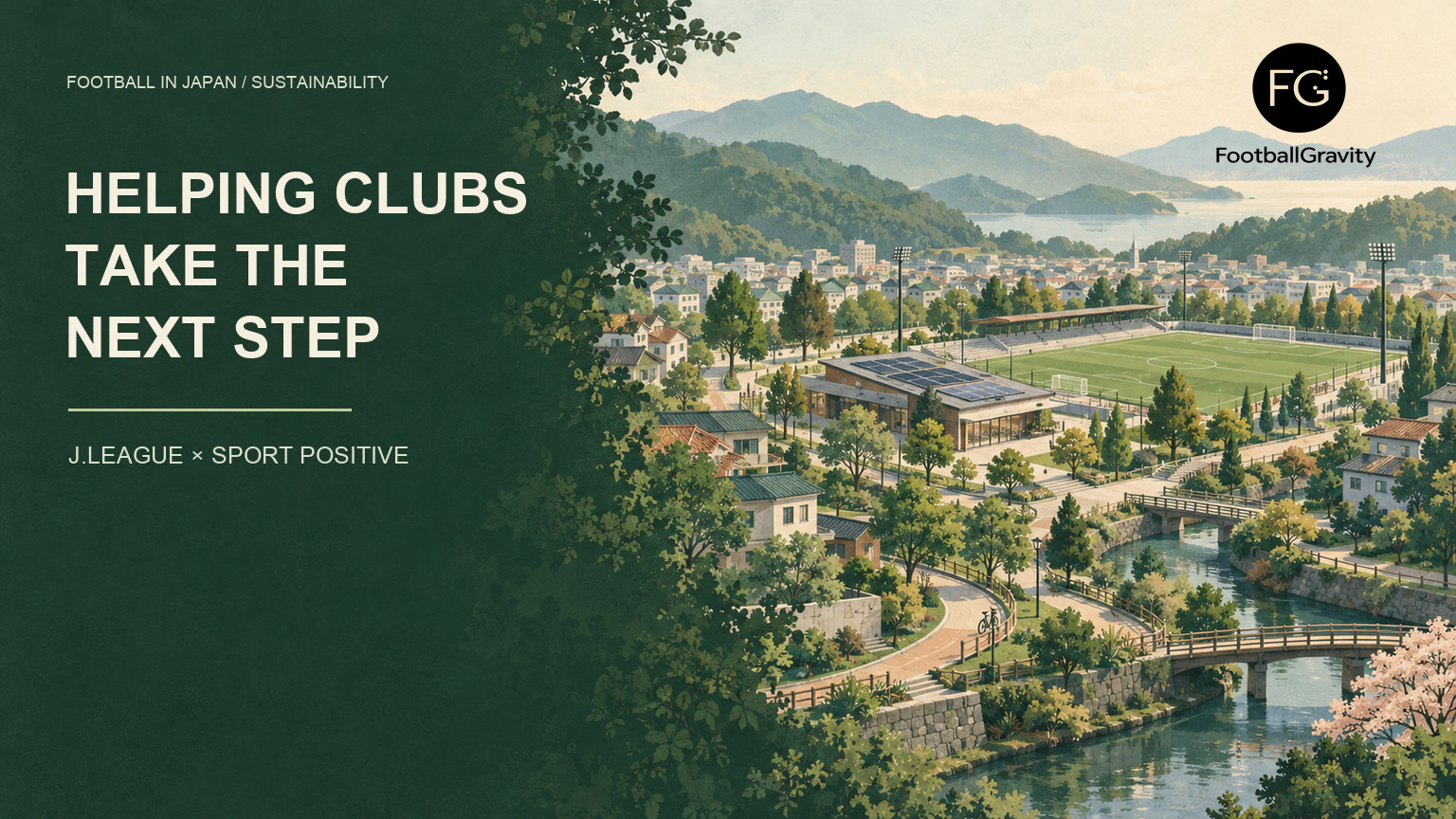
Conceptual illustration of a Japanese town linked by paths to a football ground and a solar-roofed clubhouse, with the FootballGravity logo.

A journey to the ground, the electricity used during a match, the food served before kick-off: environmental action has many places to begin in football. For the people running a club, the practical questions soon follow. Who can help? What should come first? Where will the money come from? A league can help clubs work through those decisions together.

The J.League is bringing that supporting role into focus through Sport Positive Leagues (SPL). Its April 2025 announcement committed the league and its 60 clubs to an environmental assessment framework already used in European football, making the J.League its first Asian participant. The programme connects a shared framework with financial support for clubs and opportunities to learn from one another.

Getting started deserves encouragement. Environmental work can mean finding time for another task, changing a familiar routine or accepting a less convenient option. Its benefits may take time to become visible. A club willing to begin can give others a reason to join in. The J.League’s approach is worth sharing beyond Japan because it puts support around that first step and the patient work that follows.

Finding a place to start

The framework gives clubs a broad view of the work. The twelve areas set out in the launch announcement cover policy and reporting, renewable energy, energy efficiency, lower-impact transport, single-use plastics, waste, water, plant-based and low-carbon food, biodiversity, education, communication and sustainable procurement. They reach from decisions in the office to the routines around a stadium.

That range makes room for different starting points. A conversation with a facility operator about energy use could be one beginning. Finding a local partner to help with waste or supporter travel could be another. Starting with someone the club already knows can make a large subject feel more manageable. A modest first project also gives people an opportunity to learn by doing.

With support from KPMG, the J.League has adapted the framework for use in Japan. That gives clubs a way to learn from overseas experience while working through the practical circumstances they encounter at home.

A common set of topics also gives people something specific to discuss. A supporter can ask about the journey to a match; a supplier can recognise where its expertise might help. For a club employee trying to bring colleagues into the work, a clearly described area of activity is an easier conversation to begin than sustainability in the abstract.

Putting support behind the invitation

Good intentions still need time and a budget. In May 2025, The Nippon Foundation announced a ¥370 million grant for the broader J.League Sustainability Activation Project, helping prepare clubs for SPL and supporting efforts to bring environmental action into their communities.

The initial club grant scheme announced in April 2025 set aside ¥240 million, with clubs able to apply for up to ¥4 million each. They could propose work in one or several environmental areas. A club with a willing partner and an idea had a route to seeking funds to put it into practice.

That support recognises the work involved in beginning. Someone has to make enquiries, bring colleagues into the conversation and agree on a project with partners. Helping with the cost can make it easier for those people to take the next step. It gives a promising idea a chance to become something people can try together.

The J.League also plans to give higher-ranked clubs a larger share of future grants. Alongside the initial support for getting started, this would offer encouragement to keep developing the work. The connection between assessment and funding gives clubs another reason to build on what they learn.

For other leagues, the useful idea is the connection between an assessment framework and resources to act on it. Recognition can bring attention to a project. Financial support can help a club find the room to begin it or take it further. The Japanese approach brings both into the same programme.

Making experience easier to share

At the January 2026 Sustainability Conference, club staff met with partners and public bodies to discuss how to move the work forward. Sport Positive founder Claire Poole and Bristol City representative Peter Smith gave presentations, the Japanese criteria were introduced, and participants worked through ideas in group discussions.

The conference’s message was one of shared progress: clubs could exchange useful practices and advance together. Supporters are used to seeing their clubs as rivals, but an environmental idea can help more people when it travels from one club to another. There is something hopeful in using football’s connections that way.

In environmental work, an idea can become more useful when another club takes it up. A conversation about arranging a collection point, working with a local authority or involving a supplier can save someone elsewhere from having to work out every step alone. A league has the relationships to make those conversations possible, including between clubs that might rarely otherwise share their day-to-day experience.

The international exchange works in both directions. Japanese clubs can draw on experience from overseas, while people elsewhere can learn how a Japanese club works with its hometown and partners. FootballGravity’s introduction to Tokyo Verdy’s TOKYO♡GREEN follows some of those local connections. Its clothing collection and supporter travel activities put a local face on those wider environmental themes.

A framework that can keep the conversation going

Sport Positive’s own work offers a helpful perspective on the role of a table. For its Premier League Clubs 2023 edition, the organisation replaced the points table with a searchable environmental sustainability report. It explained that the format was intended to make clubs’ activities easier to find and share. Different formats can serve that continuing purpose.

The J.League plans to publish Japan’s first ranking in November 2026, covering activities during January–June of that year. It will offer a new way to discover clubs’ work and the people and partnerships behind it.

Some of that work may be quiet: a conversation with a supplier, a collection point that needs looking after, an invitation to try a different way of travelling. Such tasks require someone to keep showing up. Making them more visible can help supporters recognise the care involved and see a place for themselves in the effort.

For football elsewhere, Japan offers an encouraging example of how to stand behind clubs that are willing to try. A shared direction helps people find a starting point; funding and contact with others can help them continue. The willingness to begin, make adjustments and invite more people in deserves recognition in its own right. Given time and support, those first steps can become part of the everyday care a club takes of its community.

Based on public league, funder and Sport Positive documents. Researched on 16 October 2026; revised on 23 October, with the league’s programme overview and first-ranking schedule rechecked.

Featured image: AI-generated conceptual editorial illustration, with the official FootballGravity logo added separately. It depicts no actual club, stadium or project.

Part of Football in Japan — What can football learn from Japan?

More Than a Colour: Tokyo Verdy’s TOKYO♡GREEN

Conceptual illustration of green football stands, a bicycle, a folded T-shirt, a tote bag and a tree, with the FootballGravity logo.

An old T-shirt can still have a place on matchday. Tokyo Verdy’s TOKYO♡GREEN DAY programme invites supporters to bring one they no longer wear and turn it into a bag, using scissors rather than a needle and thread. The invitation leaves room for a shirt from any part of someone’s life, not just the club shop. It is a small, approachable way to think about keeping something useful.

That attention to familiar things runs through TOKYO♡GREEN, the sustainability initiative Verdy launched in 2024. A journey to the stadium, clothes waiting to be cleared out, a child’s afternoon of making things: each offers a way to take part. For a football club whose name and colour are rooted in green, these activities give supporters another way to express their connection to the club.

The programme spans environmental footprint reduction, greening, education, inclusion and well-being. This introduction follows its environmental activities, where Verdy and its partners are finding practical ways to bring sustainability into the routines around football. The club’s overview sets out the wider ambition.

The journey is part of the day

Verdy’s Green Route Challenge begins before supporters reach the turnstiles. Introduced for home league games from 29 August 2026, it offers a limited-edition sticker to the first 100 participants at each match who share an eligible journey on X and show the post at the stadium.

The qualifying routes are specific: walking all the way from home, cycling all the way, or travelling by car with at least three people sharing the ride. Different stickers recognise the different journeys. Public transport is encouraged separately in the club’s Fan Policy, but is not listed among the challenge’s sticker-qualifying options.

It is an invitation people can recognise in their own plans for a match. Supporters who can walk or cycle may choose to make that trip part of the occasion; people travelling by car can arrange to go together. Sharing the journey also makes a usually private choice visible within the supporter community. That is a useful role for a club: giving an everyday decision a social connection.

Clothes with somewhere else to go

The GREEN RELAY PROJECT brings another everyday decision to the ground. Verdy collects unwanted clothing with corporate partner Chori, using the company’s B-LOOP textile recycling scheme to connect collection with sorting and reprocessing. The project is designed to turn collected material into new supporter goods and other products.

There is already a record of supporters taking part. In its December 2025 account, Chori reported that the project had collected approximately 585kg of clothing across that season. The total included matchday collections and a permanent collection box at the clubhouse, with players also contributing. Chori said the material was to be sorted and reprocessed for supporter goods in the following season.

A clubhouse collection point is a thoughtful addition. It gives the activity a place in the club’s working week as well as its match calendar. The practical work continues beyond handing over a bag: B-LOOP coordinates handling, transport and recycled products with partner companies, as Chori’s explanation of the scheme describes.

For clubs elsewhere, the partnership is worth understanding. A stadium offers a familiar meeting place and a reason to bring clothes along; the textile partner supplies the route for what happens afterwards. The reported weight tells us how much was collected. It should be read as a collection figure, rather than a measure of carbon savings or the amount of finished merchandise.

Something to make and take home

The TOKYO♡GREEN DAY scheduled for 11 October 2026 at Ajinomoto Stadium brings several of these activities together. Alongside clothing collection and the T-shirt-to-bag workshop, the programme includes wooden crafts and a workshop using SORAKASA KIT to assemble an umbrella whose fabric incorporates recycled Ziploc material.

The umbrella workshop is supported by Asahi Kasei Home Products. Its recycling programme developed the kit with umbrella company Ca Et La so that participants could encounter the idea of material circulation by assembling something they can use. In the football setting, that offers families an activity to share before the match.

On the same day, the announced clean-up activity includes routes between Ajinomoto Stadium and nearby AGF Field, where Nippon TV Tokyo Verdy Beleza are scheduled to play. The women’s team already carries out hometown clean-ups through the year. Linking the two venues gives that continuing work a place in a shared football afternoon.

These are planned activities, with details subject to change. Their appeal is in the invitation itself: bring something, make something, or help care for the place around the ground. A useful object to take home can give the subject a life beyond the event.

Giving the work a home in the club

There is also an organisational side to the initiative. On 22 May 2026, Verdy published its first Sustainability Report, covering 2025, alongside an ESG Policy and a Fan Policy. The documents were prepared using the J.League sustainability activities grant funded by The Nippon Foundation. They give the club and its supporters a shared reference for work that reaches beyond an individual event.

The Fan Policy is framed as recommendations and an invitation to contribute. Its scope includes Verdy and Beleza home games and official away games. Alongside travel, it encourages reducing waste, reuse and repair, respect for other supporters and care for the local environment. The language leaves space for people to contribute according to their circumstances.

Verdy has also announced work with Milan-based RIGHT HUB on a sustainability management framework for Tokyo Verdy, Inc.’s activities, aligned with the principles and requirements of ISO 20121:2024. Bringing this work into club operations can help give the public-facing activities continuity.

An international connection has already produced a shared activity. In March 2025, visiting staff from Real Betis joined Verdy in holding a sustainability awareness workshop at Ajinomoto Stadium. The clubs’ visit report documents that encounter, and their July 2025 partnership renewal includes collaboration between Betis’s Forever Green and TOKYO♡GREEN.

What can football learn from this Japanese example? One promising idea is to make participation feel familiar. People already have a relationship with their club, plans for getting to a match and belongings they care about. Verdy’s activities meet them there, with partners who can help carry the work forward. There is room for that connection to grow, through repeated invitations and the pleasure of doing something useful together.

This article is based on published club and partner documents checked on 8 October 2026. The 11 October activities are described as scheduled, rather than as a report from the event.

Featured image: AI-generated conceptual editorial illustration with the official FootballGravity logo added separately. It depicts no actual stadium, event or participant.

Part of Football in Japan — What can football learn from Japan?
From a First Step to a Place to Stay: How Osaka’s Football Clubs Are Widening Access to Sport

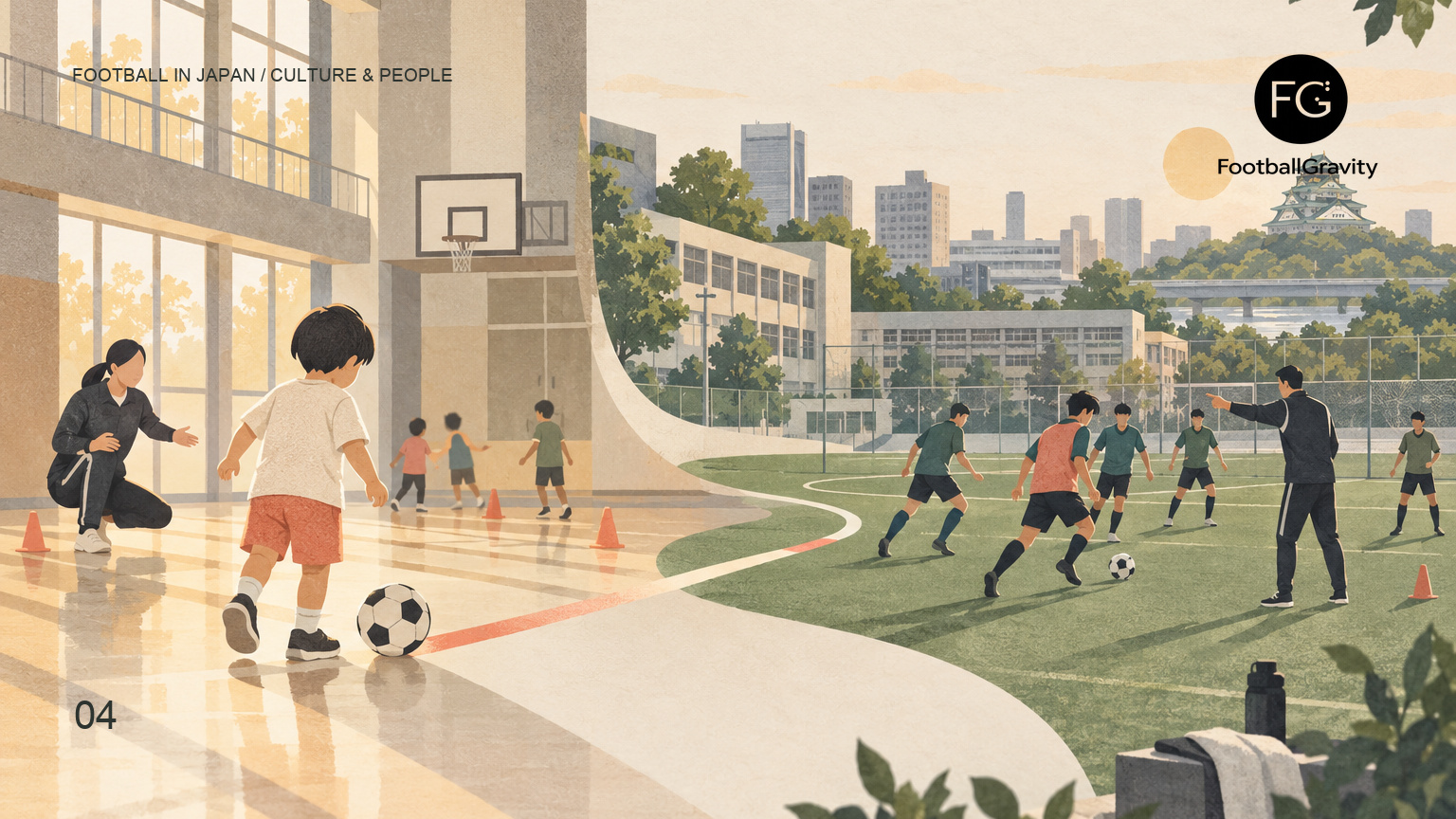
An AI-generated editorial illustration connecting a child's first ball activity in a university gym with teenagers training on a school football field.

A child walks into a university arena unsure whether sport is really for them. Elsewhere in Osaka, a teenager wants to keep playing football, but the school system around that team is becoming harder to sustain. Neither scene belongs to the familiar world of elite academies. Both are places where a professional club may have something useful to offer.

Two recent projects involving Cerezo Osaka and Gamba Osaka sit at different points in a young person’s sporting life. One creates a gentle first encounter with movement. The other is designed to help an established school activity continue. Read together, they suggest a broader role for clubs: sharing their people, expertise and local standing so that more children can find a way into sport and a reason to stay.

A first step for children who feel left behind

On 18 August 2026, the Osaka Sports Association and Osaka Metropolitan University’s Research Center for Urban Health and Sports held a free Children’s Exercise Challenge Class at the university’s Morinomiya campus. It was designed for third- and fourth-year primary school pupils, particularly those who felt they were not good at exercise. The organisers set a capacity of 50.

The programme moved through running, throwing, rhythm exercises and games with a ball. University students worked alongside the children, while Cerezo ambassadors Toshinobu Katsuya and Yusuke Maruhashi joined the ball activities. The club’s account describes the ambassadors speaking to the children individually and sharing the simple pleasure of kicking a ball together.

That detail matters. Organised sport can appear to begin with confidence, ability and knowing the rules. A class built for children who already feel uneasy about exercise begins somewhere else. Its first task is to make movement feel possible and enjoyable.

Cerezo did not create the class alone. It was organised through the university and the Osaka Sports Association, using the university’s facilities, students and research base. The club brought recognisable football figures and a direct connection to play. This is a modest form of partnership, but also a practical one: each organisation contributes something the others do not hold by themselves.

Keeping a school team available

In Suita, the challenge begins later. The city says about eight in ten of its junior-high students take part in extracurricular clubs. At the same time, teacher workload and a shortage of staff able to serve as advisers have made it difficult in some schools to maintain the range and quality of those activities.

Suita has been testing external management since 2024 and now contracts out the operation of selected clubs across all of its municipal junior high schools. The school activity remains in place. An outside operator selects and coordinates coaches, communicates with schools and parents, handles incidents and accompanies teams to weekend competition. A teacher remains a school contact and continues to support pupils in their wider school life.

The city has now announced a model involving Gamba Osaka. Subject to the contracting process, Gamba Osaka Academy is due to manage the football clubs at three municipal junior high schools from April 2027. The two-year model is scheduled to run until March 2029, with the participating schools still to be selected in the material published by the city.

This is more than sending a coach for an occasional session. It places the academy inside the routine responsibilities of a school club. The value of the club’s expertise will lie not only in the content of a training session, but in whether it can help provide a dependable place to play week after week.

Two stages of the same journey

The projects are different in scale and status. Cerezo joined a class that has already taken place; Gamba’s school-club role is planned for 2027. One lasts a day and welcomes younger children at an entry point. The other is intended to operate for two years within the weekly life of junior-high students.

They nevertheless belong in the same conversation. Access to sport is not secured by opening a single door. Children need an invitation that feels safe, adults who understand how to teach them and places where participation can continue as they grow. Universities, public bodies, schools and community organisations all hold parts of that chain. Football clubs can strengthen it.

Japan’s wider reform of school club activities makes the second example especially timely. The national reform period that began in the 2026 financial year is intended to expand sustainable opportunities for children while reducing a system’s dependence on teachers alone. Suita has chosen to preserve extracurricular clubs as part of school education while outsourcing parts of their management. The planned work with Gamba is one local version of a much larger national transition.

Beyond the academy

Professional academies are usually judged by the players they produce. These Osaka projects point to another kind of contribution. Coaching knowledge can help a hesitant child enjoy a ball for the first time. Organisational capacity can help a school keep a familiar activity available. A club’s name can also give public programmes visibility and make participation feel connected to the football culture of the city.

Neither project needs to turn every participant into a footballer. The more generous ambition is to help children build a comfortable relationship with movement, teammates and a place to belong. Cerezo’s involvement begins with an invitation. Gamba’s planned role is about continuity. Osaka offers room for both.


This article is part of What can football learn from Japan?, FootballGravity’s continuing series on ideas, communities and experiments in Japanese football.

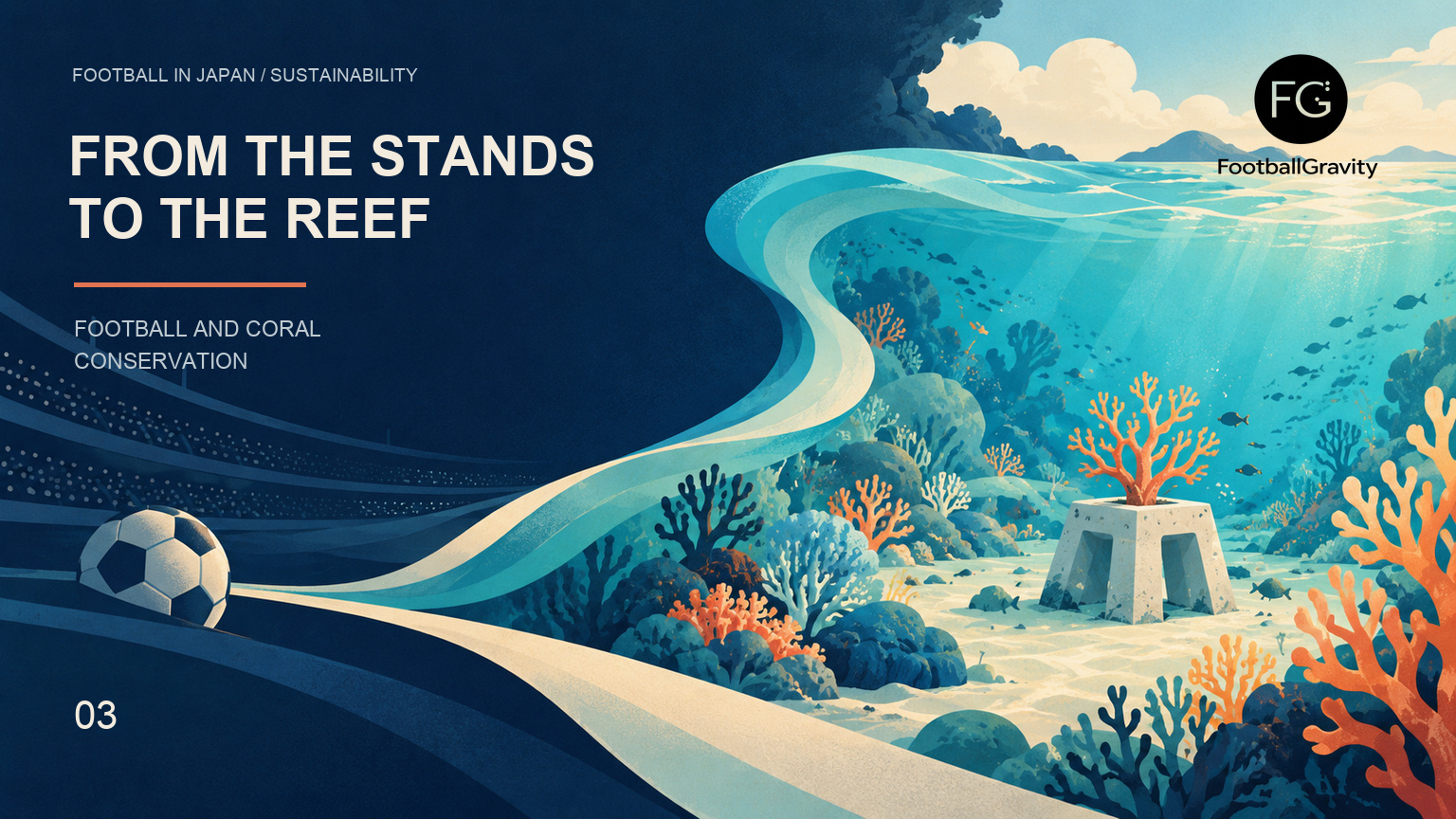
From the Stands to the Reef: How Kawasaki Frontale Supports Coral Conservation

An AI-generated editorial illustration linking football stands in a Japanese city with a coral reef off Okinawa.

At a Kawasaki Frontale home game, a small coral planting base becomes a canvas. Supporters add colour, a shirt number or a message, knowing that the finished piece will later travel to Onna Village on the west coast of Okinawa. There, local specialists attach a nursery-grown coral fragment and place it in the sea.

It is a simple journey from a matchday workshop to a living reef. It also offers a thoughtful answer to a question that matters far beyond Japan: how can a football club help people care about an ecosystem they may never have seen?

Frontale enters a story that began long before the club arrived. The ecological knowledge and the long-term work belong to people in Onna who have been raising, transplanting and monitoring coral for years. The club brings a new group of participants, a public stage and a relationship that keeps Okinawa present in Kawasaki long after pre-season camp has ended.

A camp relationship that travelled north

Kawasaki Frontale has held training camps in Onna since 2021. The village is one of Okinawa’s best-known resort areas, but the relationship has gradually grown beyond the practical needs of preparing a football team.

In August 2023, an Onna-themed event at Frontale’s home stadium included a coral-base painting workshop. The club explained that staff from Okinawa Diving Service Lagoon would later attach coral seedlings to the decorated bases and transplant them into the sea. The workshop returned in 2024, 2025 and 2026. Its advertised capacity grew from 100 participants in 2024 to 125 in each of the following two editions.

The wider event brought more of Onna to Kawasaki: tourism information, local products and environmental learning. In 2025, the club and village formalised their connection through a friendship agreement. The plans attached to it include sports tourism, educational programmes, improvements around the village’s sports facilities and activities that raise awareness of nature conservation and climate change.

This continuity matters. A one-day workshop can introduce an idea; a repeated event and an institutional relationship give people a reason to meet it again.

Joining conservation work already under way

Onna did not begin caring for coral when a J.League club arrived. The village declared itself a “Coral Village” in 2018 and has built environmental stewardship into its approach to tourism and local development. The Onna Village Fisheries Cooperative and its partners had already developed methods for raising coral fragments from locally sourced parent colonies, transplanting them and checking what happened afterwards.

A peer-reviewed study published in 2020 followed five Acropora species transplanted off Onna in 2013 and 2014. The researchers photographed individual colonies at roughly six-month intervals, recording differences in growth among species and sites. Some colonies matured and spawned within about two and a half years. Those corals were part of the village’s earlier restoration work, not Frontale’s workshops, but the study shows the local knowledge and monitoring culture into which the football project fits.

The arrangement respects that division of roles. Onna provides the coral expertise; Frontale opens the work to a new audience.

What football can bring

Coral bleaching can feel distant to someone living in a city near Tokyo. A matchday activity gives it a human scale. A supporter makes something by hand; a local specialist completes the technical work; the object enters the sea in a place connected to the club. The path is easy to understand, and it turns an environmental issue into a relationship between people and places.

That does not make the environmental challenge small. Unusually warm water caused severe bleaching around Okinawa in 2024, including heavy losses at monitored sites in Manza Bay. Coral planting cannot remove the heat stress affecting reefs. It can, however, form part of local conservation practice while helping more people understand what is at stake.

Football is useful here because it already has attention and shared rituals. The same supporter who comes for a league match can encounter an Okinawan community, learn why healthy reefs matter to local life and tourism, and take part in a small act of care. The club makes that encounter possible without asking every participant to become a marine biologist.

A small place to begin

The workshop is best understood as one part of a wider effort. Its painted bases join the village’s established conservation process, while the matchday setting allows that work to reach people far from Okinawa. The club’s contribution begins with participation and attention; both gain value when the relationship continues year after year.

Its value is easier to see in the connection it creates. The workshop carries Onna’s conservation work into a J.League matchday. The club’s annual camp becomes part of a longer relationship with the place that hosts it. Tourism promotion sits beside a reminder that the landscape drawing visitors also needs care.

A painted base is a small object. Yet it can carry a supporter’s attention from the stands in Kawasaki to the water off Okinawa. When a club uses its reach to help local expertise travel further, small is a perfectly worthwhile place to begin.


This article is part of What can football learn from Japan?, FootballGravity’s continuing series on ideas, communities and experiments in Japanese football.

ASU-PASS!: Passing a Better Future Forward

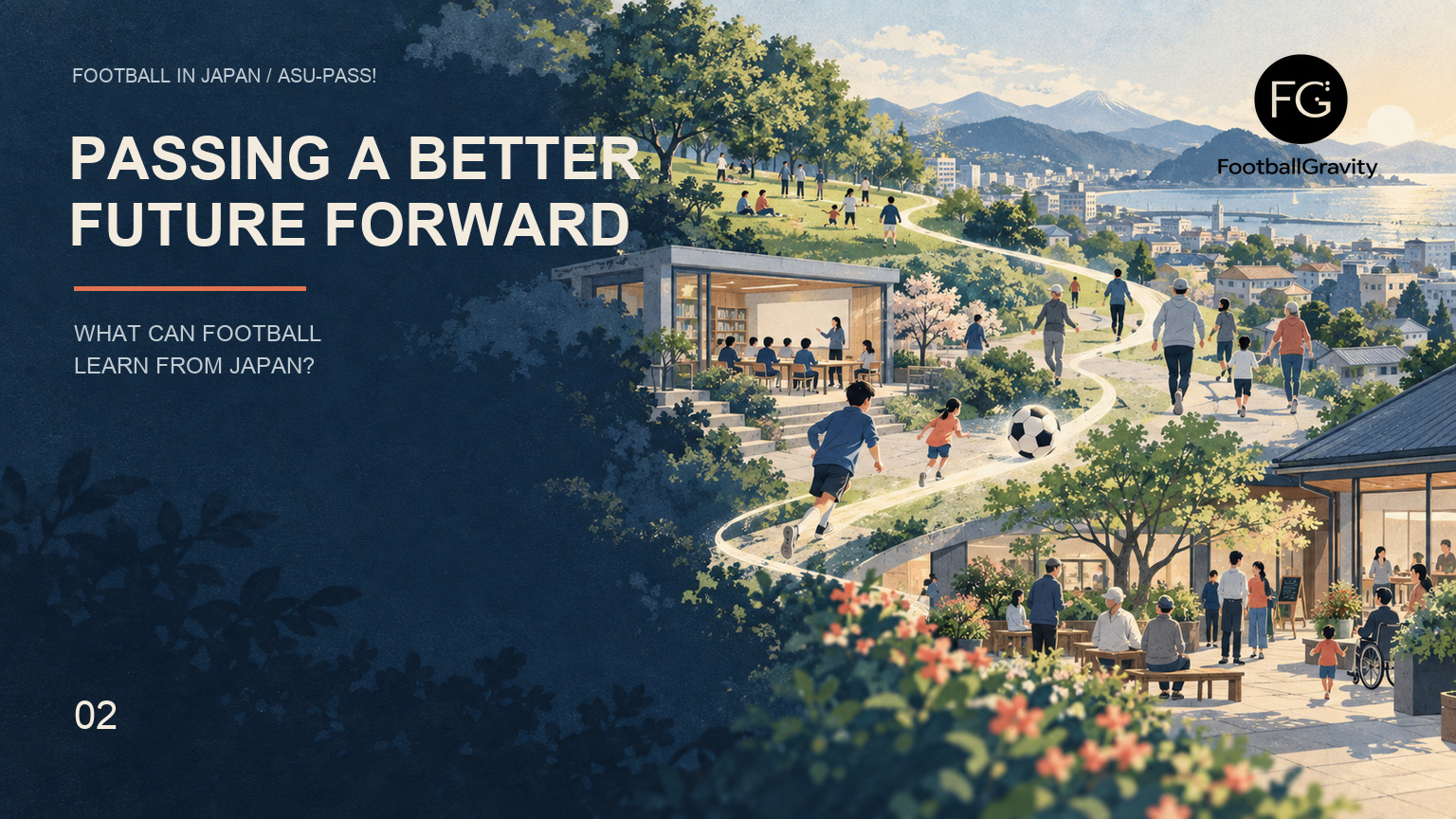
An AI-generated editorial illustration of a football pass connecting green space, learning, exercise and community life in an abstract Japanese town.

A football does not need much introduction. In its most informal form, a game can begin with a ball, a patch of shared ground and an agreement about where the goals are. The rules are familiar across languages, ages and borders. That accessibility helps explain why FIFA routinely describes football as the world’s most popular sport — and why the game can carry ideas far beyond the touchline.

In Japan, the national association is putting that reach behind a broad sustainability programme called ASU-PASS! The name is written アスパス! in Japanese. It brings together Earth, asu — the Japanese word for tomorrow — us, and the footballing act of passing something forward.

The result is more than a slogan attached to one campaign. ASU-PASS! is the Japan Football Association’s shared name for work across five connected areas: environment, human rights, health, education and community. It gives activities that can otherwise look separate a common direction: using football to help create a future in which the game, and the communities around it, can thrive.

A name for the next hundred years

The JFA introduced ASU-PASS! in December 2021, the year of its centenary. Its announcement looked ahead to the association’s next hundred years, while drawing together work that had already been developing for much longer.

That distinction matters. ASU-PASS! did not begin with a blank page. Grassroots football, respect and fair-play education, the JFA Green Project, disaster recovery, children’s learning and women’s leadership were among the activities already in motion. The new framework made it easier to see them as parts of the same responsibility.

Its five areas are deliberately broad. Environment includes climate action, heat safety and reducing waste. Human rights covers the work of building a game free from violence and discrimination, narrowing children’s experience gaps, advancing gender equality and widening access. Health uses grassroots sport to support physical and mental wellbeing across generations. Education includes learning through football and programmes that encourage children to imagine their future. Community connects the game with recovery, disaster preparedness and stronger local relationships.

The categories are useful, but the most interesting work often crosses between them. Protecting players from extreme heat is an environmental and health issue. A welcoming place to play is about health, rights and community at once. A football lesson can become an education project, a meeting point and a first experience of belonging.

Why football can move an idea

The ambitions behind the Sustainable Development Goals are easy to support, yet their scale can make them feel remote from daily life. Climate, equality, health, learning and resilient communities are enormous subjects. People may agree with the destination without knowing where to begin.

Football offers an inviting first step. It has familiar places, shared rituals and networks that already gather people: a school field, a local association, a national-team match, a coaching course, a community club. An idea introduced there arrives through a relationship that already exists.

The JFA’s own sustainability strategy describes two strengths of the game: its power to connect and its power to encourage. ASU-PASS! uses both. It can connect an association with schools, municipalities, companies and civic organisations, then use the visibility and emotion of football to encourage action. In 2025, the JFA also joined the United Nations’ Football for the Goals initiative, placing this Japanese programme within a wider international effort to use football’s reach in support of the SDGs.

The size of the existing network gives that idea practical weight. The JFA works with 47 prefectural associations and nine regional associations, while its 2025 data records more than 836,000 registered football players. Those figures do not include everyone who plays informally, watches, volunteers or supports a family member. They show how many doors football can open before a sustainability conversation has even begun.

Five areas, many ways to take part

The breadth of ASU-PASS! is one of its strengths. A supporter might meet it through recycling or a food drive at a stadium. A coach may encounter it through safeguarding, respect or heat-safety guidance. A child may know it through outdoor play or a Dream Class. A town recovering from disaster may experience football as companionship, fundraising and a reason to gather again.

The JFA’s 2024 Sustainability Report shows this range in practice. It records support following the Noto Peninsula earthquake, learning and exercise programmes for children, work on inclusive participation, community events and a decision to avoid staging JFA-hosted competitions in July and August from 2025 in response to rising heat risk. The report also sets out nine priority themes beneath the five areas, giving the programme a clearer route from a generous ambition to recognisable activity.

That variety gives people more than one way into the programme. Sustainability does not have to begin with specialist vocabulary. It can begin with a safer summer schedule, a shared meal, a child’s first touch of a ball, a conversation about respect or a pitch that brings neighbours together.

A pass invites another pass

ASU-PASS! is still in the early part of the long future imagined at its launch. That is precisely why it is worth following. The framework can become more valuable each time an association, club, school or partner finds a practical way to use it and shares what happened next.

There is room for the programme to grow through simple, generous forms of exchange: practical guides that help local organisers begin, stories that show how one community adapted an idea, and regular reporting that lets participants recognise their work as part of something larger. The five areas provide a map; the people using football in their own places will give that map its detail.

Football is especially suited to this kind of invitation. A pass assumes that someone else is there. It travels, it asks for attention, and it keeps the move alive. ASU-PASS! takes that ordinary action and turns it into a hopeful civic idea: the future is something the football family can move towards together.


This article is part of What can football learn from Japan?, FootballGravity’s continuing series on ideas, communities and experiments in Japanese football.

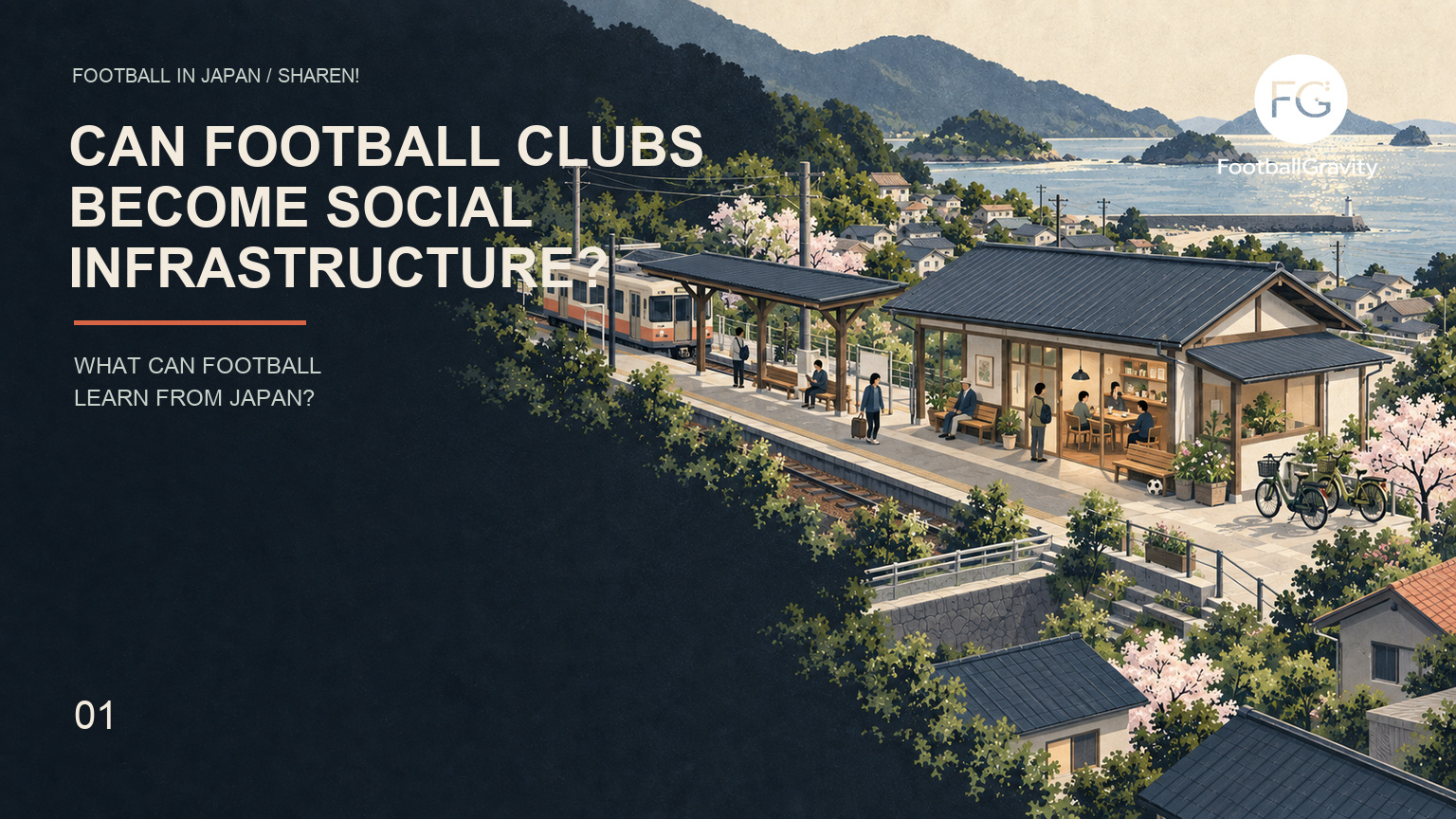
Can Football Clubs Become Social Infrastructure?

An AI-generated editorial illustration of an abstract Japanese town where a railway station, community buildings and football pitches are linked by public paths.

Part one of FootballGravity’s What can football learn from Japan? series looks at SHAREN!, the J.League’s framework for social collaboration, through a small station project in Kagoshima.
At Kiire station in Kagoshima, coffee is now served in a room that used to be part of the station office. The space also sells Kagoshima United FC merchandise and handles bicycle rental. Commuters, local residents, visitors and football supporters all have a reason to pass through the same small place.

There is nothing grand about the idea. That is part of its appeal. Community infrastructure is often made from ordinary places that remain useful between events. In Kiire, a football club has become one of the organisations responsible for keeping such a place open.

The project offers a clear way into SHAREN!, the J.League’s name for social collaboration between clubs and local partners. It also raises a question with relevance beyond Japan: what can a club contribute when the work is for a town, including people who may never attend a match?

What SHAREN! means

J.League clubs have carried out hometown activities since the competition’s early years. In 2018, the league gave a more specific name to work in which clubs join other organisations in addressing a social or local issue. Its official description of SHAREN! envisages at least three collaborators creating shared value together.

Those collaborators may include residents, companies, non-profits, schools and public authorities. The point is not simply that a club supports a good cause. It is that different partners bring different things: a place, local knowledge, public responsibility, operational experience, communications or the ability to bring people together.

This makes SHAREN! useful to an international audience. The individual projects are rooted in Japanese towns, but the underlying question travels well. How can the attention and relationships around a football club become useful in everyday local life?

A new use for part of a station

Kiire is on JR Kyushu’s Ibusuki Makurazaki Line, south of central Kagoshima. Kagoshima United says the station had been without permanently stationed staff since May 2000. The railway continued to serve the town, but part of the former station office was available for another use.

The result was Unibase Kiire, which opened on 14 April 2025. JR Kyushu describes it as an approximately eight-tsubo community space created by renovating part of the former office. One tsubo is about 3.3 square metres, making the room roughly 26 square metres.

The operating arrangement matters as much as the size. Kagoshima City commissioned a joint venture formed by Kagoshima Pro Sports Project, the company that operates Kagoshima United, and local company NK Customize. JR Kyushu provided the station setting. The club’s opening announcement described the intended users as local residents, tourists and supporters.

The community space did not restore staffed railway services: ticket sales, ticket collection and railway enquiries are not provided there. Its role is different. It sells drinks and food, carries official club merchandise and acts as the reception point for bicycle rental.

The project also continued after the April opening. Kagoshima City completed improvements to the station waiting area on 20 August 2025 and began a rental service with two electric-assist bicycles on the same day. Before the unveiling, 21 people joined a public workshop that included local children and finished the paintwork on four wooden benches. A local high school student supplied the calligraphy for a station entrance curtain made by JR Kyushu’s Kagoshima branch.

These details give the project its character. The club name is visible, but the space is tied to waiting for a train, having a drink, travelling onward by bicycle and taking part in the making of the station itself. Football is present without being the only reason for the place to exist.

A partnership, not a club acting alone

Kiire also shows why the word “collaboration” matters. The city refurbished the facilities and commissioned the operation. JR Kyushu made railway space part of its wider ekinico initiative for bringing new activity to underused station areas. The joint venture runs the community space, and the company behind Kagoshima United is one of its two members.

In May 2026, the J.League gave the Kiire project its Social Challenger Award at the SHAREN! Awards. The league’s selection comment presented unmanned stations as a challenge shared by communities across Japan and praised the decision to form a joint venture and reuse the station as a gathering place. That recognition shows how the league understands the project; it should not be read as independent evidence of its long-term impact.

What can be seen already is a practical division of roles. A public authority, a railway, a local business and a football club have each contributed something the others could not provide alone. The result is modest in scale, but it is part of daily life rather than limited to a matchday campaign.

What football can learn from Kiire

Kiire offers a principle rather than a template. Its arrangement belongs to its own town, partners and transport network. What others can take from it is the way the partnership starts with a real place and gives each organisation a recognisable job.

The phrase “social infrastructure” earns its meaning through use. A club moves closer to that role when its name, relationships and staff help sustain something that people can use in ordinary life.

Unibase Kiire is still a young project, and it is too early to know how it will shape local life over time. What the public record does show is the structure: a small part of a station, reopened for community use through a partnership in which a football club has an operational role. That is a useful first answer to what football can learn from Japan.

Method note: This article is an independent, document-based analysis using material published by the J.League, Kagoshima United FC, Kagoshima City and JR Kyushu. FootballGravity has not interviewed operators or users. “Social infrastructure” is FootballGravity’s analytical frame, not an official SHAREN! designation or a claim that long-term impact has already been established.