
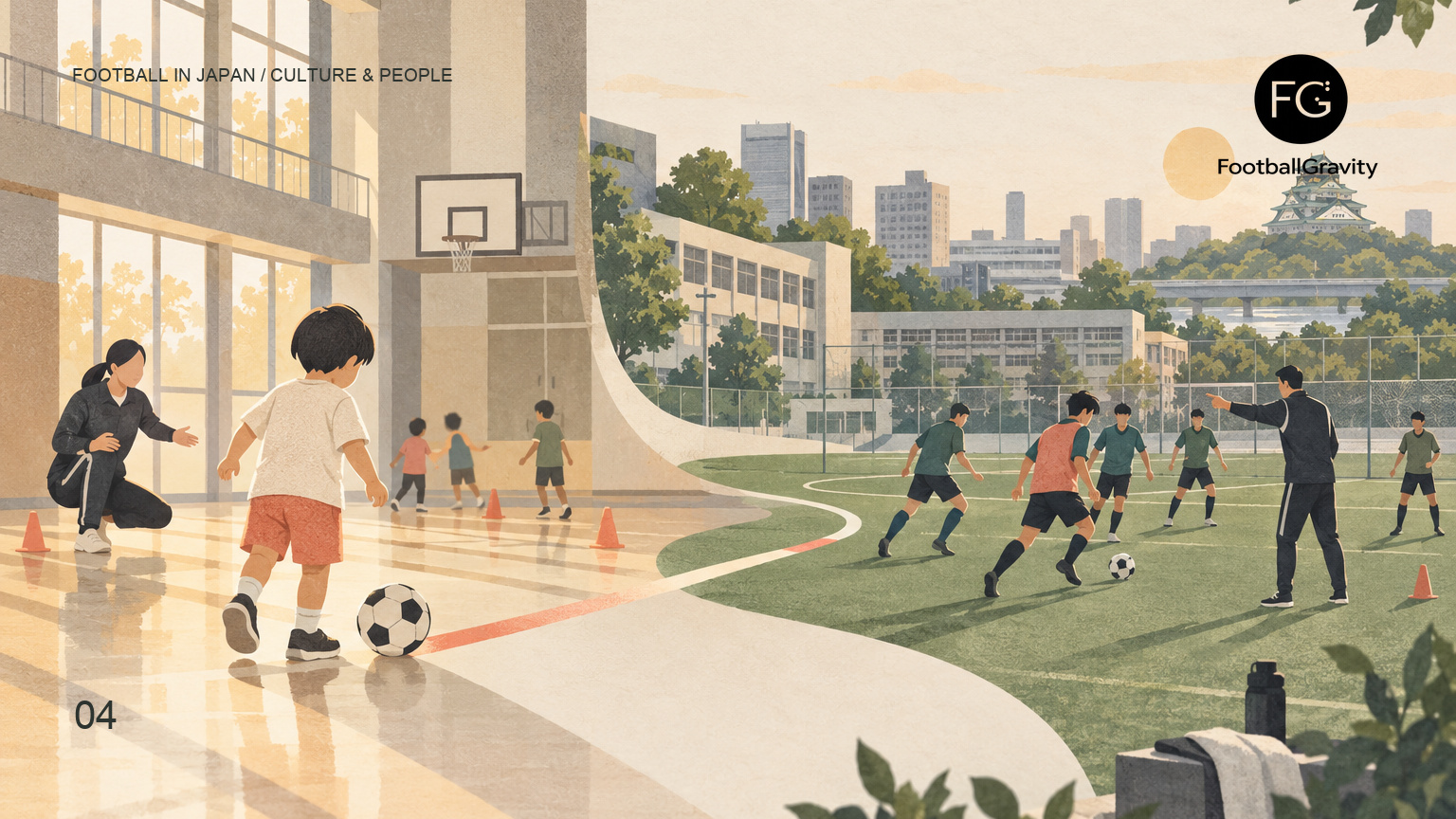
A child walks into a university arena unsure whether sport is really for them. Elsewhere in Osaka, a teenager wants to keep playing football, but the school system around that team is becoming harder to sustain. Neither scene belongs to the familiar world of elite academies. Both are places where a professional club may have something useful to offer.
Two recent projects involving Cerezo Osaka and Gamba Osaka sit at different points in a young person’s sporting life. One creates a gentle first encounter with movement. The other is designed to help an established school activity continue. Read together, they suggest a broader role for clubs: sharing their people, expertise and local standing so that more children can find a way into sport and a reason to stay.
A first step for children who feel left behind
On 18 August 2026, the Osaka Sports Association and Osaka Metropolitan University’s Research Center for Urban Health and Sports held a free Children’s Exercise Challenge Class at the university’s Morinomiya campus. It was designed for third- and fourth-year primary school pupils, particularly those who felt they were not good at exercise. The organisers set a capacity of 50.
The programme moved through running, throwing, rhythm exercises and games with a ball. University students worked alongside the children, while Cerezo ambassadors Toshinobu Katsuya and Yusuke Maruhashi joined the ball activities. The club’s account describes the ambassadors speaking to the children individually and sharing the simple pleasure of kicking a ball together.
That detail matters. Organised sport can appear to begin with confidence, ability and knowing the rules. A class built for children who already feel uneasy about exercise begins somewhere else. Its first task is to make movement feel possible and enjoyable.
Cerezo did not create the class alone. It was organised through the university and the Osaka Sports Association, using the university’s facilities, students and research base. The club brought recognisable football figures and a direct connection to play. This is a modest form of partnership, but also a practical one: each organisation contributes something the others do not hold by themselves.
Keeping a school team available
In Suita, the challenge begins later. The city says about eight in ten of its junior-high students take part in extracurricular clubs. At the same time, teacher workload and a shortage of staff able to serve as advisers have made it difficult in some schools to maintain the range and quality of those activities.
Suita has been testing external management since 2024 and now contracts out the operation of selected clubs across all of its municipal junior high schools. The school activity remains in place. An outside operator selects and coordinates coaches, communicates with schools and parents, handles incidents and accompanies teams to weekend competition. A teacher remains a school contact and continues to support pupils in their wider school life.
The city has now announced a model involving Gamba Osaka. Subject to the contracting process, Gamba Osaka Academy is due to manage the football clubs at three municipal junior high schools from April 2027. The two-year model is scheduled to run until March 2029, with the participating schools still to be selected in the material published by the city.
This is more than sending a coach for an occasional session. It places the academy inside the routine responsibilities of a school club. The value of the club’s expertise will lie not only in the content of a training session, but in whether it can help provide a dependable place to play week after week.
Two stages of the same journey
The projects are different in scale and status. Cerezo joined a class that has already taken place; Gamba’s school-club role is planned for 2027. One lasts a day and welcomes younger children at an entry point. The other is intended to operate for two years within the weekly life of junior-high students.
They nevertheless belong in the same conversation. Access to sport is not secured by opening a single door. Children need an invitation that feels safe, adults who understand how to teach them and places where participation can continue as they grow. Universities, public bodies, schools and community organisations all hold parts of that chain. Football clubs can strengthen it.
Japan’s wider reform of school club activities makes the second example especially timely. The national reform period that began in the 2026 financial year is intended to expand sustainable opportunities for children while reducing a system’s dependence on teachers alone. Suita has chosen to preserve extracurricular clubs as part of school education while outsourcing parts of their management. The planned work with Gamba is one local version of a much larger national transition.
Beyond the academy
Professional academies are usually judged by the players they produce. These Osaka projects point to another kind of contribution. Coaching knowledge can help a hesitant child enjoy a ball for the first time. Organisational capacity can help a school keep a familiar activity available. A club’s name can also give public programmes visibility and make participation feel connected to the football culture of the city.
Neither project needs to turn every participant into a footballer. The more generous ambition is to help children build a comfortable relationship with movement, teammates and a place to belong. Cerezo’s involvement begins with an invitation. Gamba’s planned role is about continuity. Osaka offers room for both.
This article is part of What can football learn from Japan?, FootballGravity’s continuing series on ideas, communities and experiments in Japanese football.