
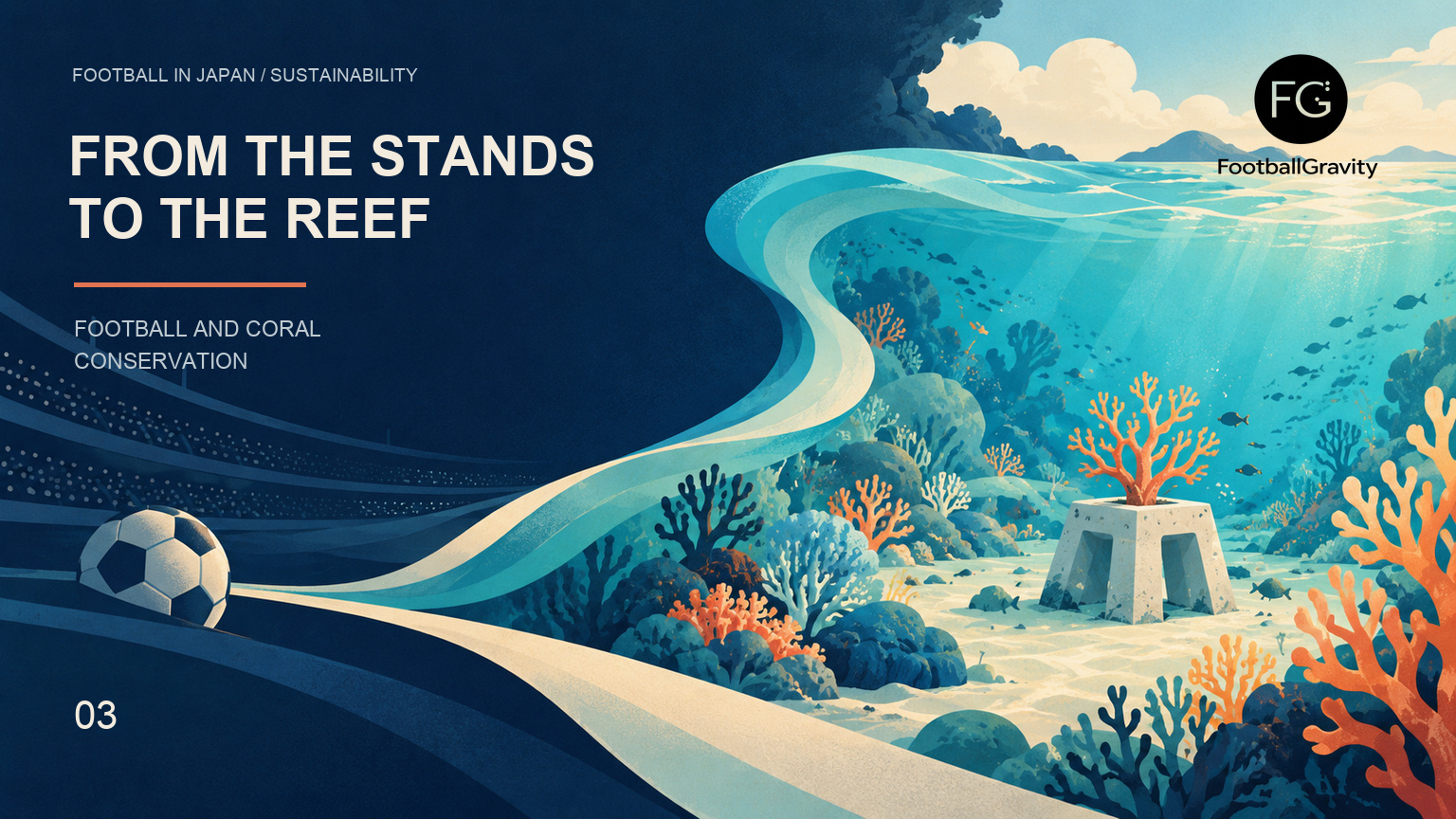
At a Kawasaki Frontale home game, a small coral planting base becomes a canvas. Supporters add colour, a shirt number or a message, knowing that the finished piece will later travel to Onna Village on the west coast of Okinawa. There, local specialists attach a nursery-grown coral fragment and place it in the sea.
It is a simple journey from a matchday workshop to a living reef. It also offers a thoughtful answer to a question that matters far beyond Japan: how can a football club help people care about an ecosystem they may never have seen?
Frontale enters a story that began long before the club arrived. The ecological knowledge and the long-term work belong to people in Onna who have been raising, transplanting and monitoring coral for years. The club brings a new group of participants, a public stage and a relationship that keeps Okinawa present in Kawasaki long after pre-season camp has ended.
A camp relationship that travelled north
Kawasaki Frontale has held training camps in Onna since 2021. The village is one of Okinawa’s best-known resort areas, but the relationship has gradually grown beyond the practical needs of preparing a football team.
In August 2023, an Onna-themed event at Frontale’s home stadium included a coral-base painting workshop. The club explained that staff from Okinawa Diving Service Lagoon would later attach coral seedlings to the decorated bases and transplant them into the sea. The workshop returned in 2024, 2025 and 2026. Its advertised capacity grew from 100 participants in 2024 to 125 in each of the following two editions.
The wider event brought more of Onna to Kawasaki: tourism information, local products and environmental learning. In 2025, the club and village formalised their connection through a friendship agreement. The plans attached to it include sports tourism, educational programmes, improvements around the village’s sports facilities and activities that raise awareness of nature conservation and climate change.
This continuity matters. A one-day workshop can introduce an idea; a repeated event and an institutional relationship give people a reason to meet it again.
Joining conservation work already under way
Onna did not begin caring for coral when a J.League club arrived. The village declared itself a “Coral Village” in 2018 and has built environmental stewardship into its approach to tourism and local development. The Onna Village Fisheries Cooperative and its partners had already developed methods for raising coral fragments from locally sourced parent colonies, transplanting them and checking what happened afterwards.
A peer-reviewed study published in 2020 followed five Acropora species transplanted off Onna in 2013 and 2014. The researchers photographed individual colonies at roughly six-month intervals, recording differences in growth among species and sites. Some colonies matured and spawned within about two and a half years. Those corals were part of the village’s earlier restoration work, not Frontale’s workshops, but the study shows the local knowledge and monitoring culture into which the football project fits.
The arrangement respects that division of roles. Onna provides the coral expertise; Frontale opens the work to a new audience.
What football can bring
Coral bleaching can feel distant to someone living in a city near Tokyo. A matchday activity gives it a human scale. A supporter makes something by hand; a local specialist completes the technical work; the object enters the sea in a place connected to the club. The path is easy to understand, and it turns an environmental issue into a relationship between people and places.
That does not make the environmental challenge small. Unusually warm water caused severe bleaching around Okinawa in 2024, including heavy losses at monitored sites in Manza Bay. Coral planting cannot remove the heat stress affecting reefs. It can, however, form part of local conservation practice while helping more people understand what is at stake.
Football is useful here because it already has attention and shared rituals. The same supporter who comes for a league match can encounter an Okinawan community, learn why healthy reefs matter to local life and tourism, and take part in a small act of care. The club makes that encounter possible without asking every participant to become a marine biologist.
A small place to begin
The workshop is best understood as one part of a wider effort. Its painted bases join the village’s established conservation process, while the matchday setting allows that work to reach people far from Okinawa. The club’s contribution begins with participation and attention; both gain value when the relationship continues year after year.
Its value is easier to see in the connection it creates. The workshop carries Onna’s conservation work into a J.League matchday. The club’s annual camp becomes part of a longer relationship with the place that hosts it. Tourism promotion sits beside a reminder that the landscape drawing visitors also needs care.
A painted base is a small object. Yet it can carry a supporter’s attention from the stands in Kawasaki to the water off Okinawa. When a club uses its reach to help local expertise travel further, small is a perfectly worthwhile place to begin.
This article is part of What can football learn from Japan?, FootballGravity’s continuing series on ideas, communities and experiments in Japanese football.