
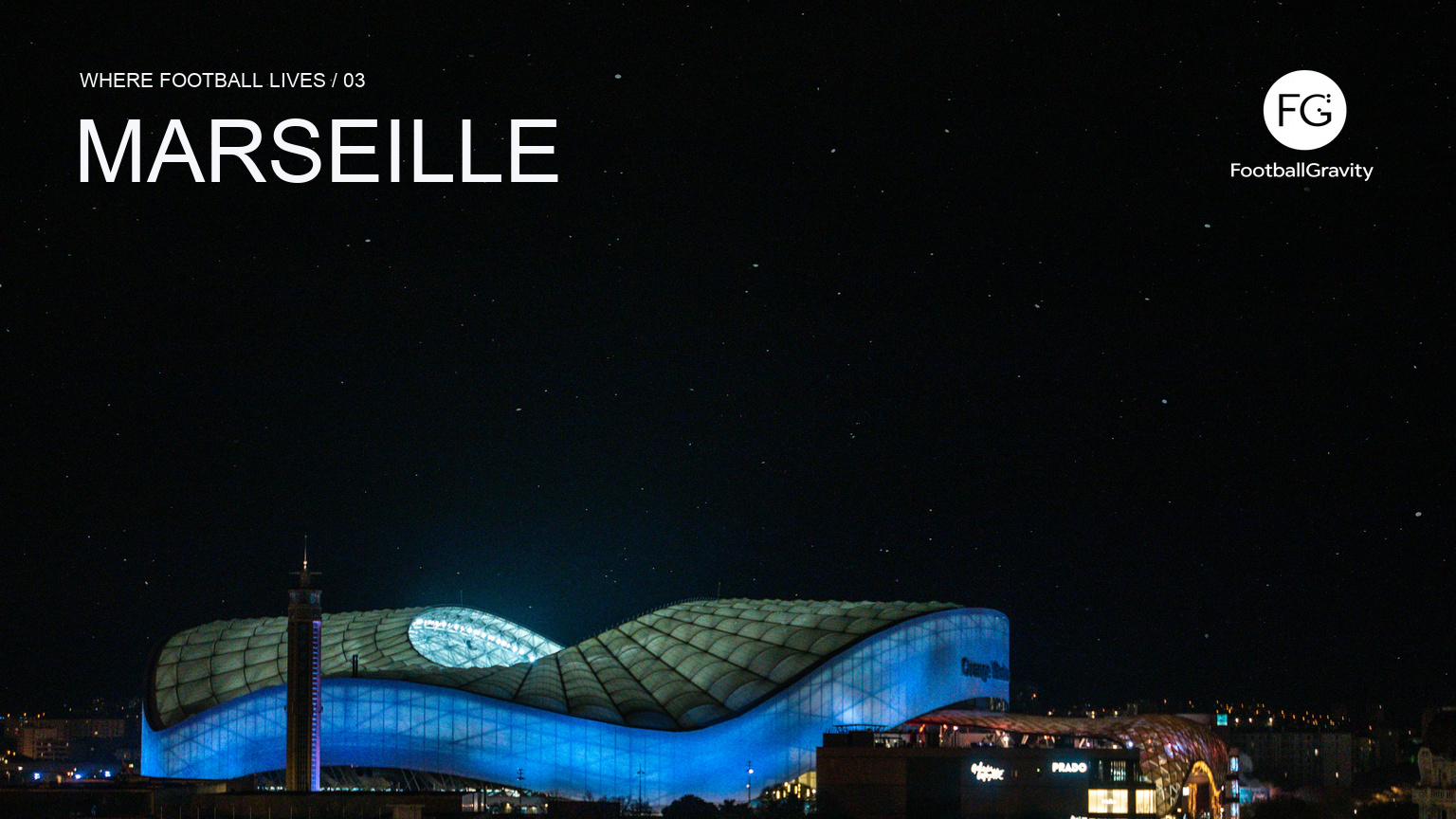
Where Football Lives / 03. In Marseille, the stadium is not a separate destination. It is one of the places where a large, restless city gathers to hear itself.
The Vélodrome stands in Marseille’s eighth arrondissement, south of the old port and west of the sea. Its roof is visible from a long way off, but it does not sit alone on an open plain. The ground shares its surroundings with housing, the Chanot exhibition complex, a sports clinic, shops and the routes that carry people across the city. The stadium is large enough to dominate a map; the city around it keeps it from feeling isolated.
Olympique de Marseille has played there since 1937. The City of Marseille describes the stadium as a symbol of Marseille culture and the setting for sporting victories, concerts, international matches and events across generations. That language can sound promotional, yet it points to something useful for a visitor: the Vélodrome is part of the city’s public calendar, not only a venue that switches on for football.
For the third instalment of Where Football Lives, Marseille is less a guide to the famous image of the port than a look at how a football club becomes an address system. Supporters organise from different parts of the city. Metro Line 2 brings people to the gates from Rond-Point du Prado and Sainte-Marguerite Dromel. Inside, the two virages turn a crowd into a visible, audible part of the game. The ground becomes the place where many separate journeys arrive at once.
A stadium built for a growing city
Marseille’s first decades of organised football did not begin at the Vélodrome. OM’s official history dates the club to 31 August 1899 and records a home at the Stade de l’Huveaune from 1902 to 1937. The Vélodrome opened in June 1937, as the club’s support and ambitions outgrew that earlier setting. The ground’s name remembers its original purpose: it was designed to include a cycling track as well as football.
The stadium has changed more than once since then. Its most recent major reconfiguration was completed ahead of Euro 2016. The city now lists 67,354 covered seats, while OM’s stadium information uses the simpler figure of 67,000. The exact marketing number matters less than the scale: a home match can bring an arena-sized audience into a residential and commercial district without moving the club away from the city it represents.
That scale creates practical demands. The city lists both Métro 2 stations as access points and describes an urban redevelopment zone of about twenty hectares around the stadium. The development includes housing, offices, hotels, a shopping centre and other facilities. A football ground can be a district’s busiest building without being its only reason to exist. That is one reason the Vélodrome reads differently from a stadium built beyond a motorway interchange: it is threaded into uses that continue through the week.
The city arrives from many directions
It is easy to speak of “the Marseille supporter” as if a city of more than a million people could have one voice. OM’s own supporter directory offers a more useful picture. Its listed groups have addresses in the first, third, fourth, seventh, ninth and tenth arrondissements, as well as beyond Marseille itself. The addresses do not measure devotion, but they show how the club’s organised life is distributed through the city rather than contained by the stadium neighbourhood.
The club describes the Virage Nord as the stadium’s beating heart and the Virage Sud as a place of tifos and constant energy. These are the club’s words, and they should not be mistaken for an ethnographic account of every matchday. Still, they identify the architecture of attention. At the Vélodrome, the crowd is not merely behind the play. The two ends of the ground have their own histories, associations and responsibilities for the atmosphere.
For an arriving supporter, this changes what it means to watch. The point is not to seek a dramatic scene on demand or to imitate local rituals from a distance. It is to notice that the songs, flags and pre-match movement have organisations behind them. The noise belongs to people who have arranged transport, meetings, displays and away travel over many seasons. A visitor can respect that work by treating the stadium as a shared home rather than a backdrop.
From the port to the pitch
Marseille can make a football day feel geographically larger than the distance between a hotel and a stadium. The Vieux-Port offers the city’s familiar opening: boats, quays and the movement between water and old streets. From there, a trip south on the metro gradually changes the frame. The match is not played beside the port, and that separation is part of the point. A club associated so strongly with the whole city asks people to cross it.
There is no need to turn this into a rigid itinerary. Marseille Tourism’s stadium page presents the Vélodrome as a place whose history includes cycling, athletics, boxing and concerts alongside football. A day can leave space for the city before the gates open: a walk around the port, time in a neighbourhood café, a meal with the pace to talk rather than rush. The stadium gives the afternoon a fixed destination; Marseille supplies the long approach.
That approach is worth protecting from cliché. Marseille is more than a postcard of the Mediterranean, and OM is more than a ready-made soundtrack of intensity. The city has different districts, languages, histories and pressures. Football can create a strong shared identification without erasing those differences. The most interesting matchday experience leaves room for both: the common pull of the club and the sense that everyone has arrived with their own route behind them.
A ground used beyond football
The Vélodrome also makes a useful case study in the demands placed on modern stadia. The City of Marseille says rainwater is recycled for non-drinking uses, including the pitch, sanitation and cleaning, and that heating and cooling demand has been reduced through energy recovered from the nearby wastewater-treatment plant. These details do not make a stadium environmentally simple. They do show that its relationship with the city includes systems of water, energy, transport and maintenance that continue when no football is being played.
OM’s community platform, Treizième Homme, says the club renewed its ISO 20121 certification for responsible-event management in 2024 and completed a second carbon assessment at the end of 2025. The assessment includes matchdays at the Vélodrome as well as the club’s other sites. Such claims are the club’s own reporting, not an independent verdict on its impact. They are nevertheless a reminder that a football city is sustained by workers, infrastructure and decisions that rarely appear in the highlights.
The right distance
Como’s stadium sat beside the lake. Valencia’s old Mestalla stood in the dense fabric of a city preparing for a move. Marseille gives this series a third relationship between football and place: a vast stadium that collects a city’s many neighbourhoods while remaining tied to one of them.
The best way to visit is with the right distance. Check the club’s ticket, stadium-entry and transport information close to the fixture date. Follow the instructions of stewards and supporter groups. Make room for Marseille before and after the game, but avoid treating anyone else’s attachment as an attraction staged for outsiders. The Vélodrome can be memorable precisely because it asks a visitor to enter an ongoing relationship between a club and a city, rather than a performance made for one evening.
At the final whistle, the journeys reverse. The metro fills, groups re-form, and the stadium slowly gives people back to their separate parts of Marseille. The club remains a shared reference point. Where football lives here is not only in the roar beneath the roof. It is in the routes that lead there, and in the many districts that send people home.
This article was prepared from published sources with AI assistance; it is not a report from an on-site visit. Ticketing, entry rules, transport conditions and stadium naming should be checked close to the fixture date.