
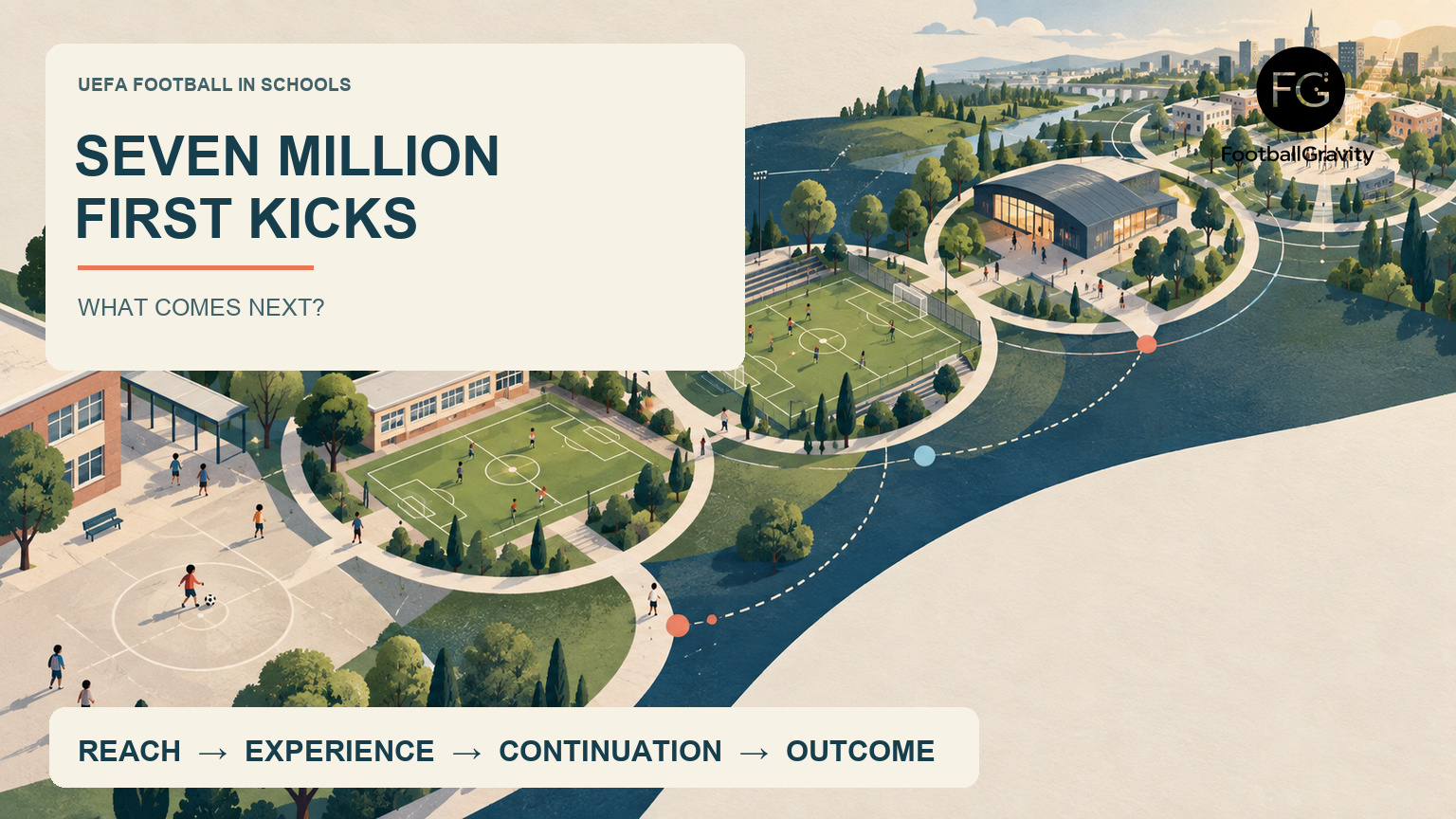
For many children, football does not begin in a stadium, an academy or even a club. It begins at school: a ball in a playground, a teacher with a simple game and a chance to join without already belonging to the sport.
UEFA has tried to make that first experience available at continental scale. Its Football in Schools programme reported 7.2 million children introduced to the game during its first cycle from 2020 to September 2024. It involved 41,500 schools, trained 111,000 teachers and reached more than three million girls. UEFA also recorded 15,500 volunteers, 4,400 festivals and events, and 830 new links between schools and clubs across all 55 member associations.
Those figures describe an unusual achievement in reach. By the end of 2025, UEFA’s running total had risen to 7.6 million children. The organisation has committed a further €11 million for 2024–28, taking its own investment across the programme’s first eight years to €22 million.
The next opportunity is to follow the journey beyond the first session. How often does an introduction become a habit? Does a school programme lead to more movement across the whole day, a welcoming route into a club or a stronger sense of belonging? These are not objections to counting participation. They are the questions that become possible because UEFA and its associations have built something large enough to follow.
Schools make the first step more open
A club is not an equally easy starting point for every family. Membership fees, travel, equipment, confidence and knowledge of the local system can all affect access. A school is different. Children are already there, the setting is familiar and an activity can reach those who would not have sought out football on their own.
That is why Football in Schools is best understood as more than a talent pathway. UEFA describes its aim as providing a safe and positive experience regardless of ability, gender, ethnicity or religion. The programme also promotes physical activity and values including cooperation, respect, fair play and leadership. Its national forms are delivered through partnerships among football associations, schools, education authorities, teachers and local clubs.
At this scale, football begins to resemble social infrastructure: not because every session produces a measurable social benefit, but because the game supplies people, places and relationships through which regular activity can happen. The important unit is not only the child reached on one day. It is also the teacher who can run another session, the school that keeps equipment available and the local organisation ready to welcome a child who wants to continue.
Different countries are building different bridges
The variety inside the European programme is one of its strengths. A UEFA review published during Grassroots Week 2026 shows national associations working on several stages of the journey rather than repeating one model.
In Sweden, Skolbollen serves children from preschool to Year 9. Participating schools receive equipment, training and a guide containing more than 100 adaptable games. More than 2,100 schools take part, and nearly a third have established a partnership with a local club. This combines broad access with a possible next step into organised football.
Lithuania’s Futboliukas offers an eight-month programme for children aged three to seven. Around 30,000 children participate each year through more than 400 institutions. Monthly plans and digital resources allow teachers without a football background to lead activities, while club links give interested children somewhere to go afterwards. The design values repetition: football returns through the school year rather than arriving as a single festival.
Switzerland’s Doppelpass starts explicitly with the connection between school and club. Its latest iteration recorded 28 new links; half included after-school sport and ten were designed specifically for girls. The number is modest beside the Europe-wide reach figure, yet it describes a different kind of output: an institutional relationship that may support continued participation.
None of these measures answers every question. A partnership on paper does not tell us how many children use it, how welcome they feel or how long they remain involved. It does, however, bring the programme closer to the next stage of measurement.
Malta shows what an outcome study can add
The clearest example so far comes from Malta. The Malta Football Association’s Fun Fit 5 programme used Football in Schools support for daily 45-minute physical-activity sessions in primary schools. MCAST researchers followed Year 4 pupils during the 2022–23 school year, comparing three treatment classes with three control classes across three state primary schools.
The research report found that children in the treatment group took an average of 5,836 steps during school hours, compared with 4,239 in the control group. The difference — 1,597 steps, or about 38% — was statistically significant (p = .049).
The result needs its full context. The study did not find a statistically significant increase in total daily steps: the treatment group’s daily total was lower by an estimated 1,788 steps, but the difference could not be distinguished from chance (p = .34). Nor did the intervention produce a significant difference in the change in academic performance between groups (p = .70). The careful conclusion is therefore useful and limited: the daily programme increased movement during school hours, while the study found no significant academic disadvantage; it did not demonstrate an increase in movement across the whole day.
The researchers also state the boundaries of their work. Classes could not be randomly assembled, the pedometer sample was small and the one-year study could not establish long-term effects. That candour is part of the value. A serious outcome study can reveal a positive result, a neutral result and an uncertainty at the same time.
From reach to social outcome
A practical measurement chain for Football in Schools could have four stages.
- Reach: who was offered the programme, where, how often and at what cost?
- Experience: did children feel safe, included and eager to return?
- Continuation: did they keep playing at school, join a club or choose another form of regular physical activity?
- Social outcome: did activity levels, wellbeing, confidence, friendship or access improve, and for whom?
The sequence matters. It prevents a participation count from being asked to prove more than it can. It also avoids treating club registration as the only successful destination. A child may become more active without joining a team. Another may enjoy football for a term, build confidence and move towards a different sport. For a programme that presents itself as inclusive and educational, those routes deserve to be visible too.
Europe-wide reporting could begin with a small shared set of measures: repeat participation, frequency and duration of sessions, girls’ participation, school-to-club transitions, accessibility by place and socioeconomic background, and follow-up after six or twelve months. National associations would still need room to measure what matters in their own settings. Sweden’s school network, Lithuania’s eight-month rhythm and Switzerland’s club links should not be flattened into a single league table.
The value of returning later
UEFA’s reach is already meaningful. Millions of children have been offered an experience that the club system alone might not have provided, and teachers across Europe have gained tools to make football part of the school day. The national examples show that the programme can become locally rooted rather than remain a sequence of central events.
It is too early to describe Europe-wide continuation or long-term social effects. That makes this a starting point rather than a verdict. As the second funding cycle develops, the most revealing number may be the one that connects today’s first kick with what a child is still doing a year later.
Football in Schools has established reach. Malta has shown that outcome research is possible, including results that resist a simple success story. Sweden, Lithuania and Switzerland are building bridges from a school session towards regular participation. Taken together, they suggest the next chapter: protect the joy and openness of the first experience, then learn carefully what it allows children and communities to sustain.
Method note: UEFA figures in this article are reported programme totals and are attributed to UEFA; FootballGravity has not independently audited participant counting across 55 associations. The Fun Fit 5 findings come from MCAST’s mixed-method, quasi-experimental report and are not generalised here to all countries or age groups. “Football as social infrastructure” is FootballGravity’s analytical frame, not an official UEFA designation or a claim that long-term effects have already been established.