Where Football Lives #02 — Valencia: Before the Move

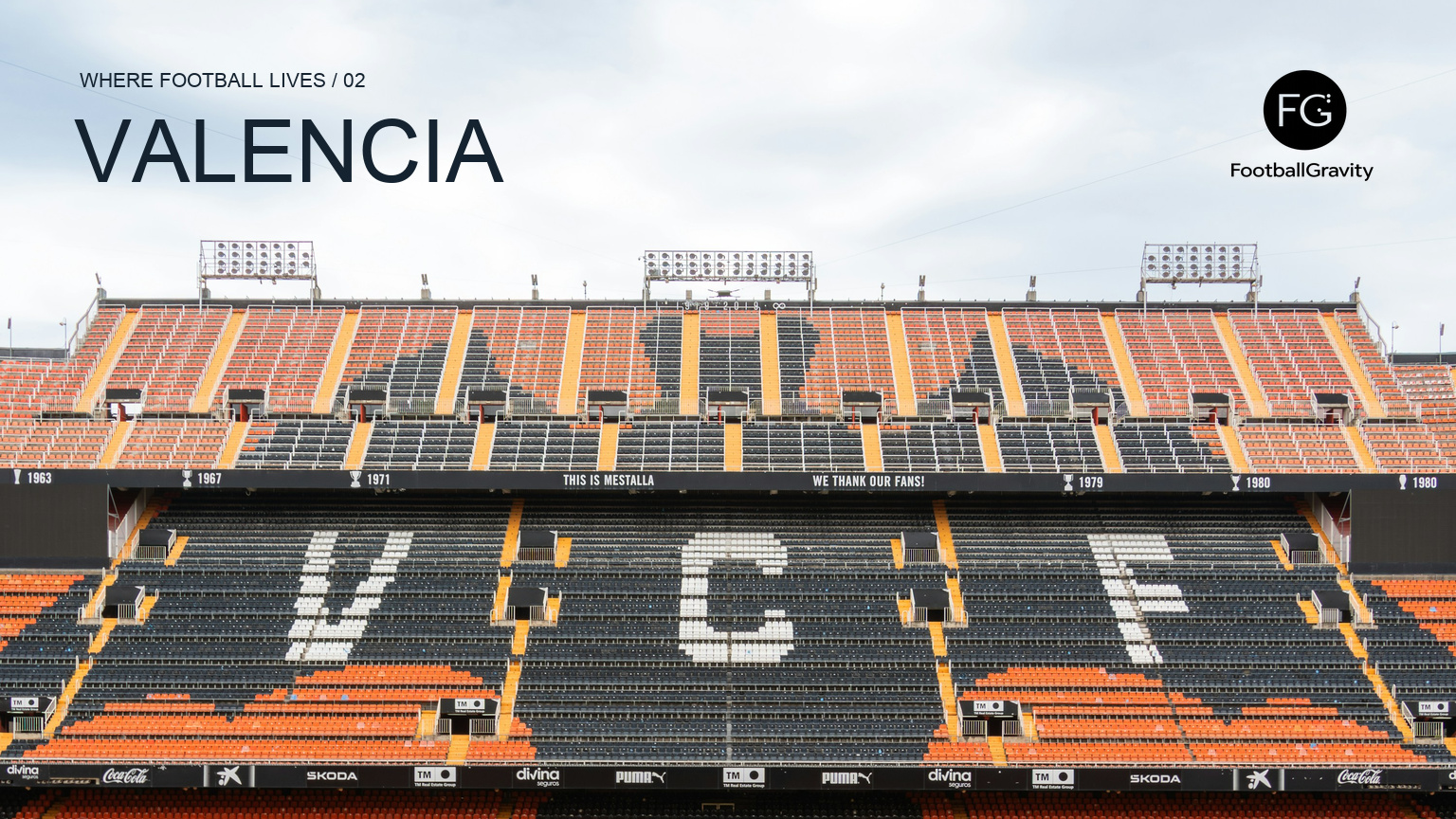
An empty Mestalla stand spelling VCF, with Valencia series typography and the FootballGravity logo.

Where Football Lives / 02. In Valencia, the walk to a football ground is also a way of reading the city’s next chapter.

Mestalla has the proportions of a stadium that has spent a century learning the streets around it. Its steep stands rise among apartment blocks and cafés, north-east of Valencia’s old centre. On a matchday, the approach is not a ceremonial march through a sports district. It is a change in the rhythm of an ordinary neighbourhood: the sound from bars carries a little further, orange and white scarves appear at corners, and the ground arrives without much warning.

For Japanese readers, Ryunosuke Sato’s arrival has supplied a fresh reason to look towards Valencia. The club announced his transfer from FC Tokyo on 7 July 2026, on a five-season contract, and described him as the first Japanese player registered with its men’s first team. The announcement placed a young Japanese player inside one of Spanish football’s older civic institutions.

That is a useful entrance to the city, but it is not the whole story. Valencia CF is approaching a move that will alter how supporters reach their football and how the club sits within Valencia. The future Nou Mestalla is taking shape across town, with the club’s 2024/25 sustainability report listing an expected opening in the 2027/28 season. Until then, the old ground remains the place where the relationship between club and city can be felt at close range.

A name from the water

Mestalla was inaugurated on 20 May 1923, for a friendly against Levante. Valencia’s own history says the ground took its name from an irrigation canal that once ran beside it. That detail makes the stadium feel less like an object set down in the city than part of an older working landscape: water, farmland and the routes that connected them.

The club’s history traces football in Valencia to people involved in the citrus trade who had travelled to Britain, and to British sailors playing in the port. Valencia Football Club was founded in 1919. Its first home, Algirós, soon became too small, so the club bought the Mestalla site in January 1923. The new ground opened with room for 17,000 people; today the club lists its capacity as 49,419.

Numbers explain growth, but not the particular pressure of the old stadium. Mestalla has hosted more La Liga matches than any other ground, according to the club, and marked its 103rd anniversary in May 2026. It survived Civil War damage, hosted Spain at the 1982 World Cup and held major European nights for Valencia. The archive is present in the building’s shape. Spectators are close to the pitch, and the sightlines make every collective reaction seem to arrive early.

The city beyond the turnstiles

Valencia is easier to understand by following the Turia than by treating its landmarks as separate stops. After the devastating flood of 1957, the river was diverted south of the city. The old riverbed became the Turia Gardens, a long public park that now runs through Valencia. Visit València describes more than nine kilometres of paths, sports spaces, bridges and gardens linking the city from west to east.

The stadium lies a short distance from this green corridor. A visitor can begin in the old centre, cross the former riverbed near Puente de las Flores or the Aragón area, then move towards Mestalla through streets that remain residential and busy. It is a route with no need for a football-only itinerary. The city is already doing the work: cafés, bakeries, university buildings, apartment balconies and the park create the texture around the match.

That everyday density matters in a place known internationally for bigger images: the City of Arts and Sciences, the beach, paella and the Fallas. During Fallas, Valencia’s neighbourhood commissions fill streets and squares with temporary sculptures, music, fireworks and the scent of gunpowder. The festival is not a matchday accessory, but it shows a city used to bringing public space, local affiliation and noise together. Mestalla belongs to the same civic habit of gathering.

Before the move

The move to Nou Mestalla has been discussed for so long that it is tempting to write as if the old ground has already become a museum piece. It has not. The club says construction resumed in January 2025, and its current reporting describes work on the roof structure, façade and interior areas. Its published plan gives the new stadium a capacity of 70,044 and places it on Avenida de las Cortes Valencianas. Those are the club’s plans and targets, not yet a completed matchday reality.

A new stadium will offer space, accessibility and commercial possibilities that a century-old city ground struggles to provide. The club has also described a public square and municipal sports facilities within the development. The questions worth following are more intimate. Which pre-match routes will survive? Where will people meet when a familiar walk no longer ends at the same gates? What does a supporter lose, and gain, when a stadium leaves a neighbourhood that has grown around it?

These questions do not require nostalgia to be serious. Valencia is a city that has repeatedly altered its physical shape, including the redirection of the Turia itself. Change can create valued public space. A stadium move can do the same, but it asks a football culture to carry its habits across the city and make them live in a different setting.

A new connection

Sato’s arrival belongs to this moment without defining it. A first Japanese player in Valencia’s men’s first team makes the club newly legible to supporters in Japan. It may bring more readers, viewers and visitors to a stadium whose name they have known through old highlights, Champions League memories or Spanish football broadcasts. The value of the connection is not only that it points outward. It can also encourage people to look closely at the place that has received him.

For someone visiting Valencia for a match, that begins with allowing enough time for the city to remain visible. Walk through the Turia Gardens. Eat before the game somewhere that belongs to the neighbourhood rather than a generic stadium concourse. Check the club’s ticket and travel information close to the date, especially as fixtures and access arrangements can change. Then arrive early enough to notice what is still there: the slope of the stands, the narrowness of the streets, and the way football enters the evening without ever separating itself from the city.

Como showed the pleasures of a stadium beside a lake. Valencia offers a different kind of proximity. At Mestalla, football is set within the daily density of a Mediterranean city and a century of accumulated expectation. The next ground is rising elsewhere. For now, the old one still tells the clearest version of where Valencia’s football lives.

This draft was prepared from published sources with AI assistance; it is not a report from an on-site visit. Stadium construction, access arrangements and fixtures should be checked again before publication.
Where Football Lives #01 — Como: Football at the Edge of the Lake

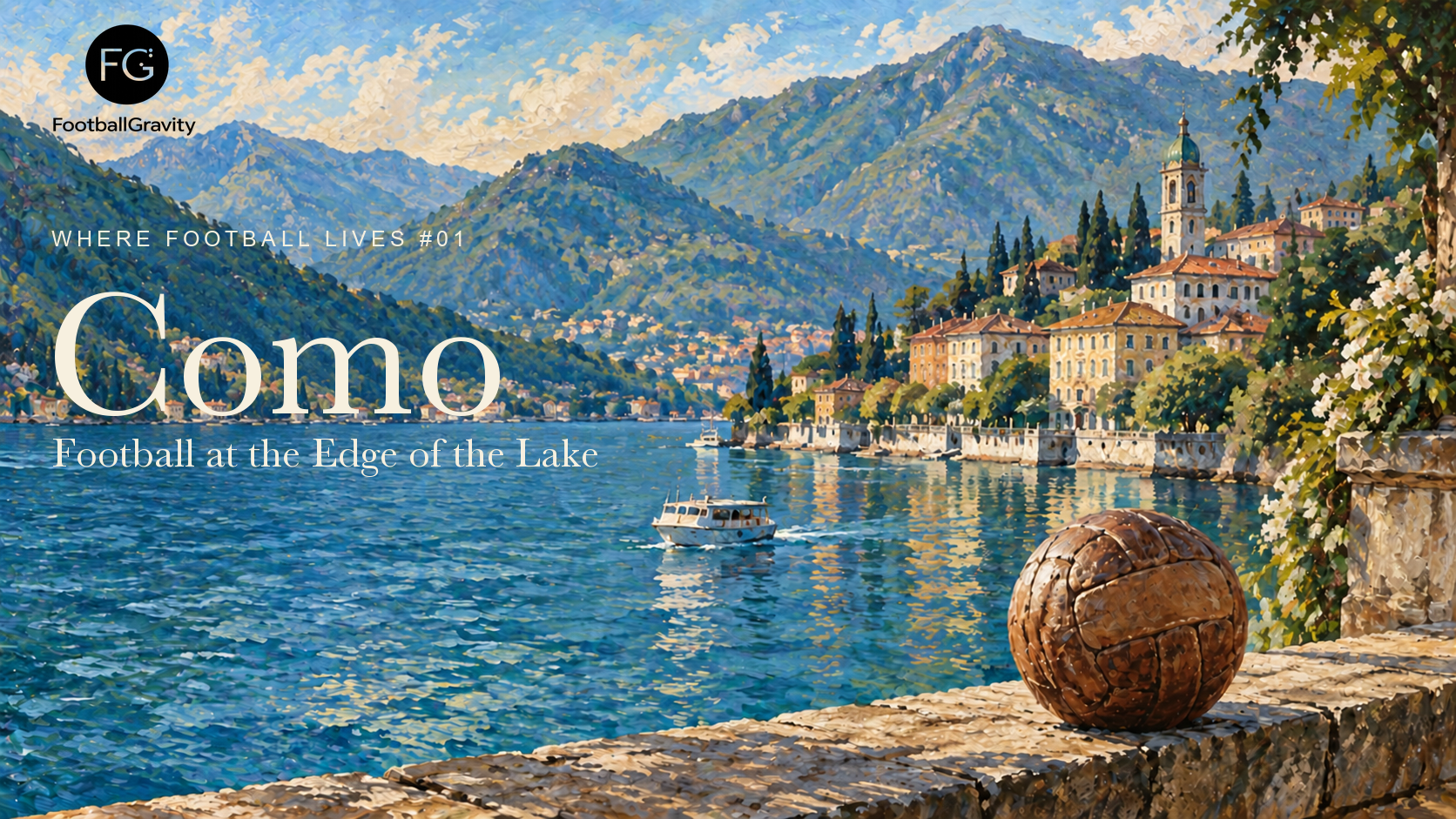
Oil-painting-style illustration of Lake Como, mountains, a lakeside town and a vintage football, with the FootballGravity logo and Where Football Lives #01 — Como: Football at the Edge of the Lake typography.

Where Football Lives / 01. Lake Como has long drawn visitors. Beside the water, a football club is giving them another reason to come.

At the western edge of Como’s centre, Stadio Giuseppe Sinigaglia fits between the city and the lake. Across the water, houses climb the hills. The stands, floodlights and strip of green belong to the same view as the boats. Football occupies a piece of the waterfront that a visitor might otherwise associate with a promenade or a hotel.

The location has always been remarkable. What has changed is the scale of the football being played there. On 10 September 2026, Como beat Leipzig 4–1 on their Champions League debut, with Cesc Fàbregas’s side making an emphatic entrance. UEFA’s match report records a result that would have been difficult to imagine when the club was working its way through Italy’s lower divisions.

Como qualified by finishing fourth in Serie A in 2025/26. They had returned to the top division only in 2024, ending an absence that stretched back to 2003. This is their first season in European competition. For a city already familiar to travellers around the world, that creates a different kind of arrival: people coming for the football, then finding the place around it.

A ground inside the city

The lake runs through the club’s own account of its beginnings. Its official history describes a match on the shore in 1906 between members of the local rowing club and people travelling with Buffalo Bill’s circus. Como Football Club was founded the following year. Even allowing for the distance between a club’s origin story and the present, the setting is strikingly familiar.

Sinigaglia’s position gives the stadium a place in an ordinary walk through Como. From the historic centre, the waterfront leads towards the ground; the journey stays within the city’s most recognisable landscape. The approach matters. It lets a visitor understand the club’s surroundings at walking speed, with time to register how little space separates the football from the water.

That intimacy also complicates expansion. In February 2025, Como, the municipality and architecture practice Populous presented initial redevelopment concepts. The announcement envisaged phased construction from 2027 and an ambition to make the site accessible beyond matchdays. Those were proposals and an anticipated timetable, rather than a completed design or a guarantee of delivery.

The planning problem is easy to grasp from the location. A larger ground would have to accommodate more people while remaining part of a waterfront used by residents and visitors throughout the week. Capacity can be counted. The effect on a familiar route through town is harder to measure, yet it will help determine whether the redevelopment feels like an improvement to Como itself.

A destination with a football club

The club’s recent climb began far from this level. Como restarted in Serie D in 2017/18, and SENT Entertainment acquired the club in April 2019. Promotions brought them to Serie C, then Serie B and, in 2024, Serie A. The club’s history of that recovery emphasises investment in the organisation and its facilities alongside results on the pitch.

Rapid success changes who encounters a club. A television audience discovers the ground. New supporters look for tickets. A visit that once required a particular attachment to the team begins to appeal to people planning a holiday. In Como, these changes take place in a city whose name already carries considerable value abroad.

The club has made that connection explicit. Its matchday experiences combine football with lakeside hospitality, stadium access and, in some packages, a boat trip. The lake becomes part of what the club can sell. A match ticket can sit within a day whose other pleasures are already familiar to the international visitor.

There is a persuasive commercial logic here. Football supplies a date and a reason to travel; the destination gives a companion who cares less about the result reasons to come along. It can also encourage a supporter to stay longer. The risk is that a club becomes easiest to describe through its most expensive experiences, leaving the everyday habits of its followers in the background.

The walk from Jean Caffè

A small kiosk near the Duomo and Teatro Sociale offers another starting point. In a profile published by Como 1907, Jean Caffè co-owner Mattia Cairoli describes supporters meeting there for drinks before heading to the stadium together, then returning after the game. His own attachment began with visits to the old Curva Ovest alongside his father and grandfather in the 1990s.

That account puts the match into the shape of a day: a meeting place, a shared walk, somewhere to return to afterwards. The football extends beyond the time spent inside the ground. A ticket admits a visitor to the ground; learning where the match sits in other people’s lives takes more attention.

Como-born Alessio Iovine provides a longer view. Asked by the club about his favourite match as a supporter, he recalled a lower-league playoff victory at Alessandria that took Como up from the old Serie C2. He had been in the away end, celebrating with the players. In the same interview, he described the pride he felt in Como’s growing visibility and its relationship with the community.

His memories make room for both experiences: the supporters who travelled in the lower divisions and the pleasure of seeing the club recognised abroad. They are a useful corrective to the assumption that local attachment and international interest must always pull apart. The practical question is how much room the growing club continues to leave for people whose commitment predates its appeal as a destination.

Time around the match

For someone arriving from outside, Como’s compact centre offers a way to spend that time without an elaborate itinerary. The old streets lead to Piazza Cavour and the waterfront. Above the city is Brunate, connected by a funicular that opened in 1894. A visit up the hill gives the lake and the city a different scale; the walk towards Sinigaglia brings them close again.

Food carries the geography indoors. The club’s guide to local cooking points to risotto with perch and missoltini with polenta. Lake fish and the ingredients of the surrounding region offer a way into Como that extends beyond its luxury image. There is enough here to let lunch become part of the visit, rather than an interval to be filled before kick-off.

Milan makes the city accessible within a wider journey through northern Italy. Trenord advertises a direct Como San Giovanni–Milan service of around 68 minutes; that is a guide for the listed route, not a journey time for every Milan station or train. Match tickets, kick-off times and the return service deserve checking together before a visit is booked, especially for an evening game.

A day might begin in the old centre, leave time for the water and finish at the stadium. The appeal lies partly in how little needs to be added. The football gives the day a fixed point while the hours around it remain available to the city.

Who gets to belong?

As Como’s audience grows, access will be an important measure of the project. The availability of ordinary tickets, the place of established supporters and the use of the redeveloped waterfront will say more about its relationship with the city than the attractiveness of a hospitality brochure. These are questions to follow, rather than evidence that a particular outcome has already occurred.

There is also an opportunity for visitors to encounter a Como they would otherwise miss. Someone drawn by the lake can discover the club’s lower-league past. A supporter arriving because of Fàbregas can learn about the city through its food or the walk to the ground. The exchange works best when the place is given enough time to become more than the view behind a photograph.

For the first instalment of Where Football Lives, Como offers an unusually direct introduction. The ground is there beside the water, close enough to become part of the same afternoon. After the final whistle, the walk back towards the centre remains part of the matchday.

Featured image: Lake Como-inspired editorial illustration, created with AI assistance by FootballGravity, with the official FootballGravity logo. It is not a documentary photograph or an exact representation of the stadium. This article was prepared from published sources with AI assistance; it is not a report from an on-site visit.

The World Cup 2026 Was Worth Celebrating

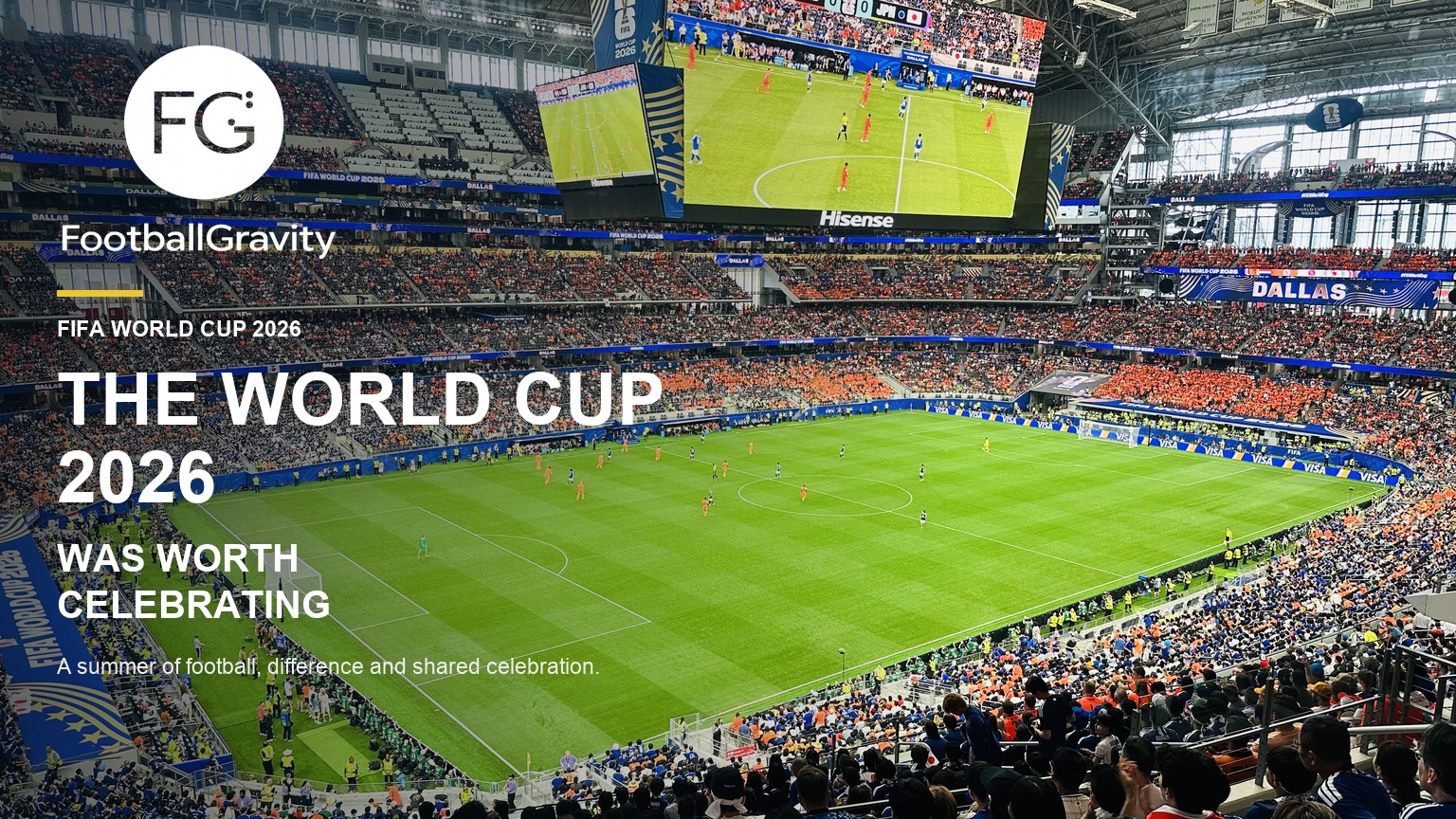
A packed Dallas stadium during a FIFA World Cup 2026 match between the Netherlands and Japan, viewed from the stands.

For all the arguments that followed it, the 2026 World Cup left a simpler memory for those who were there: an enormous, varied and unusually generous sporting celebration.

Now that the noise around the 2026 World Cup has settled a little, it is tempting to remember the tournament through its disputes. There were valid questions about prices, travel, heat, the expanded format and the way football is packaged for television. A World Cup that spread 104 matches across three countries and 16 host cities was always going to ask a lot of players and supporters.

But a tournament should also be judged by the experience it gave to the people who entered it. In stadiums, on streets and in the long stretches between one city and the next, this one often felt magnificent. It made room for many different versions of football culture at once. It gave supporters a reason to travel a long way, spend real money and give up precious time—not because there was nothing else to do, but because being there offered something that a highlights clip cannot.

The World Cup is often called the world’s greatest festival. From a distance, that can sound like a slogan. On the ground, it is a useful description.

A continent-sized stage

FIFA’s first 48-team men’s World Cup was also its largest: 104 matches, staged across Canada, Mexico and the United States. The distances were real. So was the summer heat. Neither should be romanticised away.

Yet North America’s scale was not only a logistical problem. It was part of the tournament’s character. The United States in particular contains cities that feel markedly different from one another: their stadiums, climate, transport habits, music, food and local sporting rituals all change as you move across the map. The World Cup did not ask those places to become identical. It let the tournament pass through them.

That mattered because this was not a small, self-contained event. It was an arrival point for people from everywhere. To receive that many visiting supporters safely, keep them moving, fill large venues and still make the day feel festive is a serious achievement of planning and civic infrastructure. The host cities had the physical capacity, but just as importantly they had a familiar instinct for treating a sporting occasion as a shared public event.

At the matches I attended, that instinct was visible before the opening whistle. Music was chosen to speak to the teams and the crowd. Big screens and in-stadium hosts built anticipation without asking supporters to sit silently until the football began. In some venues, local cheer squads brought the grammar of American game day into a World Cup setting. It did not replace football culture. It added another layer to it.

A mass singalong can look frivolous on a broadcast, but it changes a stadium from a collection of ticket holders into a temporary community. A song such as Bon Jovi’s Livin’ on a Prayer, sung by tens of thousands of people who arrived wearing different flags, has a very simple appeal. The same was true when Queen or Oasis filled the pauses around a match. For a few minutes, the competition did not disappear; it became easier to share.

More colours in the stands

The expansion from 32 to 48 teams brought familiar objections. More places can produce uneven group matches. The value of a single goal can feel different in a larger competition, and the draw carries more weight when the path is longer and more complicated. Those are reasonable football questions.

They are not the whole story. More teams also meant more songs, clothes, languages, rituals and football memories in the same places. Mexico’s support did not need an introduction, but the energy around Mexican matches and fan spaces still gave the tournament a pulse that no broadcast graphic could measure. Norway’s supporters, with their synchronized Viking Row, offered another kind of theatre: playful, specific and instantly recognisable. FIFA itself highlighted the tradition alongside French supporters’ clapping as an example of the fan cultures meeting during the tournament.

What stayed with me was not a sentimental idea that every supporter was the same. The pleasure came from the opposite. People brought different ways of showing affection for a team, and those differences made everyone else more aware of their own colours. A supporter can see another country’s style, admire it, laugh with it and then sing a little more loudly for home. Difference did not weaken identity. It gave identity an audience.

Club football has its own cosmopolitan beauty, but the globalised transfer market has made many squads resemble one another. National teams remain imperfect representatives of a country, of course. Still, the World Cup lets a wider range of local accents appear in public: not only in the players, but in the people who travel with them. The 2026 edition made that visible at a scale the tournament had not previously reached.

The pauses were part of the day

The mandatory hydration breaks became one of the tournament’s most argued-over innovations. Critics were right to notice that a three-minute pause can affect rhythm, tactics and the old expectation of two uninterrupted 45-minute halves. The heat risk was also genuine: FIFA introduced the breaks throughout the tournament as a player-welfare measure.

From a seat in the stadium, though, the pauses had another effect. They gave people time to drink water, find a restroom, settle a child, look around and return their attention to the pitch. The match did not necessarily become less intense; it acquired a different tempo. Rather than one long, unbroken demand on the audience, it had several distinct movements.

That will not persuade every traditionalist, and it need not. Football should be careful about changing its basic rhythm. But the World Cup is also a live event for a huge and varied public, many of whom are attending a match of this size for the first time. Making the stadium easier to inhabit is not automatically a betrayal of the game. In this case, it often felt like hospitality.

A difficult thing, done with ambition

It is possible to hold two thoughts at once. The 2026 World Cup was expensive, exhausting to follow across long distances and open to serious criticism in parts of its design. It was also an extraordinary piece of sports entertainment, staged with ambition and received with enthusiasm by many of the people who made the journey.

That distinction matters. The fact that a supporter has spent heavily to be there does not make the experience shallow. People with choices about where to spend their time and money still chose this tournament. They chose flights, queues, unfamiliar streets, stadium searches and the awkwardness of crossing a continent because the reward was rare: to be inside a gathering large enough to show the world to itself.

Online, the sharpest criticism usually travels fastest. It is easier to share a clip of a disputed decision or an argument about a rule than the quieter fact that strangers were enjoying a city together. In the stands and around them, I saw something different: supporters respecting other supporters, hosts taking pride in their city, and people treating a football match as a reason to be generous with one another.

That is not an argument for ignoring the tournament’s flaws. It is an argument for keeping the scale of the experience in view. The 2026 World Cup did not have to be perfect to be worth celebrating. It gave football an enormous stage, filled it with more of the world than ever before, and for a summer made the differences between us feel less like a problem than a reason to gather.

Still a Player at 59

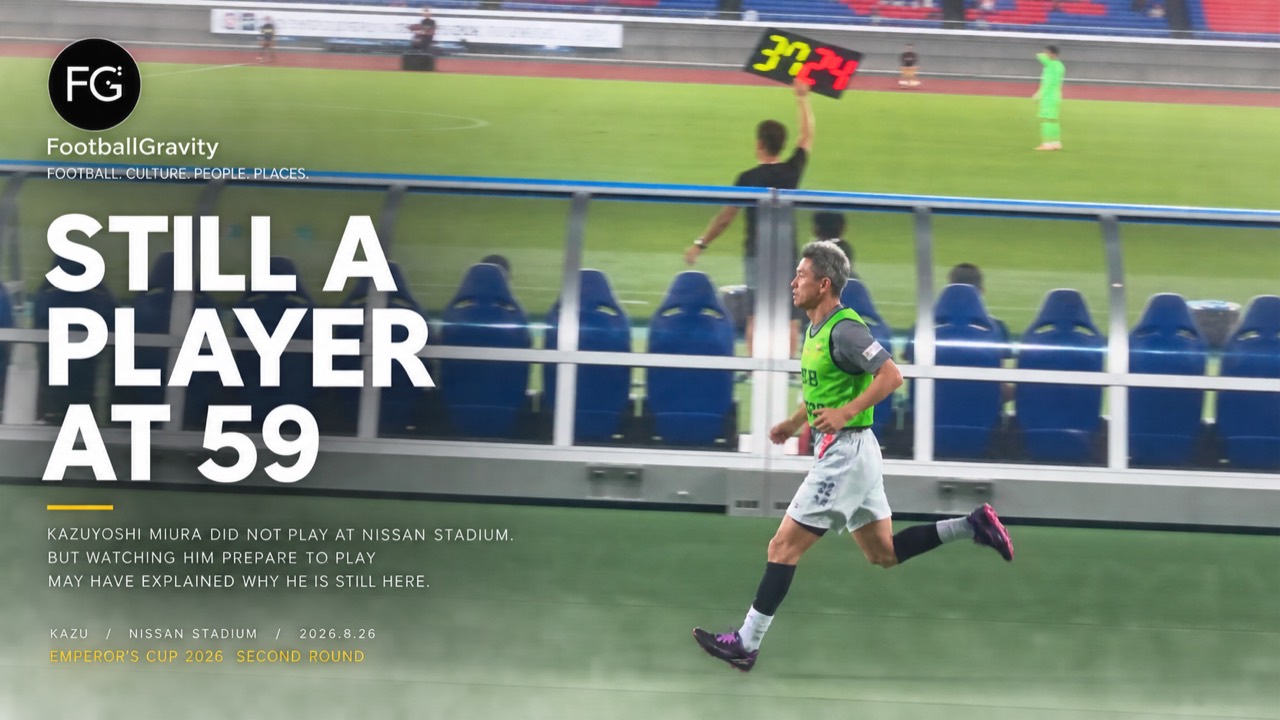
Kazuyoshi Miura warming up during Yokohama F. Marinos vs Fukushima United in the Emperor’s Cup at Nissan Stadium.

Kazuyoshi Miura did not play at Nissan Stadium. But watching him prepare to play may have explained why he is still here.

There was a strange anticipation around Nissan Stadium.

It was the second round of the Emperor’s Cup, Yokohama F. Marinos against Fukushima United. A J1 club against a J3 side. On paper, there were plenty of ordinary football reasons to watch.

But cameras kept turning towards one man on the touchline.

Kazuyoshi Miura.

Kazu.

King Kazu.

He is 59 years old.

And he was preparing to play professional football.

A Stadium Full of History

There was something fitting about the setting.

Nissan Stadium hosted the 2002 World Cup final. For Japanese football, it is one of those places where different eras seem to overlap.

Miura belongs to several of them.

Long before the J.League existed, he played in the rivalry between Yomiuri Club and Nissan Motors, the predecessors of two of the clubs that would help define the early professional game in Japan.

Then came the birth of the J.League, the national-team boom of the 1990s, Japan’s long pursuit of the World Cup, and Miura’s move to Serie A at a time when such a journey for a Japanese player still seemed almost unimaginable.

Now, more than three decades later, he was back beside the pitch at Nissan Stadium.

Across from him was another symbol of time.

Yokohama F. Marinos had 16-year-old Shin Miidera among their substitutes — a player 43 years younger than Miura. The possibility that the two might share the pitch became one of the stories surrounding the match.

It never happened.

Miidera came on in the 63rd minute. Miura remained on the bench. After the match, however, they exchanged shirts, and Miura encouraged the teenager to keep the passion he has now.

Football sometimes measures time more elegantly than a calendar.

The Player Who Never Came On

Yokohama led 1–0.

Fukushima stayed in the match.

And as the minutes passed, attention increasingly moved towards the Fukushima bench.

Would Kazu come on?

He warmed up.

Then he kept warming up.

Other substitutes gradually stopped. Miura continued.

From the stands, it was difficult not to notice.

There was nothing ceremonial about it.

He did not look like a famous former player waiting for the crowd to receive a nostalgic cameo. He looked like a substitute trying to convince his manager that he was ready.

Running.

Stretching.

Accelerating.

Again.

And again.

The photograph accompanying this article was taken from the stands that evening.

It is not a photograph of a goal.

It is not even a photograph of Miura playing football.

Perhaps that is why it says so much.

He Was Actually Trying to Get On

It would have been easy to assume that the appearance itself was the achievement.

At 59, merely being registered as a professional player is extraordinary.

But Miura’s behaviour suggested something different.

He genuinely expected that he might be needed.

That matters.

A week earlier, this was not simply nostalgia. Miura had started Fukushima’s Emperor’s Cup first-round match and scored twice from the penalty spot, extending his own record as the competition’s oldest scorer.

So when Fukushima needed a goal at Nissan Stadium, wondering whether he might appear was not entirely sentimental.

The substitution never came.

It is reasonable to wonder whether there was a way to use him. Fukushima were only one goal behind, and Miura is, after all, a forward. Supporters who had come hoping to see him play were understandably disappointed.

But perhaps the more interesting story begins precisely there.

Because Miura behaved as though disappointment changed nothing.

He kept preparing.

The Same Game

Miura’s career is often described through records.

Oldest player.

Oldest scorer.

Another year.

Another season.

Soon, perhaps, sixty.

But records may be the least interesting part of the story.

His career has repeatedly involved going somewhere where there was no obvious path.

As a teenager, he went to Brazil when becoming a professional footballer was hardly a conventional career in Japan.

He became one of the faces of the national team before Japan had ever played at a World Cup.

He went to Serie A.

Later came Croatia.

Australia.

And then the long journey through Japanese football that somehow never reached the expected final chapter.

Each move looked different.

But perhaps the underlying impulse was the same.

There was another place to go.

Another environment to enter.

Another version of himself to test.

At 59, the frontier is simply different.

There is almost no established map for what he is doing now.

How does a professional footballer train at 59?

How does he recover?

How much speed can be preserved?

How should his body be managed?

Can experience compensate for physical decline?

Can he still score?

There are few predecessors from whom to borrow the answers.

So, once again, Kazu is exploring.

Not a Legend Performing His Past

This is perhaps why arguments about whether Miura “should retire” often seem to miss the point.

If his objective were simply to protect his reputation, retirement would have been the easier option long ago.

His place in Japanese football history is already secure.

He does not need another appearance to become King Kazu.

What seems to matter is something else.

To train tomorrow.

To compete for selection.

To believe that the manager might call his number.

To enter the match.

To score.

That is a much more ordinary ambition.

And, at 59, an extraordinary one.

There is humility in that contradiction.

A man who helped transform Japanese football still accepts the most basic condition of being a footballer:

You may not be selected.

You may sit on the bench.

You may warm up for a long time.

And nobody owes you the next minute.

Former Sydney FC teammate and current Yokohama F. Marinos manager Steve Corica described Miura’s professionalism from their time together two decades ago and said that, seeing how carefully he managed his condition even then, it was understandable that he had been able to play for so long.

Perhaps longevity is built from moments exactly like this one.

Still Warming Up

The final whistle came.

Yokohama F. Marinos won 1–0.

Miura did not play.

The anticipated 43-year age-gap encounter never happened.

For anyone who came specifically to watch Kazu, there was disappointment.

But from the stands, there was also something unexpectedly satisfying about what remained.

A 59-year-old man had spent much of the evening preparing for a moment that never arrived.

And he prepared for it seriously anyway.

Maybe that is the point.

Miura has spent much of his football life moving towards places Japanese players had not yet reached.

Brazil.

Professional football.

The World Cup dream.

Serie A.

Croatia.

Australia.

And now this strange, almost unmapped territory beyond the conventional lifespan of an athlete.

People can debate how long he should continue.

Miura seems occupied by a different question.

How far can I go?

At Nissan Stadium, he never crossed the touchline.

But he kept running beside it.

Still preparing.

Still hoping.

Still a player.

Before the Trophy, There Was a Song

AI-generated Football Stadium Anthems jacket with ivory record shapes, red and blue accents, stadium supporters and the official FootballGravity logo; tournament badge removed.

The soundtrack that has always belonged to football

The first thing many people remember from a football match is a goal.

The second might be a save, a celebration, or a dramatic final whistle.

But ask supporters what stays with them years later, and surprisingly often, it is neither.

It is the song.

Before kickoff, before the first pass, and long after the trophy has been lifted, football has always had its own soundtrack.

The game has never been silent.


Football was born with music

Perhaps that is no coincidence.

Modern football and much of modern popular music grew from similar places.

Industrial cities.
Working-class communities.
Crowded streets.
Local pride.

Especially in Britain, football and rock music developed almost side by side.

Both became ways for ordinary people to express identity, frustration, hope, and belonging.

A football stadium and a concert venue may look different, but emotionally they share something remarkably similar.

Thousands of strangers arrive separately.

By the end, they leave having shared the same voice.


Every nation has its own sound

The 2026 FIFA World Cup in the United States has made that relationship even more visible.

This tournament has introduced a new tradition.

Winning teams are accompanied by songs that have become part of their own football identity.

For the United States, supporters celebrate with Take Me Home, Country Roads.

England have embraced Wonderwall, turning one of Britain’s most famous songs into a post-match anthem.

Japan entered the stadium accompanied by Ukasuka-G – Egao no Shori wo Kimi to, a song already familiar to many Japanese supporters.

These are not official FIFA songs.

They are cultural choices.

Music has become another way for each nation to say,

“This is who we are.”


Songs that belong to everyone

Some songs, however, no longer belong to one country.

They belong to football itself.

When We Will Rock You begins before extra time, every supporter understands the moment.

When We Are the Champions plays after the final whistle, victory feels complete.

And perhaps no modern football anthem represents this better than Seven Nation Army.

Originally released by The White Stripes, the song became something entirely different once supporters adopted its unforgettable riff.

Across Europe, its stadium version evolved into a faster, louder chant.

Today, millions of supporters know the melody without ever having listened to the original recording.

Football transformed the song.

And the song transformed football.


More than watching

Perhaps this is what makes football unique.

Supporters do not simply watch.

They participate.

They sing.

Outside football—or perhaps outside live music itself—there are very few places where tens of thousands of people willingly raise their voices together.

No script.

No rehearsal.

No invitation.

Only a shared emotion.

For ninety minutes, a stadium becomes something more than a sports venue.

It becomes a choir.


The soundtrack of memory

Long after the score is forgotten, people still remember where they were when they first heard those songs.

A goal can become a memory.

A song can become a lifetime.

Perhaps that is why football has never needed music as decoration.

Music has always been part of the game itself.

Before every trophy, there was a song.

And long after every trophy, the song remains.

🎵Listen

Football Stadium Anthems

The songs that turn stadiums into one voice.

Curated by FootballGravity on Apple Music.

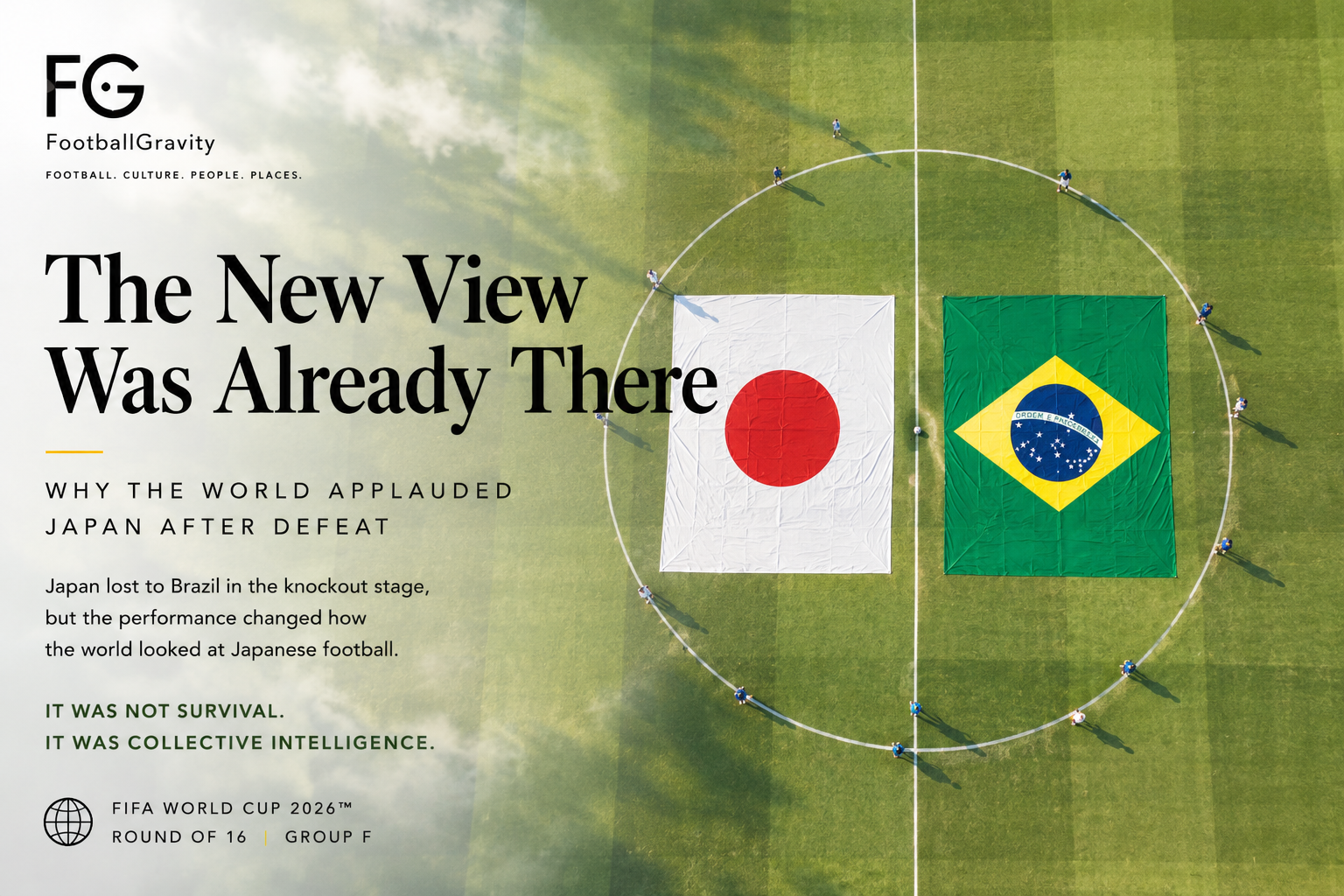
The New View Was Already There

Why the world applauded Japan after defeat

Japan lost.

That is the simplest sentence.

Brazil advanced. Japan went home. Another World Cup knockout match ended without Japan’s first victory beyond the group stage.

And yet, after the final whistle, the conversation did not feel like a simple story of failure.

Around the world, Japan were not spoken of merely as brave losers. They were discussed as a team that had shown something rare: a national side capable of making Brazil look human, not through luck, not through chaos, but through collective intelligence.

That may be why this defeat felt different.

For years, Hajime Moriyasu had spoken about “a new view.”

Perhaps many imagined that view would mean a quarter-final, a semi-final, or even something more ambitious.

Those results did not arrive.

But against Brazil, something else did.

The football world saw Japan differently.

The Cruelest Path

The first knockout round was especially unforgiving for Group F.

Japan faced Brazil.

The Netherlands faced Morocco.

Sweden faced France.

All three teams that advanced from Group F were eliminated.

That does not erase their defeats. But it does change the frame.

Japan did not fall against an ordinary opponent. The Netherlands were pushed out by a Morocco side that looked like one of the most complete teams in the tournament. Sweden were beaten by France, a side whose individual quality and tournament experience remain among the highest in world football.

Group F had produced competitive teams.

But the next path was brutal.

Japan’s loss belonged to that context.

And still, among the three defeated sides, Japan seemed to leave the strongest impression.

Why?

It Was Never Only About the Result

Football usually remembers winners.

Paraguay, for example, achieved something Japan could not: they took Germany to penalties and won. That deserves full respect.

But global admiration does not always follow the scoreboard alone.

Japan were praised because of how they played.

They did not appear to be a team simply waiting for Brazil to make a mistake.

They did not defend as if survival was the only plan.

They defended as if defending itself could be a way of attacking.

That distinction matters.

Japan were not trying only to reach penalties.

They were trying to win.

Against Brazil.

The Mystery the World Wanted to Solve

Japan are no longer an unknown football nation.

The old assumption that European or South American teams could underestimate Japan no longer works.

This is the country that beat Germany and Spain in Qatar. The country that later defeated Germany again. The country that has shown, repeatedly, that its best football belongs on the same pitch as elite opposition.

The question has changed.

It is no longer:

Can Japan compete?

It is now:

Why have Japan become so difficult to play against?

Against Brazil, the answer became clearer.

It was not only technique.

It was not only discipline.

It was synchronisation.

Eleven Players, One Organism

International football usually favours individual quality.

National teams do not train together like clubs. They do not have months to build mechanisms, pressing traps, defensive distances, or shared habits.

That is why knockout football often belongs to individual brilliance.

A winger beats a defender.

A striker finds half a yard.

A midfielder breaks the structure with one pass.

Japan proposed another answer.

Collective movement.

The back line moved together.

The midfield moved together.

The wing-backs adjusted together.

Even the forwards defended as part of the same structure.

At times, Japan looked less like eleven separate players and more like one organism responding to the ball, the space and the opponent at the same time.

That is rare in international football.

And that is what many observers seemed to recognise.

Brazil Did Not Become Ordinary

There is a danger in misreading the match.

Brazil did not suddenly become ordinary.

Japan simply prevented Brazil from looking extraordinary.

That may be the greatest compliment a defensive structure can receive.

The best attacking teams usually make opponents look reactive. They stretch the pitch, isolate defenders, and create the impression that danger can appear from anywhere.

Against Japan, Brazil were forced to think.

They had to adjust.

They had to suffer.

They had to wait until the final moments.

That was not because Brazil lacked quality.

It was because Japan denied them rhythm.

Not Defensive Football, But Winning Football

Japan’s structure was defensive in shape, but not defensive in spirit.

There is a difference between protecting a score and refusing to play.

Japan did not simply sit low and hope.

They pressed.

They shifted.

They tried to create moments.

They looked for the chance that would turn control into shock.

This is why the performance felt attractive, even without attacking fluency.

Japan’s injuries mattered. Several important attacking options were missing or limited. The final combinations were not always clean.

But the intention was visible.

This was not football designed only to avoid defeat.

It was football designed to find a path to victory against a superior collection of individual talent.

That is why it resonated.

Why Coaches Understand It

Some performances are appreciated first by fans.

Others are understood most deeply by coaches, former players and analysts.

Japan’s performance belonged to the second category.

Anyone can admire a dribble.

Anyone can celebrate a goal.

But collective coordination is harder to see.

It requires watching distances, timing, cover, body orientation and the relationship between players who may never touch the ball.

Against Brazil, Japan showed that a national team can still build something close to club-level collective behaviour.

That is not easy.

It is not accidental.

And it is not simply “hard work.”

It is design.

A New View

Moriyasu’s phrase, “a new view,” will always carry the sadness of unfinished ambition.

Japan wanted more.

The players wanted more.

The supporters wanted more.

A first knockout victory was close enough to touch, and then gone.

But perhaps the phrase does not belong only to the result.

Perhaps a new view can also be the moment when the world looks at Japanese football and no longer sees an outsider.

Not a surprise.

Not a guest.

Not a romantic underdog.

But a serious football nation with its own method, its own intelligence, and its own way of making the game difficult for anyone.

The players saw it.

The coach saw it.

The supporters felt it.

And perhaps, for the first time, the world saw it too.

The new view was already there.

The Soundtrack of Football

AI-generated Football's Soundtrack jacket with an ivory background, a large grey vinyl record merging into a floodlit stadium and the official FootballGravity logo; tournament badge removed.

From Queen to Bon Jovi, from England to Dallas

Football has never been only a game of feet.

It is also a game of voices.

Before kickoff, after the final whistle, during a hydration break, on the way back from the stadium, in pubs, trains, fan zones and living rooms, football is always surrounded by music.

At the FIFA World Cup 2026, that feeling has become especially visible.

Songs echo through stadiums not simply as background entertainment, but as part of the tournament itself.

Bon Jovi’s “Livin’ on a Prayer” has become one of the most joyful stadium moments of this World Cup. It is not a football song in a literal sense. Yet somehow, when tens of thousands of people sing it together, it becomes one.

That is the strange power of football music.

Football does not simply borrow songs.

It gives them a second life.

Why Rock Fits Football

The connection between football and music is not accidental.

In England, where the modern game was born, football and rock music have long shared similar social roots.

Both grew from working-class culture.

Both belong to crowds.

Both understand hope, frustration, resistance and release.

That is why songs such as “Wonderwall” by Oasis or “We Will Rock You” by Queen feel so natural in football spaces. They are not tactical. They are emotional.

Football is full of moments when ordinary people believe something extraordinary might happen.

Rock music has always understood that feeling.

The underdog.

The comeback.

The last-minute goal.

The impossible night.

In that sense, football and rock have always spoken the same language.

Stadium Classics

Some songs become football songs not because they were written for football, but because football crowds adopted them.

“You’ll Never Walk Alone” is the clearest example. From Liverpool to stadiums far beyond England, it has become a song of belonging.

“Seven Nation Army” by The White Stripes has travelled even further. Its riff became a universal chant, crossing clubs, countries and languages.

“Freed From Desire” by Gala became another modern stadium anthem, while “Sweet Caroline” has turned into a collective release for England supporters and many others.

These songs work because they are simple enough to share.

A chant.

A rhythm.

A phrase.

A feeling.

Football crowds do not need perfect singing.

They need something to sing together.

World Cup Memories

The World Cup has also created its own official soundtrack.

Ricky Martin’s “The Cup of Life” still carries the bright energy of France 1998.

Shakira’s “Waka Waka” remains perhaps the most globally recognised World Cup song of the modern era.

K’naan’s “Wavin’ Flag” captured another kind of tournament emotion: not just celebration, but longing, movement and global connection.

For Japanese fans, Vangelis’ “Anthem” from the 2002 World Cup carries a special memory. It belongs to the moment when the tournament came to Japan and Korea, and when the World Cup felt physically close for the first time.

The older FIFA Anthem, familiar from the 1990s and early 2000s, also remains deeply connected to the ritual of international football. Even without words, it could make a stadium feel official.

In 2026, Shakira and Burna Boy’s “Dai Dai” continues that tradition, reminding us that World Cup music is no longer tied to one region or one genre. It is global by design.

Japan’s Football Songs

Every football country has its own soundtrack.

Japan is no exception.

UKASUKA-G, the unit formed by Kazutoshi Sakurai of Mr.Children and GAKU-MC, created music closely associated with the Japan national team. “Shori no Emi wo Kimi to” became a familiar song of support for many Japanese fans.

Superfly’s “Tamashii Revolution” is another song that instantly evokes football in Japan. For many supporters, it belongs to the emotional memory of watching the national team on television.

Dragon Ash’s “Fantasista” is different again. It carries the energy of Japanese rock and street culture at the turn of the century, when football was becoming more global, more stylish and more connected to youth culture.

In 2026, Kenshi Yonezu’s “Karasu” adds a new layer as NHK’s soccer theme, showing that Japan continues to create new songs for each football generation.

These songs may not all be known globally.

But that is exactly the point.

Football music is universal because every country has its own version.

Football in Advertising

Some football songs arrive through television rather than stadiums.

Nike’s legendary “Good vs Evil” commercial from the 1990s remains one of the most memorable examples.

Eric Cantona, Ronaldo, Maldini and other stars appeared in a dramatic football fantasy, soundtracked by “Mas Que Nada.”

The song itself was not new.

But the advertisement gave it a football image for a generation of fans.

This is another way football works with music.

It does not always create new songs.

Sometimes it changes how we remember old ones.

A FootballGravity Playlist

This is not a ranking.

It is a matchday journey.

Matchday Warm-up

  • “Livin’ on a Prayer” — Bon Jovi
  • “Don’t Stop Me Now” — Queen
  • “Fantasista” — Dragon Ash
  • “Tamashii Revolution” — Superfly
  • “Shori no Emi wo Kimi to” — UKASUKA-G

Stadium Anthems

  • “You’ll Never Walk Alone” — Gerry & The Pacemakers
  • “Seven Nation Army” — The White Stripes
  • “Wonderwall” — Oasis
  • “We Will Rock You” — Queen
  • “Freed From Desire” — Gala
  • “Sweet Caroline” — Neil Diamond

World Cup Memories

  • “The Cup of Life” — Ricky Martin
  • “Waka Waka” — Shakira feat. Freshlyground
  • “Wavin’ Flag” — K’naan
  • “Dai Dai” — Shakira & Burna Boy
  • “Anthem” — Vangelis
  • “FIFA Anthem” — Franz Lambert
  • “John Denver” – Take Me Home, Country Roads

Victory, Defeat, and the Road Home

  • “We Are the Champions” — Queen
  • “Breakthru” — Queen
  • “Mas Que Nada” — Sérgio Mendes
  • “Karasu” — Kenshi Yonezu
  • “Fix You” — Coldplay

Listen while reading:

Apple Music Playlist
YouTube Playlist

One More Song Before Kickoff

Football needs tactics.

It needs data.

It needs training, scouting, travel, climate control, stadium design and recovery science.

But it also needs songs.

A song can turn a neutral stadium into a shared place.

A song can give courage to a nervous crowd.

A song can heal defeat.

A song can follow supporters long after the match has ended.

Whether your team is still dreaming of the trophy or already heading home, football always leaves us one more thing to carry.

A melody.

Enjoy the soundtrack of this World Cup.

And remember that football has never been only ninety minutes.

Listen While Reading

Music is part of football culture.

We’ve collected the songs featured in this article so you can continue the matchday atmosphere wherever you are.

🎵 Apple Music Playlist

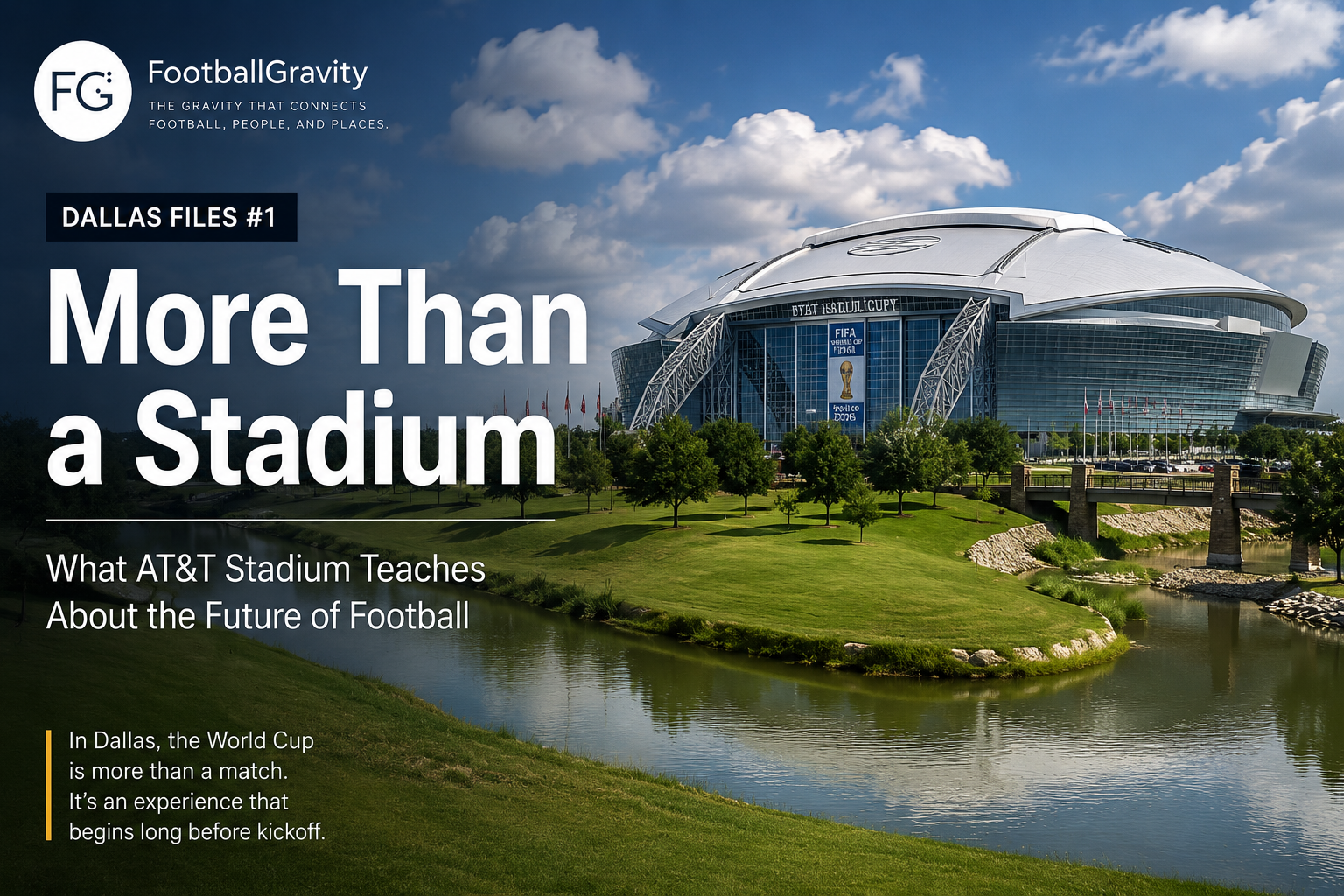
Dallas Files #1

More Than a Stadium

What AT&T Stadium Teaches About the Future of Football

Most stadium reviews begin with seats, food, or atmosphere.

AT&T Stadium deserves a different approach.

After spending an entire matchday there during the FIFA World Cup 2026, one thing became clear:

This is not simply a stadium.

It is an ecosystem.

Before You Even Enter

The experience begins long before the ticket gates.

Instead of surrounding visitors with endless parking lots and concrete roads, the stadium opens into something unexpected.

Wide green spaces.

Walking paths.

Small waterways.

Trees.

Open lawns where families gather and supporters relax before kickoff.

It feels less like approaching a sports venue and more like arriving at a public park.

Supporters naturally slow down.

They walk.

They sit.

They talk.

The World Cup begins well before the referee blows the whistle.

A Festival Rather Than an Entrance

Beyond the security gates, the atmosphere changes again.

Food trucks.

Music.

Outdoor seating.

Large grassy areas.

Fans from different countries eating together under the Texas sun.

Children kicking footballs.

Groups taking photos.

Rather than simply waiting for kickoff, people spend hours enjoying the place itself.

The stadium is not merely a destination.

It is an all-day festival.

That distinction matters.

Great tournaments are remembered not only for ninety minutes of football, but for the experiences surrounding those ninety minutes.

AT&T Stadium understands this perfectly.

Designed Around the Spectator

Inside, the architecture continues to impress.

The most iconic feature is the enormous centre-hung video board, manufactured by Mitsubishi Electric.

Unlike traditional stadiums, where replay screens sit high behind one goal, this display hangs directly above the centre circle.

The difference is surprisingly significant.

Supporters never need to turn completely away from the pitch.

The action, the replays and the atmosphere remain connected.

Rather than interrupting the match experience, the technology becomes part of it.

Combined with the stadium’s powerful sound system, the effect is closer to a live concert than a conventional football match.

Every goal celebration feels immersive.

Every pre-match sequence feels cinematic.

It is entertainment without sacrificing football itself.

Small Details That Matter

The stadium’s scale is extraordinary, yet movement inside rarely feels stressful.

Restrooms remained remarkably accessible.

Food and drink outlets were distributed throughout the concourses.

Even with tens of thousands of spectators, congestion was surprisingly limited.

These details rarely appear in highlight videos.

Yet they shape the overall experience just as much as the match itself.

The best stadiums succeed because thousands of small design decisions quietly disappear into the background.

More Than Home Advantage

For Japan, there may also be a competitive benefit.

Playing two Group F matches in the same stadium means familiarity.

The climate is controlled beneath the roof.

Players become accustomed to the lighting, the pitch, the sightlines and even the rhythm of the venue.

These are subtle advantages, but tournament football is often decided by subtle margins.

A Stadium That Belongs to the City

AT&T Stadium is frequently described as one of the world’s greatest sporting venues.

After spending an entire day there, that reputation feels deserved.

What impressed me most was not its size.

It was the way architecture, public space, football and everyday life blended into one continuous experience.

Many stadiums host matches.

Few become part of the city itself.

Perhaps the future of football is not simply about building bigger stadiums.

Perhaps it is about building better places.

And AT&T Stadium offers a compelling blueprint for what that future might look like.

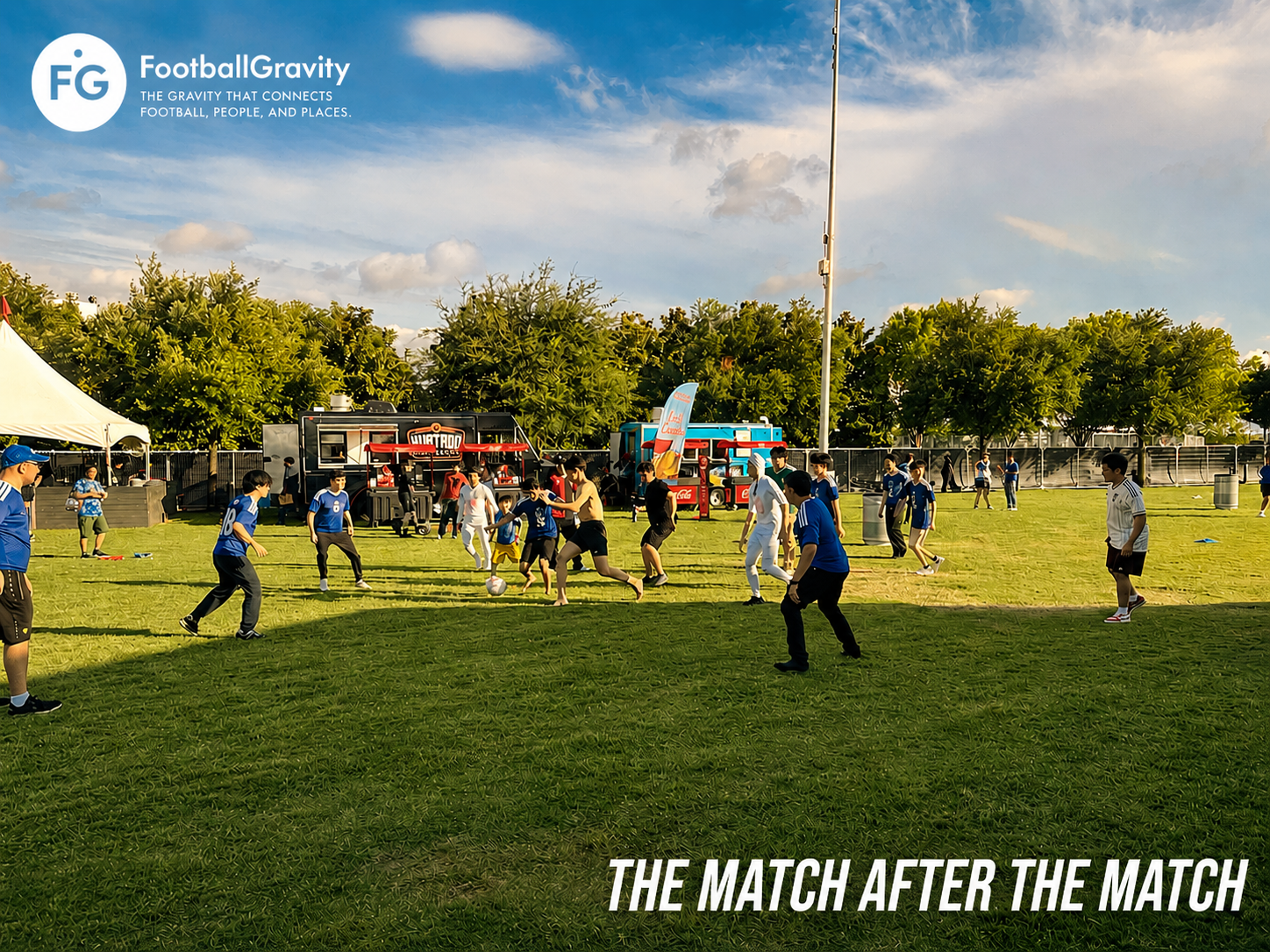
World Cup Extra Time: The Match After the Match

Sometimes the most memorable football of a World Cup is not played inside the stadium.

After Japan and the Netherlands delivered one of the tournament’s most captivating matches, thousands of supporters slowly streamed out into the vast grounds surrounding the stadium in Dallas. The game itself had been excellent. The atmosphere was electric. Most people would have been satisfied to take photos, buy souvenirs, and head home carrying the memories of a thrilling evening.

Instead, something else happened.

A ball appeared.

And football began again.

One Ball, No Rules, No Borders

The match took place not inside the stadium, but in the open supporter zone beyond the gates—a space reserved for ticket holders, filled with food trucks, merchandise stands, bars, and places to relax before and after the game.

There were no referees.

No organized teams.

No official goals.

No registration.

No language requirements.

Just a group of strangers who looked at a football and instinctively understood what to do next.

Within minutes, Japanese supporters, Dutch supporters, Americans, and Mexican fans had become teammates and opponents at the same time. Some wore national-team shirts. Others had simply wandered over after hearing laughter and seeing a crowd gather around the ball.

Names were unknown.

Languages were different.

Football was enough.

The Universal Language

One of football’s great strengths is its simplicity.

You do not need expensive equipment. You do not need a carefully prepared pitch. You do not even need shared words.

A pass communicates intention.

A run communicates possibility.

A raised hand communicates gratitude.

Within a few minutes, everyone understands who likes to dribble, who prefers to pass, who defends aggressively, and who plays with quiet elegance. Football reveals personality remarkably quickly.

Watching the scene unfold in Dallas, it became clear that the sport’s greatest power may not be its professional competitions, but its ability to create instant communities.

The World Cup gathers nations.

A football creates connections.

The Best Match of the Day?

The official match had featured elite athletes, tactical preparation, and global attention.

The unofficial match featured none of those things.

Yet the joy felt remarkably similar.

Many of the participants had spent ninety minutes passionately supporting their countries inside one of the world’s most celebrated stadiums. Moments later, they were chasing the same ball together, laughing at mistakes, applauding good plays, and celebrating goals that nobody would ever record.

There was no scoreboard.

No statistics.

No highlights package.

Only football.

In some ways, it captured the essence of the game more clearly than the professional spectacle that preceded it.

A Stadium Designed for People

This scene was only possible because the environment allowed it.

The stadium precinct offered more than transportation and security. It provided space for people to stay, gather, interact, and create their own experiences.

That is an often-overlooked aspect of football infrastructure.

Great stadiums are not merely places to watch matches. They are places where football culture can emerge organically.

How many major venues around the world would welcome an impromptu multinational kickabout after a World Cup match?

How many would have the space, atmosphere, and sense of trust required for it to happen naturally?

Dallas deserves credit for creating the conditions.

The supporters supplied the rest.

Football Beyond the Final Whistle

The World Cup is often described as a competition between nations.

Yet moments like this suggest something different.

Perhaps the tournament’s greatest achievement is not deciding a champion, but reminding millions of people that they already share something in common.

A ball.

A game.

A language that requires no translation.

Long after the result of Japan versus the Netherlands fades from memory, many supporters may remember a different match—the one played on a patch of grass outside the stadium, among strangers who became teammates for an evening.

That, too, was the World Cup.

The Sound of Resistance: How Cape Verde Stopped Spain

Spain vs Cape Verde World Cup match featuring defensive resistance and key match statistics

The FIFA World Cup always produces surprises.

But few expected one of the tournament’s biggest stories to arrive this early.

Spain, widely regarded as one of the strongest teams in the competition alongside France, were held to a draw by Cape Verde — a nation that many football fans around the world had rarely followed before this tournament.

On paper, the gap was enormous.

Spain dominated possession, completed more than 800 passes at over 90 percent accuracy, and spent long stretches circulating the ball with the confidence of a title contender.

Yet when the final whistle arrived, the scoreboard told a different story.

Football does not reward possession.

Football rewards outcomes.

And that is why the World Cup remains the most compelling sporting event on Earth.

More Than Numbers

The statistics tell part of the story.

Spain recorded 27 shots.

Cape Verde produced 46 clearances, 18 tackles, 15 interceptions, and numerous blocks.

The difference in squad value, reputation, and tournament expectations was immense.

Yet for ninety minutes, Cape Verde refused to disappear.

Every clearance carried meaning.

Every interception bought time.

Every tackle extended belief.

This was not simply a defensive performance.

It was an act of collective resistance.

The Match You Could Hear

One detail made this match feel different.

Not what we saw.

What we heard.

Modern football broadcasts have become visually stunning, but this tournament seems to have taken another step forward in audio production.

The sound of the ball striking a defender.

The impact of a blocked shot.

The collision of bodies competing for space.

All of it echoed through the stadium and through television speakers around the world.

Perhaps new microphone technology has been introduced.

Perhaps production crews have refined their methods.

Whatever the reason, the effect is remarkable.

Football feels louder.

More physical.

More immediate.

And nowhere was that more evident than in Spain versus Cape Verde.

Again and again, Spain attacked.

Again and again, a Cape Verde defender stepped into the path of the ball.

A sharp thud.

A collective gasp.

Then applause.

Not only from Cape Verde supporters, but from neutral fans who could recognize courage when they saw it.

Or heard it.

The World Cup’s Greatest Power

The World Cup has always been about more than football.

It introduces nations to one another.

It creates stories that would never emerge elsewhere.

Before this match, many viewers may not have known much about Cape Verde.

After this match, millions do.

For one evening, Cape Verde occupied the center of the football world.

That alone is part of what makes the World Cup extraordinary.

The giants may dominate the ball.

But the game still belongs to anyone brave enough to challenge them.

And on this night, the sound of football belonged to Cape Verde.