Reading Group F Through Two Matches

Group F analysis comparing Japan and the Netherlands at the 2026 FIFA World Cup

Not Just Winning, But Controlling

The second round of Group F offered an intriguing comparison.

Japan defeated Tunisia convincingly.
The Netherlands comfortably handled Sweden.

On paper, the results simply reinforced what many observers already suspected: Japan and the Netherlands have emerged as the two strongest teams in the group.

Yet the more interesting story lies beneath the scorelines.

These matches did not merely reveal who won.
They revealed how they won.

And perhaps, they also revealed why the opening 2–2 draw between Japan and the Netherlands now looks even more impressive than it did at the time.

The Myth of Physical Dominance

Football often rewards a simple narrative.

The stronger team wins more duels.
The stronger team runs harder.
The stronger team overwhelms the weaker one physically.

But the statistics from both matches suggest something different.

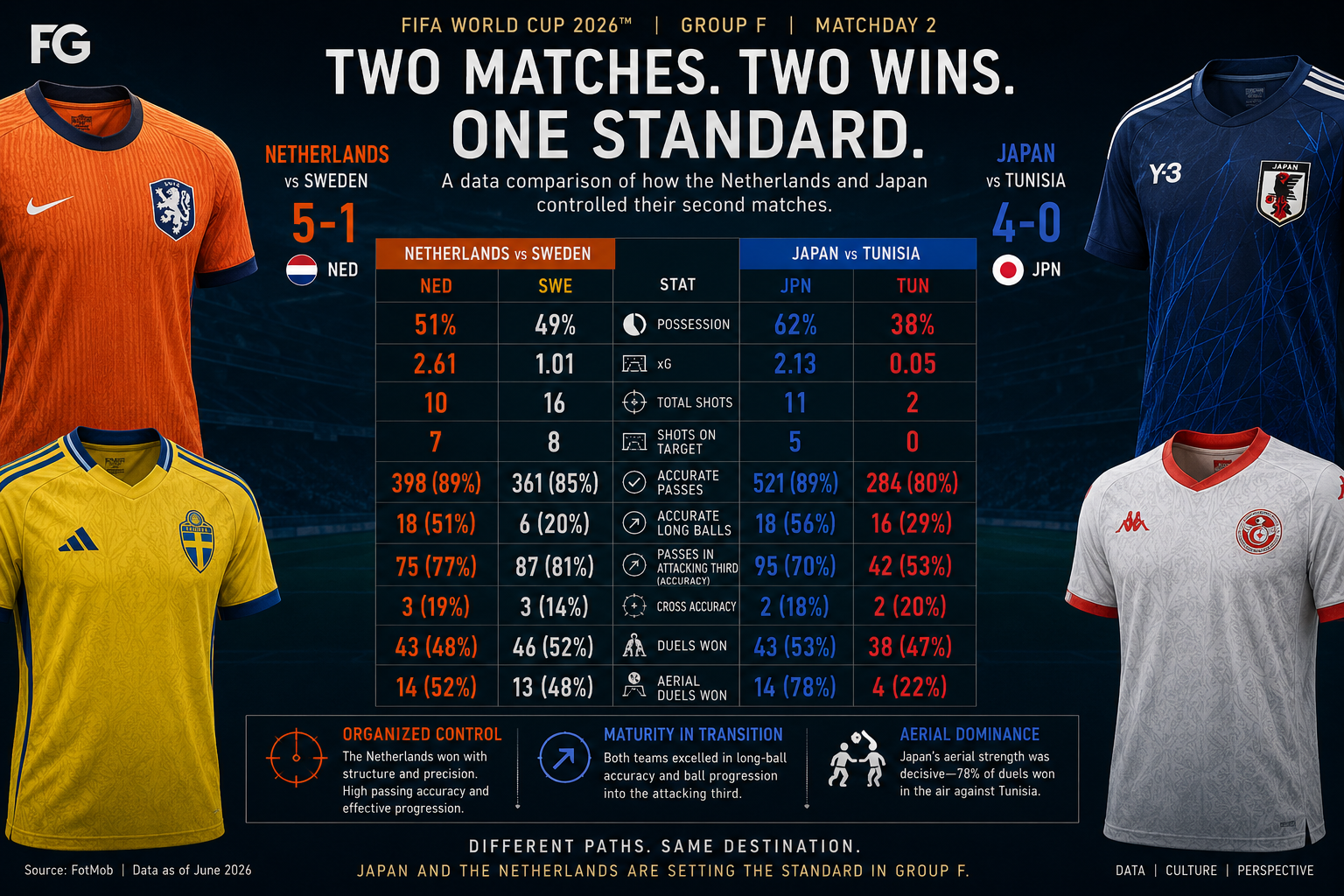
Japan defeated Tunisia 4–0 while winning only 53 percent of total duels.

The Netherlands beat Sweden 5–1 despite actually losing the overall duel count by a narrow margin.

Yet neither match felt close.

That difference matters.

The strongest teams are not necessarily the teams that win every battle.

They are often the teams that decide where the battles take place.

Japan and the Netherlands consistently placed themselves in situations where they needed fewer desperate actions, fewer emergency tackles, and fewer physical recoveries.

Control is often invisible until it is compared with chaos.

A Shared Strength: Precision in Advanced Areas

One statistic stands out across both teams.

Neither side produced particularly remarkable crossing numbers.

Japan completed just 18 percent of its crosses.
The Netherlands completed 19 percent.

Crosses remain an important weapon, but they were not the primary reason these teams created danger.

Instead, two other categories deserve attention.

First, long-ball accuracy.

Japan completed 56 percent of its accurate long balls.
The Netherlands completed 51 percent.

These numbers are not spectacular on their own, but they become significant when viewed alongside what happened next.

Second, and more importantly, both teams maintained exceptional passing quality in advanced areas.

Japan completed 70 percent of its passes in the attacking third.

The Netherlands recorded 77 percent.

Even Sweden, despite defeat, managed 81 percent.

These are unusually high numbers for the most congested and difficult part of the pitch.

They suggest teams capable not merely of reaching dangerous areas, but of remaining composed once they arrive.

The Netherlands have long been associated with this style. Their football tradition combines patient circulation with the ability to switch play instantly through accurate longer passes.

Japan’s presence in the same conversation is more surprising.

And perhaps more significant.

How Japan Has Changed

For many years, Japan’s strengths were easy to identify.

Technical quality.
Collective movement.
Short passing combinations.

Yet there were also recurring limitations.

Long passes often lacked precision.
Attacking moves frequently stalled in the final third.
Possession could be maintained, but not always converted into danger.

Against Tunisia, signs of evolution were visible.

Japan moved the ball forward more directly when necessary.

Longer passes connected with greater consistency.

Most importantly, combinations in advanced areas survived under pressure.

The result was not simply a victory.

It was evidence of a team that has expanded its toolbox.

A team that can now solve different problems in different ways.

The Air Above the Pitch

One category deserves special mention.

Aerial duels.

Japan won 78 percent of them against Tunisia.

That number is extraordinary at World Cup level.

It is also a reminder of how much Japanese football has changed.

Players such as Tomiyasu, Itakura, and Ito have developed in elite European environments where physical confrontation is unavoidable.

Midfielders such as Sano add another layer of athletic presence.

But this is about more than height.

It reflects a broader shift in the profile of Japanese football.

Technical excellence is no longer arriving alone.

It is increasingly accompanied by physical robustness and tactical maturity.

Why the Netherlands–Japan Draw Looks Different Now

Group F is beginning to resemble a familiar pattern.

Two teams separating themselves from the rest.

Two teams capable of controlling matches through structure rather than emotion.

That context changes how we view the opening match between Japan and the Netherlands.

A 2–2 draw initially looked like an entertaining result.

Now it looks like a meeting between two of the group’s most complete teams.

The statistics from Matchday Two reinforce that impression.

Neither side overwhelmed opponents through individual brilliance alone.

Neither side relied purely on physical superiority.

Instead, both demonstrated something more difficult to build.

The Netherlands controlled Sweden despite near-even possession and a slight deficit in total duels.

Japan controlled Tunisia through overwhelming superiority in possession, passing quality, and aerial dominance.

Different routes.

The same destination.

Collective control.

And in modern tournament football, that may be the most valuable quality of all.

The Sound of Resistance: How Cape Verde Stopped Spain

Spain vs Cape Verde World Cup match featuring defensive resistance and key match statistics

The FIFA World Cup always produces surprises.

But few expected one of the tournament’s biggest stories to arrive this early.

Spain, widely regarded as one of the strongest teams in the competition alongside France, were held to a draw by Cape Verde — a nation that many football fans around the world had rarely followed before this tournament.

On paper, the gap was enormous.

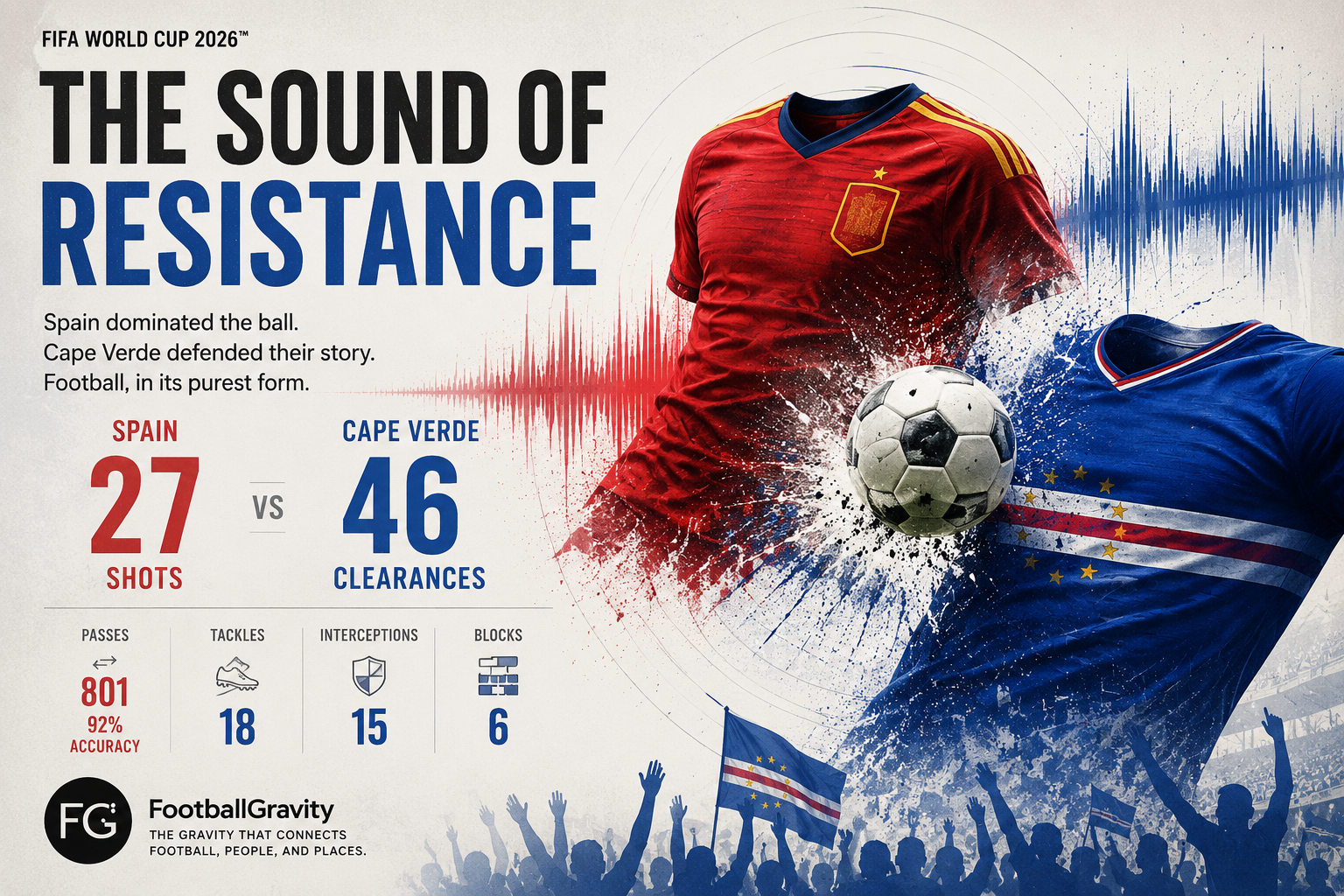
Spain dominated possession, completed more than 800 passes at over 90 percent accuracy, and spent long stretches circulating the ball with the confidence of a title contender.

Yet when the final whistle arrived, the scoreboard told a different story.

Football does not reward possession.

Football rewards outcomes.

And that is why the World Cup remains the most compelling sporting event on Earth.

More Than Numbers

The statistics tell part of the story.

Spain recorded 27 shots.

Cape Verde produced 46 clearances, 18 tackles, 15 interceptions, and numerous blocks.

The difference in squad value, reputation, and tournament expectations was immense.

Yet for ninety minutes, Cape Verde refused to disappear.

Every clearance carried meaning.

Every interception bought time.

Every tackle extended belief.

This was not simply a defensive performance.

It was an act of collective resistance.

The Match You Could Hear

One detail made this match feel different.

Not what we saw.

What we heard.

Modern football broadcasts have become visually stunning, but this tournament seems to have taken another step forward in audio production.

The sound of the ball striking a defender.

The impact of a blocked shot.

The collision of bodies competing for space.

All of it echoed through the stadium and through television speakers around the world.

Perhaps new microphone technology has been introduced.

Perhaps production crews have refined their methods.

Whatever the reason, the effect is remarkable.

Football feels louder.

More physical.

More immediate.

And nowhere was that more evident than in Spain versus Cape Verde.

Again and again, Spain attacked.

Again and again, a Cape Verde defender stepped into the path of the ball.

A sharp thud.

A collective gasp.

Then applause.

Not only from Cape Verde supporters, but from neutral fans who could recognize courage when they saw it.

Or heard it.

The World Cup’s Greatest Power

The World Cup has always been about more than football.

It introduces nations to one another.

It creates stories that would never emerge elsewhere.

Before this match, many viewers may not have known much about Cape Verde.

After this match, millions do.

For one evening, Cape Verde occupied the center of the football world.

That alone is part of what makes the World Cup extraordinary.

The giants may dominate the ball.

But the game still belongs to anyone brave enough to challenge them.

And on this night, the sound of football belonged to Cape Verde.

The Lessons of Doha: How Japan Stayed Calm Against the Netherlands

The Netherlands and Japan was one of the most anticipated group-stage matches of the 2026 FIFA World Cup.

Both nations arrived in the tournament with genuine ambitions of reaching the latter stages. The Netherlands entered as one of Europe’s most consistent contenders, while Japan carried growing expectations after its remarkable performances in recent World Cups.

The match delivered.

A dramatic 2-2 draw combined technical quality, tactical discipline, and moments of individual brilliance. More importantly, it revealed something about how this Japanese team has evolved.

Numbers Favored the Netherlands

The statistics suggested a Dutch advantage.

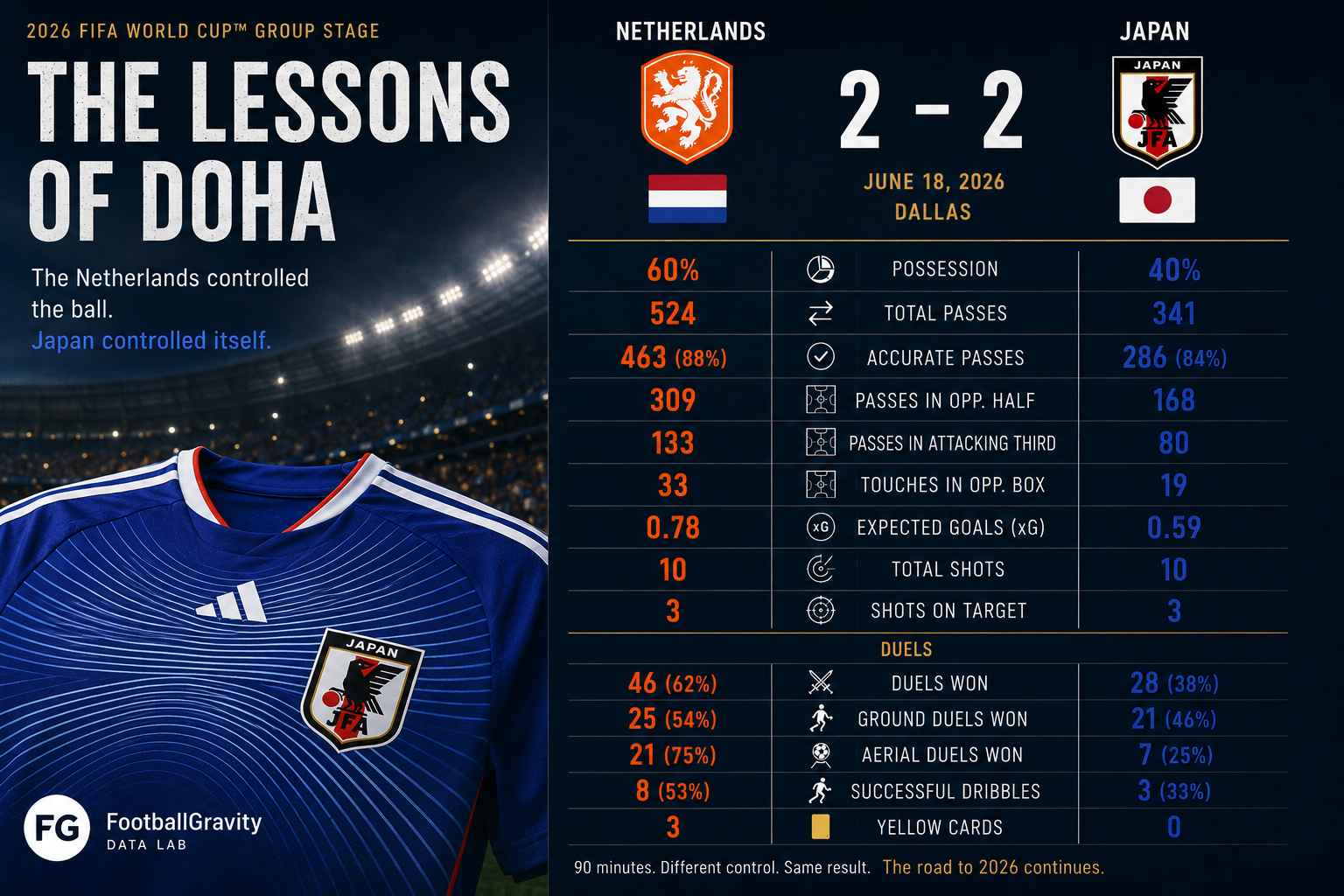
The Netherlands controlled 60 percent of possession, completed more than 500 passes, and generated slightly more territorial control throughout the match. They entered Japan’s penalty area more frequently and dictated long stretches of the game’s rhythm.

On paper, it was the Netherlands who controlled the match.

Yet the contest never felt one-sided.

Japan accepted periods without the ball, remained organized, and repeatedly found ways to respond whenever momentum appeared to swing against them.

That may have been the most important statistic of all.

A Match Played in Quarters

The Texas heat created an unusual dynamic.

Cooling breaks effectively divided the match into shorter segments, making the game feel closer to a four-quarter contest than a traditional ninety-minute match.

For some teams, interruptions can disrupt momentum.

For Japan, they seemed to provide opportunities.

Players gathered frequently, exchanged information, and recalibrated their positioning. The team appeared to treat every restart as a chance to reset collectively.

Combined with halftime and the moments immediately following each conceded goal, Japan effectively received multiple opportunities to reorganize and refocus.

Each time, they returned looking composed.

The Difference Between Panic and Control

One of the most striking aspects of the match was what did not happen.

After conceding goals, there were no visible signs of frustration. No blaming teammates. No emotional collapse. No rush to abandon the game plan.

The reactions looked almost routine.

As if difficult moments had already been anticipated and rehearsed.

This was not a team trying to avoid mistakes.

It was a team prepared for them.

That distinction matters at a World Cup.

Tournament football is rarely won by teams that avoid adversity. It is often won by teams that know how to respond when adversity inevitably arrives.

Japan looked ready.

The Long Shadow of Doha

Japanese football has carried the memory of Doha for more than three decades.

The “Agony of Doha” in 1993 remains one of the defining moments in the nation’s football history. A World Cup dream disappeared in stoppage time, leaving lessons about concentration, game management, and emotional control that shaped an entire generation.

One of the players on the pitch that night was Hajime Moriyasu.

Today, he stands on the touchline as Japan’s head coach.

His team also carries another Doha memory.

In 2022, Japan produced one of the greatest achievements in its history by overturning Germany and Spain at the World Cup in Qatar.

The agony and the joy were born in the same city.

Both experiences appear woven into the identity of this team.

Watching Japan calmly navigate difficult moments against the Netherlands, it was difficult not to see traces of those lessons.

There was no sign of panic.

There was no sign of complacency.

A team shaped by both disappointment and triumph tends to understand that matches are never over until they truly are.

More Than a Draw

A 2-2 draw against the Netherlands will not define this tournament.

But it offered an important reference point.

The Netherlands may have controlled more of the ball.

They may have completed more passes and spent more time in advanced areas.

Japan controlled something else.

Themselves.

As the knockout stage approaches, that quality may prove just as valuable as any tactical system or statistical advantage.

From Doha to Dallas, Japanese football continues to carry its lessons forward.

And on one of the biggest stages in world football, those lessons were visible once again.

Brazil vs Morocco: A New Benchmark for the Knockout Stage

The FIFA World Cup group stage often produces entertaining matches.

Sometimes, however, it offers something more valuable: a glimpse into what may come later.

Brazil versus Morocco was one of those matches.

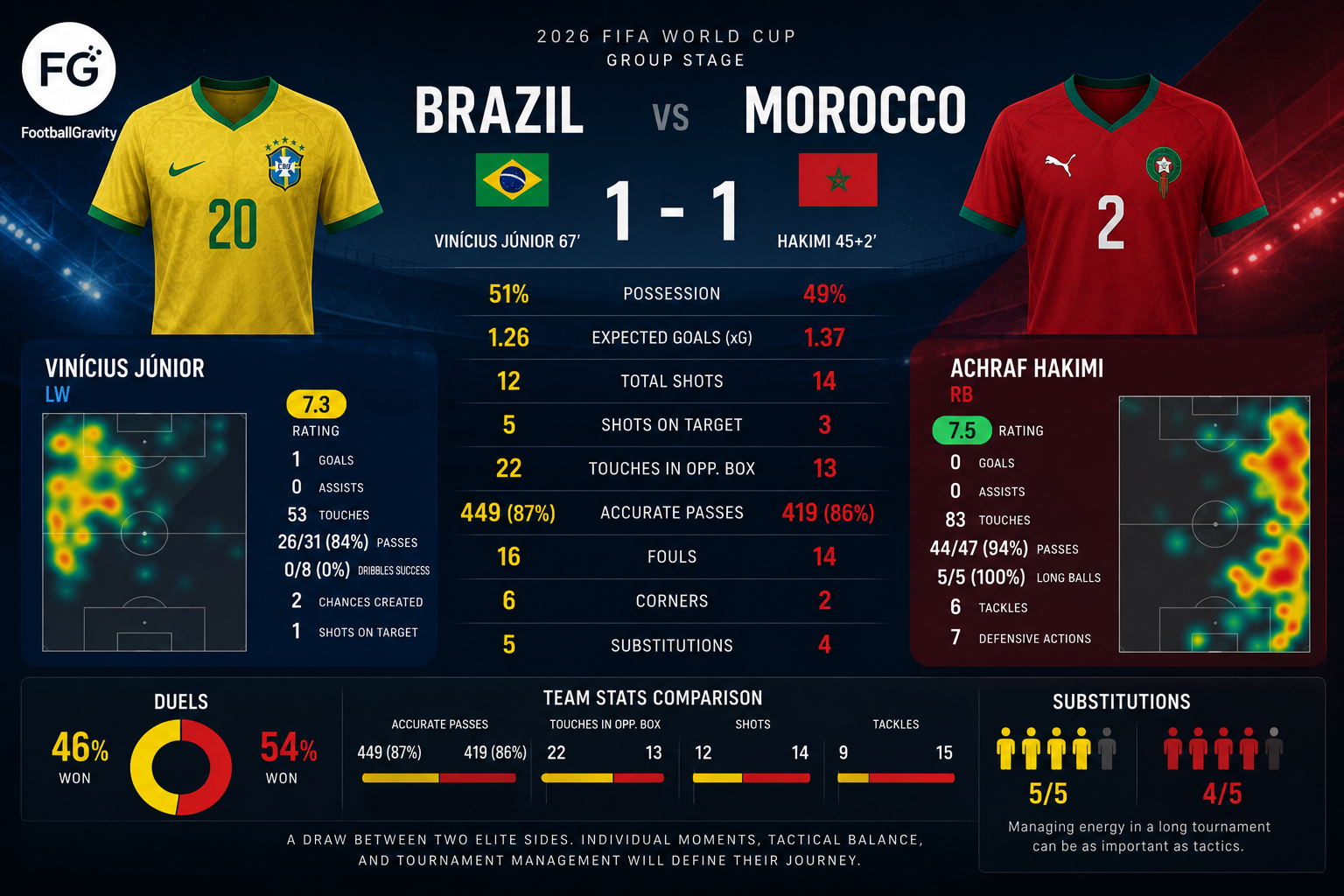
A 1–1 draw between two teams capable of reaching the quarterfinals, semifinals, or even beyond. For Japan, the match carried additional significance, as both nations have frequently appeared in projections as potential Round of 16 opponents.

More importantly, it provided the first real tournament data point. Qualification campaigns and friendly matches belong to the past. The World Cup creates its own environment, pressures, and rhythms.

This was the first opportunity to observe how two elite teams perform when the stakes become real.

A Duel on the Right Flank

The match featured an intriguing individual battle.

Brazil’s Vinícius Júnior and Morocco’s Achraf Hakimi are among the world’s most recognizable players. Both play for European giants. Both influence matches through speed and attacking transitions. And both often operate in overlapping spaces along Brazil’s left and Morocco’s right.

On paper, Vinícius delivered the decisive moment.

He scored Brazil’s equalizer and once again demonstrated why elite attackers require only a single opportunity to influence a match.

Yet the broader statistical picture tells a different story.

Hakimi’s heat map covered an extraordinary amount of ground. His presence stretched from defensive areas to advanced attacking positions throughout the ninety minutes. He completed every long ball attempted, recorded six tackles, won the majority of his duels, and accumulated strong defensive contributions while remaining an attacking threat.

The contrast was fascinating.

One player changed the scoreline.

The other seemed to influence almost every area of the pitch.

Small Margins, Elite Teams

The overall statistics reflected how evenly matched the teams were.

Brazil slightly led possession with 51%.

Morocco produced a marginally higher expected goals figure (1.37 vs 1.26).

Brazil generated more touches inside the opposition penalty area (22 vs 13).

Morocco won more duels overall and displayed greater success in defensive actions.

Neither side appeared dominant. Neither side appeared vulnerable.

Instead, both demonstrated the characteristics that separate elite international teams from the rest of the field: balance, adaptability, and resilience.

The match also highlighted an increasingly important reality of modern tournament football.

Winning individual moments often matters more than controlling every statistic.

The Management of a Long Tournament

One overlooked detail was the substitution pattern.

Brazil used five substitutions.

Morocco used four.

In previous eras, such decisions might have been viewed purely as tactical adjustments.

Today they are also part of tournament management.

The 2026 World Cup is expected to challenge players with heat, travel, recovery demands, and a congested schedule. Managing energy may become as important as managing tactics.

A team that peaks too early risks fading later.

A team that conserves resources without sacrificing results gains an advantage.

This match suggested that both coaching staffs understand that reality.

The World Cup is not a sprint.

It is a month-long endurance test.

What Does It Mean for Japan?

For Japan, this match offered more questions than answers.

How would defenders such as Tomiyasu, Ito, or Suzuki approach Vinícius in one-on-one situations?

How should Japan respond to the relentless overlapping runs of a player like Hakimi?

Can Japan maintain its pressing intensity against opponents capable of circulating possession under pressure?

These questions are no longer hypothetical.

The tournament has begun.

Every match now creates new evidence.

Every performance becomes part of a growing database that coaches, analysts, and supporters will study.

Brazil versus Morocco ended in a draw.

Yet its significance may extend far beyond the result itself.

The World Cup has entered a new phase.

Not the phase of qualification.

Not the phase of prediction.

The phase of observation.

And for teams with ambitions of reaching the later rounds, that may be the most important stage of all.

Japan 1–0 Iceland: A Useful Warning Before the World Cup

International friendly matches before a World Cup are often difficult to interpret.

Some fans saw Japan’s narrow victory over Iceland as a worrying performance from a World Cup-qualified side. Others simply felt Iceland were stronger and more organized than expected. But the statistics reveal something more interesting: not panic, but a clearer picture of where Japan still needs to improve before the tournament begins.

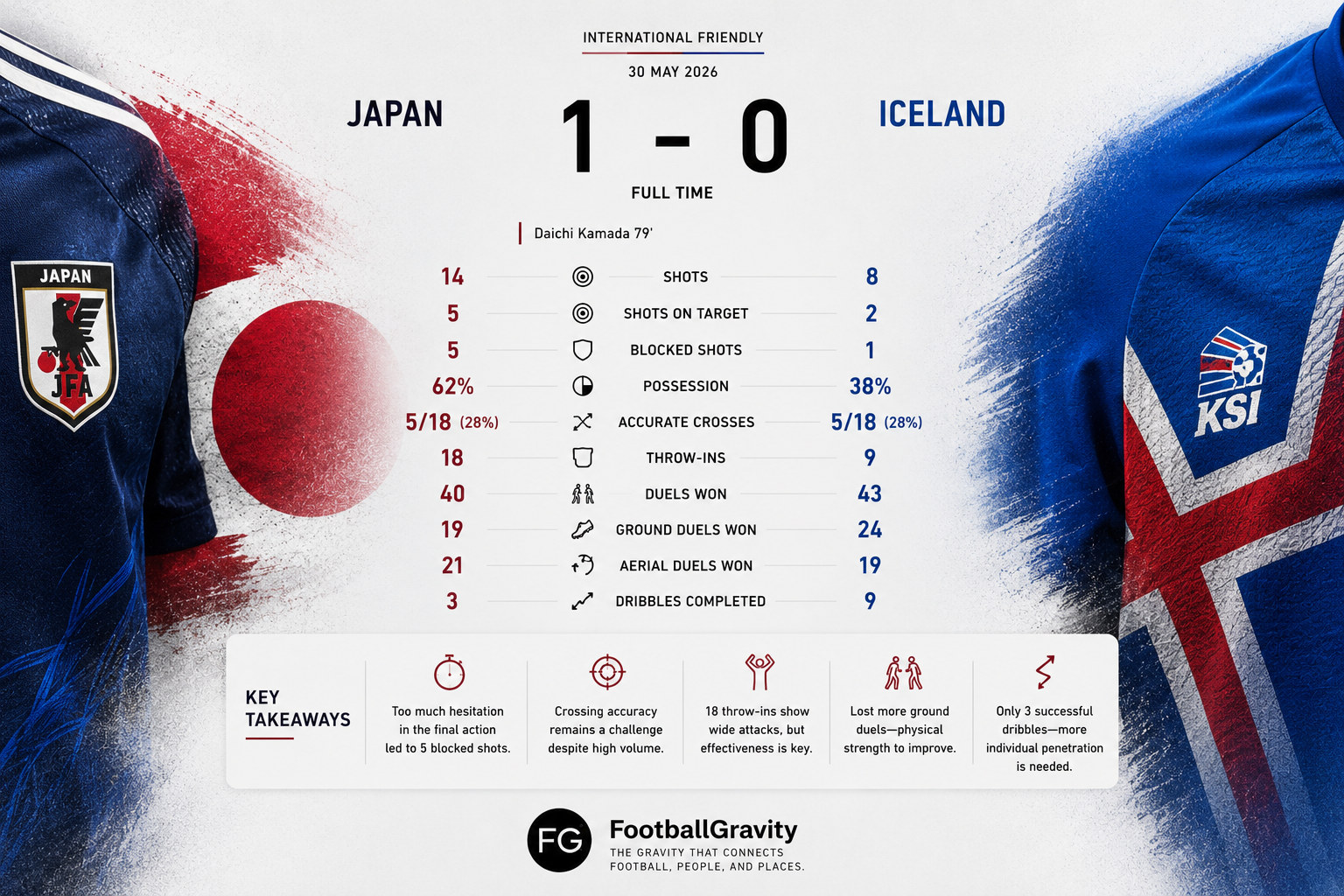
At first glance, Japan controlled many of the game’s core metrics. They recorded more shots, more shots on target, and more possession. Yet despite that territorial advantage, the match rarely felt fully comfortable.

One number stands out immediately: five blocked shots.

That suggests Japan were reaching dangerous areas, but often taking too long to create clean shooting angles or separation inside the box. Against physically compact European defenses, even a fraction of hesitation can be enough for defenders to close space. The issue may not have been chance creation itself, but the speed and sharpness of the final action.

Crossing efficiency also remains an important topic.

Both teams completed five accurate crosses, but Japan required many more attempts to reach that number. A 28% crossing accuracy rate is not disastrous, but at World Cup level, wide attacks often depend on precision rather than volume. Improving timing, positioning, and delivery quality could make Japan’s possession far more dangerous.

Another quietly revealing statistic was throw-ins.

Japan recorded 18 throw-ins — nearly double Iceland’s total. That indicates Japan spent long periods advancing play into wide areas, but it also raises the question of whether those situations were converted into meaningful attacking momentum. Modern football increasingly treats throw-ins as structured attacking phases rather than simple restarts, especially against compact defensive blocks.

Perhaps the most important concern, however, came from the duel numbers.

Japan lost the overall duel battle 40–43, and more notably struggled in ground duels. Interestingly, their aerial duel numbers were relatively competitive, which may surprise many observers given common assumptions about European physical superiority. The larger issue appeared to be second-ball reactions, body positioning, and direct physical resistance in tight spaces.

Dribble success was also limited. Japan completed only three successful dribbles during the match. The absence of Kaoru Mitoma naturally changes the attacking profile of the team, but it also highlighted how heavily Japan sometimes depends on individual progressive carries to destabilize defenses.

Still, this is precisely why matches like this matter before a World Cup.

The performance did not expose fatal weaknesses. Instead, it clarified the margins Japan must sharpen: quicker decision-making near goal, cleaner delivery from wide areas, stronger ground duels, and more individual penetration in transition moments.

The encouraging part is that many of these are adjustable details rather than structural problems.

Japan already showed organization, patience, and enough technical quality to control large portions of the match. What remains is transforming control into efficiency against opponents who are physically disciplined and tactically compact — exactly the type of teams they are likely to face on football’s biggest stage.

In that sense, Iceland may have provided Japan with something more valuable than an easy victory: a realistic reminder of the intensity still waiting at the World Cup.

PSG’s Control Was Not About Possession Alone

Paris Saint-Germain and Arsenal ended the Champions League final level on the scoreboard.
The match eventually went to penalties.

But beneath the drama, the data tells a very different story.

This was not a balanced game that happened to finish 1-1.
It was a match in which PSG controlled the rhythm, geography, and mental tempo of football itself.

And the clearest symbol of that control may have been Vitinha.


The Match Was Played Inside PSG’s Network

At first glance, Arsenal defended bravely.

They limited clear chances.
They survived long stretches without collapsing.
Declan Rice fought aggressively, covered space, and tried to slow transitions.

But PSG gradually created something more exhausting than pressure.

They created permanence.

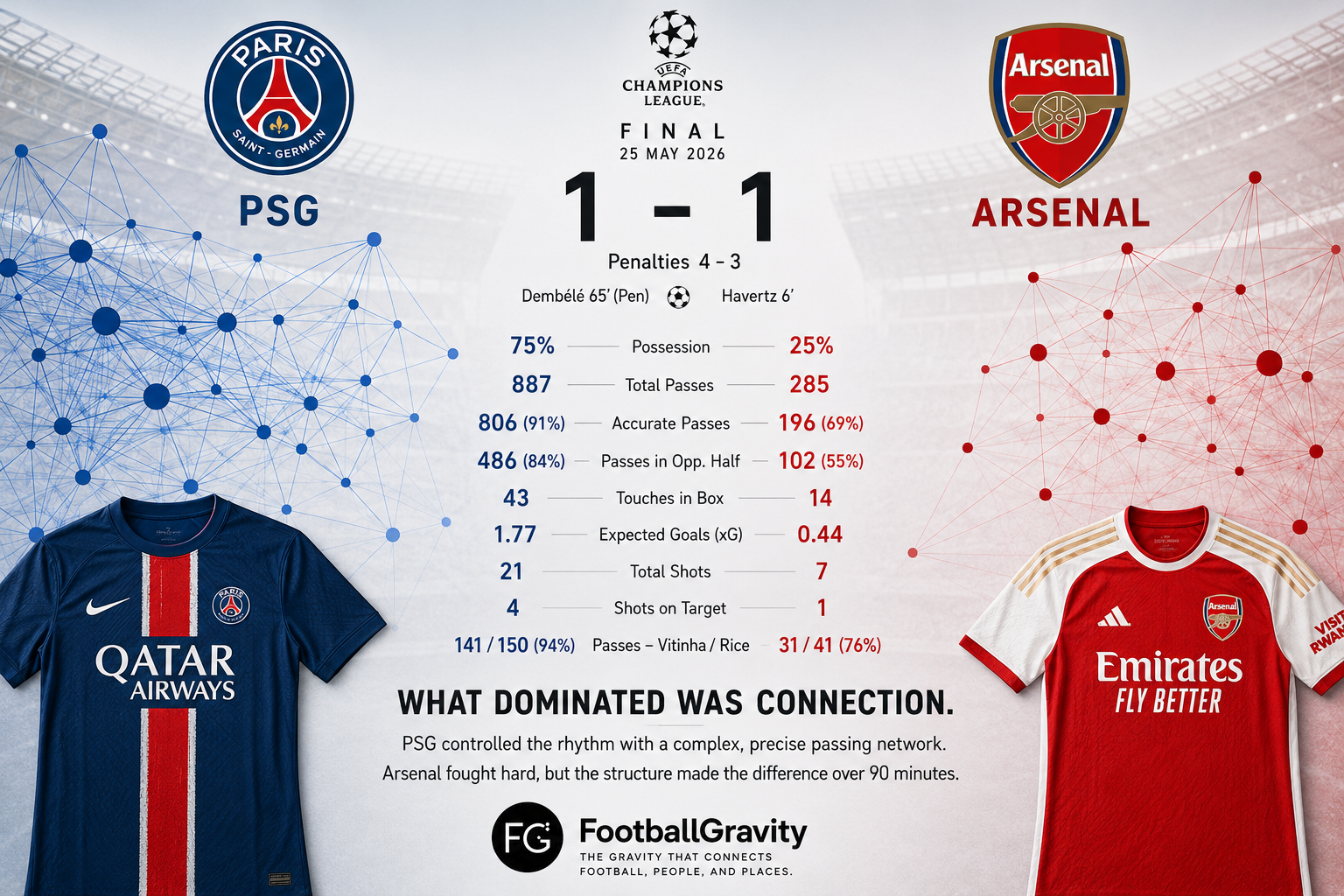
  • 75% possession
  • 887 total passes
  • 806 accurate passes (91%)
  • 486 successful passes in Arsenal’s half
  • 43 touches inside Arsenal’s box

These are not simply attacking numbers.

They describe territorial occupation.

PSG did not only move the ball.
They moved Arsenal.

Every pass forced another defensive shift.
Another rotation.
Another sprint without recovery.

Football fatigue is often invisible.
Sometimes players become tired not from running forward, but from chasing shadows.


Vitinha Was the Center of Gravity

Vitinha completed 141 passes.

Declan Rice completed 31.

The difference is extraordinary, especially considering both players operated near the center of midfield.

Even accounting for different tactical roles, the gap reflects something deeper:

PSG’s midfield existed as a connected circulation system.
Arsenal’s midfield existed as a reaction system.

Vitinha’s heatmap tells the story clearly.

He was everywhere:

  • receiving from defenders,
  • escaping pressure,
  • progressing the ball,
  • recycling possession,
  • controlling tempo.

Rice, meanwhile, spent much of the match compressing space, defending transitions, and responding to PSG’s positioning.

This is not criticism of Rice.

In many ways, Rice performed heroically.

But one player was dictating the geometry of the game.
The other was trying to survive it.

That difference matters.


PSG’s Passing Network Became Psychological Pressure

One of the most interesting numbers is not xG.

It is pass accuracy.

  • PSG: 91%
  • Arsenal: 69%

At elite level football, this gap is enormous.

High possession alone is not always meaningful.
Teams can circulate harmlessly.

But PSG’s passing was progressive, positional, and multidirectional.

Vitinha, João Neves, Fabián Ruiz, Hakimi, and Marquinhos constantly formed new passing triangles.
The ball rarely stayed still.

Arsenal could not lock onto stable reference points.

And when defending becomes mentally unstable, physical fatigue follows.

This is why PSG’s dominance felt larger than the scoreline.


Arsenal Still Threatened Through Chaos

And yet, football remains football.

Despite the control gap:

  • Arsenal still scored,
  • still created moments,
  • and still reached penalties.

That is important.

Football is not chess.

A team can dominate territory, possession, and rhythm — and still remain vulnerable to a single transition, set piece, rebound, or mistake.

That uncertainty is part of the sport’s beauty.

Arsenal’s approach relied less on control and more on compression, verticality, and isolated moments.

In another universe, perhaps one decisive counterattack changes everything.

Football always leaves room for alternative realities.


The Final Was About More Than Possession

This match may ultimately be remembered not for penalties, but for structure.

PSG looked like a team operating through interconnected movement and spatial intelligence.

Arsenal looked like a team fighting against a constantly shifting network.

Vitinha’s 141 passes are not just statistics.
They are evidence of a team turning football into circulation.

Not simply attacking.
Not simply defending.

But controlling the emotional and physical rhythm of the match itself.

And for long stretches of this final, Arsenal were not chasing the ball.

They were chasing PSG’s idea of football.

Was 5-0 an Accident?

Reading Kobe vs Kashima Through the Data

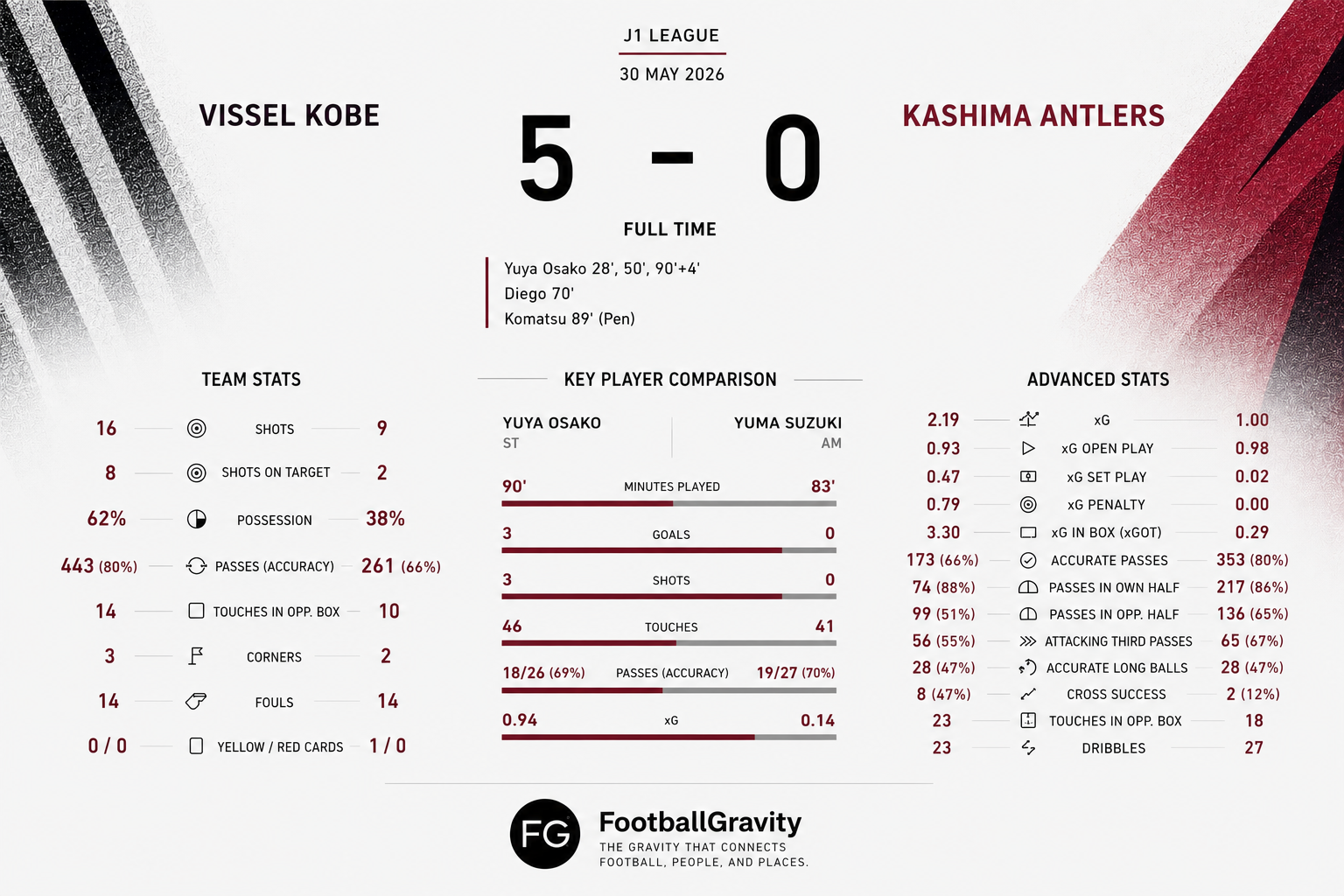
On May 30, 2026, Vissel Kobe defeated Kashima Antlers 5-0 in one of the most surprising results of the J.League season.Before kickoff, many expected Kashima — last season’s champions and dominant leaders of the East League — to control the match. Instead, football produced something far less predictable.


The Match Everyone Expected — and the One That Actually Happened

Before kickoff, the atmosphere around the game leaned naturally toward Kashima.

Defensive stability.
Organized structure.
Physical intensity.
And an attack built around Yuma Suzuki.

Kobe, meanwhile, possessed experience and individual quality, but many still viewed Kashima as the more complete and reliable side.

Ninety minutes later, however, the scoreboard showed 5-0.

And perhaps most surprisingly, the match did not feel like a random collapse caused by a red card or chaotic counterattacks.

There were long stretches where Kobe appeared fully in control.


The Two Aces

Yuya Osako vs Yuma Suzuki

The clearest contrast in the match came through the two strikers.

Yuya Osako (Kobe)

  • 3 goals
  • xG: 0.94
  • xGOT: 1.64
  • 3 shots on target
  • 50% shot conversion
  • 7 touches inside the box
  • 2/2 successful long balls
  • Defensive contribution: 2

Meanwhile:

Yuma Suzuki (Kashima)

  • 0 goals
  • xG: 0.14
  • xGOT: 0.00
  • 0 shots on target
  • Ground duel success: 22%
  • Aerial duel success: 0%

The difference was extreme.


Osako Was More Than Clinical

One of the most interesting details is that Osako’s xG (0.94) was not unusually high for a player who scored three times.

In other words, Kobe did not simply create endless open chances.

Instead:

Osako converted a limited number of high-value moments with extraordinary efficiency.

The most revealing number may actually be:

xGOT: 1.64

This metric reflects shot placement quality — how dangerous the shot became after leaving the foot.

Osako’s finishing precision was exceptional.

He repeatedly:

  • arrived in the correct space,
  • timed his movements perfectly,
  • and directed shots into difficult areas for the goalkeeper.

This was not only a striker scoring goals.

It was an elite center-forward controlling decisive moments.


What Happened to Yuma Suzuki?

In contrast, Yuma Suzuki was effectively removed from dangerous areas.

His heatmap shows him dropping deeper and deeper in search of the ball.

But the numbers reveal the larger problem:

  • 4 touches inside the box
  • 0 shots on target
  • xG: 0.14

Kobe prevented him from operating where he is most dangerous.

Even more significant were the duels:

  • Ground duel success: 22%
  • Aerial duel success: 0%

Kobe’s center-backs consistently won the physical battles, preventing Kashima from establishing a stable attacking reference point.

As a result, Kashima struggled to:

  • progress forward cleanly,
  • retain possession in advanced areas,
  • and recover second balls consistently.

The attack never stabilized.


Kashima Were Not Actually Terrible

Despite the 5-0 scoreline, the data suggests Kashima were not completely dominated.

For example:

  • xG: Kashima 1.00
  • Total shots: 9
  • Shots inside the box: 7
  • Touches inside opponent box: 18

This indicates that Kashima still reached relatively dangerous attacking positions.

Their open-play xG (0.98) was also respectable.

But the decisive gap appeared in:

xGOT

Kobe: 3.30
Kashima: 0.29

The difference was not simply chance creation.

It was finishing quality.

Kobe transformed chances into highly accurate shots. Kashima reached promising areas, but failed to produce dangerous final execution.


Why Kobe Won

Not Through Chaos — But Through Maturity

Kobe did not win this match through relentless pressing alone.

What stood out instead was:

  • game management,
  • positional balance,
  • ball retention,
  • timing,
  • and emotional control.

At the center of all of it was Yuya Osako.

An especially fascinating layer to this story is that Osako himself was once Kashima’s great striker.

Several players on the pitch knew each other well.

And yet, Osako seemed to understand the emotional rhythm of a “final-like” match better than anyone else on the field.


Was 5-0 an Accident?

Probably not entirely.

But it would also be misleading to say the true gap between the teams was five goals.

Football occasionally creates scorelines where:

  • finishing efficiency,
  • confidence,
  • momentum,
  • psychology,
  • and atmosphere

suddenly amplify everything.

This felt like one of those matches.

The game tilted heavily toward Kobe, and once the emotional balance shifted, the scoreline expanded rapidly.


Football sometimes produces results that feel impossible to fully explain.

Data helps organize the match.

But numbers alone cannot completely capture:

  • tension,
  • confidence,
  • momentum,
  • memory,
  • familiarity,
  • or the instinctive feeling of an elite striker in decisive moments.

5-0.

Behind that score existed something more complicated than luck or simple superiority.

It was a match where football’s emotional and psychological forces amplified reality itself.


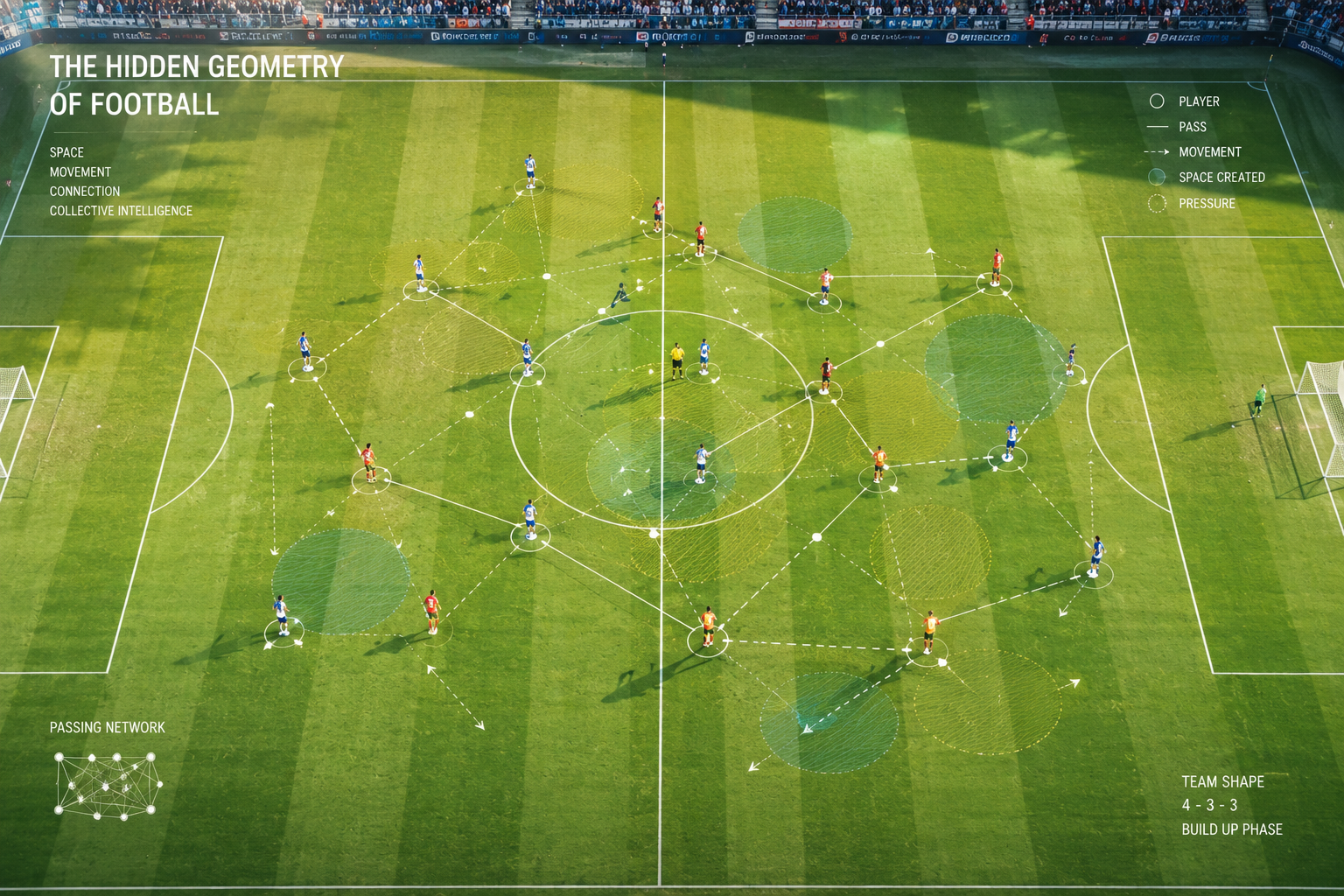
The Hidden Geometry of Football

Why football is not only played with the ball — but through space, timing, and collective movement.

rom above, football looks different.

The chaos disappears.

What remains is movement.

Lines begin to emerge across the pitch. Spaces open and close. Players rotate, compress, spread, and reorganize in response to one another.

At times, football resembles less a sport and more a living system.

Modern football is often described through goals, tactics, or statistics. But beneath all of these exists something more fundamental:

geometry.

Not static geometry, but moving geometry — shaped collectively by twenty-two players sharing the same space in real time.

And perhaps that is one reason football feels beautiful even before we fully understand why.

Football Is About Space Before the Ball

One of football’s paradoxes is that the ball itself occupies only a small fraction of the game.

Most of football happens away from it.

Players constantly adjust positioning in anticipation of future movement. Defenders close passing lanes before passes occur. Midfielders create angles before receiving. Forwards manipulate space simply through their presence.

At the highest level, football becomes a continuous negotiation over territory, distance, and timing.

This is why elite teams often appear calm even under pressure.

They are not reacting only to the ball.

They are reacting to space.

Teams Move Like Networks

Football teams are often analyzed through formations.

But formations are only starting points.

During matches, teams behave more like dynamic networks than fixed structures.

Passing triangles emerge temporarily and disappear seconds later. Connections strengthen or weaken depending on pressure, fatigue, and momentum.

Some players function as hubs. Others create bridges between distant areas of the pitch.

Modern data analysis increasingly visualizes football through passing networks, positional maps, compactness metrics, and spatial occupation models.

Yet even without statistics, supporters intuitively sense these invisible structures.

We feel when a team is connected.

And we feel when it is not.

Collective Movement and Crowd Intelligence

Football is not only collective on the pitch.

It is collective in the stands as well.

Crowds synchronize emotionally through chants, reactions, gestures, and anticipation. Thousands of individuals begin behaving as part of a larger system.

Atmosphere emerges from coordination.

Sometimes consciously. Often unconsciously.

This may explain why football stadiums feel fundamentally different from many other forms of entertainment.

People are not merely consuming an event.

They are participating in a temporary collective experience.

In that sense, football culture resembles something closer to ritual than spectacle.

Why Football Feels Beautiful

The beauty of football rarely comes from isolated moments alone.

It emerges from relationships.

The timing of a pass. The balance between movement and stillness. The tension between structure and improvisation.

Great football often feels inevitable only after it happens.

A sequence of movements aligns for a few seconds, and suddenly the entire pitch appears synchronized.

Perhaps this is why football remains so emotionally powerful across cultures and generations.

Because underneath the competition, football reveals something deeply human:

our ability to move together within shared space.

Football is often described through results.

Wins. Losses. Transfers. Statistics.

But beneath those surface narratives exists another layer — quieter, more spatial, and more connected.

A game shaped by geometry, rhythm, anticipation, and collective movement.

And maybe that hidden structure is what continues to draw millions of people toward the sport every week, across cities, languages, and borders.