
The Soundtrack of Football

Football stadium atmosphere with music and supporters during the World Cup

From Queen to Bon Jovi, from England to Dallas

Football has never been only a game of feet.

It is also a game of voices.

Before kickoff, after the final whistle, during a hydration break, on the way back from the stadium, in pubs, trains, fan zones and living rooms, football is always surrounded by music.

At the FIFA World Cup 2026, that feeling has become especially visible.

Songs echo through stadiums not simply as background entertainment, but as part of the tournament itself.

Bon Jovi’s “Livin’ on a Prayer” has become one of the most joyful stadium moments of this World Cup. It is not a football song in a literal sense. Yet somehow, when tens of thousands of people sing it together, it becomes one.

That is the strange power of football music.

Football does not simply borrow songs.

It gives them a second life.

Why Rock Fits Football

The connection between football and music is not accidental.

In England, where the modern game was born, football and rock music have long shared similar social roots.

Both grew from working-class culture.

Both belong to crowds.

Both understand hope, frustration, resistance and release.

That is why songs such as “Wonderwall” by Oasis or “We Will Rock You” by Queen feel so natural in football spaces. They are not tactical. They are emotional.

Football is full of moments when ordinary people believe something extraordinary might happen.

Rock music has always understood that feeling.

The underdog.

The comeback.

The last-minute goal.

The impossible night.

In that sense, football and rock have always spoken the same language.

Stadium Classics

Some songs become football songs not because they were written for football, but because football crowds adopted them.

“You’ll Never Walk Alone” is the clearest example. From Liverpool to stadiums far beyond England, it has become a song of belonging.

“Seven Nation Army” by The White Stripes has travelled even further. Its riff became a universal chant, crossing clubs, countries and languages.

“Freed From Desire” by Gala became another modern stadium anthem, while “Sweet Caroline” has turned into a collective release for England supporters and many others.

These songs work because they are simple enough to share.

A chant.

A rhythm.

A phrase.

A feeling.

Football crowds do not need perfect singing.

They need something to sing together.

World Cup Memories

The World Cup has also created its own official soundtrack.

Ricky Martin’s “The Cup of Life” still carries the bright energy of France 1998.

Shakira’s “Waka Waka” remains perhaps the most globally recognised World Cup song of the modern era.

K’naan’s “Wavin’ Flag” captured another kind of tournament emotion: not just celebration, but longing, movement and global connection.

For Japanese fans, Vangelis’ “Anthem” from the 2002 World Cup carries a special memory. It belongs to the moment when the tournament came to Japan and Korea, and when the World Cup felt physically close for the first time.

The older FIFA Anthem, familiar from the 1990s and early 2000s, also remains deeply connected to the ritual of international football. Even without words, it could make a stadium feel official.

In 2026, Shakira and Burna Boy’s “Dai Dai” continues that tradition, reminding us that World Cup music is no longer tied to one region or one genre. It is global by design.

Japan’s Football Songs

Every football country has its own soundtrack.

Japan is no exception.

UKASUKA-G, the unit formed by Kazutoshi Sakurai of Mr.Children and GAKU-MC, created music closely associated with the Japan national team. “Shori no Emi wo Kimi to” became a familiar song of support for many Japanese fans.

Superfly’s “Tamashii Revolution” is another song that instantly evokes football in Japan. For many supporters, it belongs to the emotional memory of watching the national team on television.

Dragon Ash’s “Fantasista” is different again. It carries the energy of Japanese rock and street culture at the turn of the century, when football was becoming more global, more stylish and more connected to youth culture.

In 2026, Kenshi Yonezu’s “Karasu” adds a new layer as NHK’s soccer theme, showing that Japan continues to create new songs for each football generation.

These songs may not all be known globally.

But that is exactly the point.

Football music is universal because every country has its own version.

Football in Advertising

Some football songs arrive through television rather than stadiums.

Nike’s legendary “Good vs Evil” commercial from the 1990s remains one of the most memorable examples.

Eric Cantona, Ronaldo, Maldini and other stars appeared in a dramatic football fantasy, soundtracked by “Mas Que Nada.”

The song itself was not new.

But the advertisement gave it a football image for a generation of fans.

This is another way football works with music.

It does not always create new songs.

Sometimes it changes how we remember old ones.

A FootballGravity Playlist

This is not a ranking.

It is a matchday journey.

Matchday Warm-up

  • “Livin’ on a Prayer” — Bon Jovi
  • “Don’t Stop Me Now” — Queen
  • “Fantasista” — Dragon Ash
  • “Tamashii Revolution” — Superfly
  • “Shori no Emi wo Kimi to” — UKASUKA-G

Stadium Anthems

  • “You’ll Never Walk Alone” — Gerry & The Pacemakers
  • “Seven Nation Army” — The White Stripes
  • “Wonderwall” — Oasis
  • “We Will Rock You” — Queen
  • “Freed From Desire” — Gala
  • “Sweet Caroline” — Neil Diamond

World Cup Memories

  • “The Cup of Life” — Ricky Martin
  • “Waka Waka” — Shakira feat. Freshlyground
  • “Wavin’ Flag” — K’naan
  • “Dai Dai” — Shakira & Burna Boy
  • “Anthem” — Vangelis
  • “FIFA Anthem” — Franz Lambert
  • “John Denver” – Take Me Home, Country Roads

Victory, Defeat, and the Road Home

  • “We Are the Champions” — Queen
  • “Breakthru” — Queen
  • “Mas Que Nada” — Sérgio Mendes
  • “Karasu” — Kenshi Yonezu
  • “Fix You” — Coldplay

Listen while reading:

Apple Music Playlist
YouTube Playlist

One More Song Before Kickoff

Football needs tactics.

It needs data.

It needs training, scouting, travel, climate control, stadium design and recovery science.

But it also needs songs.

A song can turn a neutral stadium into a shared place.

A song can give courage to a nervous crowd.

A song can heal defeat.

A song can follow supporters long after the match has ended.

Whether your team is still dreaming of the trophy or already heading home, football always leaves us one more thing to carry.

A melody.

Enjoy the soundtrack of this World Cup.

And remember that football has never been only ninety minutes.

Listen While Reading

Music is part of football culture.

We’ve collected the songs featured in this article so you can continue the matchday atmosphere wherever you are.

🎵 Apple Music Playlist

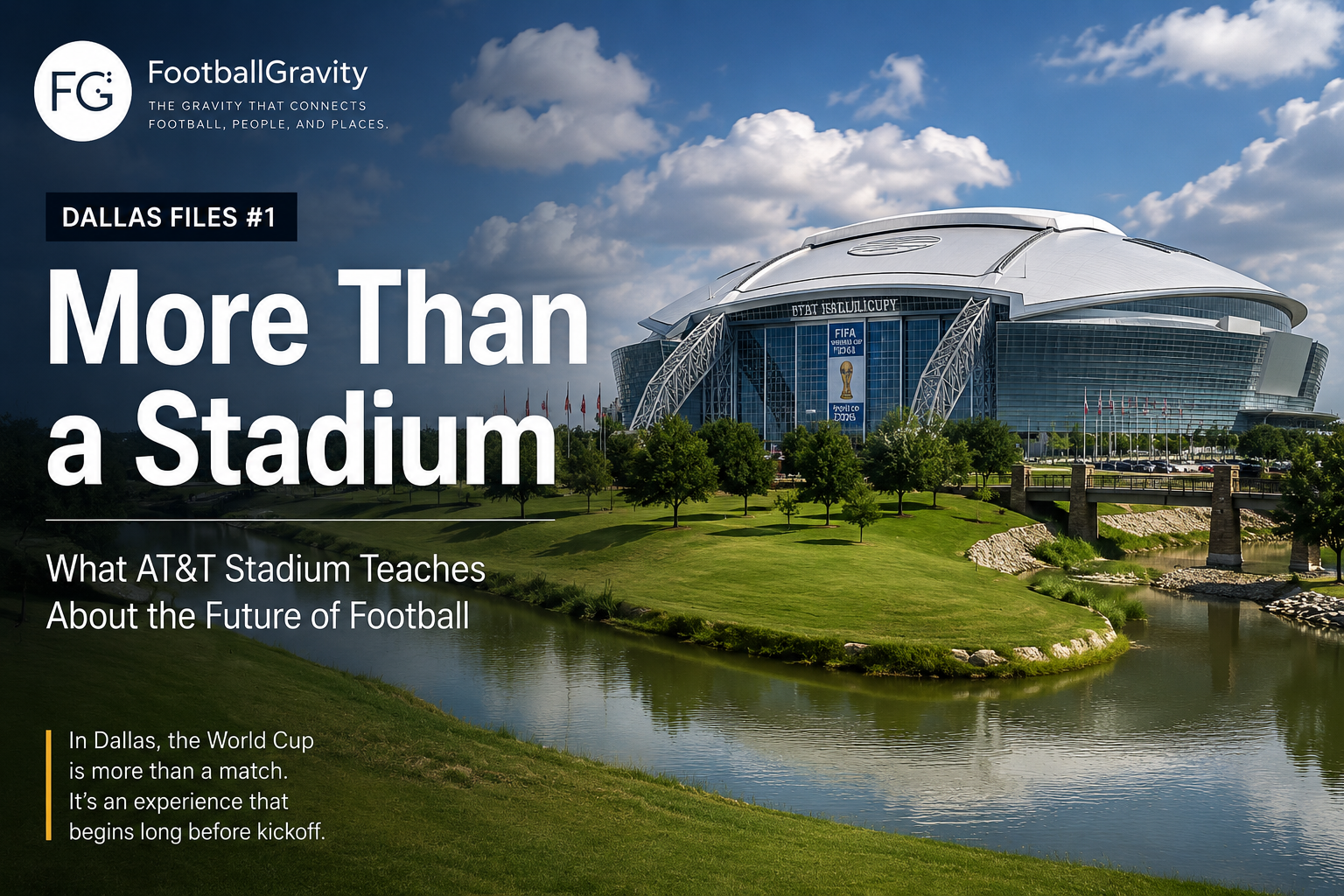
Dallas Files #1

More Than a Stadium

What AT&T Stadium Teaches About the Future of Football

Most stadium reviews begin with seats, food, or atmosphere.

AT&T Stadium deserves a different approach.

After spending an entire matchday there during the FIFA World Cup 2026, one thing became clear:

This is not simply a stadium.

It is an ecosystem.

Before You Even Enter

The experience begins long before the ticket gates.

Instead of surrounding visitors with endless parking lots and concrete roads, the stadium opens into something unexpected.

Wide green spaces.

Walking paths.

Small waterways.

Trees.

Open lawns where families gather and supporters relax before kickoff.

It feels less like approaching a sports venue and more like arriving at a public park.

Supporters naturally slow down.

They walk.

They sit.

They talk.

The World Cup begins well before the referee blows the whistle.

A Festival Rather Than an Entrance

Beyond the security gates, the atmosphere changes again.

Food trucks.

Music.

Outdoor seating.

Large grassy areas.

Fans from different countries eating together under the Texas sun.

Children kicking footballs.

Groups taking photos.

Rather than simply waiting for kickoff, people spend hours enjoying the place itself.

The stadium is not merely a destination.

It is an all-day festival.

That distinction matters.

Great tournaments are remembered not only for ninety minutes of football, but for the experiences surrounding those ninety minutes.

AT&T Stadium understands this perfectly.

Designed Around the Spectator

Inside, the architecture continues to impress.

The most iconic feature is the enormous centre-hung video board, manufactured by Mitsubishi Electric.

Unlike traditional stadiums, where replay screens sit high behind one goal, this display hangs directly above the centre circle.

The difference is surprisingly significant.

Supporters never need to turn completely away from the pitch.

The action, the replays and the atmosphere remain connected.

Rather than interrupting the match experience, the technology becomes part of it.

Combined with the stadium’s powerful sound system, the effect is closer to a live concert than a conventional football match.

Every goal celebration feels immersive.

Every pre-match sequence feels cinematic.

It is entertainment without sacrificing football itself.

Small Details That Matter

The stadium’s scale is extraordinary, yet movement inside rarely feels stressful.

Restrooms remained remarkably accessible.

Food and drink outlets were distributed throughout the concourses.

Even with tens of thousands of spectators, congestion was surprisingly limited.

These details rarely appear in highlight videos.

Yet they shape the overall experience just as much as the match itself.

The best stadiums succeed because thousands of small design decisions quietly disappear into the background.

More Than Home Advantage

For Japan, there may also be a competitive benefit.

Playing two Group F matches in the same stadium means familiarity.

The climate is controlled beneath the roof.

Players become accustomed to the lighting, the pitch, the sightlines and even the rhythm of the venue.

These are subtle advantages, but tournament football is often decided by subtle margins.

A Stadium That Belongs to the City

AT&T Stadium is frequently described as one of the world’s greatest sporting venues.

After spending an entire day there, that reputation feels deserved.

What impressed me most was not its size.

It was the way architecture, public space, football and everyday life blended into one continuous experience.

Many stadiums host matches.

Few become part of the city itself.

Perhaps the future of football is not simply about building bigger stadiums.

Perhaps it is about building better places.

And AT&T Stadium offers a compelling blueprint for what that future might look like.

When Weather Decides the World Cup

Children playing football in the rain under dramatic skies during a stormy World Cup-inspired atmosphere

Football Cannot Escape Nature

The 2026 FIFA World Cup is already raising concerns about extreme heat.

Cooling breaks.
Adjusted kickoff times.
Debates over player safety and physical performance.

For months, the conversation around this tournament has focused on temperature.

But there is another element that may shape the World Cup just as much — and strangely, almost nobody is talking about it.

Weather itself.

Rain.
Humidity.
Wind.
Storms.
Mud.

Football has always belonged to nature more than many modern sports are willing to admit.

And this summer, nature may return to the center of the game.


Japan vs Netherlands — In the Rain?

Japan’s opening match against the Netherlands is currently forecast to be played in rainy conditions.

How many people even know that?

World Cup football is often remembered through bright sunlight, dry stadiums, and cinematic skies. Qatar 2022, held in winter in the Middle East, rarely dealt with rain at all. Even earlier tournaments — Russia 2018 or the previous United States World Cup in 1994 — are not widely associated with wet-weather football.

But football itself was never designed for perfect laboratory conditions.

It was built outdoors.
On imperfect grass.
Inside wind.
Inside rain.

And perhaps climate change is now quietly pushing the sport back toward those uncontrollable realities.


Football Is a Sport Played With Uncertainty

Most sports try to eliminate uncertainty.

Football never fully could.

The ball is round.
The pitch changes.
The weather changes.
Human bodies tire differently under heat, humidity, or rain.

And unlike many sports, football almost never stops for bad weather.

Unless lightning becomes dangerous, the match continues.

Anyone who has played football in the rain remembers the feeling instantly:
the unpredictable bounce,
the wet grass,
the slightly delayed reaction of the body,
the slide tackles that travel farther than expected.

There is frustration in it.
But also excitement.

Because in those moments, you are not only playing against the opponent.

You are also playing with nature itself.


The Endurance of Pressing Football

Modern football increasingly depends on physical intensity.

High pressing.
Repeated sprints.
Compact defensive transitions.

But heavy heat and humidity change everything.

Even the most carefully organized pressing systems begin to collapse when the body cannot recover oxygen quickly enough.

Rain creates different problems.

A wet pitch speeds up some passes while slowing others.
Timing changes.
Defenders hesitate.
Goalkeepers lose certainty.
One unexpected skid can decide an entire tournament.

At the highest level of international football, few teams truly want more uncertainty.

Yet uncertainty may become unavoidable.


Which Countries Adapt Better?

That raises an uncomfortable and fascinating question.

Which football cultures are actually better prepared for climate uncertainty?

South American teams may possess natural familiarity with unstable conditions.
Many Asian nations regularly deal with heavy rain, humidity, and exhausting summer climates.
African teams often grow up playing in environmental conditions European players rarely experience.

Perhaps resilience itself becomes an advantage.

Or perhaps Europe — through tactical structure, squad depth, and control — once again proves capable of managing uncertainty better than anyone else.

The World Cup may become not only a competition between football systems,
but between relationships with nature itself.


Football Was Never Meant To Be Perfect

Modern football increasingly seeks precision.

Data.
Control.
Optimization.
Scientific recovery.
Perfect passing angles.

But weather reminds the sport of its original character.

Football is not played inside a simulation.

It is played on Earth.

And maybe that is why rainy matches remain strangely memorable.
Not because they are clean.
But because they feel alive.

The 2026 World Cup may ultimately be remembered not only for tactics or stars,
but for something much older:

Twenty-two players trying to negotiate with nature.

J.League’s Carnival of Change

On June 13, 2026 — just one day before Japan’s opening match at the FIFA World Cup — the J.League will attempt something remarkably unusual.

Not simply an All-Star game.

A football carnival.

Six teams.
Including mixed squads from J1, J2, and J3.
Fan-selected players divided into East and West selections.
Seven matches played consecutively in a one-day knockout tournament.
Each game lasting only 30 minutes.

In football, there is almost no precedent for this kind of format.

If anything, it feels closer to gaming culture, combat sports events, or even professional wrestling entertainment than traditional league football.

And that may be exactly why it matters.

Football Searching for New Forms

Football has always balanced two forces.

Tradition and adaptation.

The sport protects its rituals carefully: 90 minutes, league tables, home and away seasons, continental structures built over decades. Those traditions carry memory, identity, and local culture.

But football is also alive.

And living systems change.

Former Barcelona defender Gerard Piqué once explained the philosophy behind the Kings League by saying younger generations no longer watch full 90-minute matches the same way previous generations did. Whether one agrees or disagrees with that observation, it reflects a reality many leagues are now confronting.

Attention spans shift.
Media consumption changes.
Audiences fragment.

The question is not whether football should abandon tradition.

It should not.

The question is whether football can create safe spaces for experimentation without damaging the foundations that make the sport meaningful.

An All-Star event may be the perfect place to try.

A Tournament Designed for Curiosity

What makes this J.League project fascinating is not simply its entertainment value.

It is the willingness to experiment publicly.

Thirty-minute matches naturally create urgency.
Tournament structures increase unpredictability.
Mixed-division squads disrupt normal hierarchies.
Fans are invited not only to watch, but to participate in the construction of the event itself.

The result feels less like a conventional exhibition match and more like a living laboratory for football culture.

Not every experiment succeeds.

But leagues that never experiment eventually become static.

And static systems rarely stay healthy forever.

Football, Energy, and Life

In biology, adaptation is often described as the key to survival.

But perhaps the idea goes even deeper.

From the perspective of energy and modern physics, one could argue that change itself is a sign of life. Living systems continuously reorganize, exchange energy, and evolve through interaction with their environment.

A perfectly static organism is no longer alive.

In that sense, maybe leagues are not so different.

A league willing to test new formats, invite uncertainty, and reimagine its relationship with supporters may reveal something important: not instability, but vitality.

Football is not merely preserved through repetition.

Sometimes, it survives through movement.

More Than Entertainment

This All-Star tournament may ultimately become a one-time curiosity.

Or it may influence future football events in subtle ways.

Either outcome is valuable.

Because the most interesting part is not whether every rule works perfectly.

It is that the J.League is willing to ask new questions at all.

And in modern football — where many institutions become increasingly cautious, commercialized, and predictable — curiosity itself may be one of the rarest strengths left.

Gravity and the Ball

In a small park at sunset, children were practicing juggling.

Most of them could not even reach ten touches consistently. The ball would bounce away after three, five, sometimes eight touches. Then they would run after it, place it carefully back on the ground, and start again.

Again.
And again.

Even after the sky slowly turned orange.

There is something strangely beautiful about football juggling.

At its core, it is an endless conversation with gravity.

Kick the ball upward, and it always comes back down. According to Newtonian physics, gravitational acceleration is effectively constant on Earth. The speed at which the ball falls does not care whether you are a child in a park, a professional footballer, or a retired player in your sixties.

The ball always returns at almost the same speed.

That shared rhythm is part of what makes football universal.

Little by little, the body adapts to that rhythm. Eyes begin to predict the fall. Ankles react slightly faster. Timing improves. One clean touch becomes two. Two become five.

And for a brief moment, the body feels synchronized with the laws of the planet itself.

That is why juggling is so addictive.

Every great footballer once followed the exact same falling ball.

Whether it was Dennis Bergkamp, Romário, Ronaldinho, Zinedine Zidane, or Japan’s Shinji Ono, they all spent countless hours adjusting themselves to the same gravity, the same uncertainty, and the same imperfect sphere.

Football is difficult precisely because the ball is round.

A perfect control is impossible. Even the greatest players misjudge a bounce or slightly mistime a floating pass. Human legs are not designed for precision in the same way human hands are. That instability — that constant possibility of failure — is what makes football beautiful.

If someone catches a square object with their hands, nobody is amazed.

But when a player cushions a spinning ball perfectly with one touch using their foot, chest, or thigh, people stop and stare. We admire it because we understand, instinctively, how difficult it really is.

We have all felt the ball bounce away from us before.

That shared experience matters.

The beauty of football does not come from perfect control. It comes from humanity trying to negotiate with imperfection.

And sometimes, for just one touch, it works.

One perfectly controlled juggling touch can feel magical. For a second, you feel connected to the same sensation experienced by the masters of the game.

For one touch, maybe you become Zidane.
For one touch, maybe you become Shinji Ono.

That is enough to make you smile and try again.

The Earth has changed across centuries, cultures, and generations. Stadiums became larger. Football became faster. Data became more sophisticated.

But gravity never changed.

And somewhere in the world, even tonight, a child is still kicking a ball upward and learning the same rhythm that footballers have followed for generations.

That may be one of football’s simplest and most beautiful truths.

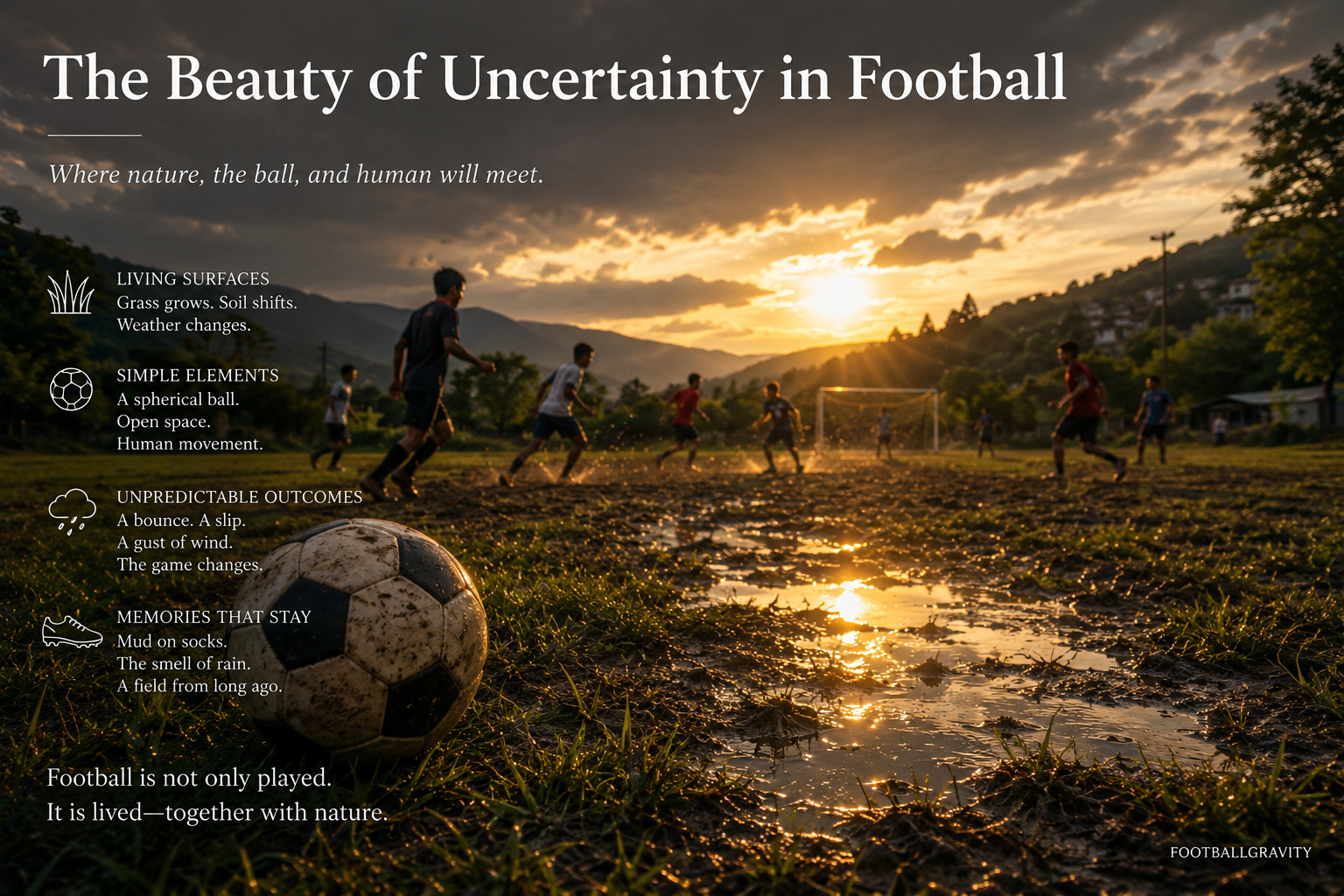
The Beauty of Uncertainty in Football

Football is shaped not only by players and tactics, but by grass, rain, soil, wind, and the unpredictable movement of a simple ball across living ground.


Some of the strongest memories in football are not only about goals.

They are about places.

The smell of wet grass after rain.
Dust rising from dry ground in summer.
Mud on socks.
Sand inside boots.
The sound of a ball bouncing differently on uneven soil.

Football has always existed slightly closer to nature than many modern sports.

And perhaps that connection is one reason the game still feels alive.


Football Is Played on Living Surfaces

Football is unusual because it is played directly on changing natural environments.

Grass grows. Soil shifts. Water changes movement. Wind alters trajectories.

Even at the highest level, football remains dependent on surfaces that are never completely identical from one day to the next.

That uncertainty influences everything.

Ball speed.
Passing rhythm.
Player balance.
Decision-making.

Ground conditions are not simply background scenery.

They participate in the match itself.

In some stadiums, grass is cut shorter to increase passing speed. In heavy rain, the game slows into physical struggle. On dry pitches, the ball moves unpredictably across rough surfaces.

Football constantly negotiates with the physical world around it.


The Ball, the Field, and Uncertainty

At its core, football is surprisingly simple.

A spherical ball.
Open space.
Human movement.

And yet from those simple elements emerges endless unpredictability.

Perhaps this is part of football’s beauty.

The ball never moves perfectly. The surface is never completely controlled. The environment always introduces small variations beyond human intention.

A wet patch changes a pass.
A bounce changes a goal.
Wind changes timing by fractions of a second.

Modern football increasingly relies on analysis, precision, and optimization.

But football never becomes fully programmable.

Nature still interrupts the system.

And maybe that interruption is essential.


Artificial Perfection — and What Gets Lost

Artificial turf reduces uncertainty.

The bounce becomes more predictable. Maintenance becomes easier. Conditions become more standardized.

In many situations, that consistency is practical and necessary.

Yet something subtle also disappears.

Perfectly controlled surfaces often reduce the strange emotional texture that natural environments create.

The game becomes cleaner.
More manageable.
More optimized.

But perhaps slightly less alive.

Because football has never been only about technical perfection.

It is also about adaptation.

Players responding to conditions they cannot fully control.

Teams negotiating rain, mud, friction, noise, fatigue, and atmosphere together in real time.

Natural imperfection creates part of the drama.


Why Football Memories Feel Physical

When people remember playing football as children, they rarely remember statistics.

They remember environments.

A local dirt field at sunset.
Grass stains on knees.
Cold air in winter training.
The uneven bounce that ruined or created a goal.

Football memories often remain tied to texture, weather, light, and landscape.

Perhaps this happens because football is experienced not only mentally, but physically through the environment itself.

The game enters memory through the senses.

And unlike many increasingly digital experiences, football still depends on contact with real surfaces, changing conditions, and uncontrollable surroundings.


Football is often described through tactics, data, and systems.

But underneath all of those structures remains something older and simpler:

a ball moving across living ground.

Perhaps that is why football continues to feel universal across generations and cultures.

Because despite all modern technology, the game still depends on uncertainty.

Grass grows differently. Rain changes rhythm. Soil shifts beneath movement.

And somewhere between human intention, physical law, and the unpredictability of nature, football finds its beauty.


Football and the Future of Sustainable Cities

How football shapes mobility, public space, and urban life beyond the pitch.

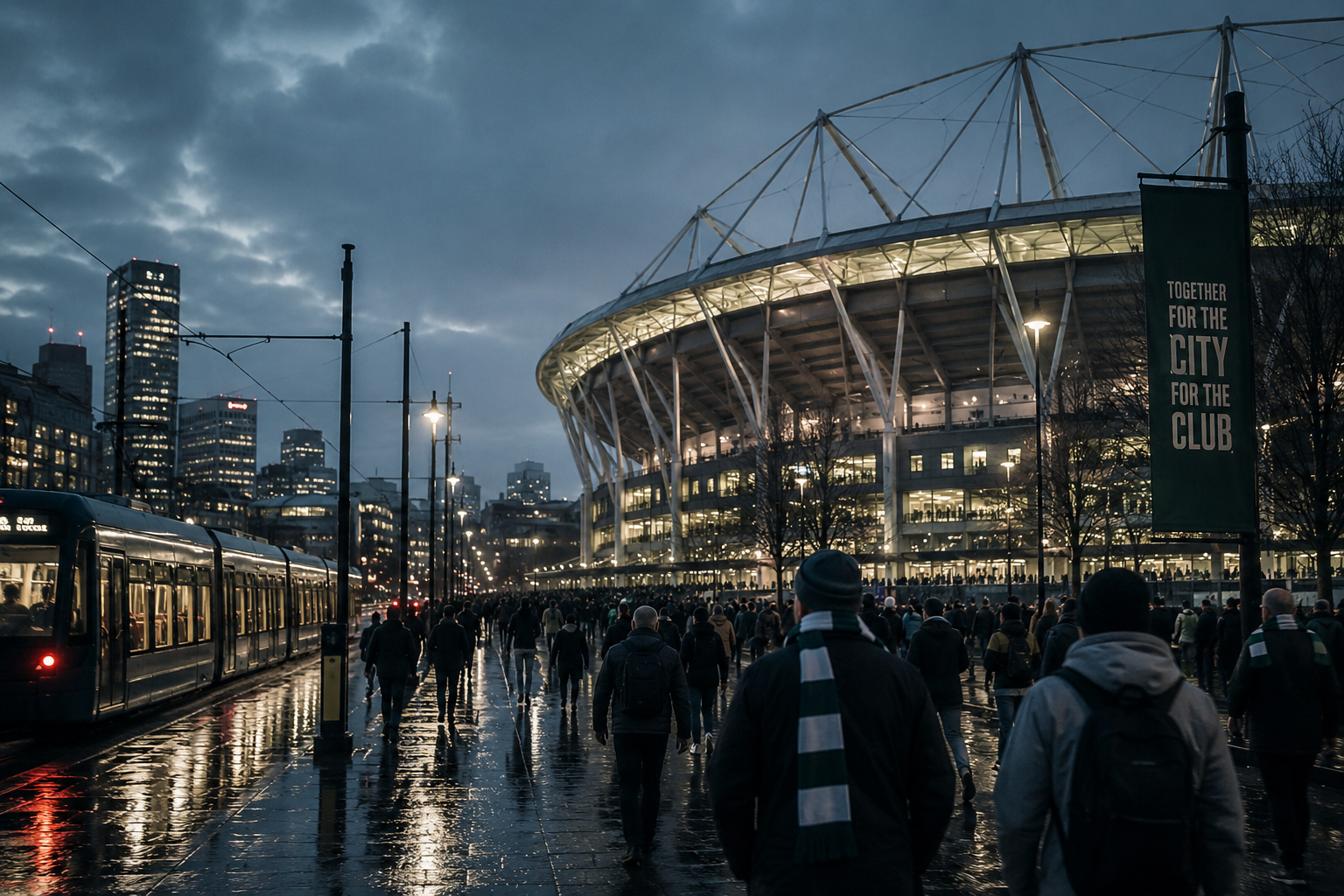
On matchdays, cities move differently.

Trains become louder. Streets stay active longer. Scarves appear across stations, bars, and sidewalks. Thousands of people begin moving toward the same destination — not only to watch a game, but to participate in a shared urban experience.

Football has always been deeply connected to cities.

Not just economically, but spatially, culturally, and emotionally.

A stadium is more than a sports venue. It is a temporary center of movement, energy, and collective behavior.

As cities around the world face challenges related to climate change, transportation, density, and social fragmentation, football may offer unexpected insights into how sustainable urban life can work.

Stadiums as Urban Ecosystems

A football stadium functions like a living urban system.

Before kickoff, transportation networks intensify. Trains, buses, bicycles, and pedestrians begin synchronizing around a fixed point in space and time.

Local restaurants become temporary gathering spaces. Public security systems adapt to crowd density. Energy consumption changes throughout surrounding districts.

In many European and South American football cultures, stadiums are deeply integrated into existing urban structures rather than isolated from them.

This matters.

Because sustainable cities are not only about reducing emissions. They are also about reducing unnecessary fragmentation between people, transportation, and public life.

Football naturally creates density, walkability, and shared movement.

Why Walkability Matters

One of football’s overlooked strengths is that it encourages people to move through cities together.

In many football cultures, supporters do not simply arrive at stadiums. They walk to them.

They pass through local streets, cafés, small businesses, train stations, and public squares.

This creates a different relationship between sport and urban life.

Car-dependent stadium environments often isolate football from surrounding communities. But walkable football culture strengthens local economies and reinforces a sense of place.

The experience begins long before kickoff.

And sometimes, that experience matters just as much as the match itself.

Football Clubs as Community Infrastructure

The world’s most influential football clubs are rarely just sports organizations.

They function as social institutions.

Youth academies, local outreach programs, educational partnerships, and community spaces often become part of the club ecosystem.

In some cities, football provides one of the few remaining shared identities across generations, cultures, and economic backgrounds.

This social dimension may become increasingly important in the future.

As many cities struggle with loneliness, fragmentation, and declining trust in public institutions, football continues to create physical spaces where people gather regularly and collectively.

That kind of social infrastructure is difficult to measure — but increasingly valuable.

Could Football Help Shape Better Cities?

Football alone cannot solve urban challenges.

But it can help us rethink them.

Future stadiums may become laboratories for sustainable mobility, renewable energy, cooling systems, and mixed-use public space.

More importantly, football reminds us that cities are not only systems of infrastructure.

They are systems of human movement and emotional connection.

And perhaps that is why football still matters so deeply in urban life around the world.

Perhaps football has never been only about football.

It may also be about how people learn to share space, movement, atmosphere, and identity together.

In that sense, the future of football and the future of cities may be more connected than we think.