
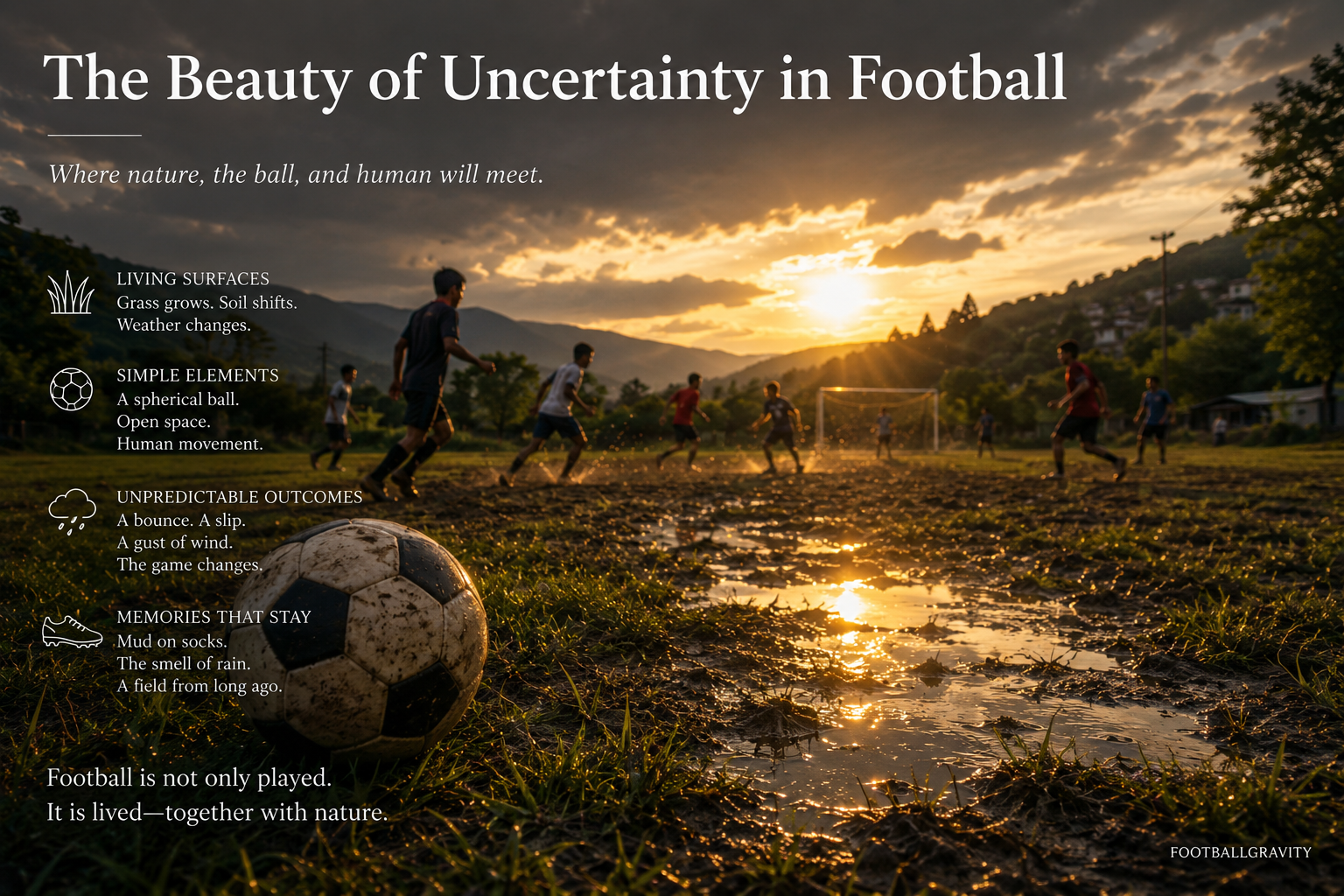
The Beauty of Uncertainty in Football

Football is shaped not only by players and tactics, but by grass, rain, soil, wind, and the unpredictable movement of a simple ball across living ground.


Some of the strongest memories in football are not only about goals.

They are about places.

The smell of wet grass after rain.
Dust rising from dry ground in summer.
Mud on socks.
Sand inside boots.
The sound of a ball bouncing differently on uneven soil.

Football has always existed slightly closer to nature than many modern sports.

And perhaps that connection is one reason the game still feels alive.


Football Is Played on Living Surfaces

Football is unusual because it is played directly on changing natural environments.

Grass grows. Soil shifts. Water changes movement. Wind alters trajectories.

Even at the highest level, football remains dependent on surfaces that are never completely identical from one day to the next.

That uncertainty influences everything.

Ball speed.
Passing rhythm.
Player balance.
Decision-making.

Ground conditions are not simply background scenery.

They participate in the match itself.

In some stadiums, grass is cut shorter to increase passing speed. In heavy rain, the game slows into physical struggle. On dry pitches, the ball moves unpredictably across rough surfaces.

Football constantly negotiates with the physical world around it.


The Ball, the Field, and Uncertainty

At its core, football is surprisingly simple.

A spherical ball.
Open space.
Human movement.

And yet from those simple elements emerges endless unpredictability.

Perhaps this is part of football’s beauty.

The ball never moves perfectly. The surface is never completely controlled. The environment always introduces small variations beyond human intention.

A wet patch changes a pass.
A bounce changes a goal.
Wind changes timing by fractions of a second.

Modern football increasingly relies on analysis, precision, and optimization.

But football never becomes fully programmable.

Nature still interrupts the system.

And maybe that interruption is essential.


Artificial Perfection — and What Gets Lost

Artificial turf reduces uncertainty.

The bounce becomes more predictable. Maintenance becomes easier. Conditions become more standardized.

In many situations, that consistency is practical and necessary.

Yet something subtle also disappears.

Perfectly controlled surfaces often reduce the strange emotional texture that natural environments create.

The game becomes cleaner.
More manageable.
More optimized.

But perhaps slightly less alive.

Because football has never been only about technical perfection.

It is also about adaptation.

Players responding to conditions they cannot fully control.

Teams negotiating rain, mud, friction, noise, fatigue, and atmosphere together in real time.

Natural imperfection creates part of the drama.


Why Football Memories Feel Physical

When people remember playing football as children, they rarely remember statistics.

They remember environments.

A local dirt field at sunset.
Grass stains on knees.
Cold air in winter training.
The uneven bounce that ruined or created a goal.

Football memories often remain tied to texture, weather, light, and landscape.

Perhaps this happens because football is experienced not only mentally, but physically through the environment itself.

The game enters memory through the senses.

And unlike many increasingly digital experiences, football still depends on contact with real surfaces, changing conditions, and uncontrollable surroundings.


Football is often described through tactics, data, and systems.

But underneath all of those structures remains something older and simpler:

a ball moving across living ground.

Perhaps that is why football continues to feel universal across generations and cultures.

Because despite all modern technology, the game still depends on uncertainty.

Grass grows differently. Rain changes rhythm. Soil shifts beneath movement.

And somewhere between human intention, physical law, and the unpredictability of nature, football finds its beauty.
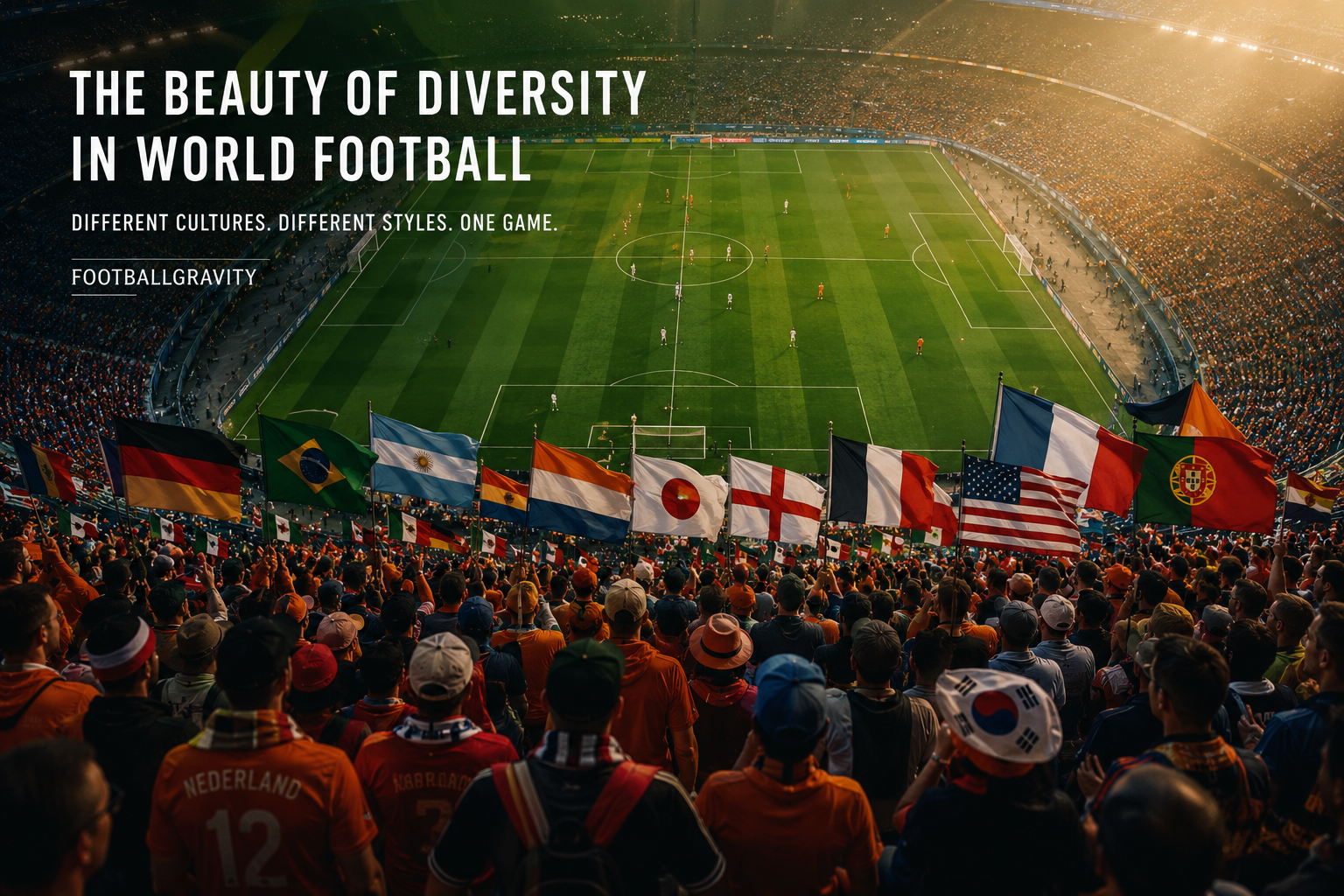
Football Beyond Tactics: Why the World Cup Feels Different in Every Country

The World Cup is not only a tournament of football.
It is a collision of histories, personalities, aesthetics, and national identities.


Every World Cup feels familiar.

And yet, every World Cup feels completely different.

Different rhythms.
Different emotions.
Different atmospheres.

Some teams appear calm and structured. Others feel chaotic, improvisational, emotional, or explosive.

Supporters sing differently. Players celebrate differently. Even the movement of teams across the pitch often reflects deeper cultural tendencies.

The World Cup is not only a tournament between nations.

It is a meeting point between different ways of seeing the world.

And perhaps that diversity is one reason football continues to feel uniquely global.


Football as Cultural Expression

Football is often discussed through tactics and results.

But international football has always carried something larger than sport.

National teams become temporary expressions of identity.

Not in a simplistic sense, but through atmosphere, style, rhythm, emotional behavior, and collective psychology.

Some countries value structure and discipline. Others celebrate improvisation and individuality. Some emphasize collective synchronization. Others rely on moments of genius.

Of course, modern football is increasingly globalized. Players train abroad. Coaches move internationally. Tactical systems spread rapidly.

Yet even today, traces of cultural personality still remain visible.

And supporters around the world continue to recognize them intuitively.


Germany: Precision, Physicality, and Resilience

Few football cultures carry a stronger historical identity than Germany.

German football has long been associated with structure, physical strength, tactical organization, and psychological resilience.

Even during difficult matches, German teams often appear emotionally stable. They continue pressing forward with discipline and intensity.

For decades, international football has attached almost mythological language to Germany:

“German efficiency.”
“The machine.”
“Never give up.”

These stereotypes are sometimes exaggerated, yet they emerged for a reason.

Germany repeatedly built teams capable of combining athletic power with strategic control.

From Franz Beckenbauer — “Der Kaiser” — to modern high-intensity pressing systems, German football often projects authority through organization.

Physically, German teams have also historically embodied a recognizable image:

high stamina,
strong duels,
powerful running,
and aerial dominance.

But perhaps the defining characteristic is mental.

Germany often appears most dangerous when matches become psychologically difficult.

Because resilience itself has become part of the football identity.


The Netherlands: Innovation, Individuality, and Beautiful Risk

If Germany represents structure, the Netherlands often represents imagination.

Dutch football has consistently produced ideas that changed the sport globally.

Total Football.
Positional fluidity.
The offside trap.
Technical spatial play.

For a relatively small country, the Netherlands has had an extraordinary tactical influence on world football.

And perhaps that influence reflects something broader within Dutch culture itself:

openness,
experimentation,
and a willingness to challenge convention.

The visual identity is equally distinctive.

Orange crowds.
Minimalist aesthetics.
Tall silhouettes moving fluidly across space.

Dutch football often feels stylish even before kickoff.

At the same time, Dutch football history is filled with strong personalities.

Johan Cruyff.
Marco van Basten.
Dennis Bergkamp.
Arjen Robben.

Many of these players possessed not only technical brilliance, but highly individual ways of interpreting the game.

Dutch teams can appear intellectually creative and emotionally fragile at the same time.

Moments of beauty coexist with moments of internal tension.

And perhaps that contradiction is part of what makes Dutch football endlessly fascinating.

The multicultural influence of migration — including players with Surinamese roots — has also shaped modern Dutch football identity in profound ways.

Technique, athleticism, rhythm, and creativity merged into something globally recognizable, yet difficult to replicate.


Why Difference Creates Beauty

Modern football is becoming increasingly interconnected.

Tactical ideas spread instantly online. Elite players move constantly between leagues. Training methods become standardized.

Yet during the World Cup, national differences still feel visible.

Not perfectly.
Not scientifically.
But emotionally.

And that emotional contrast matters.

Because football becomes more compelling when styles collide.

Control versus improvisation.
Structure versus freedom.
Collective discipline versus individual genius.

The World Cup is powerful not because every team is the same.

But because every team carries different histories, climates, social structures, and emotional cultures into the same tournament.

Football transforms those invisible differences into something visible on the pitch.


Perhaps the World Cup is ultimately a celebration of human diversity.

Different languages.
Different movements.
Different ideas of beauty.

And for a few weeks, those differences gather inside the same stadiums.

That is why the tournament feels larger than sport.

It becomes a global conversation played through atmosphere, identity, and movement.

And maybe that is the deepest gravity of football:

it allows the world to remain different — while still sharing the same game.

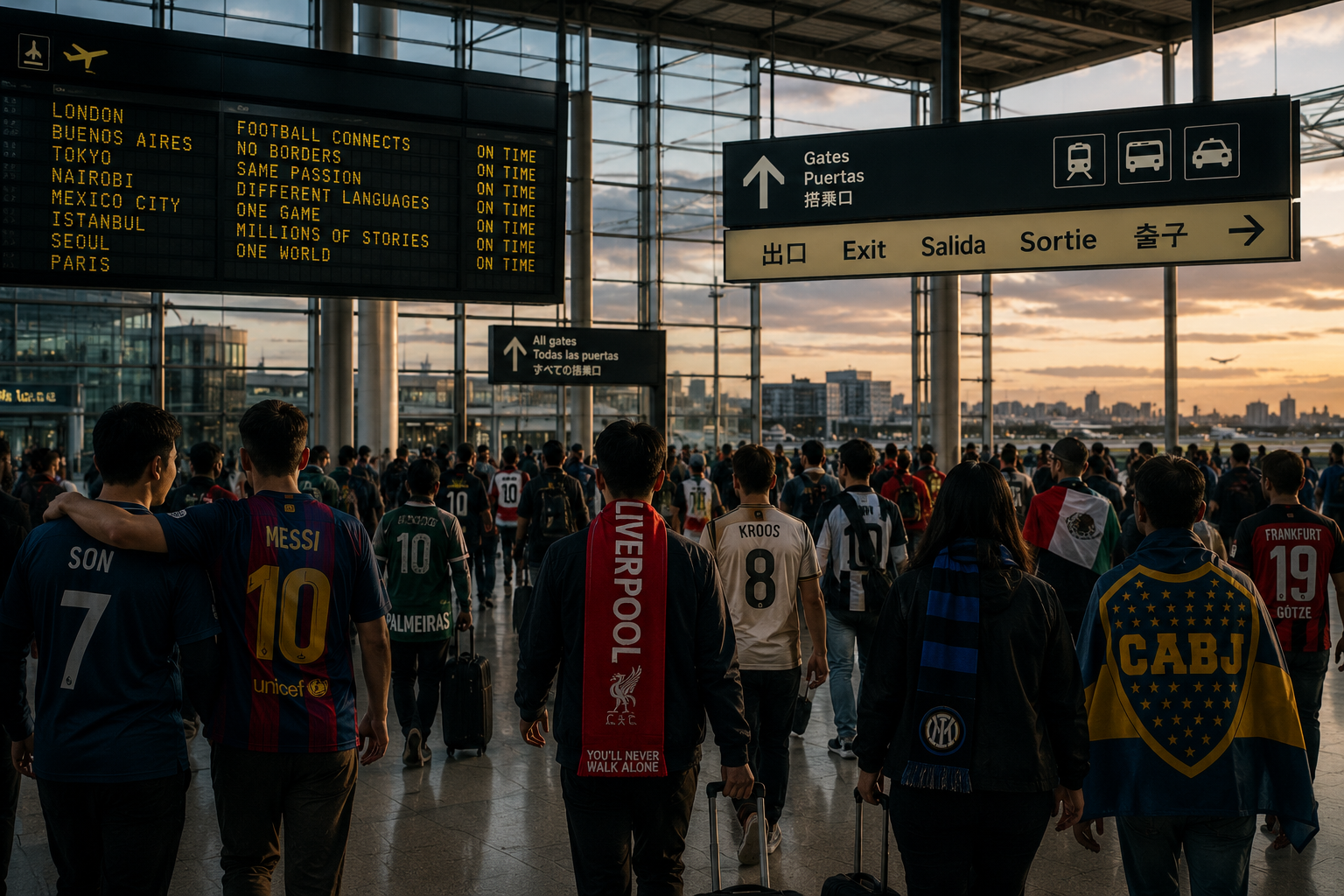
Football Beyond Borders

Why football continues to create connection across languages, cultures, and identities.

In many parts of the world, football begins long before kickoff.

It begins at airports.

At train stations. In crowded city centers. In conversations between strangers wearing different colors and speaking different languages.

A scarf from Buenos Aires appears in Tokyo. A supporter from Seoul shares a table with fans from Amsterdam. A child in Nairobi wears the shirt of a club thousands of kilometers away.

Football moves constantly across borders.

Not only through players and clubs, but through people, memory, migration, media, and emotion.

And perhaps that global movement is one reason the sport continues to feel uniquely powerful in an increasingly fragmented world.

A Shared Language Without Translation

Football is one of the few cultural experiences that can be understood almost immediately across languages.

A celebration. A collective gasp. A last-minute goal.

Even without translation, people recognize the emotional structure of the game.

This does not erase cultural differences. In fact, football often amplifies them through chants, traditions, styles of support, and local identity.

But at the same time, football creates temporary spaces where strangers can still participate in something shared.

That balance between difference and connection may be one of football’s most remarkable qualities.

Migration, Identity, and Football

Modern football has always been shaped by movement.

Players move between continents. Families migrate across borders. Supporters carry club identities far from their places of origin.

Many of today’s teams reflect multiple histories simultaneously.

A single squad may contain players with different languages, religions, and cultural backgrounds — all operating within the same collective structure.

Football does not remove complexity.

But it often provides a visible example of cooperation across identity.

And in many cities, football clubs become important cultural anchors for migrant communities and second-generation families navigating questions of belonging.

Clubs as Global Cultural Networks

Today, football clubs exist simultaneously in physical and digital space.

A supporter in Jakarta may wake up at 3 a.m. to watch a match in London. Fans in Mexico City discuss the same moment as supporters in Berlin or Lagos within seconds online.

Football communities increasingly operate like global networks connected through media, algorithms, and shared emotional investment.

Yet despite this digital expansion, football remains deeply physical.

People still travel across countries and continents to experience atmosphere directly — to hear chants in person, walk through stadium districts, and become temporarily part of a crowd.

In an era dominated by screens, that physicality still matters.

Why Football Still Creates Belonging

Many modern societies are experiencing increasing fragmentation.

People move more frequently. Communities become less stable. Public trust declines. Daily life becomes more individualized.

Football does not solve these problems.

But it continues to create recurring moments of collective presence.

People gather regularly in the same places. They wear shared symbols. They experience synchronized emotion with thousands of others.

Perhaps this explains why football remains emotionally resilient even as media environments rapidly change.

Because beneath the business, spectacle, and commercialization, football still satisfies something fundamentally human:

the desire to belong to something larger than ourselves.

Football crosses borders because people do.

The sport travels through migration, memory, media, and movement.

And wherever it arrives, football creates new local meanings while still remaining globally recognizable.

That tension between local identity and worldwide connection may be what makes football more than a game.

It becomes a shared human language — spoken differently in every city, but understood almost everywhere.

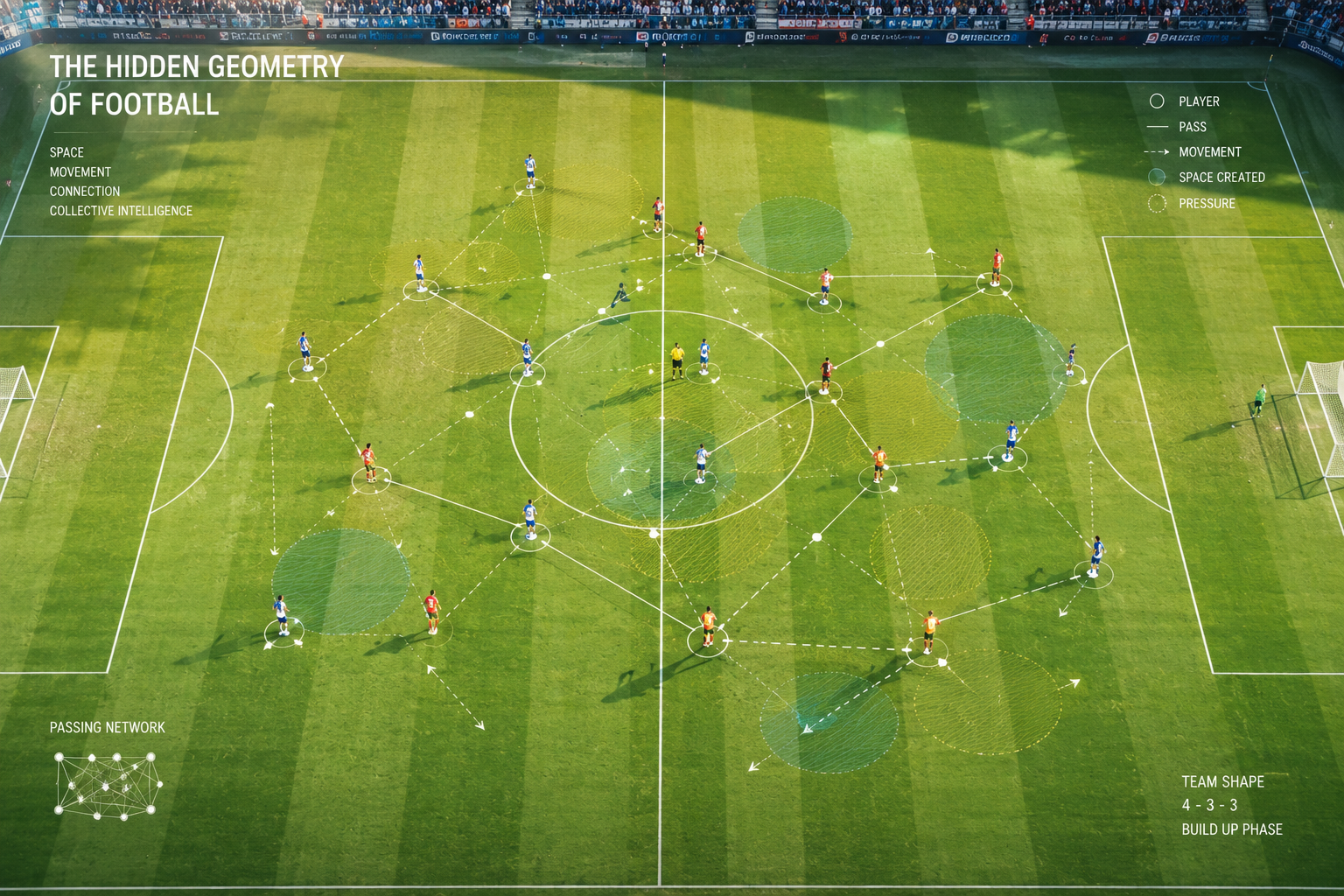
The Hidden Geometry of Football

Why football is not only played with the ball — but through space, timing, and collective movement.

rom above, football looks different.

The chaos disappears.

What remains is movement.

Lines begin to emerge across the pitch. Spaces open and close. Players rotate, compress, spread, and reorganize in response to one another.

At times, football resembles less a sport and more a living system.

Modern football is often described through goals, tactics, or statistics. But beneath all of these exists something more fundamental:

geometry.

Not static geometry, but moving geometry — shaped collectively by twenty-two players sharing the same space in real time.

And perhaps that is one reason football feels beautiful even before we fully understand why.

Football Is About Space Before the Ball

One of football’s paradoxes is that the ball itself occupies only a small fraction of the game.

Most of football happens away from it.

Players constantly adjust positioning in anticipation of future movement. Defenders close passing lanes before passes occur. Midfielders create angles before receiving. Forwards manipulate space simply through their presence.

At the highest level, football becomes a continuous negotiation over territory, distance, and timing.

This is why elite teams often appear calm even under pressure.

They are not reacting only to the ball.

They are reacting to space.

Teams Move Like Networks

Football teams are often analyzed through formations.

But formations are only starting points.

During matches, teams behave more like dynamic networks than fixed structures.

Passing triangles emerge temporarily and disappear seconds later. Connections strengthen or weaken depending on pressure, fatigue, and momentum.

Some players function as hubs. Others create bridges between distant areas of the pitch.

Modern data analysis increasingly visualizes football through passing networks, positional maps, compactness metrics, and spatial occupation models.

Yet even without statistics, supporters intuitively sense these invisible structures.

We feel when a team is connected.

And we feel when it is not.

Collective Movement and Crowd Intelligence

Football is not only collective on the pitch.

It is collective in the stands as well.

Crowds synchronize emotionally through chants, reactions, gestures, and anticipation. Thousands of individuals begin behaving as part of a larger system.

Atmosphere emerges from coordination.

Sometimes consciously. Often unconsciously.

This may explain why football stadiums feel fundamentally different from many other forms of entertainment.

People are not merely consuming an event.

They are participating in a temporary collective experience.

In that sense, football culture resembles something closer to ritual than spectacle.

Why Football Feels Beautiful

The beauty of football rarely comes from isolated moments alone.

It emerges from relationships.

The timing of a pass. The balance between movement and stillness. The tension between structure and improvisation.

Great football often feels inevitable only after it happens.

A sequence of movements aligns for a few seconds, and suddenly the entire pitch appears synchronized.

Perhaps this is why football remains so emotionally powerful across cultures and generations.

Because underneath the competition, football reveals something deeply human:

our ability to move together within shared space.

Football is often described through results.

Wins. Losses. Transfers. Statistics.

But beneath those surface narratives exists another layer — quieter, more spatial, and more connected.

A game shaped by geometry, rhythm, anticipation, and collective movement.

And maybe that hidden structure is what continues to draw millions of people toward the sport every week, across cities, languages, and borders.