
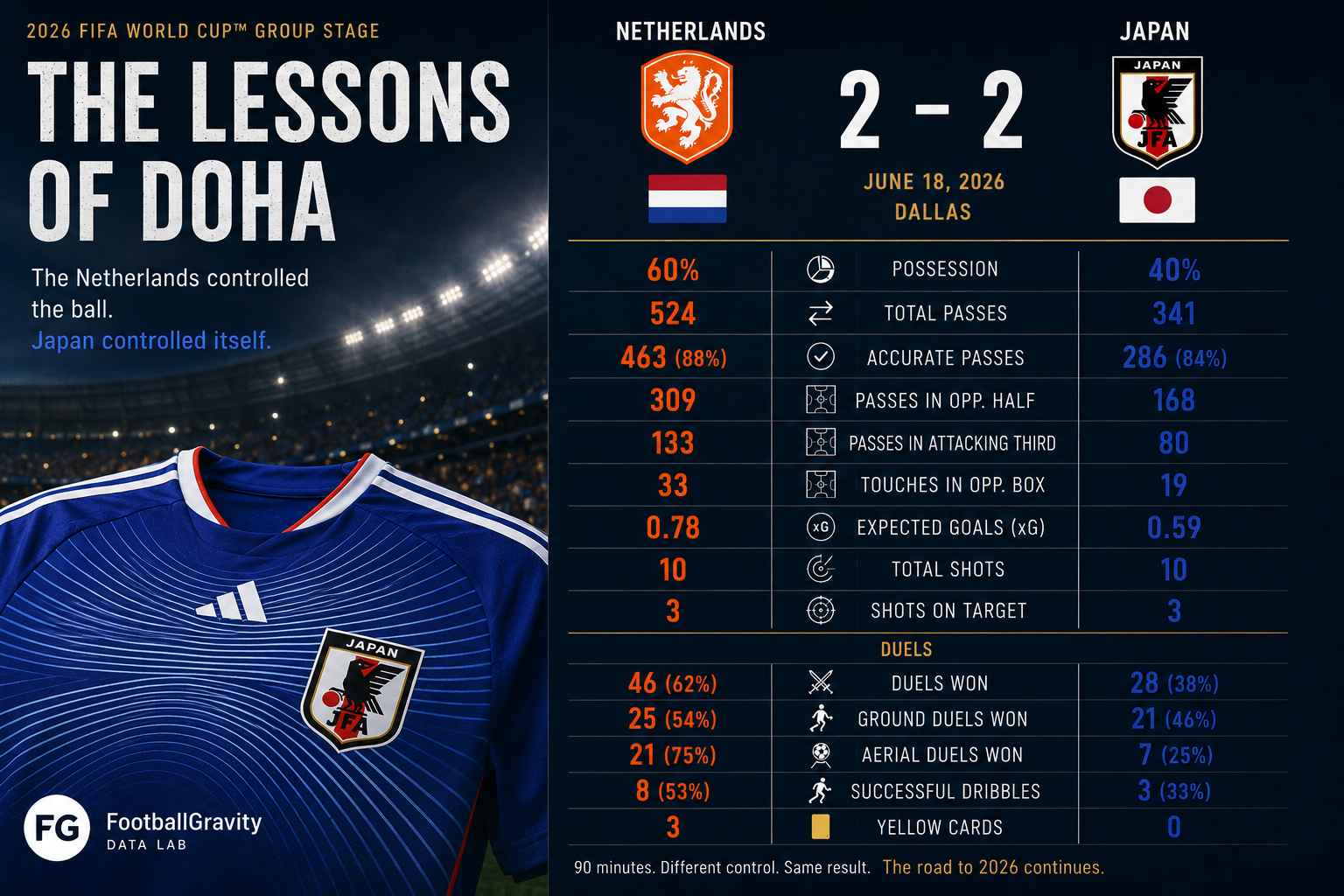
The Netherlands and Japan was one of the most anticipated group-stage matches of the 2026 FIFA World Cup.
Both nations arrived in the tournament with genuine ambitions of reaching the latter stages. The Netherlands entered as one of Europe’s most consistent contenders, while Japan carried growing expectations after its remarkable performances in recent World Cups.
The match delivered.
A dramatic 2-2 draw combined technical quality, tactical discipline, and moments of individual brilliance. More importantly, it revealed something about how this Japanese team has evolved.
Numbers Favored the Netherlands
The statistics suggested a Dutch advantage.
The Netherlands controlled 60 percent of possession, completed more than 500 passes, and generated slightly more territorial control throughout the match. They entered Japan’s penalty area more frequently and dictated long stretches of the game’s rhythm.
On paper, it was the Netherlands who controlled the match.
Yet the contest never felt one-sided.
Japan accepted periods without the ball, remained organized, and repeatedly found ways to respond whenever momentum appeared to swing against them.
That may have been the most important statistic of all.
A Match Played in Quarters
The Texas heat created an unusual dynamic.
Cooling breaks effectively divided the match into shorter segments, making the game feel closer to a four-quarter contest than a traditional ninety-minute match.
For some teams, interruptions can disrupt momentum.
For Japan, they seemed to provide opportunities.
Players gathered frequently, exchanged information, and recalibrated their positioning. The team appeared to treat every restart as a chance to reset collectively.
Combined with halftime and the moments immediately following each conceded goal, Japan effectively received multiple opportunities to reorganize and refocus.
Each time, they returned looking composed.
The Difference Between Panic and Control
One of the most striking aspects of the match was what did not happen.
After conceding goals, there were no visible signs of frustration. No blaming teammates. No emotional collapse. No rush to abandon the game plan.
The reactions looked almost routine.
As if difficult moments had already been anticipated and rehearsed.
This was not a team trying to avoid mistakes.
It was a team prepared for them.
That distinction matters at a World Cup.
Tournament football is rarely won by teams that avoid adversity. It is often won by teams that know how to respond when adversity inevitably arrives.
Japan looked ready.
The Long Shadow of Doha
Japanese football has carried the memory of Doha for more than three decades.
The “Agony of Doha” in 1993 remains one of the defining moments in the nation’s football history. A World Cup dream disappeared in stoppage time, leaving lessons about concentration, game management, and emotional control that shaped an entire generation.
One of the players on the pitch that night was Hajime Moriyasu.
Today, he stands on the touchline as Japan’s head coach.
His team also carries another Doha memory.
In 2022, Japan produced one of the greatest achievements in its history by overturning Germany and Spain at the World Cup in Qatar.
The agony and the joy were born in the same city.
Both experiences appear woven into the identity of this team.
Watching Japan calmly navigate difficult moments against the Netherlands, it was difficult not to see traces of those lessons.
There was no sign of panic.
There was no sign of complacency.
A team shaped by both disappointment and triumph tends to understand that matches are never over until they truly are.
More Than a Draw
A 2-2 draw against the Netherlands will not define this tournament.
But it offered an important reference point.
The Netherlands may have controlled more of the ball.
They may have completed more passes and spent more time in advanced areas.
Japan controlled something else.
Themselves.
As the knockout stage approaches, that quality may prove just as valuable as any tactical system or statistical advantage.
From Doha to Dallas, Japanese football continues to carry its lessons forward.
And on one of the biggest stages in world football, those lessons were visible once again.