
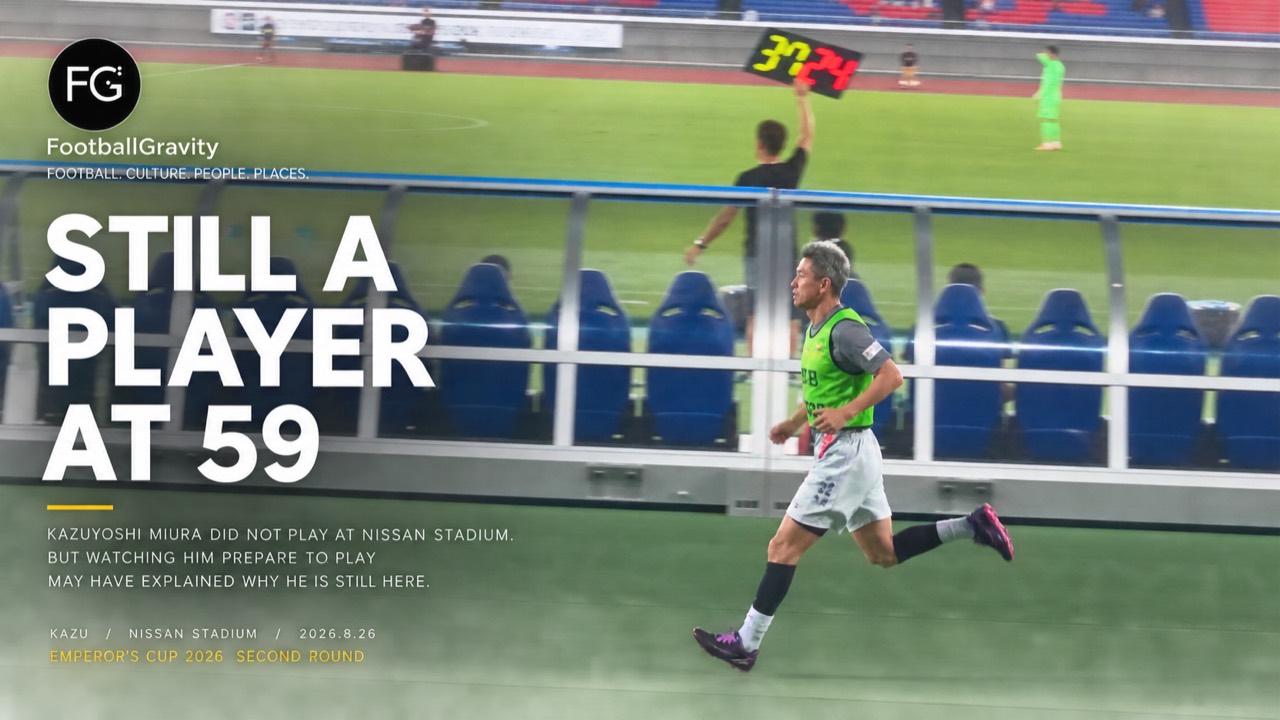
Kazuyoshi Miura did not play at Nissan Stadium. But watching him prepare to play may have explained why he is still here.
There was a strange anticipation around Nissan Stadium.
It was the second round of the Emperor’s Cup, Yokohama F. Marinos against Fukushima United. A J1 club against a J3 side. On paper, there were plenty of ordinary football reasons to watch.
But cameras kept turning towards one man on the touchline.
Kazuyoshi Miura.
Kazu.
King Kazu.
He is 59 years old.
And he was preparing to play professional football.
A Stadium Full of History
There was something fitting about the setting.
Nissan Stadium hosted the 2002 World Cup final. For Japanese football, it is one of those places where different eras seem to overlap.
Miura belongs to several of them.
Long before the J.League existed, he played in the rivalry between Yomiuri Club and Nissan Motors, the predecessors of two of the clubs that would help define the early professional game in Japan.
Then came the birth of the J.League, the national-team boom of the 1990s, Japan’s long pursuit of the World Cup, and Miura’s move to Serie A at a time when such a journey for a Japanese player still seemed almost unimaginable.
Now, more than three decades later, he was back beside the pitch at Nissan Stadium.
Across from him was another symbol of time.
Yokohama F. Marinos had 16-year-old Shin Miidera among their substitutes — a player 43 years younger than Miura. The possibility that the two might share the pitch became one of the stories surrounding the match.
It never happened.
Miidera came on in the 63rd minute. Miura remained on the bench. After the match, however, they exchanged shirts, and Miura encouraged the teenager to keep the passion he has now.
Football sometimes measures time more elegantly than a calendar.
The Player Who Never Came On
Yokohama led 1–0.
Fukushima stayed in the match.
And as the minutes passed, attention increasingly moved towards the Fukushima bench.
Would Kazu come on?
He warmed up.
Then he kept warming up.
Other substitutes gradually stopped. Miura continued.
From the stands, it was difficult not to notice.
There was nothing ceremonial about it.
He did not look like a famous former player waiting for the crowd to receive a nostalgic cameo. He looked like a substitute trying to convince his manager that he was ready.
Running.
Stretching.
Accelerating.
Again.
And again.
The photograph accompanying this article was taken from the stands that evening.
It is not a photograph of a goal.
It is not even a photograph of Miura playing football.
Perhaps that is why it says so much.
He Was Actually Trying to Get On
It would have been easy to assume that the appearance itself was the achievement.
At 59, merely being registered as a professional player is extraordinary.
But Miura’s behaviour suggested something different.
He genuinely expected that he might be needed.
That matters.
A week earlier, this was not simply nostalgia. Miura had started Fukushima’s Emperor’s Cup first-round match and scored twice from the penalty spot, extending his own record as the competition’s oldest scorer.
So when Fukushima needed a goal at Nissan Stadium, wondering whether he might appear was not entirely sentimental.
The substitution never came.
It is reasonable to wonder whether there was a way to use him. Fukushima were only one goal behind, and Miura is, after all, a forward. Supporters who had come hoping to see him play were understandably disappointed.
But perhaps the more interesting story begins precisely there.
Because Miura behaved as though disappointment changed nothing.
He kept preparing.
The Same Game
Miura’s career is often described through records.
Oldest player.
Oldest scorer.
Another year.
Another season.
Soon, perhaps, sixty.
But records may be the least interesting part of the story.
His career has repeatedly involved going somewhere where there was no obvious path.
As a teenager, he went to Brazil when becoming a professional footballer was hardly a conventional career in Japan.
He became one of the faces of the national team before Japan had ever played at a World Cup.
He went to Serie A.
Later came Croatia.
Australia.
And then the long journey through Japanese football that somehow never reached the expected final chapter.
Each move looked different.
But perhaps the underlying impulse was the same.
There was another place to go.
Another environment to enter.
Another version of himself to test.
At 59, the frontier is simply different.
There is almost no established map for what he is doing now.
How does a professional footballer train at 59?
How does he recover?
How much speed can be preserved?
How should his body be managed?
Can experience compensate for physical decline?
Can he still score?
There are few predecessors from whom to borrow the answers.
So, once again, Kazu is exploring.
Not a Legend Performing His Past
This is perhaps why arguments about whether Miura “should retire” often seem to miss the point.
If his objective were simply to protect his reputation, retirement would have been the easier option long ago.
His place in Japanese football history is already secure.
He does not need another appearance to become King Kazu.
What seems to matter is something else.
To train tomorrow.
To compete for selection.
To believe that the manager might call his number.
To enter the match.
To score.
That is a much more ordinary ambition.
And, at 59, an extraordinary one.
There is humility in that contradiction.
A man who helped transform Japanese football still accepts the most basic condition of being a footballer:
You may not be selected.
You may sit on the bench.
You may warm up for a long time.
And nobody owes you the next minute.
Former Sydney FC teammate and current Yokohama F. Marinos manager Steve Corica described Miura’s professionalism from their time together two decades ago and said that, seeing how carefully he managed his condition even then, it was understandable that he had been able to play for so long.
Perhaps longevity is built from moments exactly like this one.
Still Warming Up
The final whistle came.
Yokohama F. Marinos won 1–0.
Miura did not play.
The anticipated 43-year age-gap encounter never happened.
For anyone who came specifically to watch Kazu, there was disappointment.
But from the stands, there was also something unexpectedly satisfying about what remained.
A 59-year-old man had spent much of the evening preparing for a moment that never arrived.
And he prepared for it seriously anyway.
Maybe that is the point.
Miura has spent much of his football life moving towards places Japanese players had not yet reached.
Brazil.
Professional football.
The World Cup dream.
Serie A.
Croatia.
Australia.
And now this strange, almost unmapped territory beyond the conventional lifespan of an athlete.
People can debate how long he should continue.
Miura seems occupied by a different question.
How far can I go?
At Nissan Stadium, he never crossed the touchline.
But he kept running beside it.
Still preparing.
Still hoping.
Still a player.