
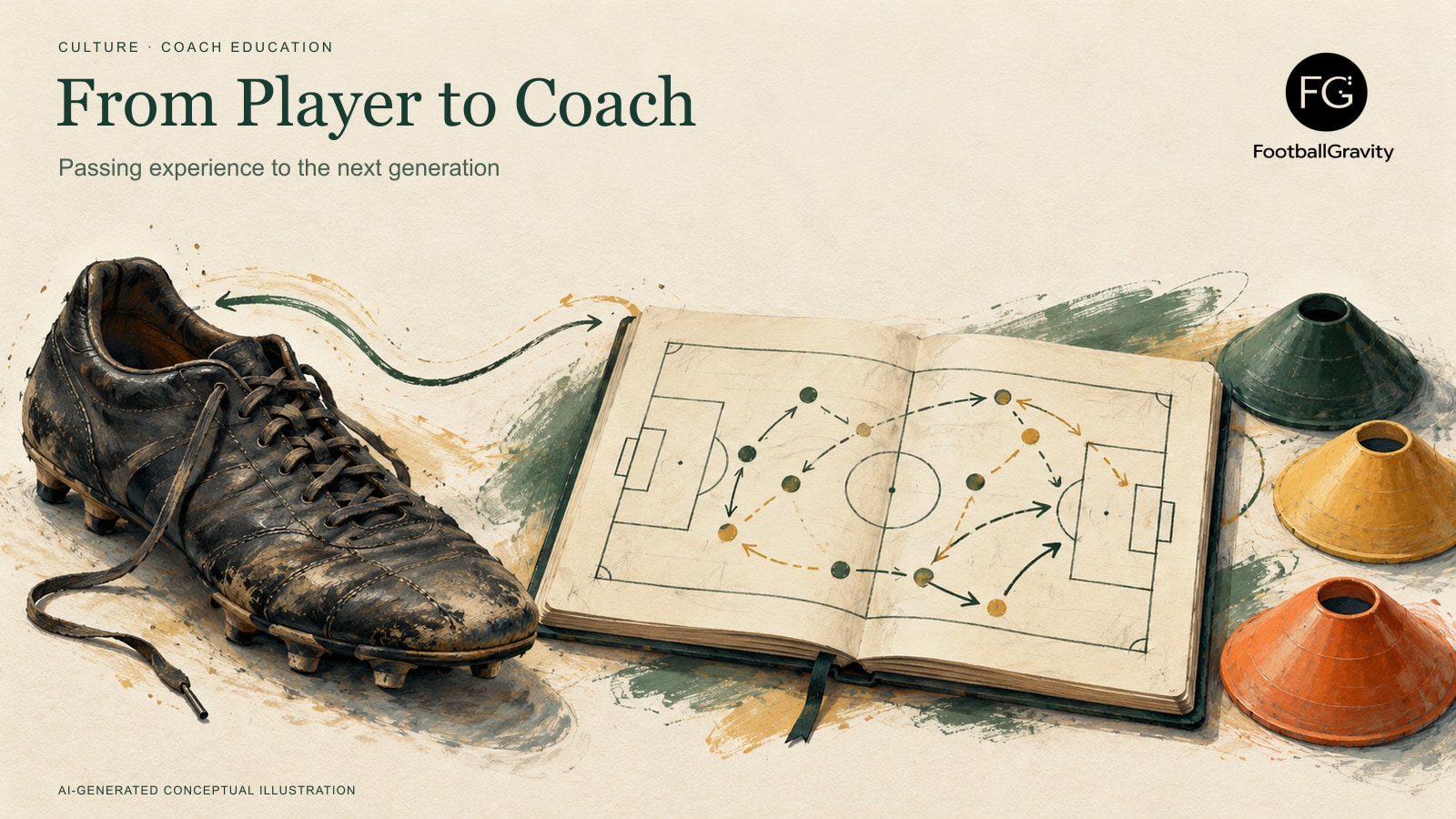

Germany’s new Player’s Pathway course offers a way to keep former professionals in football. The work of passing on what they know begins with learning how to teach.
A player can recognise a moment before finding the words to explain it: when to move, where pressure will come from, how a teammate needs help. Years in football accumulate in these decisions. Becoming a coach requires finding ways for somebody else to learn them.
That transition gives Germany’s new Player’s Pathway course an interest beyond its familiar names. In its 20 October announcement, the German Football Association said 20 former professionals, including Sami Khedira, Shkodran Mustafi and Nils Petersen, had begun the coaching course the previous day. The DFB presents the wider pathway, which also includes management education, as a means of keeping former players within football.
There is a personal opportunity here: another working life in a game that has occupied much of the first. There is also a shared interest. Football has invested years in developing these players. Their experience can continue to serve the game, provided they have opportunities to examine it, question it and make it useful to others.
Learning to explain
The DFB Academy curriculum includes reflection on the player’s identity, training methods and feedback. Those subjects suggest how much can change when somebody moves to the other side of a session.
A former player may remember what helped them improve. A coach has to work with people whose needs and understanding differ from their own. Demonstrating a movement, designing a practice and deciding when to intervene each require judgement. Personal experience supplies material for that work; education gives it room to be tested.
Germany is building on an established European approach. In 2021, UEFA described combined B and A courses for long-serving professionals, with examples from Italy and Belgium. Recognising an experienced player’s starting point can coexist with substantial further learning.
For clubs, the practical opportunity is to make that learning part of everyday football. A developing coach needs players to work with, colleagues who will discuss a session and enough responsibility to discover what still needs improvement.
A Japanese experience of learning again
Japan offers a useful account of that process through Yukari Kinga.
In a JFA interview published in January 2026, Kinga described pursuing coaching qualifications while still playing and gaining her A General licence in 2025. She found value in encountering other coaches’ approaches and receiving feedback during practical club work.
Her account makes the transition tangible. A long playing career had given her experience, while studying coaching exposed her to different ways of organising and communicating the game. The learning continued through conversation with people observing her work.
The institutional support can take different forms. The JFA’s 2026 course information describes practical learning and mentoring within its coaching education. It also published a women’s preparation workshop intended to strengthen coaching skills before an A General course.
These examples offer grounds for exchange between associations. An integrated programme for former professionals and support for progression through existing qualifications address related needs, although they should not be treated as equivalent courses.
Education, access and the licence debate
Keisuke Honda has raised a separate question about entry to coaching work. In a July 2026 post, he distinguished the value of coaching education from making a licence a mandatory condition of employment.
That distinction deserves to be represented accurately. The educational value of a course and the justification for a compulsory qualification are connected questions, but evidence for one does not settle the other.
A system can recognise prior experience while asking candidates to demonstrate what they can teach. It must also consider the time and resources needed to participate, and the opportunities available to people who arrive without a celebrated playing career. Neither reputation nor a certificate alone tells the whole story of a coach’s work.
For this new German cohort, the most interesting developments will take place in the sessions they lead and the players they help. Some knowledge will prove transferable; other habits may need to change. Football benefits when there is a place for both discoveries.
Prepared from public sources checked on 21 October 2026 JST. FootballGravity has not interviewed the participants or observed the course.