
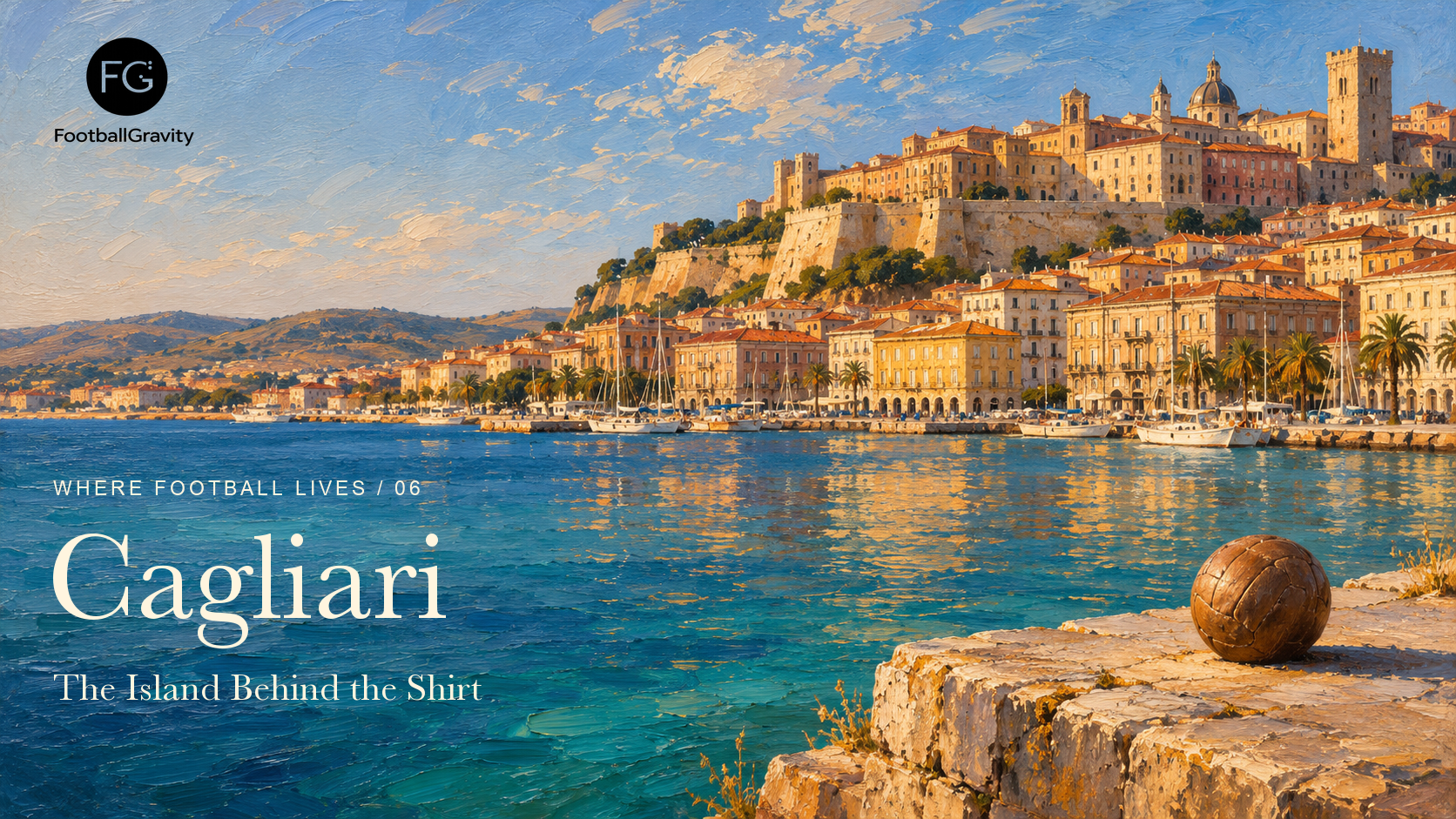
Above the port, Cagliari climbs into a fortified old town. Along its coastal edge, football sits close to salt ponds and the sea. The club connects these city landscapes with a memory that reaches across Sardinia.
Cagliari takes some effort to understand on a flat map. Its historic districts rise behind the waterfront, with Castello occupying the fortified upper town. The port belongs to the city below; towers and old gateways mark a different level above it. A walk between them involves changing height as well as changing streets. Cagliari Tourism: Castello
Football leads towards another part of this landscape. Cagliari’s current ground, the Unipol Domus, stands in the Sant’Elia district, away from the hilltop centre and close to the city’s coastal surroundings.
For a visitor arriving through football, that journey can introduce a city whose life extends beyond its historic skyline. Understanding the club also means looking beyond the city itself, towards the island whose name and identity recur throughout its history.
A championship that still has an address
On 12 April 1970, Cagliari secured the Italian championship after beating Bari at the Amsicora stadium. The club’s anniversary accounts continue to place that afternoon at the centre of its history: the result, the ground and the celebrations remain closely connected. Cagliari Calcio: Campioni d’Italia
For a club outside the familiar centres of Italian football power, winning the league gave a particular place national prominence. Decades later, revisiting the achievement keeps the geography visible. The championship happened at the Amsicora, before Cagliari’s subsequent homes at Sant’Elia and the present ground.
Gigi Riva is central to that memory. He came from Leggiuno in Lombardy and became deeply associated with the island where he played. In its own tributes, Cagliari describes a relationship that grew into belonging: a player from elsewhere becoming one of Sardinia’s most important football figures. Cagliari Calcio: Gigi Riva
That makes his story especially useful for someone discovering the island from abroad. Attachment to a place can develop over time. It can come through work, relationships and the decision to keep making a life there.
Riva’s place in Cagliari’s history gives the visitor something more substantial than a famous name to recognise. It offers a way to think about how a football club can become a home for someone who arrived from elsewhere.
Following football towards the water
The current matchday address is the Unipol Domus, built in 2017. The club places it approximately three kilometres from the city centre, in the vicinity of the former Sant’Elia stadium, the salt ponds and the Poetto side of the city. Cagliari Calcio: stadium information
Those locations give a football visit a different shape from a day spent entirely around Castello. The approach to the ground brings the coastal city into view: roads and residential districts, water and the spaces between sporting venues.
The stadium succession needs care. The Amsicora belongs to the championship story; Sant’Elia to a later period; the Unipol Domus is the place to check when planning a current home fixture. Each name holds part of the club’s history, and an old photograph may show a different ground from the one printed on a ticket.
Cagliari has also developed plans for a new stadium on the former Sant’Elia site, adjacent to the current venue. The published proposal belongs to an ongoing process, so a visitor should follow current club information rather than assume a future opening date. Cagliari Calcio: stadium proposal
For this series, the setting matters as much as the building. Football occupies a piece of a working city that also meets the sea.
Salt, birds and the hours around a match
Nearby Molentargius gives that coastal setting greater depth. The protected wetland contains former salt-production basins and provides habitat for waterbirds, including pink flamingos. Its name recalls the workers who used donkeys to carry harvested salt. The landscape combines an industrial history with a living ecosystem. Cagliari Tourism: Molentargius
A football weekend can make room for this without turning the park into a hurried stop before kick-off. Give it a separate part of the day, follow the designated routes and leave enough distance for the birds to continue their own routines.
Poetto offers another way to spend time near the water. Together, the beach and wetlands broaden the picture of a city a visitor may initially know only through a league table. They also reward a longer stay, allowing the match to become one event within a few days in Cagliari.
Food can do similar work. Fregula with clams and pasta with bottarga introduce ingredients associated with the area. A meal becomes an opportunity to learn a little of the place before moving on to the ground. Sardinia’s official tourism guide: Cagliari
There is enough here to resist filling every hour. A morning in the upper town, an unhurried lunch and time by the water need not all happen on the same day.
Finding a connection from elsewhere
A player’s arrival can introduce a club to people who have never visited its city. Yukinari Sugawara’s loan move from Southampton in September 2026 provides one such connection with Japan. Cagliari Calcio: Sugawara signing
For readers encountering Cagliari through a new signing, the club’s history offers paths further into Sardinia: the championship at the Amsicora, Riva’s lasting association with the island, and the changing grounds where supporters have gathered.
These histories belong alongside the present city. Residents work around the port, spend time on the waterfront and make their own journeys to football. Sardinia also contains different towns, communities and football loyalties. Cagliari offers an introduction to part of the island, with more to discover beyond it.
Leaving time for Cagliari
The final journey into the city can be short: the airport operator lists a rail trip of roughly five to seven minutes between Elmas Aeroporto and central Cagliari. Match tickets, stadium access and return transport still need checking against the actual fixture. Cagliari Airport: transport
Once those arrangements are settled, the more interesting decision is how much time to give the city.
A visit can begin with an interest in the club and grow to include a championship won long before the visitor’s arrival. It can move from Castello’s elevated streets to a ground near the water, with a meal or a walk opening another part of the day.
Cagliari’s football history gives the journey a point of focus. The city and the island provide reasons to stay after the match.
Reporting note: This article was prepared with AI assistance from published club, municipal, airport and heritage sources and reviewed by the editor. It is not an account of an on-site visit. No club endorsement is implied.
Featured image: Cagliari-inspired conceptual oil-painting illustration, created with AI assistance by FootballGravity. It is not a documentary view or an exact representation of the city. Typography and the official FootballGravity logo were composited separately.