
Part three of Between Club and Country, FootballGravity’s series on the changing international calendar.
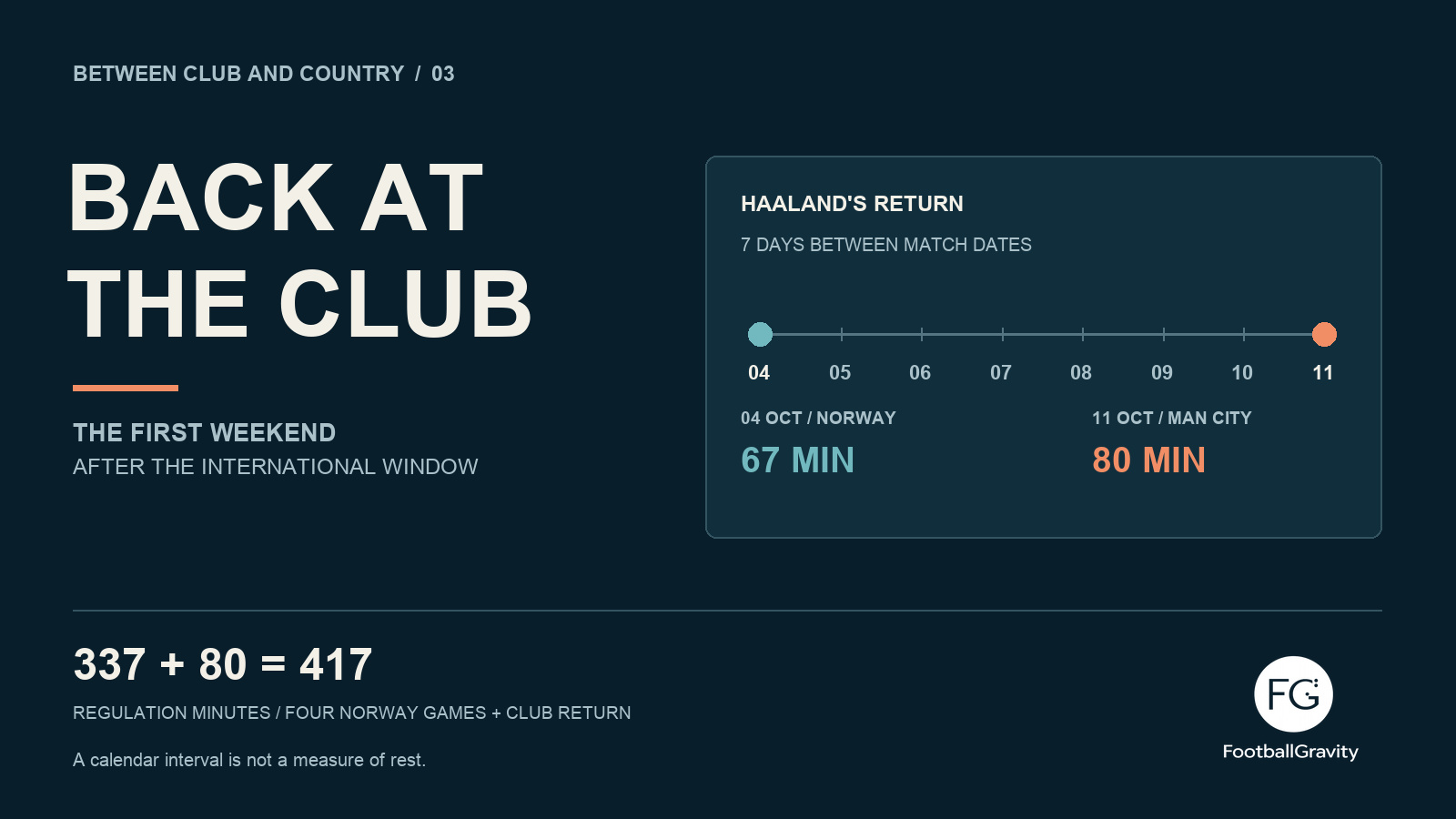
A week after leaving Norway’s final international match in the 67th minute, Erling Haaland started at Anfield. He scored Manchester City’s opening goal and was substituted after 80 minutes in a 3–0 victory over Liverpool on 11 October. The club season had resumed, and he was contributing again.
At the end of the international break, he had asked to come off after becoming exhausted. In his first game back at the club, he helped secure a win. The week between those appearances gives the story of his international workload a necessary next chapter.
Seven days between matches
His last Norway match was against Portugal on 4 October. His club return came on 11 October. Six calendar dates lay between them, but a gap in the fixture list is not a record of uninterrupted rest. A return journey, club training and preparation for the next opponent also have to fit around recovery. A player’s work continues on days without a match.
Across Norway’s four matches and his 80 minutes at Anfield, Haaland played 417 regulation minutes. That adds his club return to the 337 international minutes examined in our previous article. Stoppage time is excluded.
A goal cannot tell us whether all his fatigue had cleared. Equally, exhaustion at the end of a national-team camp does not predict a poor performance the following week. Time and recovery work sit between those moments. His substitution in Portugal and his goal at Anfield belong to the same continuing season.
Paris allowed a different return
Paris Saint-Germain took another approach to the league’s restart. The club gave Ousmane Dembélé and Nuno Mendes a period of rest, with training returns scheduled for 10 and 11 October respectively. Both were left out of the squad for the 10 October match against Le Mans.
The club calendar starts moving again on a set date. Players return with different demands behind them: their national-team minutes, journeys and accumulated workload vary. Some go straight into the opening line-up; others are given more time.
Haaland’s start and the two Paris players’ rest involved different people and circumstances. They offer no basis for ranking the clubs’ decisions. They do make visible the individual choices that accompany the handover from country to club.
An absence can reflect a decision to prioritise recovery for the games ahead. A start follows the work of preparing a player to compete. Behind the names included in a weekend squad—and those left out—there is a process of adjustment.
One fewer journey, then time to return
FIFA’s new calendar combines the former September and October periods into a 16-day window allowing up to four matches. Reducing two club-to-country cycles to one can remove a substantial journey, particularly for players crossing continents. Our first article modelled that change across ten internationals.
That benefit can coexist with a need for recovery after a concentrated run of national-team games.
After starting all four Norway matches, Haaland started for City a week later. In Paris, two internationals were given more room before resuming training. The way a new calendar reaches players can become visible in these club returns as well as in the national-team matches themselves.
One goal or one missed match cannot settle the merits of the whole system. The first weekend back nevertheless brings a familiar task into focus: clubs receive players with different needs and prepare them for what comes next.
The international window has a closing date. A player’s season continues across it.
Read the series: Between Club and Country · Part 1: One Less Round Trip · Part 2: When ‘Available’ Does Not Mean Fresh.