
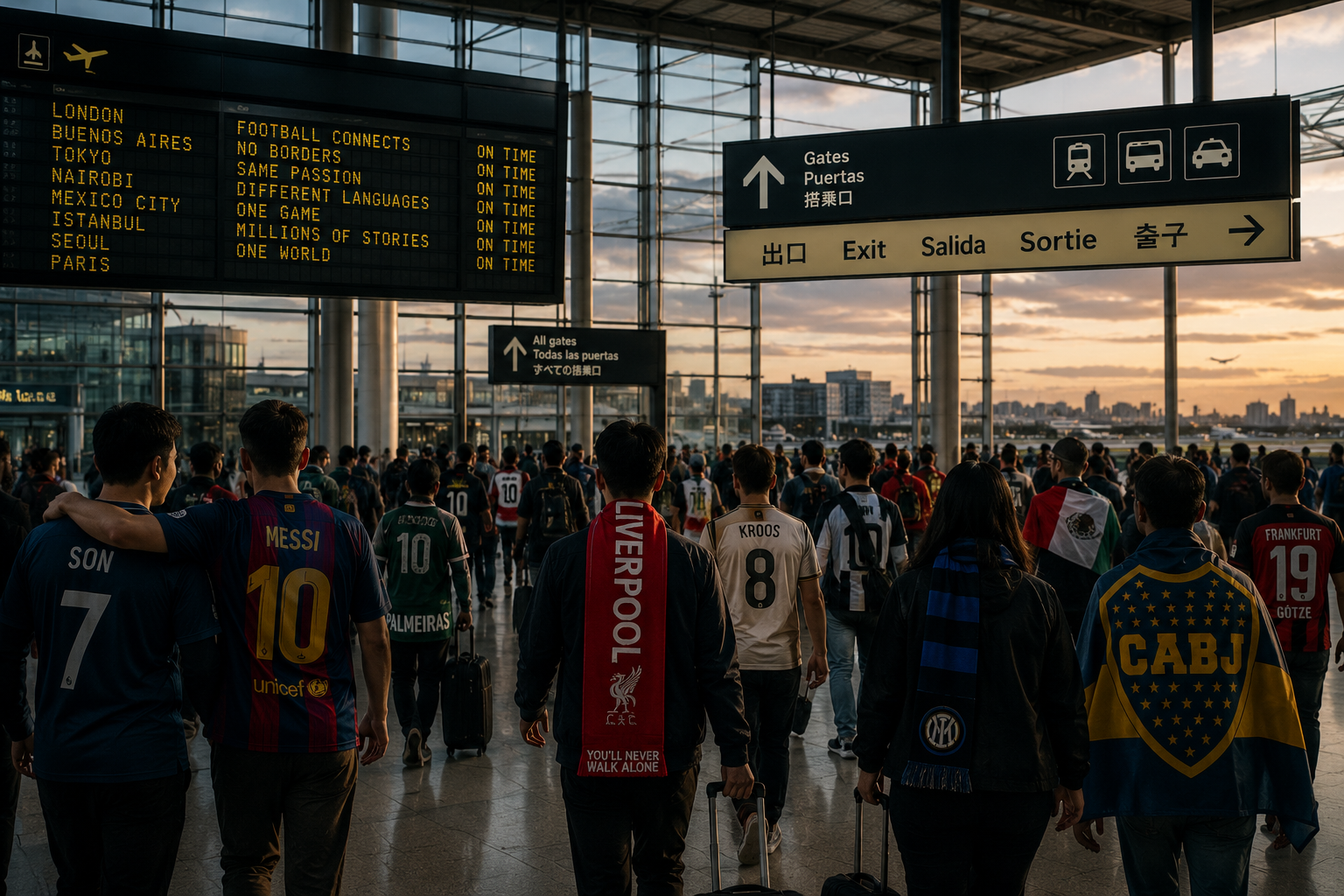
Why football continues to create connection across languages, cultures, and identities.
In many parts of the world, football begins long before kickoff.
It begins at airports.
At train stations. In crowded city centers. In conversations between strangers wearing different colors and speaking different languages.
A scarf from Buenos Aires appears in Tokyo. A supporter from Seoul shares a table with fans from Amsterdam. A child in Nairobi wears the shirt of a club thousands of kilometers away.
Football moves constantly across borders.
Not only through players and clubs, but through people, memory, migration, media, and emotion.
And perhaps that global movement is one reason the sport continues to feel uniquely powerful in an increasingly fragmented world.
A Shared Language Without Translation
Football is one of the few cultural experiences that can be understood almost immediately across languages.
A celebration. A collective gasp. A last-minute goal.
Even without translation, people recognize the emotional structure of the game.
This does not erase cultural differences. In fact, football often amplifies them through chants, traditions, styles of support, and local identity.
But at the same time, football creates temporary spaces where strangers can still participate in something shared.
That balance between difference and connection may be one of football’s most remarkable qualities.
Migration, Identity, and Football
Modern football has always been shaped by movement.
Players move between continents. Families migrate across borders. Supporters carry club identities far from their places of origin.
Many of today’s teams reflect multiple histories simultaneously.
A single squad may contain players with different languages, religions, and cultural backgrounds — all operating within the same collective structure.
Football does not remove complexity.
But it often provides a visible example of cooperation across identity.
And in many cities, football clubs become important cultural anchors for migrant communities and second-generation families navigating questions of belonging.
Clubs as Global Cultural Networks
Today, football clubs exist simultaneously in physical and digital space.
A supporter in Jakarta may wake up at 3 a.m. to watch a match in London. Fans in Mexico City discuss the same moment as supporters in Berlin or Lagos within seconds online.
Football communities increasingly operate like global networks connected through media, algorithms, and shared emotional investment.
Yet despite this digital expansion, football remains deeply physical.
People still travel across countries and continents to experience atmosphere directly — to hear chants in person, walk through stadium districts, and become temporarily part of a crowd.
In an era dominated by screens, that physicality still matters.
Why Football Still Creates Belonging
Many modern societies are experiencing increasing fragmentation.
People move more frequently. Communities become less stable. Public trust declines. Daily life becomes more individualized.
Football does not solve these problems.
But it continues to create recurring moments of collective presence.
People gather regularly in the same places. They wear shared symbols. They experience synchronized emotion with thousands of others.
Perhaps this explains why football remains emotionally resilient even as media environments rapidly change.
Because beneath the business, spectacle, and commercialization, football still satisfies something fundamentally human:
the desire to belong to something larger than ourselves.
Football crosses borders because people do.
The sport travels through migration, memory, media, and movement.
And wherever it arrives, football creates new local meanings while still remaining globally recognizable.
That tension between local identity and worldwide connection may be what makes football more than a game.
It becomes a shared human language — spoken differently in every city, but understood almost everywhere.