
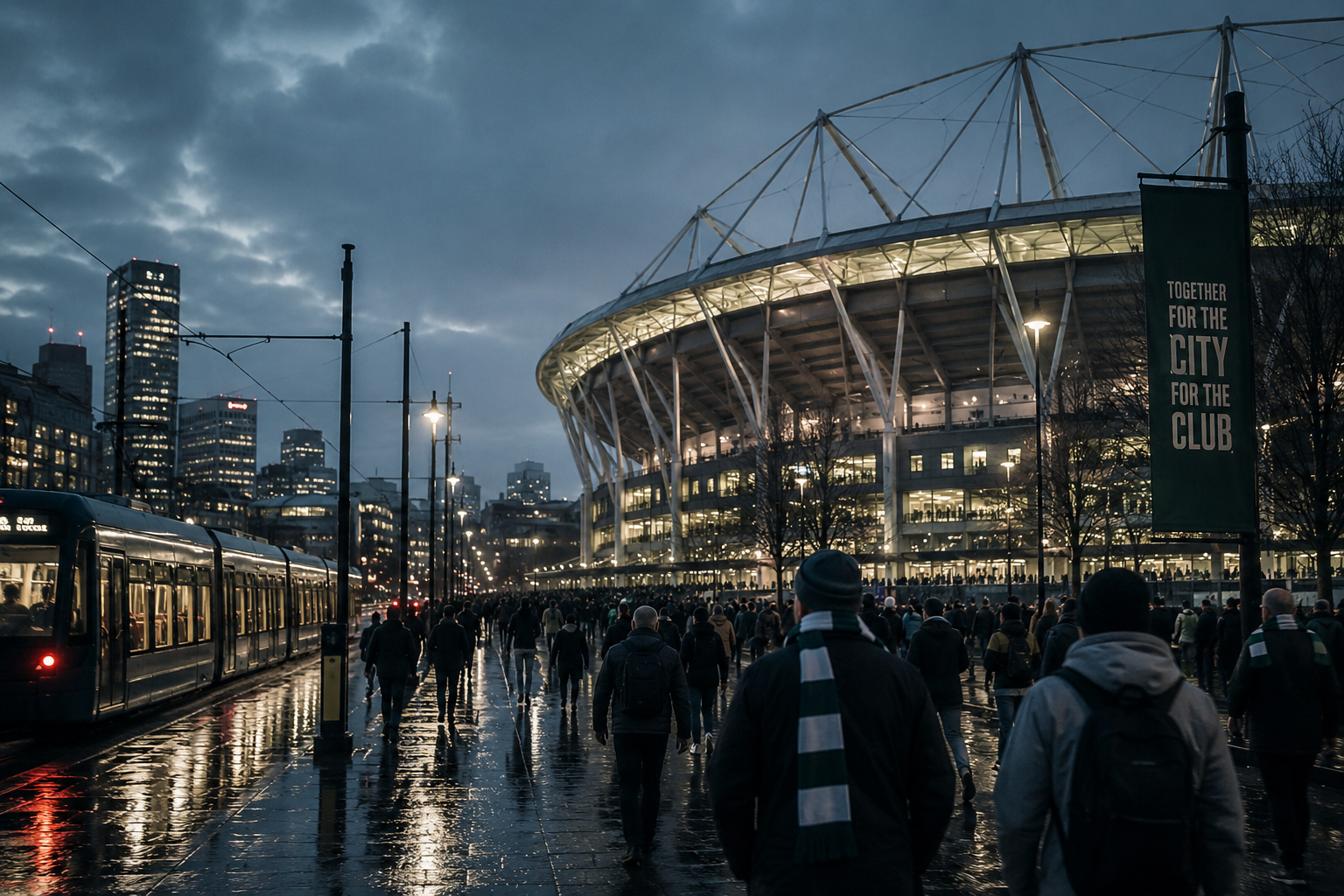
How football shapes mobility, public space, and urban life beyond the pitch.
On matchdays, cities move differently.
Trains become louder. Streets stay active longer. Scarves appear across stations, bars, and sidewalks. Thousands of people begin moving toward the same destination — not only to watch a game, but to participate in a shared urban experience.
Football has always been deeply connected to cities.
Not just economically, but spatially, culturally, and emotionally.
A stadium is more than a sports venue. It is a temporary center of movement, energy, and collective behavior.
As cities around the world face challenges related to climate change, transportation, density, and social fragmentation, football may offer unexpected insights into how sustainable urban life can work.
Stadiums as Urban Ecosystems
A football stadium functions like a living urban system.
Before kickoff, transportation networks intensify. Trains, buses, bicycles, and pedestrians begin synchronizing around a fixed point in space and time.
Local restaurants become temporary gathering spaces. Public security systems adapt to crowd density. Energy consumption changes throughout surrounding districts.
In many European and South American football cultures, stadiums are deeply integrated into existing urban structures rather than isolated from them.
This matters.
Because sustainable cities are not only about reducing emissions. They are also about reducing unnecessary fragmentation between people, transportation, and public life.
Football naturally creates density, walkability, and shared movement.
Why Walkability Matters
One of football’s overlooked strengths is that it encourages people to move through cities together.
In many football cultures, supporters do not simply arrive at stadiums. They walk to them.
They pass through local streets, cafés, small businesses, train stations, and public squares.
This creates a different relationship between sport and urban life.
Car-dependent stadium environments often isolate football from surrounding communities. But walkable football culture strengthens local economies and reinforces a sense of place.
The experience begins long before kickoff.
And sometimes, that experience matters just as much as the match itself.
Football Clubs as Community Infrastructure
The world’s most influential football clubs are rarely just sports organizations.
They function as social institutions.
Youth academies, local outreach programs, educational partnerships, and community spaces often become part of the club ecosystem.
In some cities, football provides one of the few remaining shared identities across generations, cultures, and economic backgrounds.
This social dimension may become increasingly important in the future.
As many cities struggle with loneliness, fragmentation, and declining trust in public institutions, football continues to create physical spaces where people gather regularly and collectively.
That kind of social infrastructure is difficult to measure — but increasingly valuable.
Could Football Help Shape Better Cities?
Football alone cannot solve urban challenges.
But it can help us rethink them.
Future stadiums may become laboratories for sustainable mobility, renewable energy, cooling systems, and mixed-use public space.
More importantly, football reminds us that cities are not only systems of infrastructure.
They are systems of human movement and emotional connection.
And perhaps that is why football still matters so deeply in urban life around the world.
Perhaps football has never been only about football.
It may also be about how people learn to share space, movement, atmosphere, and identity together.
In that sense, the future of football and the future of cities may be more connected than we think.