
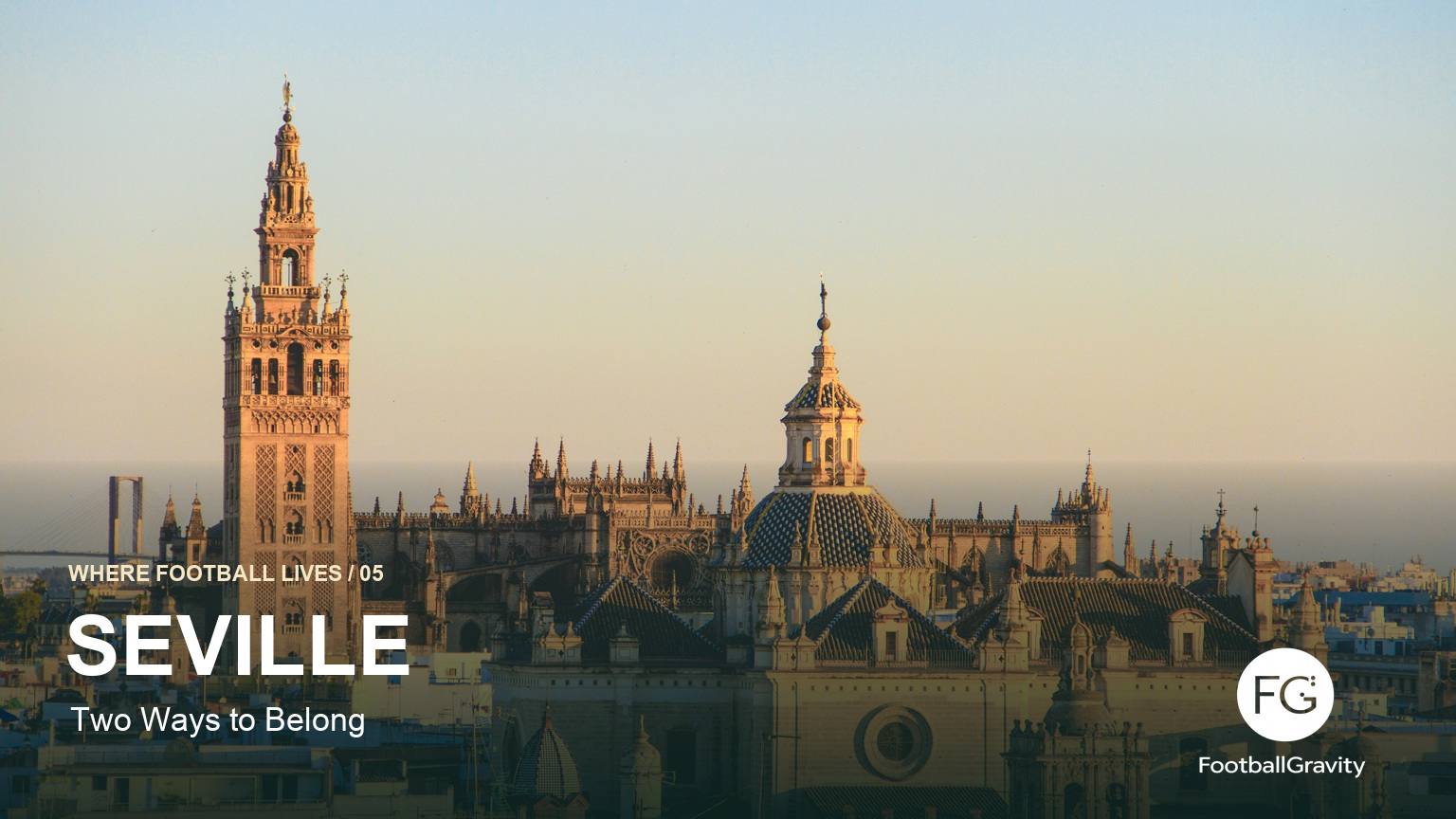
With Real Betis playing temporarily at La Cartuja and Sevilla FC rooted in Nervión, football offers a way into a city whose attachments reach well beyond its famous centre.
For someone planning a football weekend in Seville, Real Betis currently presents an instructive complication. The stadium most closely associated with the club is not where the first team plays its home matches.
The Benito Villamarín stands in Heliópolis, south of the historic centre. While it is being redeveloped, Betis are playing at La Cartuja, in another part of the city. The club’s own history records the 2025/26 season as the beginning of that temporary stay. Real Betis club history
A ticket tells a visitor where to go. Understanding why the other address still matters takes longer.
That distance between a match venue and a sense of home is a useful place to begin in Seville. Across the city, Sevilla FC has its own enduring association with Nervión and the Ramón Sánchez-Pizjuán. Following these clubs takes a visitor beyond the cathedral precinct and into neighbourhoods that give football a more particular address.
Heliópolis, even from elsewhere
The Benito Villamarín belongs to a period when Seville was extending and remaking itself. The stadium opened in 1929 as part of the urban programme associated with the Ibero-American Exposition. The exhibition’s footprint reached through María Luisa Park and the city’s southern expansion towards what is now Heliópolis. Seville Tourism: stadium history, regionalist architecture guide
Betis established its home there after the Spanish Civil War, in 1939. The club had already arranged to lease the ground before the war; ownership followed in 1961. Those dates describe a gradual attachment: a stadium built for a major civic event became a place shaped by the repeated use of a football club and its supporters. Real Betis: the return of league football, the stadium purchase
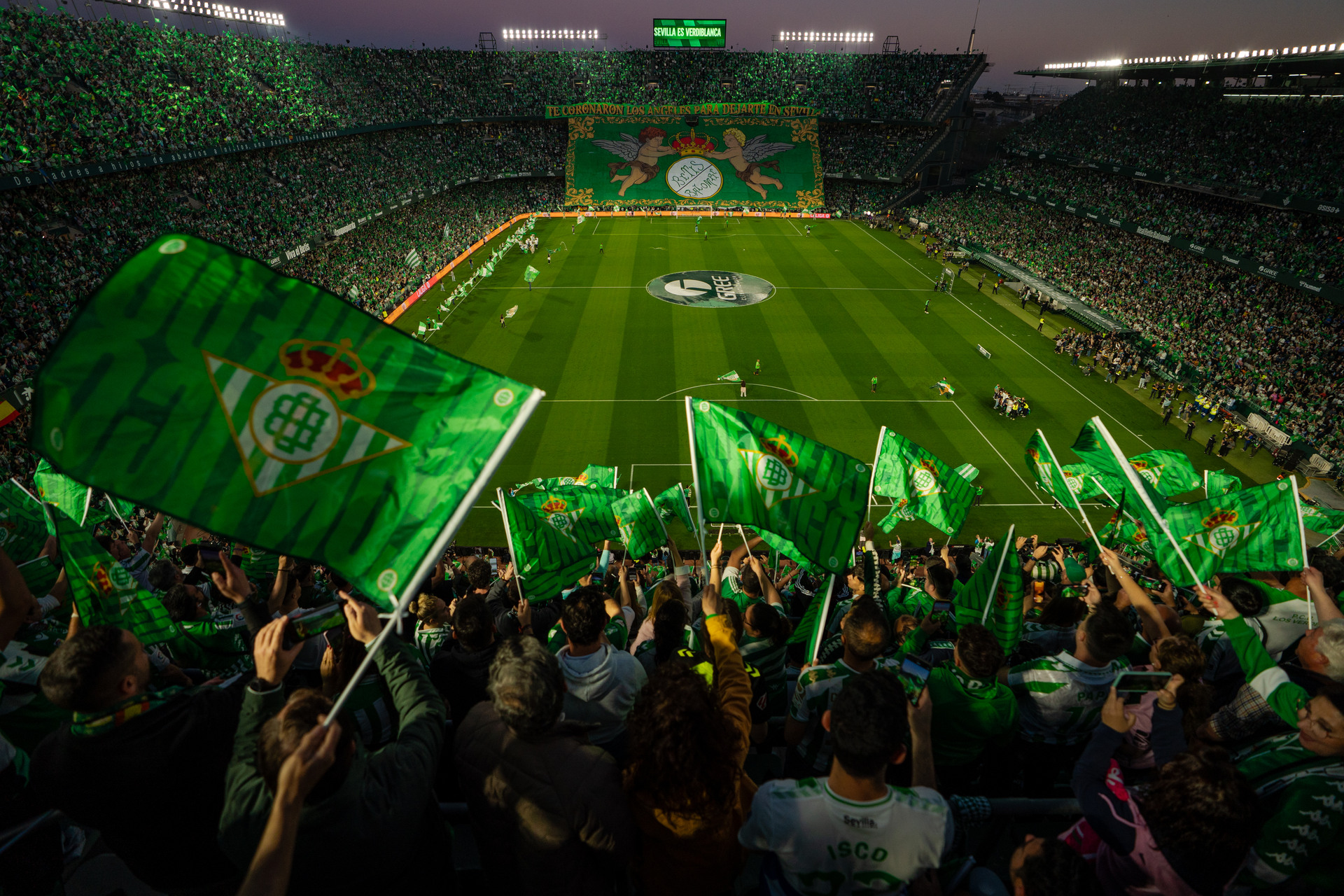
A neighbourhood acquires meaning through repetition. A familiar approach to the ground, a meeting place, the journey with someone who first brought you: these are modest things individually. Over many seasons, they become part of what going to football means.
The temporary move to La Cartuja makes that relationship easier to notice. Betis can organise home fixtures elsewhere in Seville while Heliópolis remains central to the club’s identity. Supporting the team now involves making room for a different journey without discarding the old one.
For a visitor, the distinction matters in practical terms too. A photograph of the Benito Villamarín is not a guide to the present matchday destination. Betis confirmed in October 2026 that its home games are being played at La Cartuja. The current fixture and access information should determine the journey.
It also changes what a visit to Heliópolis can offer. With the first team playing elsewhere, the district remains part of the story: a place to understand how closely a club’s identity can become tied to a particular piece of the city.
Nervión has its own address
Sevilla FC leads the visitor east, towards Nervión.
The Ramón Sánchez-Pizjuán opened in 1958. Its setting places the club within the everyday city, with the Nervión and Gran Plaza metro stops serving the area. The surrounding district is part of the approach to the match, rather than a view glimpsed only from the stadium entrance. Seville Tourism: Ramón Sánchez-Pizjuán, stadium access
Music gives that attachment another form. Sevilla’s centenary anthem, composed by Javier Labandón, known as El Arrebato, emerged in 2005 and became an important expression of the club’s support. It is a relatively recent addition to a much longer history, a reminder that football traditions continue to be made. Sevilla FC: club and anthems
The rivalry with Betis gives these places additional intensity. It also creates a temptation for the visiting writer: to assign each club a fixed personality and divide the whole city neatly between them.
The stadium map cannot carry that explanation. It identifies important roots, without telling us where every supporter lives or how every family chose its club. Heliópolis and Nervión provide starting points for understanding attachment. They leave room for lives that cross those boundaries.
The city around the football
Seville rewards time away from the stadiums.
The Giralda began as an Almohad minaret and later became the cathedral’s bell tower. In the Alcázar, Islamic remains coexist with later building, including the Mudéjar palace of Pedro I. These are substantial histories of construction, conquest and adaptation, visible within the same urban fabric. UNESCO: Seville’s monumental complex
They help explain why Seville feels different from Valencia, the Spanish city visited earlier in this series. They do not provide a shortcut to explaining how Sevillians support a football club.
Music deserves the same care. Flamenco has a strong Andalusian setting and an essential contribution from Gitano communities. UNESCO describes its transmission through families, social groups and local associations. Seville’s own cultural guide points visitors towards neighbourhood peñas as well as performance venues and festivals. UNESCO: flamenco, Seville Tourism: flamenco
There is something useful here for a football visitor: an invitation to pay attention to how people sustain a shared practice. Songs depend on people who know them, teach them and find occasions to perform them. A stadium anthem and flamenco have their own histories, but both reward listening to the communities around the sound.
Food offers a quieter introduction. Espinacas con garbanzos—spinach with chickpeas, seasoned with ingredients including cumin and garlic—is among the city’s established tapas. A meal before travelling to the ground can give the day a local rhythm without requiring an elaborate itinerary. Seville Tourism: espinacas con garbanzos
The river, Triana, the historic centre and the southern districts need more time than the gaps between two appointments. Leave part of the day unfilled.
Finding the right ground
A visitor can begin with a few simple decisions: which club, which fixture, which stadium.
For Betis, that means checking La Cartuja information rather than following an old route to the Benito Villamarín. For Sevilla FC, it means looking at the current arrangements for the Sánchez-Pizjuán. Tickets and match-specific travel instructions should come from official club channels; a derby requires particular attention to the arrangements for that fixture.
Beyond those practicalities, a weekend here can accommodate different kinds of attention. There is the concentrated time of a match, and the slower work of learning where a neighbourhood sits within the city.
Seville gives this series a chance to examine both. Betis’s temporary move makes the persistence of Heliópolis especially visible. Sevilla’s association with Nervión offers another way to follow a club through its surroundings.
For someone arriving from abroad, learning the correct stadium address is the first step. Learning why another address still matters is part of getting to know the city.
Reporting note: This feature was prepared with AI assistance, reviewed by a human editor, and based on published sources and background information supplied by Real Betis Balompié’s Communications Department. It is not an account of an on-site visit. Real Betis supplied a stadium photograph and crest for editorial use; editorial responsibility remains with FootballGravity.
Featured image: Seville Cathedral and the Giralda. Photograph by Henrique Ferreira / Unsplash, published 5 November 2017. Editorial layout and official logo: FootballGravity. No generative editing.