
FC Bayern and Allianz’s Munich Climate Week programme offers schools and families a closer look at the systems behind the game.
A heated pitch, the lights above it and the journey through the turnstiles are familiar parts of football. Each also involves decisions about energy and resources. At the Allianz Arena, FC Bayern and Allianz are inviting visitors to look more closely at those decisions, using the stadium itself as a place to learn.
Their Munich Climate Week programme is scheduled for 22–24 October 2026. Around 40 minutes of guided exploration will introduce energy efficiency, renewable power and mobility alongside biodiversity and waste sorting. The audience changes across the three days: Climate Week visitors and specialists on Thursday, Munich classes from Bavaria’s climate schools on Friday, and Munich families on Saturday.
Afterwards, participants are due to visit the Allianz lounge for examples of climate risks and adaptation, information about the company’s climate measures, and a playful activity inviting them to consider their own future commitments. These are the activities set out in Bayern’s 20 October announcement.
The invitation deserves attention because a stadium gives a large subject a recognisable address. People can encounter environmental technology through a place they already care about, with practical examples close enough to discuss.
Looking behind the matchday experience
The Arena’s environmental work has developed over time. Its June 2026 infrastructure overview describes air-to-water heat pumps for pitch heating, LED lighting across the façade, interior and playing field, and photovoltaic installations on the visitor car park and south entrance canopy. The operator says the remaining electricity supply comes from certified renewable sources.
These systems offer useful starting points for a conversation. A solar installation above an entrance connects electricity generation with a part of the stadium that visitors use. Heating the pitch introduces the less visible work involved in keeping football playable. Lighting provides another familiar route into discussing how a building consumes energy.
Opening up that work also makes room to recognise the people maintaining and improving a stadium. Environmental change involves facilities teams, engineers and other staff whose decisions usually sit outside the match report. A tour can help visitors understand the care involved in operating the place.
The Arena also has an established reporting framework. Its environmental information page records EMAS certification dating from 2006 and links to its 2024/25 environmental declaration. That continuing record gives the public something to return to as the infrastructure develops.
Installing equipment, recording its operation and establishing the savings attributable to it are different stages of understanding. The same care applies to education: offering a tour creates a learning opportunity, while lasting changes in understanding or behaviour require evidence gathered afterwards. Keeping those distinctions clear allows the work to be appreciated on its own terms.
Bringing the experience back to school
The participation of Bavaria’s climate schools gives the programme a particularly useful connection beyond the stadium.
According to the Bavarian education ministry, Klimaschule Bayern supports schools in calculating their carbon footprint, preparing climate action plans and involving pupils in practical climate measures. The programme already connects learning with the buildings and routines of school life.
A stadium visit could give that work another reference point. Pupils might compare how energy is used in a large sports venue with the needs of their own school, or discuss how travel choices depend on the routes available. These are possibilities the setting creates; the published tour announcement does not establish a specific classroom follow-up programme.
For families, there is a similar opportunity to explore the subject together. Adults and children can bring different questions to the same piece of equipment or familiar part of the ground. Football provides a shared interest from which the conversation can begin.
That is a worthwhile contribution from a club. Technical information becomes more approachable when people can connect it with an experience they recognise. Repeated encounters could give the subject a continuing place in the relationship between the stadium and its neighbours.
A German transition with work still ahead
The Arena’s programme sits within Germany’s wider energy transition, the Energiewende.
Germany’s Federal Climate Change Act sets a greenhouse gas reduction target of at least 65 per cent by 2030 compared with 1990, and net greenhouse gas neutrality by 2045. Its neutrality deadline comes five years before the EU-wide 2050 target.
The country has also made a substantial shift in electricity supply. The German Environment Agency’s figures, updated on 19 October 2026, put renewables at 55.1 per cent of electricity consumption in 2025. Their share of heating and cooling was 19.2 per cent, illustrating how differently the transition is progressing across sectors. Umweltbundesamt
Those differences help explain why a stadium’s heating systems belong in the public conversation alongside its solar panels. Germany offers experience of sustained environmental policy and changing infrastructure, with considerable work continuing in everyday buildings and transport.
For football elsewhere, the useful idea is adaptable. A club can begin with the systems it operates, the expertise of its staff and the schools or community organisations around it. Making that experience available gives other people a way into the subject.
Bayern and Allianz’s programme offers such an opening. Its educational promise lies in connecting the running of a football ground with questions visitors can recognise in their own surroundings. Giving that connection time and continuity would help the Arena’s environmental work reach further into the life of the city.
Based on public primary sources checked on 21 October 2026, with the event announcement and German renewables figures rechecked on 22 October. The tours are described according to the published programme. This article is based on documents and does not report attendance at the event.
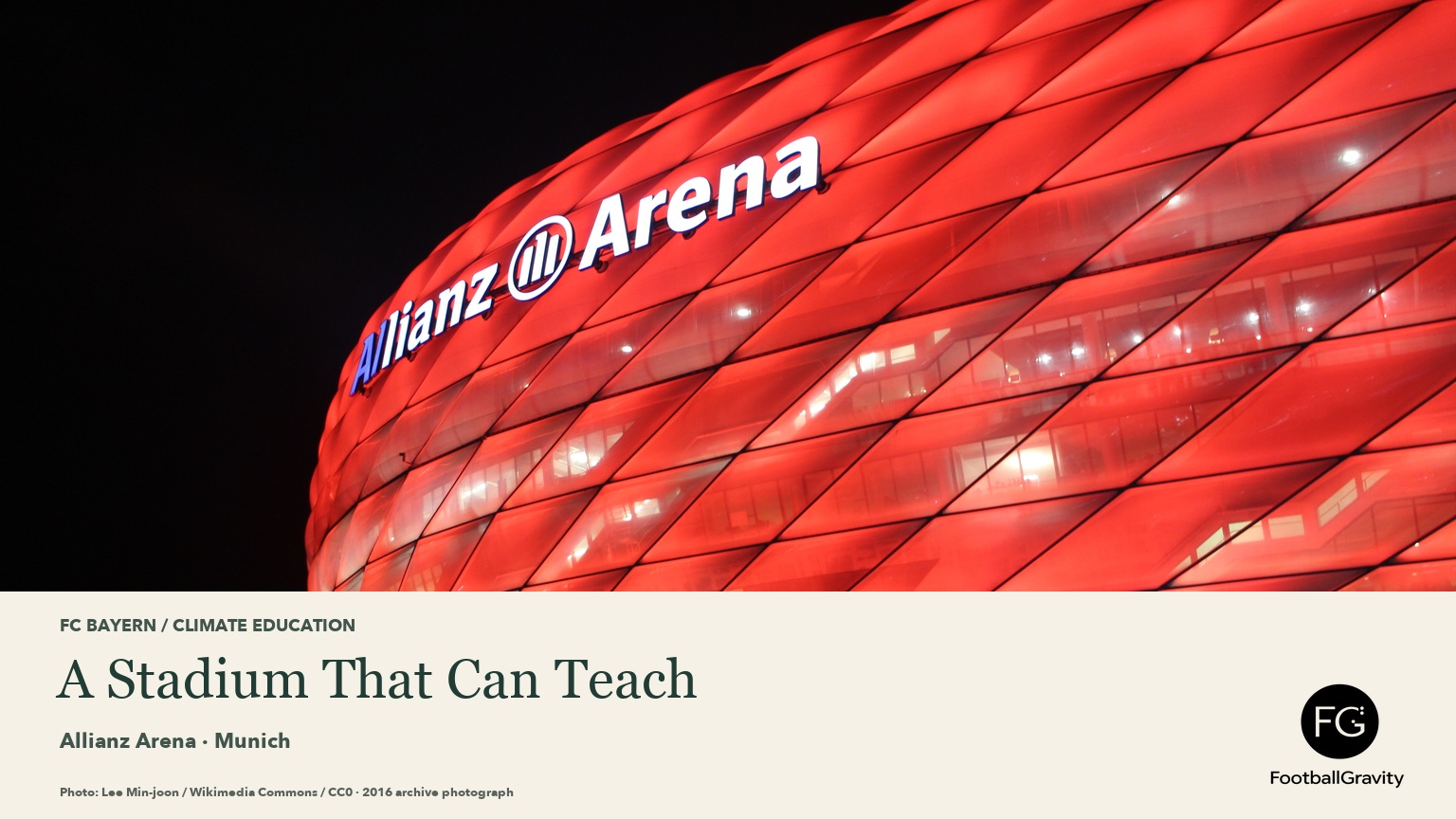
Featured image: Allianz Arena, photographed on 31 January 2016. Photo: Lee Min-joon / Wikimedia Commons, CC0 1.0. Cropped and resized; headline and official FootballGravity logo added. Archive photograph, not a record of the 2026 programme.
